Ring Main Unit Market

Key Players: ABB Ltd., Schneider Electric, Siemens Energy, Eaton Corporation, Lucy Electric, LS Electric, Alfanar Group, CHINT Group

Ring Main Unit Market

Ring Main Unit Market Size, Share & Growth Analysis Report By Type (Oil Insulated, Gas Insulated, Air Insulated, Solid Dielectric), By Installation (Indoor And Outdoor), By Application (Distribution Utilities, Industrial, Commercial) And By Region (North America, Europe, Asia-Pacific, And Rest Of The World) – Trends & Industry Forecast to 2035
ID: MRFR/EnP/2085-HCR
188 Pages
Anshula Mandaokar
Last Updated: June 04, 2026
 

Ring Main Unit Market Summary

The Ring Main Unit Market reached an estimated USD 2.87 billion in 2025 and is projected to climb from USD 3.08 billion in 2026 to USD 5.48 billion by 2035, registering a CAGR of 7.24% across the forecast window. Two catalysts are accelerating procurement cycles: the European Union's revised F-Gas Regulation (EU) 2024/573, which phases down SF₆ use in medium-voltage switchgear starting 2026, and Asia-Pacific governments channeling over USD 320 billion into urban underground cabling programs through 2030[2]. These policy mandates are converting what was once a replacement-driven aftermarket into a front-loaded capital-expenditure cycle.

Technology transformation sits at the heart of the Ring Main Unit Market's growth story. Legacy oil-insulated and air-insulated compact RMU distribution network designs are giving way to SF6 free RMU switchgear vacuum platforms and solid insulated RMU SIS switchgear architectures that eliminate greenhouse-gas liabilities while shrinking footprint by up to 40% [3]. Siemens Energy's 2024 commitment of EUR 180 million toward vacuum-interrupter production capacity signals the scale of capital flowing into next-generation insulation [4]. Meanwhile, smart RMU remote control IEC 61850 communication modules are turning passive ring-main cabinets into network-aware nodes capable of fault isolation in under 200 milliseconds.

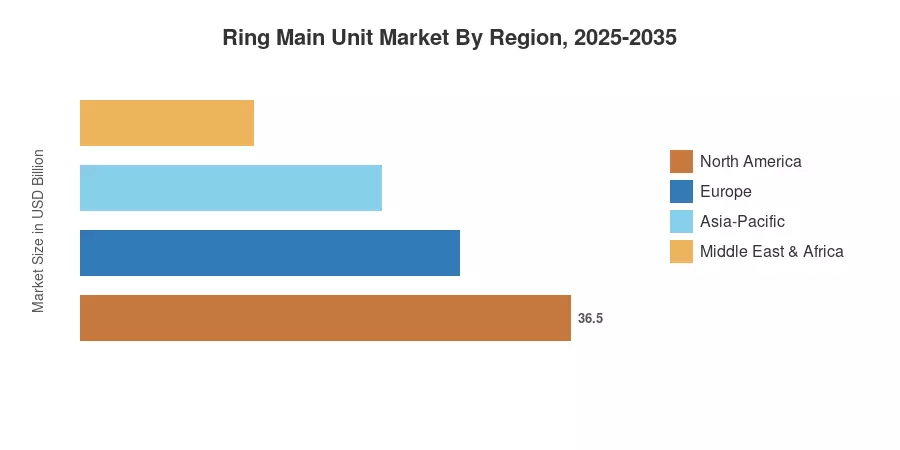
Asia-Pacific dominates the Ring Main Unit Market with roughly 46% of 2025 revenue, driven by China's State Grid underground feeder expansions and India's RDSS utility modernization scheme. The region is also the fastest-growing, forecast to compound at 9.1% through 2035. Europe holds the second-largest share at approximately 24%, propelled by the F-Gas phase-down and renewable collector-loop installations across the North Sea wind corridor


Key Report Takeaways

• By Insulation Type

  • Gas-insulated configurations captured an estimated 62% of Ring Main Unit Market revenue in 2025, reflecting entrenched installed bases across mature grids
  • SF6 free RMU switchgear vacuum and solid insulated RMU SIS switchgear variants are forecast to expand at a 10.3% CAGR through 2035, outpacing all other insulation categories

• By Installation


Outdoor RMU ring main outdoor enclosure units held a 61% share of 2025 shipments, favored for rural and peri-urban feeder loops

  • Voltage
  • The above-25 kV segment is set to grow at 8.3% CAGR, as renewable parks and data centers demand higher-voltage collector architectures

• By Automation

  • Conventional manually operated units comprised 82% of 2025 Ring Main Unit Market shipments, yet smart RMU remote control IEC 61850 variants will register a 9.7% CAGR


  • End User


  • Distribution utilities commanded roughly USD 1.52 billion in 2025 revenue, while renewable energy and micro-grid developers represent the fastest-expanding end-user bracket

• By Region

  • Asia-Pacific led all regions, accounting for 46% of 2025 sales in the Ring Main Unit Market
  • South America is expected to reach USD 0.31 billion by 2035, aided by Brazil's PRODIST grid-code updates


Market Size and Forecast (2021–2035)

MRFR's market sizing employs a hybrid bottom-up/top-down methodology. Bottom-up estimates aggregate OEM shipment volumes, unit ASPs, and aftermarket service revenues across 42 countries. Top-down validation cross-references utility CAPEX disclosures, customs trade data (HS code 8537), and quarterly earnings from publicly listed switchgear manufacturers[5].
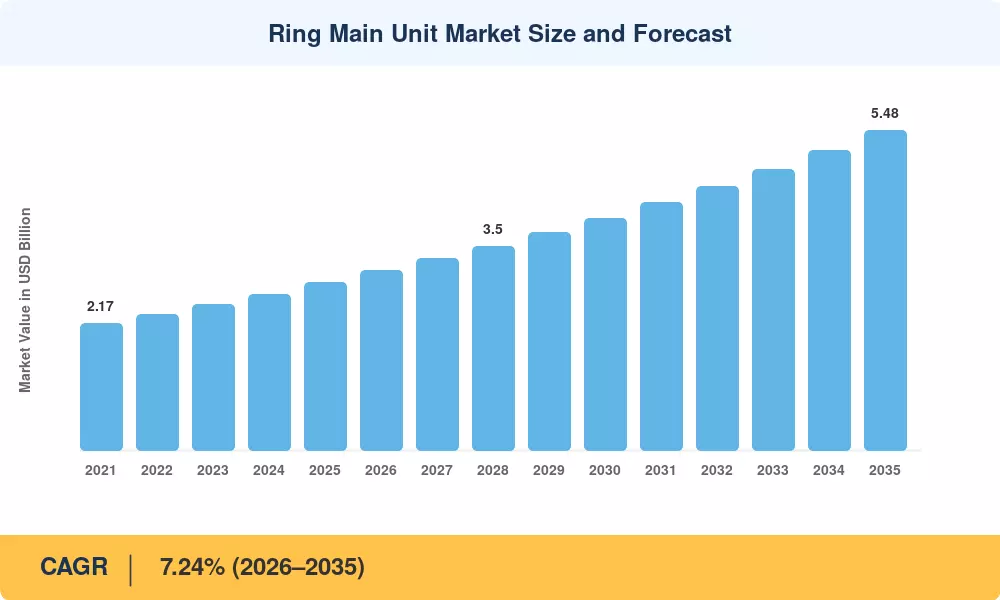
Ring Main Unit Market Size and Forecast
Our Impact
Enabled $4.3B Revenue Impact for Fortune 500 and Leading Multinationals
Partnering with 2000+ Global Organizations Each Year
30K+ Citations by Top-Tier Firms in the Industry
 

Driver Impact Analysis

Driver ~% Impact on CAGR Geographic Relevance Impact Timeline
EU F-Gas Regulation 2024/573 phase-down ~18% Europe, global OEM R&D Short-term (≤2 yr)
Asia-Pacific urban underground cabling ~22% China, India, ASEAN Medium-term (2–4 yr)
IEC 61850 digital substation adoption ~14% North America, Europe Medium-term (2–4 yr)
Renewable energy collector-loop demand ~15% Global Long-term (≥4 yr)
Data-center 99.995% uptime requirements ~12% North America, Nordics Short-term (≤2 yr)
SAIDI/SAIFI reliability mandates (NERC, CEER) ~10% North America, Europe Long-term (≥4 yr)
Aging MV switchgear replacement cycle ~9% Europe, Japan Long-term (≥4 yr)


EU F-Gas Regulation and SF₆ Phase-Down

Europe's revised F-Gas Regulation (EU) 2024/573 prohibits SF₆ in new medium-voltage switchgear rated below 24 kV from January 2026, with the threshold extending to all ratings by 2030 [2]. This single regulation redirects an estimated EUR 1.2 billion in European procurement budgets toward SF6 free RMU switchgear vacuum and solid insulated RMU SIS switchgear platforms over the next five years. OEMs that secured early type-test certifications — notably ABB's SafeLink and Schneider Electric's RM AirSeT — hold a first-mover advantage in contract tenders across Germany, France, and the Nordic Countries

Urban Underground Cabling Programs in Asia-Pacific

China's State Grid Corporation committed CNY 520 billion to underground distribution networks during its 14th Five-Year Plan, requiring compact RMU distribution network enclosures at every cable junction and branch tee [7]. India's Revamped Distribution Sector Scheme (RDSS) earmarks INR 3.04 trillion for loss reduction and supply reliability, with 12kV 24kV ring main unit procurement embedded in smart metering district plans. Together, these programs translate into over 280,000 new RMU ring main outdoor enclosure installations annually across the region.

IEC 61850 Digital Substation Migration

Utilities pursuing feeder automation increasingly specify smart RMU remote control IEC 61850 communication capability as a baseline rather than an add-on. North American utilities operating under NERC CIP-014 physical-security standards are pairing IEC 61850 GOOSE messaging with RMU motorized actuators to achieve sub-cycle fault isolation [8]. The U.S. Department of Energy's Grid Resilience and Innovation Partnerships (GRIP) program, which awarded USD 10.5 billion in 2024, explicitly funds IEC 61850-ready secondary-substation upgrades [12].

Renewable Energy and Data-Center Demand

Solar parks above 50 MW and offshore wind collector platforms now routinely employ medium-voltage ring configurations using 12kV 24kV ring main unit switchgear for redundant loop protection [10]. Hyperscale data-center operators such as Equinix and Digital Realty specify dual-feed RMU ring main outdoor enclosure arrangements to guarantee 99.995% power availability, often combining compact RMU distribution network units with on-site battery storage [11].


Restraints Impact Analysis

Restraint ~% Negative Impact Geographic Relevance Impact Timeline
High upfront cost of SF₆-free alternatives ~–8% Price-sensitive emerging markets Short-term (≤2 yr)
Fragmented MV switchgear standards ~–5% Middle East, Africa, South America Medium-term (2–4 yr)
Skilled workforce shortage for digital RMU commissioning ~–6% Global Long-term (≥4 yr)
Raw-material volatility (copper, epoxy resins) ~–4% Global Short-term (≤2 yr)
Grid interconnection delays slowing project pipelines ~–3% Europe, India Medium-term (2–4 yr)


Premium Pricing of SF₆-Free Technologies

Vacuum and solid insulated RMU SIS switchgear platforms carry a 20–35% price premium over incumbent gas-insulated designs, creating procurement resistance in markets such as Southeast Asia, sub-Saharan Africa, and parts of South America where utility tariffs barely cover operational costs [3]. Until manufacturing scale drives per-unit costs below parity — projected around 2029 by BloombergNEF — this premium will temper adoption outside regulated markets [17].

Standards Fragmentation

While IEC 62271-200 governs MV switchgear globally, regional deviations persist. Middle Eastern utilities often require additional sand-and-dust ingress testing (IP65+), and several African markets still reference superseded IEC 298 standards [14]. OEMs must maintain parallel type-test portfolios, inflating compliance costs and lengthening go-to-market timelines for compact RMU distribution network products.

Digital Skills Gap

Commissioning a smart RMU remote control IEC 61850 unit demands expertise in substation configuration language (SCL), GOOSE mapping, and cybersecurity hardening. CIGRÉ's 2024 workforce survey found that 38% of distribution utilities in OECD countries report insufficient in-house competency to commission IEC 61850 devices, delaying digital RMU deployments by 6–12 months on average [15].


Ring Main Unit Market Opportunities

SF₆-Free Retrofit and Swap-Out Programs

European DSOs with more than 1.5 million installed gas insulated RMUs will be required to recover SF₆ by 2030. This installed base offers a captive retrofit opportunity of an estimated USD 1.8 billion through 2035 for SF6 free RMU switchgear vacuum drop-in replacements


Modular Micro-Grid RMU Packages

The growth in distributed energy resources (DERs) is creating the need for pre-engineered, containerized 12kV 24kV ring main unit solutions that incorporate solar inverter protection, battery disconnect, and grid-tie switching in a single RMU ring main external enclosure. Vendors supplying turnkey microgrid RMU packages will be able to exploit the rising renewable developer category at around 9.5% CAGR


Edge Intelligence and Predictive Maintenance

Embedding partial-discharge sensors and temperature monitors, and edge-AI inference processors in smart RMU remote control IEC 61850 enclosures offer a steady revenue stream through condition based maintenance contracts. ABB’s Ability platform and Schneider’s EcoStruxure already provide cloud-connected diagnostics, but the addressable installed base remains largely untapped


Emerging-Market Electrification

51% of sub-Saharan Africa is electrified and compact RMU distribution network units are appropriate for last-mile secondary substations where space constraints and theft resistance are important [18]. The African Development Bank’s Desert-to-Power project and India’s Saubhagya scheme both direct cash to medium-voltage distribution facilities


Data Monetization Through Digital Twins

Utilities that instrument their RMU fleet with IEC 61850-compliant sensors generate granular load-flow and fault data. Anonymized, aggregated datasets carry commercial value for grid-planning consultancies, EV-charging network designers, and insurance underwriters assessing climate-risk exposure


Ring Main Unit Market Future Outlook

Autonomous Fault Management and AI-Driven Networks

By 2030, utilities operating smart RMU remote control IEC 61850 fleets will deploy edge-AI algorithms that predict incipient cable faults 48–72 hours ahead, enabling pre-emptive switching without human intervention. The IEA estimates that AI-assisted distribution automation could reduce global unserved energy by 15% annually, translating into billions of dollars in avoided outage costs [21].

Platform Economics and RMU-as-a-Service

OEMs are exploring outcome-based contracts where utilities lease solid insulated RMU SIS switchgear and pay per switching operation rather than purchasing outright. This model mirrors the "power-by-the-hour" approach in aerospace and could reshape competitive dynamics in the Ring Main Unit Market by favoring vendors with strong digital-services ecosystems

Electrification Supercycle and EV Charging Infrastructure

IRENA projects global electricity demand will grow 65% by 2050, driven by transport electrification. Every new EV fast-charging hub rated above 1 MW requires a dedicated medium-voltage ring feed — typically served by a 12kV 24kV ring main unit — creating a net-new demand channel that did not exist a decade ago [22].

ESG Reporting and Scope 3 Emissions Accountability

From 2026, the EU's Corporate Sustainability Reporting Directive (CSRD) requires large utilities to disclose Scope 3 emissions, which include SF₆ leakage from installed switchgear. This accounting obligation provides a financial incentive to replace aging gas-insulated units with SF6 free RMU switchgear vacuum alternatives, reinforcing the Ring Main Unit Market's transition trajectory [23].


Ring Main Unit Market Segmentation

By Insulation Type

Segment Key Metric Primary Demand Driver
Gas-Insulated 62% of 2025 revenue Mature installed base, proven reliability
Air-Insulated 6.5% CAGR (2026–2035) Cost-effective rural deployments
Solid Insulated (SIS) 10.3% CAGR (2026–2035) F-Gas compliance, zero-emission mandate
Vacuum / SF₆-Free USD 0.41 Billion (2025) Regulatory phase-down, OEM R&D focus


Gas-insulated configurations continue to dominate the Ring Main Unit Market because the majority of global utilities still operate legacy SF₆ platforms installed between 2005 and 2018. Replacement cycles typically span 25–30 years, so a large portion of the installed fleet will not reach end-of-life until the early 2030s. Yet procurement sentiment has shifted decisively: over 70% of new European tenders issued in 2024 specified SF6 free RMU switchgear, vacuum or solid insulated RMU SIS switchgear as mandatory [2].

The solid-dielectric segment is the fastest-growing insulation category in the Ring Main Unit Market, buoyed by compact form factors and zero greenhouse-gas liability. Manufacturers such as Eaton (Xiria), Lucy Electric (Gemini), and LS Electric (SIS series) are scaling production to meet the surge in orders from European and East Asian DSOs

By Installation

Segment Key Metric Primary Demand Driver
Outdoor 61% of 2025 shipments Rural feeders, renewable parks, RMU ring main outdoor enclosure applications
Indoor 9.1% CAGR (2026–2035) Urban basement substations, data centers


Outdoor units lead the Ring Main Unit Market in volume because most distribution feeders terminate at pad-mounted or pole-mounted locations. Indoor designs, however, are compounding faster as mega-cities bury secondary substations beneath commercial buildings and transit stations, requiring compact RMU distribution network enclosures rated for confined, ventilation-limited spaces.

By Voltage Rating

Segment Key Metric Primary Demand Driver
Up to 15 kV 46% of 2025 demand Standard urban distribution voltage
16 to 25 kV USD 0.72 Billion (2025) Industrial campuses, solar collector loops
Above 25 kV 8.3% CAGR (2026–2035) Wind parks, high-capacity data-center feeds


The up-to-15 kV segment anchors the Ring Main Unit Market because most municipal distribution grids worldwide operate at 10–13.8 kV. The above-25 kV class, while smaller in absolute terms, is the fastest-growing voltage bracket, propelled by offshore wind collector platforms that require 33–36 kV ring-main protection and by hyperscale data centers specifying 12kV 24kV ring main unit configurations stepped up from standard ratings.

By Automation Level

Segment Key Metric Primary Demand Driver
Conventional (Manual) 82% of 2025 shipments Cost sensitivity, simple feeder topology
Smart / Motorized / Digital 9.7% CAGR (2026–2035) SAIDI reduction, IEC 61850 mandates


Smart RMU remote control IEC 61850 variants represent the high-growth frontier of the Ring Main Unit Market. These units integrate motorized load-break switches, fault-passage indicators, and GOOSE-capable communication boards, enabling remote switching from SCADA control centers. Adoption is concentrated in North America and Europe today, but will broaden to Asia-Pacific as India's RDSS and South Korea's KEPCO mandate digital secondary substations.

By End User

Segment Key Metric Primary Demand Driver
Distribution Utilities USD 1.52 Billion (2025) Network expansion and asset renewal
Industrial Facilities 6.9% CAGR (2026–2035) Factory micro-grids, mining operations
Renewable Energy & Micro-Grids 9.5% CAGR (2026–2035) Solar/wind collector loops, DER integration
Commercial & Data Centers USD 0.22 Billion (2025) Uptime SLAs, campus ring feeds


Distribution utilities remain the Ring Main Unit Market's largest customer class, purchasing RMU ring main outdoor enclosure units for both new-build feeders and aging-asset replacement. Renewable energy developers, however, constitute the fastest-growing bracket as every new solar or wind park above 20 MW typically incorporates a medium-voltage ring-main loop for redundancy.


Regional Market Share Analysis

Region Key Metric Primary Investment Themes
Asia-Pacific 46% of 2025 revenue Underground cabling, smart-city feeders
Europe 24% of 2025 revenue F-Gas compliance, offshore wind collector loops
North America 18% of 2025 revenue Grid resilience, data-center campus builds
Middle East & Africa 7% of 2025 revenue Electrification, industrial zone expansion
South America 5% of 2025 revenue PRODIST grid-code modernization
Total USD 2.87 Billion

The Ring Main Unit Market exhibits pronounced regional variation, shaped by grid maturity, regulatory frameworks, and urbanization velocity. Asia-Pacific's dominance in the Ring Main Unit Market reflects massive underground-cabling campaigns, while Europe's share is buoyed by the SF₆ phase-down mandate.


North America

Country Key Metric Key Driver
United States 72% of regional share GRIP grants, NERC SAIDI targets
Canada 16% of regional share Hydro-Québec underground expansion
Mexico 12% of regional share CFE industrial-zone feeders


North American utilities are deploying solid insulated RMU SIS switchgear at secondary substations to meet stringent SAIDI benchmarks mandated by state public utility commissions. The U.S. DOE's GRIP program disbursed USD 10.5 billion in 2024, with distribution-automation projects specifying IEC 61850-ready 12kV 24kV ring main unit enclosures as a procurement baseline [12].

Europe

Country Key Metric Key Driver
Germany 8.6% CAGR (2026–2035) Energiewende distribution upgrades
United Kingdom 7.9% CAGR (2026–2035) Ofgem RIIO-ED2 price control
France USD 0.16 Billion (2025) Enedis SF₆-free procurement mandate
Italy 6.8% CAGR (2026–2035) Enel Grids underground program
Spain USD 0.09 Billion (2025) Solar park collector-loop demand
Nordic Countries 8.2% CAGR (2026–2035) Offshore wind substations
Russia USD 0.05 Billion (2025) Industrial zone expansion
Rest of Europe 7.1% CAGR (2026–2035) EU Cohesion Fund grid projects


Europe's Ring Main Unit Market is defined by the F-Gas Regulation timeline. Germany's four DSOs — Westnetz, Stromnetz Hamburg, Bayernwerk, and E.DIS — collectively operate over 300,000 gas-insulated RMUs, creating the continent's largest single replacement opportunity for SF6 free RMU switchgear vacuum technology [2][4].

Asia-Pacific

Country Key Metric Key Driver
China 52% of regional share State Grid underground cable mandate
India 9.5% CAGR (2026–2035) RDSS smart-metering districts
Japan USD 0.18 Billion (2025) Typhoon-resilient underground feeders
South Korea 8.7% CAGR (2026–2035) KEPCO digital substation roll-out
ASEAN 9.2% CAGR (2026–2035) Metro rail and industrial estate electrification
Rest of Asia-Pacific USD 0.11 Billion (2025) General urbanization


Asia-Pacific's leadership in the Ring Main Unit Market rests on China's sheer procurement volume — State Grid installed over 145,000 compact RMU distribution network units in 2024 alone — supplemented by India's RDSS-driven demand for RMU ring main outdoor enclosure solutions in Tier-2 and Tier-3 cities [6][7].

South America

Country Key Metric Key Driver
Brazil 58% of regional share PRODIST grid-code compliance
Argentina 6.4% CAGR (2026–2035) Industrial park electrification
Rest of South America USD 0.03 Billion (2025) Mining and commercial feeders


Brazil's ANEEL-regulated DSOs are integrating 12kV 24kV ring main unit switchgear into underground networks in São Paulo and Rio de Janeiro, prompted by PRODIST reliability benchmarks that penalize sustained outage durations [19].

Middle East & Africa

Country Key Metric Key Driver
Saudi Arabia 34% of the regional share NEOM and Vision 2030 infrastructure
UAE 7.8% CAGR (2026–2035) DEWA smart-grid strategy
South Africa USD 0.04 Billion (2025) Eskom unbundling, IPP substations
Egypt 7.2% CAGR (2026–2035) New Administrative Capital build-out
Rest of MEA USD 0.03 Billion (2025) Electrification and industrial zones


Saudi Arabia's NEOM giga-project specifies fully digital, SF₆-free compact RMU distribution network switchgear across its underground utility corridor, making it the single largest greenfield opportunity for smart RMU remote control IEC 61850 platforms in the Middle East [20].


Ring Main Unit Market By Region, 2025-2035
 

Competitive Benchmarking

The Ring Main Unit Market exhibits moderate concentration, with the five largest vendors controlling an estimated 52–58% of the 2025 global revenue. The Herfindahl-Hirschman Index (HHI) sits in the 800–1,100 range, indicating a moderately fragmented structure where global incumbents compete with regional specialists in price-sensitive tenders. Chinese manufacturers such as CHINT and TBEA exert downward pricing pressure in the Asia-Pacific and Middle East corridors, compressing margins for European OEMs.

Company Est. Revenue Share Range Key Offerings for Ring Main Unit Market Strategic Positioning
ABB Ltd. ~10–14% SafeLink (dry-air), UniSec MV Global leader in SF₆-free innovation
Schneider Electric ~9–13% RM AirSeT, SM6, Premset Broad digital-ecosystem integration (EcoStruxure)
Siemens Energy ~8–12% 8DJH compact, NXPLUS C Strong European utility relationships
Eaton Corporation ~6–9% Xiria (SIS), Power Xpert Solid-dielectric pioneer, modular design
Lucy Electric ~4–7% Gemini, Sabre, Aegis Specialist MV switchgear, strong UK/MEA presence
LS Electric ~3–6% SIS series, GIS Ring Main Leading South Korean OEM, KEPCO partnerships
Alfanar Group ~2–4% 12kV/24kV RMU, compact outdoor Middle East regional champion
CHINT Group ~3–5% HXGN-12, XGN-12 series Cost-competitive Chinese manufacturer
TBEA Co. ~2–4% MV RMU, transformer-integrated packages Vertically integrated, Belt-and-Road projects
Toshiba Energy Systems ~2–3% VRB series, SF₆-free prototypes Japanese market incumbent, typhoon-rated enclosures


Recent News & Developments


  • Siemens Energy (October 2024): Opened a vacuum-interrupter production facility in Berlin with an annual capacity of 500,000 units, earmarked for SF6 free RMU switchgear vacuum platforms [4].
  • Eaton (July 2024): Expanded the Xiria solid insulated RMU SIS switchgear range to 24 kV, addressing the Ring Main Unit Market's growing demand for higher-voltage collector loops [3].
  • European Commission (June 2024): Published final text of F-Gas Regulation (EU) 2024/573, confirming the phase-down calendar for SF₆ in MV switchgear [2].


  • LS Electric (February 2024): Won a KRW 82 billion contract from KEPCO for 12kV 24kV ring main unit switchgear with integrated IEC 61850 communication boards [9].
  • CHINT Group (November 2023): Commissioned a new MV switchgear factory in Wenzhou with 80,000-unit annual capacity, strengthening its position in the Asia-Pacific Ring Main Unit Market [7].


Ring Main Unit Market Report Scope

Parameter Detail
Market Scope Global Ring Main Unit Market covering MV switchgear (6–36 kV) used in ring-main distribution networks
Study Period 2021–2035
CAGR Window 2026–2035 (7.24%)
Base Year 2025 (USD 2.87 Billion)
2026 Forecast Start USD 3.08 Billion
2035 Forecast End USD 5.48 Billion
Fastest Growing Segment SF₆-free / solid insulated RMU SIS switchgear (10.3% CAGR)
Companies Profiled 10 (ABB, Schneider Electric, Siemens Energy, Eaton, Lucy Electric, LS Electric, Alfanar, CHINT, TBEA, Toshiba)
Valuation Currency USD Billion


FAQs

How does the total cost of ownership for SF₆-free RMUs compare with gas-insulated units over a 25-year lifecycle?

SF₆-free platforms cost 20–30% more upfront, but eliminate gas-handling, leak monitoring, and end-of-life recovery expenses. Over 25 years, lifecycle costs converge to within 5% of gas-insulated equivalents [3].

What certifications should procurement teams verify before specifying a compact RMU distribution network unit?

Verify IEC 62271-200 type-test compliance, internal arc classification (IAC AFL), and IP rating suited to the installation environment. IEC 61850 GOOSE conformance is essential for digitally automated Ring Main Unit Market applications [8].

How do vacuum-interrupter and solid-dielectric RMU architectures differ in switching-endurance ratings?

Vacuum interrupters typically offer 10,000–30,000 mechanical operations, suiting high-cycling feeders. Solid insulated RMU SIS switchgear designs deliver 5,000–10,000 operations, adequate for lightly loaded rural loops [13].

What cybersecurity standards apply to smart RMU remote control IEC 61850 deployments?

Utilities reference IEC 62351 for authentication and encryption of IEC 61850 traffic. North American operators add NERC CIP-013 supply-chain risk management requirements to procurement specifications [12].

Can existing gas-insulated RMU enclosures be retrofitted with SF₆-free internals?

Some OEMs offer drop-in retrofit kits that reuse the existing RMU ring main outdoor enclosure shell while replacing the functional module. Compatibility varies by manufacturer and vintage, so site surveys are essential [4].

What is the typical lead time for a 12kV 24kV ring main unit order in the current supply environment?

Standard lead times run 12–18 weeks for conventional units and 20–28 weeks for smart RMU remote control IEC 61850 variants, reflecting vacuum-interrupter supply tightness through 2026 [17].

How are Chinese RMU manufacturers influencing pricing in the global Ring Main Unit Market?

CHINT and TBEA price compact outdoor units 25–40% below European OEM equivalents, compressing margins in Asia-Pacific and MEA. Quality gaps are narrowing as Chinese factories achieve IEC type-test certification [7].


Author
Author
Author Profile
Anshula Mandaokar LinkedIn
Team Lead - Research
Anshula Mandaokar holds an academic degree in Chemical Engineering and has been contributing to the field for more than 5 years. She has expertise in Market Research and Business Consulting and serves as a Team Lead for a reputed Market Research firm under the Chemicals and Materials domain spectrum. She has worked on multiple projects, generating explicit results in a quick turnaround time. Her understanding of data interpretation justifies her role as a leader.
Download Free Sample

Kindly complete the form below to receive a free sample of this Report

Download PDF ×

We do not share your information with anyone. However, we may send you emails based on your report interest from time to time. You may contact us at any time to opt-out.
















