
×
Hero Background
English
Chinese
French
Japanese
Korean
German
Spanish

Rubber Conveyor Belts Market Trends

ID: MRFR/Equip/6263-HCR
100 Pages
Sejal Akre
October 2025

Rubber Conveyor Belts Market Research Report Information by Type (Light-Weight, Medium-Weight, and Heavy-Weight Conveyor Belts), by Application (Food, Mining, Construction, Airline, and Others), and by Region - Forecast till 2035

Share:
Download PDF ×

We do not share your information with anyone. However, we may send you emails based on your report interest from time to time. You may contact us at any time to opt-out.

Rubber Conveyor Belts Market Infographic
Purchase Options

Market Trends

Key Emerging Trends in the Rubber Conveyor Belts Market

The Rubber Conveyor Belts Market is a vital segment of the material handling sector and employs various approaches to attain competitive edge and increase market share. A basic approach entails product differentiation. For instance; companies involved in this industry are consistently spending on research and development to improve the longevity, flexibility and performance of rubber conveyor belts. Innovations may involve advanced materials or improved manufacturing processes or specialized designs that serve specific industries.

Strategic partnerships play a significant role in defining market positions within Rubber Conveyor Belts Market. Partnerships with manufacturing plants, logistics firms or mining operations enable businesses to reach out into new markets and access enhanced distribution channels around them. Such joint ventures often entail working together on mega projects hence improving visibility of the market and increasing their credibility in it; thus they also position themselves as providers of reliable products in their field of activities.

Cost leadership as one of the main strategies applied to gain competitive advantage over rivals within Rubber Conveyor Belts Market is very important. This involves focusing on cost effectiveness by optimizing manufacturing process as well as reducing production costs while at the same time achieving economies of scale. Offering high-quality conveyor belts at competitive prices appeals to price-sensitive customers thereby enabling firms to capture more customers giving them larger market power. This means that it has become extremely important for business organizations operating within this segment to provide cheap but long-lasting solutions that make them attractive options for their clients.

Geographical expansion is an important consideration when positioning oneself vis-à-vis other players in respect to market shares within Rubber Conveyor Belts Market. Companies strive to have a strong foot print in key territories by customizing their products to meet specific local standards and industry needs. The strategy also involves understanding the unique market demands of each locality hence producing goods that are suitable. In addition, business organizations can diversify their client base and minimize their exposure to political risks or regional economic shocks by expanding into virgin territories.

Customer-centric approaches have been important in increasing market share within the Rubber Conveyor Belts Market. For example, provision of excellent customer service as well as offering customized options and timely delivery is essential for a positive customer experience. Business firms that value customers build strong bonds with them that are not easily broken thus resulting into increased market share. Additionally, a focus on sustainability and environmental considerations in conveyor belt manufacturing resonates well with environmentally conscious customers, further strengthening market positioning.

Author
Sejal Akre
Senior Research Analyst

She has over 5 years of rich experience, in market research and consulting providing valuable market insights to client. Hands on expertise in management consulting, and extensive knowledge in domain including ICT, Automotive & Transportation and Aerospace & Defense. She is skilled in Go-to market strategy, industry analysis, market sizing, in depth company profiling, competitive intelligence & benchmarking and value chain amongst others.

Leave a Comment

FAQs

What is the competitive backdrop in the market for rubber conveyor belts industry?

Fives (France), Bridgestone (Japan), Volta Belting Technology Ltd (Israel), Goodyear Rubber Products. Inc, (US) and ContiTech AG (Germany) are the major contenders in the market.

Which region is controlling the majority share in the rubber conveyor belts?

The APAC region is likely to direct the market in the upcoming period.

What are the motivators for development in the rubber conveyor belts global market for the coming years?

The progress in technology is expected to create a favorable influence on the market.

What is the prediction for the rubber conveyor belts market’s CAGR?

A CAGR of 4.0% is expected to exert its influence in the market.

What are the market segments in the rubber conveyor belts global market?

The segments of type, application, and region are helping outline the development of the market.

Market Summary

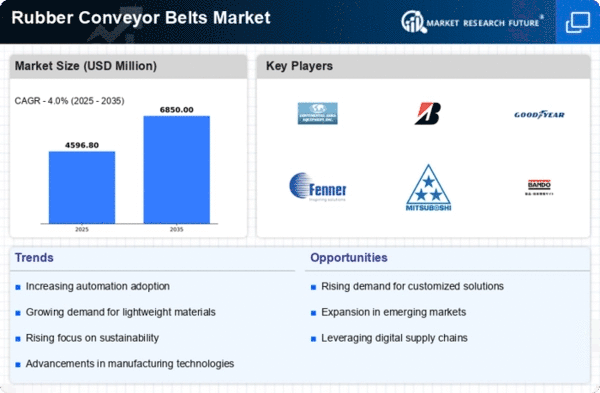
As per MRFR analysis, the Rubber Conveyor Belts Market Size was estimated at 4420.0 USD Million in 2024. The Rubber Conveyor Belts industry is projected to grow from 4640.0 USD Million in 2025 to 6850.0 USD Million by 2035, exhibiting a compound annual growth rate (CAGR) of 4.0% during the forecast period 2025-2035.

Key Market Trends & Highlights

The Rubber Conveyor Belts Market is poised for growth driven by sustainability and technological advancements.

  • North America remains the largest market for rubber conveyor belts, driven by robust industrial activities. The Asia-Pacific region is emerging as the fastest-growing market, fueled by rapid urbanization and infrastructure development. The mining segment continues to dominate the market, while the food processing segment is witnessing the fastest growth due to increasing demand for efficient material handling. Key market drivers include rising demand from the mining and construction sectors, alongside a growing focus on sustainability and eco-friendly products.

Market Size & Forecast

2024 Market Size 4420.0 (USD Million)
2035 Market Size 6850.0 (USD Million)
CAGR (2025 - 2035) 4.0%
Largest Regional Market Share in 2024 Asia-Pacific

Major Players

<p>Continental AG (DE), Bridgestone Corporation (JP), Goodyear Tire and Rubber Company (US), Fenner PLC (GB), Mitsuboshi Belting Ltd (JP), Bando Chemical Industries Ltd (JP), Yokohama Rubber Company (JP), Dunlop Conveyor Belting (NL)</p>

Market Trends

The Rubber Conveyor Belts Market is currently experiencing a dynamic phase characterized by evolving demands across various industries. The increasing emphasis on automation and efficiency in material handling processes appears to drive the adoption of advanced conveyor belt technologies. Industries such as mining, manufacturing, and logistics are integrating these systems to enhance productivity and reduce operational costs.

Furthermore, the growing focus on sustainability and eco-friendly materials is influencing manufacturers to innovate and develop belts that are not only durable but also environmentally responsible. This shift towards sustainable practices may reshape the competitive landscape, as companies strive to meet regulatory standards and consumer expectations. In addition, the Rubber Conveyor Belts Market seems to be benefiting from technological advancements, particularly in the areas of material science and engineering. Innovations in rubber compounds and manufacturing processes are likely to improve the performance and longevity of conveyor belts.

As industries continue to expand globally, the demand for customized solutions tailored to specific operational needs is expected to rise. This trend indicates a potential for growth in niche markets, where specialized conveyor belts can cater to unique applications. Overall, the Rubber Conveyor Belts Market is poised for transformation, driven by technological progress and a commitment to sustainability.

Sustainability Initiatives

The Rubber Conveyor Belts Market is witnessing a notable shift towards sustainable practices. Manufacturers are increasingly focusing on eco-friendly materials and production methods to align with global environmental standards. This trend not only addresses regulatory requirements but also meets the growing consumer demand for sustainable products.

Technological Advancements

Innovations in material science are significantly impacting the Rubber Conveyor Belts Market. Enhanced rubber compounds and advanced manufacturing techniques are leading to the development of belts that offer improved durability and efficiency. These technological advancements are likely to redefine performance standards within the industry.

Customization and Niche Markets

As industries evolve, the need for tailored solutions in the Rubber Conveyor Belts Market is becoming more pronounced. Companies are increasingly seeking customized conveyor belts that cater to specific operational requirements. This trend suggests a potential for growth in niche markets, where specialized products can provide competitive advantages.

Rubber Conveyor Belts Market Market Drivers

Market Growth Projections

The Rubber Conveyor Belt Industry is poised for substantial growth, with projections indicating a market valuation of 6.56 USD Billion by 2035. This growth trajectory suggests a compound annual growth rate (CAGR) of 3.86% from 2025 to 2035. Such figures reflect the increasing adoption of conveyor systems across various sectors, driven by technological advancements and rising demand for efficient material handling solutions. The market's expansion is likely to be influenced by factors such as industrial automation, sustainability initiatives, and the ongoing evolution of supply chain dynamics.

Growth in E-Commerce and Logistics

The surge in e-commerce and logistics activities is significantly impacting the Global Rubber Conveyor Belts Market. With the increasing volume of goods being transported, efficient material handling systems are essential for warehouses and distribution centers. Conveyor belts play a crucial role in streamlining operations, reducing labor costs, and improving order fulfillment times. This trend is expected to contribute to the market's growth, with projections indicating a valuation of 6.56 USD Billion by 2035. The logistics sector's reliance on advanced conveyor systems underscores the importance of rubber conveyor belts in modern supply chain management.

Expansion of Manufacturing Industries

The expansion of manufacturing industries globally is a key driver of the Rubber Belt Conveyor Market. As production processes become more complex, the need for reliable and efficient material handling solutions increases. Conveyor belts are integral to various manufacturing operations, facilitating the movement of raw materials and finished products. This growth is reflected in the anticipated market valuation of 4.32 USD Billion by 2024. The continuous investment in manufacturing capabilities across different regions further emphasizes the critical role of rubber conveyor belts in enhancing operational efficiency.

Technological Advancements in Conveyor Systems

Technological innovations in conveyor systems are propelling the Rubber Belt Conveyor Market forward. The integration of smart technologies, such as IoT and automation, enhances the efficiency and reliability of conveyor systems. These advancements allow for real-time monitoring and predictive maintenance, reducing downtime and increasing operational efficiency. Companies are increasingly adopting these technologies to optimize their supply chains. As a result, the market is expected to grow at a CAGR of 3.86% from 2025 to 2035, reflecting the industry's shift towards more sophisticated and automated solutions.

Rising Demand in Mining and Construction Sectors

The Industrial Conveyor Belts Market experiences a robust demand driven by the mining and construction sectors. As these industries expand, the need for efficient material handling solutions becomes paramount. Conveyor belts facilitate the transportation of heavy materials, enhancing productivity and reducing operational costs. For instance, the mining sector's growth is projected to contribute significantly to the market, with an expected valuation of 4.32 USD Billion by 2024. This trend indicates a strong reliance on rubber conveyor belts, which are essential for the seamless movement of materials in challenging environments.

Sustainability Initiatives and Eco-Friendly Materials

Sustainability initiatives are becoming increasingly influential in the Rubber Transport Belts Market. Manufacturers are exploring eco-friendly materials and production processes to meet the growing demand for sustainable solutions. The shift towards recyclable and biodegradable materials not only addresses environmental concerns but also aligns with regulatory requirements. Companies that adopt these practices may gain a competitive edge in the market. As the industry evolves, the focus on sustainability is likely to shape product development and consumer preferences, further driving market growth.

Market Segment Insights

By Application: Mining (Largest) vs. Food Processing (Fastest-Growing)

<p>The rubber conveyor belt market exhibits a diverse application landscape, with mining representing the largest segment due to its extensive demand for heavy-duty materials capable of transporting mined resources efficiently. Following mining, construction and logistics also hold significant shares, driven by the increasing need for durable conveyor solutions in various projects. Agriculture contributes a smaller yet notable portion, reflecting its specialized requirements. The food processing segment, while smaller compared to mining, is experiencing rapid growth due to stringent hygiene standards and advancements in food handling technology. Growth trends in the rubber conveyor belts market are significantly influenced by industrial expansion and technological advancements. As mining continues to evolve with innovations like automation, the demand for robust conveyor systems increases, solidifying its position as the largest application. Conversely, the food processing sector is expanding more quickly, with a focus on improving operational efficiencies and meeting safety regulations. This dynamic trend suggests a shift toward integrating advanced materials and designs in conveyor belts to cater to diverse application needs across industries.</p>

<p>Mining (Dominant) vs. Agriculture (Emerging)</p>

<p>Mining remains the dominant application in the Rubber Belt Conveyor Market, characterized by its robust and resilient conveyor systems tailored to withstand harsh environments and heavy materials. These belts are engineered for maximum durability, enabling efficient resource transport in mines. Conversely, the agriculture sector emerges as a niche yet growing area, primarily focusing on specialized belts that cater to unique agricultural processes, such as seed handling and processing. The agricultural belts are designed with features like flexibility and resistance to environmental factors, which make them optimal for on-farm usage. The contrast between mining's stronghold and agriculture's emergence showcases the diverse demands and specific adaptations required in the rubber conveyor belts market.</p>

By End Use: Manufacturing (Largest) vs. Transportation (Fastest-Growing)

<p>In the Rubber Conveyor Belts Market, the market share is primarily dominated by the manufacturing sector due to its extensive utilization across various industries such as textiles and <a href="https://www.marketresearchfuture.com/reports/automotive-industry-7683">automotive</a>. The manufacturing sector's reliance on rubber conveyor belts for efficient material handling has solidified its position as the largest segment. Following manufacturing, the transportation sector is noteworthy for its significant adoption of conveyor systems, aiding logistics and supply chain operations, which positions it as a robust contributor to the market as well.</p>

<p>Manufacturing (Dominant) vs. Transportation (Emerging)</p>

<p>The manufacturing sector stands as the dominant force in the Rubber Conveyor Belts Market due to its essential role in streamlining production processes and ensuring efficient material handling. Industries within manufacturing leverage rubber conveyor belts to improve operational efficiency, reduce downtime, and enhance safety. Conversely, the transportation sector represents an emerging market, showcasing rapid growth as businesses increasingly incorporate rubber conveyor belts for improved logistics capabilities. The growth in this segment is driven by advancements in technology and increasing demand for automation in material handling systems, highlighting the critical role of conveyor systems in enhancing supply chain efficiency.</p>

By Material Type: Natural Rubber (Largest) vs. Synthetic Rubber (Fastest-Growing)

<p>In the Rubber Conveyor Belts Industry, the material type segment showcases a diverse distribution of market share. Natural rubber is recognized as the largest segment due to its excellent elasticity and resilience, making it a preferred choice for various applications in industries such as mining and agriculture. On the other hand, synthetic rubber is gaining significant traction and is positioned as the fastest-growing material type, driven by its superior durability and resistance to harsh environmental conditions. Growth trends in the material type segment are driven primarily by technological advancements and increasing industrial automation. The demand for synthetic rubber continues to surge, fueled by its ability to withstand challenging operating conditions and enhance performance efficiency. Additionally, factors such as changing consumer preferences towards durable and sustainable materials are propelling the growth of synthetic rubber, while natural rubber remains vital in traditional applications requiring flexibility and strength.</p>

<p>Natural Rubber (Dominant) vs. Synthetic Rubber (Emerging)</p>

<p>Natural rubber remains the dominant player in the Rubber Conveyor Belts Sector due to its inherent properties, including high tensile strength and resilience, making it ideal for intensive use in agricultural and industrial applications. Its natural sourcing aligns with the increasing demand for eco-friendly products, resonating well with sustainability initiatives across various industries. In contrast, synthetic rubber is emerging rapidly because of its cost-effectiveness and versatility, catering to modern industries that require specialized performance characteristics such as heat and chemical resistance. As both segments continue to evolve, the competition between natural and synthetic rubber not only reflects changing market demands but also technological innovations that enhance product performance.</p>

By Belt Type: Flat Belt (Largest) vs. Cleated Belt (Fastest-Growing)

<p>The Rubber Conveyor Belts Industry exhibits a diverse distribution across various belt types. The Flat Belt stands out as the largest segment, dominating the market due to its widespread application in bulk material handling. Meanwhile, the Cleated Belt is rapidly gaining traction among users requiring enhanced grip and material transport efficiency on inclines, portraying a significant growth trajectory within the industry. In terms of growth, the Cleated Belt is seeing increased adoption in sectors like mining and agriculture, where efficient material elevation is crucial. Despite Flat Belts leading the market, the demand for Cleated Belts reflects a shift in operational needs, driven by technological advancements and the increasing efficiency requirements from end-users. These trends highlight a dynamic landscape where functionality dictates preference in belt selection.</p>

<p>Flat Belt (Dominant) vs. Cleated Belt (Emerging)</p>

<p>The Flat Belt is characterized by its simple construction and versatility, making it the most widely used belt type in various applications such as manufacturing and <a href="https://www.marketresearchfuture.com/reports/warehousing-and-distribution-logistics-market-12117">warehousing</a>. Its ability to transport materials over long distances with minimal friction contributes to its dominance in the Rubber Conveyor Belts Market. On the other hand, the Cleated Belt is designed with raised sections, allowing it to handle steep inclines and slippery materials more effectively. This emerging technology is particularly favored in sectors demanding high performance and reliability, such as bulk material transport in mining and food processing industries. The rise of the Cleated Belt indicates a growing market shift towards specialized solutions that enhance operational efficiency.</p>

By Thickness: Medium (Largest) vs. Thick (Fastest-Growing)

<p>In the Rubber Conveyor Belts Sector, the thickness segment showcases a diverse distribution of market share across different categories. The medium thickness belts hold the largest share, preferred for their balanced characteristics of flexibility and strength, making them ideal for a wide range of applications. Following closely are the thick rubber conveyor belts, which are favored in heavy-duty environments; however, their preference is steadily increasing, signaling a significant market shift in demand towards higher thickness options for specific industrial uses. Growth trends within the thickness segment indicate an upward trajectory, particularly for thicker variants. Factors driving this growth include the increasing adoption of automation in industries and the need for durable, high-performance belts capable of handling heavier loads. Emerging applications in sectors like mining and construction further fuel the demand for thicker belts, making it essential for manufacturers to innovate and cater to evolving needs.</p>

<p>Medium (Dominant) vs. Thick (Emerging)</p>

<p>In the Rubber Conveyor Belts Industry, medium thickness belts are currently positioned as the dominant segment, recognized for their versatility and suitability across various industries, including food processing and material handling. Their balanced profile offers an ideal combination of durability and flexibility, making them a go-to choice for many applications. On the other hand, thick belts are emerging rapidly due to their specific advantages in heavy-duty operations, particularly in mining and logistics. As industries seek enhanced performance and resistance to wear and tear, the demand for thick rubber conveyor belts is climbing. Manufacturers are adapting to these trends by developing innovative materials and designs, ensuring that both medium and thick variants can meet the rigorous demands of modern industrial environments.</p>

Get more detailed insights about Rubber Conveyor Belts Market Research Report - Global Forecast to 2035

Regional Insights

North America : Established Market with Growth Potential

The North American rubber conveyor belts market is projected to reach $800.0 million by 2025, driven by increasing industrial automation and the need for efficient material handling solutions. Regulatory support for infrastructure development and sustainability initiatives further catalyze market growth. The region's focus on technological advancements in manufacturing processes is also a significant driver, enhancing product quality and performance. Leading countries in this region include the US and Canada, where major players like Goodyear Tire and Rubber Company and Continental AG are prominent. The competitive landscape is characterized by innovation and strategic partnerships, with companies investing in R&D to develop advanced conveyor belt solutions. The presence of established manufacturers ensures a robust supply chain, catering to diverse industries such as mining, agriculture, and logistics.

Europe : Innovation and Sustainability Focus

Europe's rubber conveyor belts market is expected to reach $900.0 million by 2025, fueled by stringent environmental regulations and a shift towards sustainable manufacturing practices. The region's commitment to reducing carbon emissions and enhancing energy efficiency drives demand for innovative conveyor belt solutions. Additionally, the rise in e-commerce and logistics sectors contributes to market expansion, as companies seek efficient material handling systems. Germany, the UK, and France are key players in this market, with companies like Fenner PLC and Dunlop Conveyor Belting leading the charge. The competitive landscape is marked by a focus on eco-friendly products and advanced technologies. European manufacturers are increasingly investing in R&D to meet regulatory standards and consumer preferences for sustainable solutions. "The European Union aims to reduce greenhouse gas emissions by at least 55% by 2030, promoting sustainable industrial practices," states the European Commission.

Asia-Pacific : Dominant Market with High Growth

The Asia-Pacific region dominates the rubber conveyor belts market, projected to reach $2,700.0 million by 2025. This growth is driven by rapid industrialization, increasing mining activities, and the expansion of manufacturing sectors. Countries like China and India are significant contributors, with rising demand for efficient material handling solutions in various industries. Government initiatives to boost infrastructure development further enhance market prospects. China stands out as the largest market, with major players like Bridgestone Corporation and Yokohama Rubber Company establishing a strong presence. The competitive landscape is characterized by a mix of local and international companies, focusing on innovation and cost-effective solutions. The region's robust supply chain and manufacturing capabilities position it as a The Rubber Conveyor Belts.

Middle East and Africa : Emerging Market with Growth Opportunities

The Middle East and Africa rubber conveyor belts market is anticipated to reach $1,020.0 million by 2025, driven by increasing investments in infrastructure and mining sectors. The region's focus on diversifying economies and enhancing industrial capabilities is a significant growth driver. Additionally, the demand for efficient material handling solutions in construction and logistics sectors is on the rise, further propelling market growth. Countries like South Africa and the UAE are leading the market, with a growing presence of key players such as Bando Chemical Industries Ltd. The competitive landscape is evolving, with local manufacturers increasingly adopting advanced technologies to meet market demands. The region's strategic location also facilitates trade and distribution, enhancing its attractiveness for global players. "The Middle East is expected to see a surge in infrastructure projects, boosting demand for industrial solutions," states the Gulf Cooperation Council.

Key Players and Competitive Insights

The Rubber Conveyor Belts Market is characterized by a competitive landscape that is increasingly shaped by innovation, sustainability, and strategic partnerships. Key players such as Continental AG (DE), Bridgestone Corporation (JP), and Goodyear Tire and Rubber Company (US) are actively pursuing strategies that emphasize technological advancements and regional expansion. For instance, Continental AG (DE) has focused on enhancing its product offerings through the integration of smart technologies, which not only improves operational efficiency but also aligns with the growing demand for sustainable solutions. Similarly, Bridgestone Corporation (JP) has been investing in eco-friendly materials and processes, thereby positioning itself as a leader in sustainable manufacturing practices within the market.

The market structure appears moderately fragmented, with a mix of established players and emerging companies vying for market share. Key business tactics such as localizing manufacturing and optimizing supply chains are prevalent among major companies. This localization strategy not only reduces operational costs but also enhances responsiveness to regional market demands. The collective influence of these key players fosters a competitive environment where innovation and sustainability are paramount, driving the overall growth of the market.

In November 2025, Goodyear Tire and Rubber Company (US) announced a strategic partnership with a leading technology firm to develop AI-driven predictive maintenance solutions for conveyor systems. This initiative is expected to enhance the reliability and efficiency of conveyor operations, thereby providing Goodyear with a competitive edge in the market. The integration of AI technology signifies a shift towards more intelligent and responsive manufacturing processes, which could redefine operational standards in the industry.

In October 2025, Fenner PLC (GB) launched a new line of high-performance conveyor belts designed specifically for the mining sector. This product line leverages advanced materials that offer enhanced durability and resistance to wear and tear. The introduction of these specialized products not only caters to the specific needs of the mining industry but also reinforces Fenner's commitment to innovation and customer-centric solutions, potentially increasing its market share in this niche segment.

In September 2025, Yokohama Rubber Company (JP) expanded its production capacity in Southeast Asia to meet the rising demand for rubber conveyor belts in the region. This expansion is indicative of Yokohama's strategic focus on regional growth and its intent to capitalize on emerging market opportunities. By increasing its manufacturing capabilities, the company aims to enhance its supply chain efficiency and reduce lead times, which are critical factors in maintaining competitiveness in the global market.

As of December 2025, the competitive trends within the Rubber Conveyor Belts Market are increasingly influenced by digitalization, sustainability, and the integration of advanced technologies such as AI. Strategic alliances are becoming more common, as companies seek to leverage complementary strengths to enhance their market positions. The shift from price-based competition to a focus on innovation, technology, and supply chain reliability is evident, suggesting that future competitive differentiation will hinge on the ability to adapt to these evolving trends.

In October 2024, Alcoa and Tyrecycle partnered in Australia to recycle mining conveyor belts, extracting rubber and steel for reuse. The collaboration supports large-scale industrial waste reduction and promotes a circular materials process. This initiative highlights growing sustainability efforts in heavy-industry operations.

In September 2025, Somi Conveyor Beltings secured an order worth ₹3.04 crore from Steel Authority of India (SAIL) for conveyor belt supply. The order highlights demand for industrial belt systems in India’s mining and steel sectors. It supports Somi’s growth in heavy-industry supply contracts.

Key Companies in the Rubber Conveyor Belts Market market include

Industry Developments

Q4 2024: Marubeni, through its wholly owned Canadian subsidiary Viacore Solutions Inc., has completed the acquisition of Alternative Belting Enterprises Ltd. and Alternative Belting (Van Island) Enterprises Ltd., strengthening its conveyor belt distribution and maintenance footprint across British Columbia and wider Canada. The deal significantly enhances Viacore’s operational reach from the West Coast to the East Coast, boosts purchasing and sales capabilities, and positions the Viacore Group as one of the leading conveyor belt service providers in North America, supporting industries such as mining and forestry while advancing Marubeni’s long-term global expansion strategy.

Q4 2023: Bando Chemical Industries has expanded its industrial product portfolio with the launch of a high-performance, heat-resistant conveyor belt engineered specifically for steel mill applications. The new belt is designed to operate reliably under extreme temperatures, improving durability, productivity, and operational efficiency in heavy industrial environments.

Q3 2023: Intralox has introduced an advanced modular conveyor belt technology tailored for the food processing sector, focusing on enhanced hygiene, improved cleanability, and food safety compliance. The innovation supports processors in meeting stricter sanitation standards while improving overall operational efficiency.

Q4 2024: Fenner Dunlop has strengthened its presence in Asia through the acquisition of a conveyor belt manufacturing company in China, enabling closer access to regional customers. The move enhances local production capacity and positions the company to meet rising demand across mining, infrastructure, and industrial sectors in the Asia-Pacific region.

Q3 2023: Fives has unveiled a new conveyor belt cleaning system that significantly reduces water consumption while maintaining high cleaning efficiency. The solution aligns with sustainability goals and helps industrial operators lower operating costs and environmental impact across conveyor-intensive applications.

Future Outlook

Rubber Conveyor Belts Market Future Outlook

<p>The Rubber Conveyor Belts Market is projected to grow at a 4.0% CAGR from 2024 to 2035, driven by industrial automation, increased mining activities, and advancements in material technology.</p>

New opportunities lie in:

  • <p>Expansion into emerging markets with tailored solutions</p>
  • <p>Development of eco-friendly rubber compounds for sustainability</p>
  • <p>Integration of IoT technology for predictive maintenance solutions</p>

<p>By 2035, the market is expected to exhibit robust growth, driven by innovation and strategic expansions.</p>

Market Segmentation

Rubber Conveyor Belts Market End Use Outlook

  • Manufacturing
  • Transportation
  • Mining
  • Agriculture
  • Food Processing

Rubber Conveyor Belts Market Belt Type Outlook

  • Flat Belt
  • Modular Belt
  • Cleated Belt
  • Sidewall Belt
  • Wire Mesh Belt

Rubber Conveyor Belts Market Thickness Outlook

  • Thin
  • Medium
  • Thick
  • Extra Thick
  • Ultra Thick

Rubber Conveyor Belts Market Application Outlook

  • Mining
  • Construction
  • Agriculture
  • Food Processing
  • Logistics

Rubber Conveyor Belts Market Material Type Outlook

  • Natural Rubber
  • Synthetic Rubber
  • Fabric Reinforced
  • Steel Reinforced
  • Polymer

Report Scope

MARKET SIZE 2024 4420.0(USD Million)
MARKET SIZE 2025 4640.0(USD Million)
MARKET SIZE 2035 6850.0(USD Million)
COMPOUND ANNUAL GROWTH RATE (CAGR) 4.0% (2024 - 2035)
REPORT COVERAGE Revenue Forecast, Competitive Landscape, Growth Factors, and Trends
BASE YEAR 2024
Market Forecast Period 2025 - 2035
Historical Data 2019 - 2024
Market Forecast Units USD Million
Key Companies Profiled Continental AG (DE), Bridgestone Corporation (JP), Goodyear Tire and Rubber Company (US), Fenner PLC (GB), Mitsuboshi Belting Ltd (JP), Bando Chemical Industries Ltd (JP), Yokohama Rubber Company (JP), Dunlop Conveyor Belting (NL)
Segments Covered Application, End Use, Material Type, Belt Type, Thickness
Key Market Opportunities Integration of smart technologies enhances efficiency in the Rubber Conveyor Belts Market.
Key Market Dynamics Rising demand for durable materials drives innovation and competition in the rubber conveyor belts market.
Countries Covered North America, Europe, APAC, South America, MEA

FAQs

What is the competitive backdrop in the market for rubber conveyor belts industry?

Fives (France), Bridgestone (Japan), Volta Belting Technology Ltd (Israel), Goodyear Rubber Products. Inc, (US) and ContiTech AG (Germany) are the major contenders in the market.

Which region is controlling the majority share in the rubber conveyor belts?

The APAC region is likely to direct the market in the upcoming period.

What are the motivators for development in the rubber conveyor belts global market for the coming years?

The progress in technology is expected to create a favorable influence on the market.

What is the prediction for the rubber conveyor belts market’s CAGR?

A CAGR of 4.0% is expected to exert its influence in the market.

What are the market segments in the rubber conveyor belts global market?

The segments of type, application, and region are helping outline the development of the market.

  1. Executive Summary
  2. Scope of the Report
    1. Market Definition
    2. Scope of the Study
      1. Definition
      2. Research Objective
      3. Assumptions
      4. Limitations
    3. Research Process
      1. Primary Research
      2. Secondary Research
    4. Market Size Estimation
    5. Forecast Model
  3. Market Landscape
    1. Porter’s Five Forces Analysis
      1. Threat of New Entrants
      2. Bargaining power of buyers
      3. Threat of substitutes
      4. Segment rivalry
      5. Bargaining Power of Buyers
    2. Value Chain/Supply Chain Analysis
  4. Market Dynamics
    1. Introduction
    2. Market Drivers
    3. Market Restraints
    4. Market Opportunities
    5. Market Trends
  5. Global Rubber Conveyor Belts Market, by Type
    1. Introduction
    2. Light-Weight Conveyor Belts
      1. Market Estimates & Forecast, 2023-2032
      2. Market Estimates & Forecast, by Region, 2023-2032
    3. Medium-Weight Conveyor Belts
      1. Market Estimates & Forecast, 2023-2032
      2. Market Estimates & Forecast, by Region, 2023-2032
    4. Heavy-Weight Conveyor Belts
      1. Market Estimates & Forecast, 2023-2032
      2. Market Estimates & Forecast, by Region, 2023-2032
  6. Global Rubber Conveyor Belts Market, by Application
    1. Introduction
    2. Food Industry
      1. Market Estimates & Forecast, 2023-2032
      2. Market Estimates & Forecast, by Region, 2023-2032
    3. Construction
      1. Market Estimates & Forecast, 2023-2032
      2. Market Estimates & Forecast, by Region, 2023-2032
    4. Mining
      1. Market Estimates & Forecast, 2023-2032
      2. Market Estimates & Forecast, by Region, 2023-2032
    5. Airline Industry
      1. Market Estimates & Forecast, 2023-2032
      2. Market Estimates & Forecast, by Region, 2023-2032
    6. Others
      1. Market Estimates & Forecast, 2023-2032
      2. Market Estimates & Forecast, by Region, 2023-2032
  7. Global Rubber Conveyor Belts Market, by Region
    1. Introduction
    2. North America
      1. Market Estimates & Forecast, 2023-2032
      2. Market Estimates & Forecast, by Type, 2023-2032
      3. Market Estimates & Forecast, by Application, 2023-2032
      4. US
      5. Canada
    3. Europe
      1. Market Estimates & Forecast, by Type, 2023-2032
      2. Market Estimates & Forecast, by Application, 2023-2032
      3. UK
      4. Germany
      5. France
      6. Italy
      7. Rest of Europe
    4. Asia-Pacific
      1. Market Estimates & Forecast, by Type, 2023-2032
      2. Market Estimates & Forecast, by Application, 2023-2032
      3. China
      4. Japan
      5. India
      6. Rest of Asia-Pacific
    5. Rest of the World
      1. Market Estimates & Forecast, by Type, 2023-2032
      2. Market Estimates & Forecast, by Application, 2023-2032
      3. Middle East and Africa
      4. South America
  8. Competitive Landscape
  9. Company Profile
    1. Bando Chemical Industries, Ltd
      1. Company Overview
      2. Products/Services Offered
      3. Financial Overview
      4. Key Developments
      5. Key Strategies
      6. SWOT Analysis
    2. Intralox
      1. Company Overview
      2. Products/Services Offered
      3. Financial Overview
      4. Key Developments
      5. Key Strategies
      6. SWOT Analysis
    3. Fenner Dunlop
      1. Company Overview
      2. Products/Services Offered
      3. Financial Overview
      4. Key Developments
      5. Key Strategies
      6. SWOT Analysis
    4. Volta Belting Technology Ltd
      1. Company Overview
      2. Products/Services Offered
      3. Financial Overview
      4. Key Developments
      5. Key Strategies
      6. SWOT Analysis
    5. Fives
      1. Company Overview
      2. Products/Services Offered
      3. Financial Overview
      4. Key Developments
      5. Key Strategies
      6. SWOT Analysis
    6. Bridgestone
      1. Company Overview
      2. Products/Services Offered
      3. Financial Overview
      4. Key Developments
      5. Key Strategies
      6. SWOT Analysis
    7. ContiTech AG
      1. Company Overview
      2. Products/Services Offered
      3. Financial Overview
      4. Key Developments
      5. Key Strategies
      6. SWOT Analysis
    8. Goodyear Rubber Products. Inc,
      1. Company Overview
      2. Products/Services Offered
      3. Financial Overview
      4. Key Developments
      5. Key Strategies
      6. SWOT Analysis
    9. Qingdao Rubber 6 Conveyer Belt Co.,
      1. Company Overview
      2. Products/Services Offered
      3. Financial Overview
      4. Key Developments
      5. Key Strategies
      6. SWOT Analysis
    10. The Yokohama Rubber Co., Ltd
      1. Company Overview
      2. Products/Services Offered
      3. Financial Overview
      4. Key Developments
      5. Key Strategies
      6. SWOT Analysis
    11. List of Tables
  10. Global Rubber Conveyor Belts Market, by Region, 2023-2032
  11. North America: Rubber Conveyor Belts Market, by Country, 2023-2032
  12. Europe: Rubber Conveyor Belts Market, by Country, 2023-2032
  13. Asia-Pacific: Rubber Conveyor Belts Market, by Country, 2023-2032
  14. RoW: Rubber Conveyor Belts Market, by Country, 2023-2032
  15. Global Rubber Conveyor Belts Market, by Type, by Regions, 2023-2032
  16. North America: Rubber Conveyor Belts Market, by Type, by Country, 2023-2032
  17. Europe: Rubber Conveyor Belts Market, by Type, by Country, 2023-2032
  18. Asia-Pacific: Rubber Conveyor Belts Market, by Type, by Country, 2023-2032
  19. RoW: Rubber Conveyor Belts Market, by Type, by Country, 2023-2032
  20. Global Rubber Conveyor Belts Market, by Application: by Regions, 2023-2032
  21. North America: Rubber Conveyor Belts Market, by Application: by Country, 2023-2032
  22. Europe: Rubber Conveyor Belts Market, by Application: by Country, 2023-2032
  23. Asia-Pacific: Rubber Conveyor Belts Market, by Application: by Country, 2023-2032
  24. RoW: Rubber Conveyor Belts Market, by Application: by Country, 2023-2032
  25. Global Rubber Conveyor Belts Market, by Region, 2023-2032
  26. Global Rubber Conveyor Belts Market, by Type, 2023-2032
  27. Global Rubber Conveyor Belts Market, by Application, 2023-2032
  28. North America: Rubber Conveyor Belts Market, by Country, 2023-2032
  29. North America: Rubber Conveyor Belts Market, by Type, 2023-2032
  30. North America: Rubber Conveyor Belts Market, by Application, 2023-2032
  31. Europe: Rubber Conveyor Belts Market, by Country, 2023-2032
  32. Europe: Rubber Conveyor Belts Market, by Type, 2023-2032
  33. Europe: Rubber Conveyor Belts Market, by Application, 2023-2032
  34. Asia-Pacific: Rubber Conveyor Belts Market, by Country, 2023-2032
  35. Asia-Pacific: Rubber Conveyor Belts Market, by Type, 2023-2032
  36. Asia-Pacific Rubber Conveyor Belts Market, by Application, 2023-2032
  37. RoW: Rubber Conveyor Belts Market, by Region, 2023-2032
  38. RoW: Rubber Conveyor Belts Market, by Type, 2023-2032
  39. RoW: Rubber Conveyor Belts Market, by Application, 2023-2032
    1. List of Figures
  40. Research Process of MRFR
  41. Top-Down and Bottom-Up Approach
  42. Market Dynamics
  43. Impact Analysis: Market Drivers
  44. Impact Analysis: Market Restraints
  45. Porter's Five Forces Analysis
  46. Value Chain Analysis
  47. Global Rubber Conveyor Belts Market Share, by Type, 2023 (%)
  48. Global Rubber Conveyor Belts Market, by Type, 2023-2032 (USD MILLION)
  49. Global Rubber Conveyor Belts Market Share, by Application, 2023 (%)
  50. Global Rubber Conveyor Belts Market, by Application, 2023-2032 (USD MILLION)
  51. Global Rubber Conveyor Belts Market Share (%), by Region, 2023
  52. Global Rubber Conveyor Belts Market, by Region, 2023-2032 (USD MILLION)
  53. North America: Rubber Conveyor Belts Market Share (%), 2023
  54. North America: Rubber Conveyor Belts Market, by Country, 2023-2032 (USD MILLION)
  55. Europe: Rubber Conveyor Belts Market Share (%), 2023
  56. Europe: Rubber Conveyor Belts Market, by Country, 2023-2032 (USD MILLION)
  57. Asia-Pacific: Rubber Conveyor Belts Market Share (%), 2023
  58. Asia-Pacific: Rubber Conveyor Belts Market, by Country, 2023-2032 (USD MILLION)
  59. Rest of the World Rubber Conveyor Belts Market Share (%), 2023
  60. Rest of the World Rubber Conveyor Belts Market, by Country, 2023-2032 (USD MILLION)

Rubber Conveyor Belts Market Segmentation

Market Segmentation Overview

  • Detailed segmentation data will be available in the full report
  • Comprehensive analysis by multiple parameters
  • Regional and country-level breakdowns
  • Market size forecasts by segment
Infographic

Free Sample Request

Kindly complete the form below to receive a free sample of this Report

Get Free Sample

Customer Strories

Compare Licence

×
Features License Type
Single User Multiuser License Enterprise User
Price $4,950 $5,950 $7,250
Maximum User Access Limit 1 User Upto 10 Users Unrestricted Access Throughout the Organization
Free Customization
Direct Access to Analyst
Deliverable Format
Platform Access
Discount on Next Purchase 10% 15% 15%
Printable Versions