Rubber Track Agricultural Equipment Market (2026 - 2035)

Rubber Track Agricultural Equipment Market Size, Share & Growth Analysis Report By Equipment Type (Tractors, Harvesters/Combines, Sprayers, Loaders & Others), By Track Type (Continuous Rubber Tracks, Segmented Rubber Tracks), By Application (Crop Farming, Viticulture & Horticulture, Grassland & Pasture Management, Wetland & Specialty Farming), By End User (Large-Scale Commercial Farms, Small & Medium Farms, Agricultural Service Contractors) and By Regional (North America, Europe, South America, Asia Pacific, Middle East and Africa) – Industry Growth & Forecast to 2035
ID: MRFR/Equip/66592-CR
200 Pages
Garvit Vyas
Last Updated: July 10, 2026
Rubber Track Agricultural Equipment Market
Market Size
Forecast Period2026-2035
CAGR (2026-2035)4.50%
2025 Market SizeUSD 3,884.27 Million (USD 3.88 Billion)
2035 Market SizeUSD 5,519.35 Million (USD 5.52 Billion)
Key Players
CNH Industrial N.V.
AGCO Corporation
John Deere
CLAAS KGaA mbH
Rheinmetall AG
New Holland
Opportunities
  • Increasing Use of Rubber Tracks in Niche Agricultural Applications
  • Investment in Digital Infrastructure and Integrated Precision Platforms
  • Workforce Development and Simplified Operational Systems

Rubber Track Agricultural Equipment Market Summary

The global rubber track agricultural equipment market was valued at approximately USD 3,884.27 million in 2025 and is projected to reach USD 5,519.35 million by 2035, expanding at a compound annual growth rate (CAGR) of 3.80% during the forecast period of 2026–2035. The market's upward trajectory is underpinned by structural demand for high-efficiency, low-maintenance undercarriage systems in off-road agricultural machinery, growing adoption of rubber track platforms to enhance traction and reduce soil compaction within precision farming operations, and the sustained expansion of mechanized farming into regions characterized by challenging terrain conditions [2]. Investment in advanced land preparation and crop management technologies continued to accelerate through 2025, as original equipment manufacturers (OEMs) introduced electric drive powertrains, autonomous guidance capabilities, and expanded sprayer platforms designed for large-scale field operations, collectively reinforcing the shift toward track-based mobility in modern agriculture [3].

Due to their adaptability to row crop, broadacre, and mixed-use farming operations, rubber-track-equipped tractors continue to be the market's dominant equipment segment, accounting for the biggest revenue share in 2025. Because of their better load distribution and lower ground pressure characteristics when compared to segmented alternatives, continuous rubber tracks are the most popular track layout in terms of value. Wetland and specialty farming, where rubber tracks offer essential flotation and low soil disturbance in saturated or environmentally sensitive terrains, is the application segment with the quickest pace of growth. The convergence of track-based machinery with digital and electrified farming systems is highlighted by significant industry developments in early 2026, such as Caterpillar's introduction of the Cat D8 XE dozer with an electric drive powertrain and New Holland's introduction of the Defensor 4000 sprayer with precision agriculture integration [4].

Due to widespread mechanized farming in Germany, France, and the UK, as well as strict soil health rules that encourage low-compaction track systems, Europe maintained its position as the leading regional market in 2025 and commanded the biggest part of worldwide revenues. Due to widespread precision agriculture use in the US and Canada, as well as rising replacement demand for rubber track systems in the Midwest grain belt, North America emerged as the fastest-growing regional market, with a compound annual growth rate (CAGR) above the global average. China, Japan, and Australia are the main demand centers in Asia-Pacific, which is the third-largest regional market. As digital agriculture, autonomous machinery integration, and regulatory emphasis on soil conservation come together to drive rubber track penetration across global farming operations, the market is anticipated to maintain its growth momentum through 2035 [5].


Key Report Takeaways

Segment Dimension Key Metric Notes
Equipment Type — Dominant Tractors: USD 1,747.92 Mn (2025) Largest revenue contributor; versatile across farming operations
Equipment Type — Fastest Growing Sprayers: CAGR 4.50% (2026–2035) Driven by precision agriculture adoption and large-scale field spraying demand
Track Type — Dominant Continuous Rubber Tracks: USD 2,408.25 Mn (2025) Superior load distribution and soil protection characteristics
Track Type — Fastest Growing Segmented Rubber Tracks: CAGR 4.20% (2026–2035) Gaining share in retrofit and specialty equipment segments
Application — Dominant Crop Farming: USD 2,136.35 Mn (2025) Core demand driver across all major farming regions
Application — Fastest Growing Wetland & Specialty Farming: CAGR 4.80% (2026–2035) Niche growth in orchards, vineyards, and saturated-terrain operations
End User — Dominant Large-Scale Commercial Farms: USD 1,942.14 Mn (2025) Driven by capital expenditure cycles and fleet modernization
End User — Fastest Growing Agricultural Service Contractors: CAGR 4.40% (2026–2035) Contractor fleet expansion and utilization-based purchasing models
Region — Dominant Europe: USD 1,359.49 Mn (2025) Supported by soil health regulation and advanced mechanization
Region — Fastest Growing North America: CAGR 4.30% (2026–2035) Precision agriculture adoption and Midwest grain belt demand


Market Size and Forecast (2019–2035)

The market size estimates presented in this report are derived from MRFR's proprietary bottom-up research methodology, integrating primary data from OEM financial disclosures, distributor surveys, and agricultural machinery trade association filings with secondary data from government agricultural mechanization reports, industry journals, and regional import-export databases. Historical values (2019–2024) reflect verified shipment and revenue data, while the base year (2025) is estimated from the most recent available 12-month period. Forecast values (2026–2035) are projected using demand-side modeling that incorporates macroeconomic indicators, crop acreage trends, equipment replacement cycles, and policy developments across major farming economies [6].
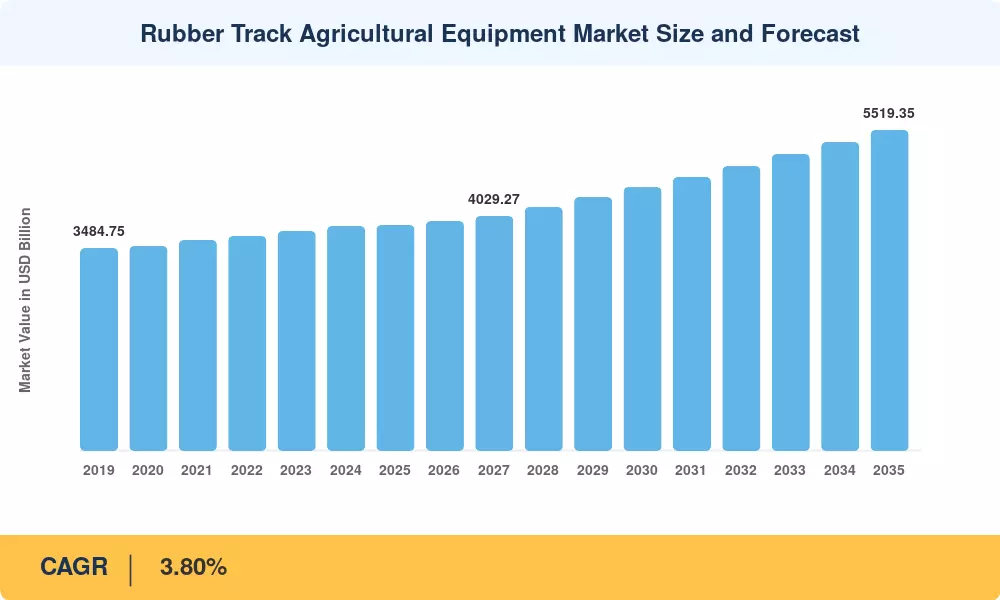
Rubber Track Agricultural Equipment Market Size and Forecast
Our Impact
Enabled $4.3B Revenue Impact for Fortune 500 and Leading Multinationals
Partnering with 2000+ Global Organizations Each Year
30K+ Citations by Top-Tier Firms in the Industry

Driver Impact Analysis

Driver ~% Impact on CAGR Geographic Relevance Impact Timeline
Growing demand for high-efficiency, low-maintenance undercarriage systems for off-road agricultural machinery ~40% Global — particularly Europe and North America Medium to Long-term
Rising adoption of rubber tracks to improve traction and reduce soil compaction in modern precision farming ~35% North America, Europe, Asia-Pacific Short to Medium-term
Expansion of mechanized farming and land use in regions with challenging terrains ~25% Asia-Pacific, Latin America, MEA Medium to Long-term


Growing Demand for High-Efficiency, Low-Maintenance Undercarriage Systems

A fundamental change is occurring in the agricultural equipment market toward machinery platforms that maximize field-operational uptime while minimizing lifecycle maintenance expenses. Commercial farms looking to reduce the total cost of ownership over multi-season operation cycles are increasingly specifying rubber track undercarriage systems because they offer smoother ride quality over uneven terrain and require fewer wear-part repairs than steel alternatives. In response, OEMs like CNH Industrial and AGCO Corporation have expanded their track-equipped product lines; as of 2025, CNH Industrial commands a projected 19.4% market share, while AGCO Corporation holds roughly 15.5%. Rubber track adoption has been further accelerated by the growth of self-propelled harvesters and high-horsepower tractors, which operate at weights and ground-contact pressures where track systems provide quantifiable fuel savings and less field damage than wheeled configurations [2].

As aging equipment fleets in North America and Europe begin replacement cycles that favor track-based platforms, this driver is anticipated to have the biggest impact during the medium to long term (2028–2035). Commercial farming businesses are increasingly considering fuel-efficiency goals and soil-health compliance when planning capital expenditures, both of which complement the operational benefits of rubber track systems. According to industry estimates, the primary commercial considerations behind this shift include a 10–15% increase in fuel efficiency on soft soils and maintenance cost reductions of 15–20% when compared to steel undercarriages [6][9].


Rising Adoption of Rubber Tracks in Precision Farming

Track-based platforms that safeguard soil structure during GPS-guided, controlled-traffic farming operations are in high demand as precision agriculture transitions from a specialized technology to an operational standard across developed-market farming. Rubber tracks maintain root-zone health in nearby crop rows and lessen compaction in designated traffic lanes by distributing machine weight over a greater contact area. In areas adopting controlled-traffic farming (CTF) practices, especially in Australia, the US Midwest, and northern Europe, this capability is becoming more and more important [3]. New Holland's introduction of the Defensor 4000 sprayer in March 2026, which combined increased operational capacity with integrated digital field-management systems and reflected the convergence of rubber track mobility and precision-application technology, demonstrated the integration of precision agriculture technologies into track-equipped machinery [4].

Since farm-level data infrastructure and agronomist advisory networks are most advanced in North America and Europe, short- to medium-term adoption (2026–2030) is anticipated to be centered there. Government-funded smart-farming initiatives are starting to impact equipment purchasing decisions in Asia-Pacific markets, especially Australia and Japan, which are secondary adoption zones [7].


Expansion of Mechanized Farming in Challenging Terrains

The global expansion of cultivated acreage into previously marginal or under-mechanized regions is creating new demand for track-based agricultural equipment that can operate on soft, steep, or waterlogged terrain where wheeled machinery is impractical. In Southeast Asia, sub-Saharan Africa, and parts of Latin America, government agricultural development programs are promoting mechanized farming on wetland, peatland, and hillside plots, all of which require the flotation and stability characteristics inherent to rubber track systems [5]. In Brazil and Argentina, the extension of soybean and sugarcane cultivation into cerrado and transition-zone soils has further incentivized track adoption to mitigate compaction in heavy clay substrates during planting and harvest seasons [8].

This driver represents a medium to long-term influence (2028–2035), as infrastructure and financing constraints in developing-market regions typically introduce multi-year lags between policy announcement and equipment deployment. Nonetheless, cumulative acreage expansion across emerging farming frontiers is projected to account for approximately one-quarter of the market's incremental growth over the forecast period [10].


Restraints Impact Analysis

Restraint ~% Drag on CAGR Geographic Relevance Impact Timeline
Higher upfront cost of rubber track systems compared with steel undercarriages ~45% Global — acute in price-sensitive Asia-Pacific, Latin America, MEA Short to Medium-term
Limited availability of region-specific service infrastructure for track sizing and refurbishment ~30% Asia-Pacific, Latin America, Middle East & Africa Medium-term
Wear and replacement frequency are impacted by aggressive field conditions ~25% Global — particularly abrasive-soil regions Short to Long-term


Higher Upfront Cost of Rubber Track Systems

Compared to traditional steel track and wheel-based alternatives, rubber track undercarriage assemblies are significantly more expensive; OEM list prices for full-track conversion kits are usually 30–50% higher than similar wheeled axle arrangements. In price-sensitive markets in South and Southeast Asia, sub-Saharan Africa, and portions of Latin America, where farm-level capital budgets are limited and access to equipment finance is still restricted, this cost gap is the biggest obstacle to adoption. The initial cash outlay is a practical barrier to adoption among smallholder and medium-sized farm operators who evaluate equipment purchases on upfront price rather than discounted lifecycle economics, even though lifecycle cost analyses consistently show total-cost-of-ownership parity or an advantage for rubber tracks over multi-season use [6][11].


Limited Availability of Region-Specific Service Infrastructure

The operational effectiveness of rubber track systems depends on access to qualified service providers capable of performing track tensioning, alignment, guide-lug inspection, and replacement procedures. In many emerging-market regions, including large parts of sub-Saharan Africa, Central Asia, and interior Latin America, the service infrastructure required for rubber track maintenance is underdeveloped, with few dealers stocking the correct track sizes and minimal availability of trained technicians. This infrastructure gap discourages OEM specification and end-user adoption of rubber track equipment outside established dealer networks in North America, Europe, and select Asia-Pacific markets [8][12].

Wear and Replacement Frequency Impacts

Rubber track assemblies operating in highly abrasive soil conditions—including sandy soils, volcanic substrates, and stony fields—experience accelerated wear that reduces effective track life and increases replacement frequency. Under aggressive field conditions, rubber track replacement intervals may be compressed to 1,500–2,500 operating hours, compared with 3,000–4,000 hours in moderate-abrasion environments. The resulting increase in total operating costs can erode the lifecycle advantage of rubber tracks relative to steel alternatives, particularly in regions where track procurement lead times are long, and replacement inventory is not locally available [9][13].


Rubber Track Agricultural Equipment Market Opportunities

Increasing Use of Rubber Tracks in Niche Agricultural Applications

Over the 2026–2035 timeframe, the market has a substantial scope for incremental growth due to the adoption of rubber track systems in specialty and niche agricultural areas, such as orchards, vineyards, wetland rice farming, and high-value horticulture activities. Narrow-gauge rubber track platforms reduce root-zone compaction between crop rows and offer crucial traction and stability on steep hillside plots in viticulture and orchard farming, hence enhancing yield quality and long-term soil productivity [7]. Because tracked harvesters and planters can work on saturated substrates without sinking or rutting—a feature that traditional wheeled equipment cannot consistently provide—they are becoming more and more popular in wetland and paddy-field operations. Specialty and niche agricultural applications might add USD 250–400 million in market value by 2035, according to MRFR estimates. This would represent a compound yearly increase of roughly 0.3–0.5 percentage points on the baseline growth trajectory. OEMs have started creating specially designed compact tracked platforms for horticultural applications, such as CLAAS KGaA mbH and New Holland, indicating the commercial validation of this opportunity segment. segment.

[14].

Investment in Digital Infrastructure and Integrated Precision Platforms

Rubber track machinery manufacturers have a chance to stand out through integrated digital platforms because of the persistent gap between the digital readiness of agricultural equipment and the changing needs of data-driven farm management. Equipment platforms that provide smooth digital integration will fetch higher prices and better customer retention rates as farm operators look for unified field-management systems that integrate machine telemetry, GPS guidance, variable-rate application, and yield mapping. The strategic investment OEMs are making to seize this potential is demonstrated by Caterpillar's January 2026 expansion of AI and autonomous technology collaborations throughout its equipment line, including dozers and track-based gear [4]. The next generation of precision-farming capital expenditure cycles will be dominated by manufacturers who can close the digital infrastructure gap by integrating connectivity, sensor arrays, and cloud-based analytics into rubber track equipment systems. As rural broadband and 5G connectivity increase through 2028–2032, Asia-Pacific markets are anticipated to follow North America and Europe, where this opportunity may be addressed most rapidly.


Workforce Development and Simplified Operational Systems

The global shortage of skilled operators and technicians capable of managing advanced digitalized farming processes presents an opportunity for rubber track equipment manufacturers to develop simplified, operator-friendly control systems that reduce the training burden associated with track-based machinery. As the agricultural labor force ages and the pool of experienced machinery operators contracts in developed markets, equipment that incorporates intuitive operator interfaces, automated track-tensioning systems, and predictive maintenance alerts will be favored in purchasing decisions. This opportunity aligns with the broader industry trend toward autonomous and semi-autonomous agricultural machinery, where rubber track platforms serve as the preferred mobility solution due to their stability and programmable path-tracking accuracy. OEMs that invest in workforce-aligned product development—including operator training simulators, remote diagnostic services, and simplified maintenance protocols—are expected to gain a competitive advantage through 2030 and beyond [10][12].


Rubber Track Agricultural Equipment Market Future Outlook

Technology and Product Evolution Trajectory

The market for rubber track agricultural equipment is about to enter a phase of rapid technical advancement, propelled by the combination of improved sensor integration, lightweight composite track materials, and electric and hybrid drive systems. Industry roadmaps indicate that full-electric and hydrogen-fuel cell-powered tracked tractors will begin pre-commercial testing by 2029–2031. Caterpillar's launch of the Cat D8 XE electric-drive dozer in March 2026 marks an early turning point for electrified track-based machinery in agricultural applications. Simultaneously, developments in material science are anticipated to increase rubber track life by 20–30% by including wear sensors that allow for predictive replacement scheduling and reinforced polymer compounds [3][4].


Competitive Dynamics and Market Structure Evolution

The competitive landscape is expected to consolidate moderately through 2035 as leading OEMs—particularly CNH Industrial (19.4% share), AGCO Corporation (15.5%), and John Deere (14.4%)—pursue platform standardization and integrated digital ecosystems that increase customer switching costs. Smaller and regional players, including Rostselmash and Versatile-ag, are likely to compete on price and regional service proximity in markets where global OEM dealer networks are less developed. Strategic partnerships between machinery OEMs and technology companies—exemplified by Caterpillar's January 2026 AI integration initiative—are expected to become a principal axis of competitive differentiation, with ecosystem breadth and data-platform capabilities increasingly influencing purchasing decisions among large commercial farm enterprises[4].

Regulatory and Sustainability-Driven Shifts

With the US Department of Agriculture's expanded Conservation Stewardship Program and the European Union's Soil Monitoring Law both encouraging or requiring low-compaction equipment practices, regulatory pressure on agricultural soil health is expected to increase throughout North American and European markets through 2035. Rubber track systems, which clearly lower ground pressure by 40–60% in comparison to equivalent-weight wheeled designs, immediately benefit from these regulatory advancements. Simultaneously, it is anticipated that sustainability-linked agricultural finance, such as carbon-credit-linked lease structures and green equipment loans, will lower the effective cost premium of rubber track systems for eligible farm operators, accelerating adoption outside of the current large-commercial-farm core market [5][9].


Long-Range Demand Scenario

Under MRFR's baseline scenario, the global rubber track agricultural equipment market is projected to reach USD 5,519.35 million by 2035, reflecting sustained demand growth across all major regions. The highest-growth scenario—contingent on accelerated electrification, favorable regulatory developments, and faster-than-expected emerging-market mechanization—places the 2035 market at approximately USD 5,800–6,000 million, while the conservative scenario, factoring in prolonged commodity-price weakness and delayed infrastructure development, suggests a floor of approximately USD 5,100–5,200 million. Under all scenarios, rubber track systems are expected to increase their share of total agricultural equipment undercarriage sales through the forecast period, driven by structural advantages in soil protection, fuel efficiency, and autonomous-platform compatibility [6][10].


Rubber Track Agricultural Equipment Market Segmentation

Dimension Sub-Segments Dominant Segment (2025) Fastest Growing Segment (2026–2035)
Equipment Type Tractors, Harvesters/Combines, Sprayers, Loaders & Others Tractors Sprayers (CAGR 4.50%)
Track Type Continuous Rubber Tracks, Segmented Rubber Tracks Continuous Rubber Tracks Segmented Rubber Tracks (CAGR 4.20%)
Application Crop Farming, Viticulture & Horticulture, Grassland & Pasture Management, Wetland & Specialty Farming Crop Farming Wetland & Specialty Farming (CAGR 4.80%)
End User Large-Scale Commercial Farms, Small & Medium Farms, Agricultural Service Contractors Large-Scale Commercial Farms Agricultural Service Contractors (CAGR 4.40%)


By Equipment Type

Segment 2025 Value (USD Mn) Primary Demand Driver
Tractors 1,747.92 High-horsepower row-crop and broadacre operations
Harvesters/Combines 971.07 Grain and oilseed harvesting on heavy soils
Sprayers 582.64 Precision field application; large-boom self-propelled units
Loaders & Others 582.64 Material handling, land preparation, and specialty fieldwork


Tractors represent the dominant equipment type within the rubber track agricultural equipment market, accounting for approximately 45% of total revenue in 2025. The segment's leadership is driven by the widespread adoption of high-horsepower track tractors in the 300–600 HP range across North American and European grain farming operations, where track configurations deliver superior traction and reduced slip on soft and wet soils. Sprayers are the fastest-growing equipment segment, with a projected CAGR of 4.50%, reflecting the expansion of large self-propelled sprayer platforms equipped with rubber tracks for improved stability and reduced crop-row damage during in-season application passes [7].

By Track Type

Segment 2025 Value (USD Mn) Primary Demand Driver
Continuous Rubber Tracks 2,408.25 Superior load distribution; OEM standard on high-horsepower platforms
Segmented Rubber Tracks 1,476.02 Retrofit demand: specialty and compact equipment applications


Continuous rubber tracks constitute the dominant track-type segment, representing approximately 62% of the market in 2025. Their prevalence reflects OEM specification as standard equipment on high-horsepower tracked tractors and combine harvesters, where continuous track belts provide the smoothest ride, lowest ground pressure, and most consistent power transmission. Segmented rubber tracks are the faster-growing sub-segment at a CAGR of 4.20%, driven by increasing demand in retrofit and aftermarket applications where existing wheeled equipment is converted to track configurations, as well as by the growing availability of modular segmented-track systems for compact and specialty machinery [13].

By Application

Segment 2025 Value (USD Mn) Primary Demand Driver
Crop Farming 2,136.35 Row-crop, grain, and oilseed production across major farming regions
Viticulture & Horticulture 776.85 Hillside vineyard and orchard operations; root-zone compaction sensitivity
Grassland & Pasture Management 582.64 Livestock-sector mechanization; forage harvesting on soft ground
Wetland & Specialty Farming 388.43 Paddy-rice cultivation; peatland and environmental farming


Crop farming is the largest application segment, accounting for 55% of market revenues in 2025, driven by the fundamental alignment between rubber track capabilities and the operational requirements of large-scale grain, corn, soybean, and cotton production. The fastest-growing application segment is wetland and specialty farming, projected at a 4.80% CAGR, reflecting expanding rubber track adoption in rice-paddy operations across Asia-Pacific, peatland farming in Northern Europe, and environmentally regulated wetland agriculture where minimal soil disturbance is a regulatory requirement [8][14].

By End User

Segment 2025 Value (USD Mn) Primary Demand Driver
Large-Scale Commercial Farms 1,942.14 Fleet-level capital planning; precision-agriculture integration
Small & Medium Farms 1,165.28 Government subsidy programs; cooperative equipment procurement
Agricultural Service Contractors 776.85 Utilization-based economics; multi-client fleet expansion


Large-scale commercial farms represent the dominant end-user segment at 50% of 2025 revenue, reflecting the capital-intensive nature of rubber track equipment and its alignment with fleet-management strategies employed by operations exceeding 1,000 hectares. Agricultural service contractors constitute the fastest-growing end-user segment at a CAGR of 4.40%, as the contractor model—in which specialized firms provide tracked machinery services on a per-hectare or per-season basis—enables smallholder and medium-scale farms to access track-based equipment without the full capital outlay of ownership [10].


Regional Market Share Analysis

Region 2025 Market (USD Mn) CAGR (2026–2035) Primary Investment Themes
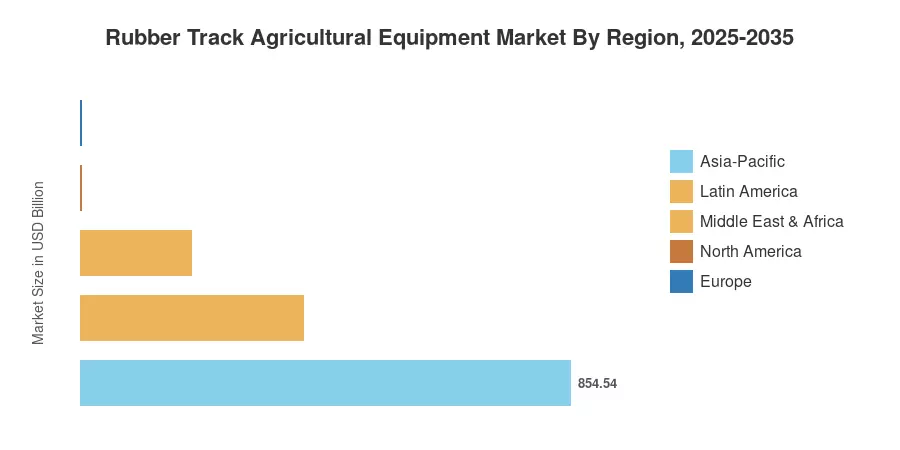
Europe 1,359.49 3.50% Soil health compliance, fleet electrification, high-horsepower track tractors
North America 1,087.60 4.30% Precision agriculture adoption, grain-belt fleet modernization, and autonomous readiness
Asia-Pacific 854.54 4.00% Government mechanization programs, wetland farming expansion, compact tracked equipment
Latin America 388.43 3.60% Cerrado expansion, soybean mechanization and export-oriented agriculture investment
Middle East & Africa 194.21 3.20% Irrigated-area development, land-reclamation projects, and small-scale mechanization
Total 3,884.27 3.80%


Europe

Country 2025 Est. (USD Mn) Key Driver
Germany 299.09 High-horsepower tractor demand; CAP soil-health incentives
France 244.71 Broadacre crop farming; cooperative equipment procurement
United Kingdom 203.92 Controlled-traffic farming; post-Brexit agricultural investment
Italy 163.14 Vineyard and orchard mechanization; specialty-crop demand
Rest of Europe 448.63 Diverse mechanization programs across Scandinavia, Iberia, and Eastern Europe


Europe's position as the dominant regional market reflects a mature mechanized-farming ecosystem in which rubber track systems have achieved high penetration among large-scale arable farming operations in Germany, France, and the United Kingdom. The European Union's Common Agricultural Policy (CAP) reform cycle continues to incentivize soil-protection measures, including the use of low-compaction track-based equipment, through eco-scheme conditionality and direct-payment linkages. Germany remains the largest national market, supported by a dense network of OEM dealerships, a strong tradition of high-horsepower tractor ownership, and a farming sector that has embraced controlled-traffic farming as an agronomic standard [5].

North America

Country 2025 Est. (USD Mn) Key Driver
United States 783.07 Midwest grain-belt fleet modernization; precision agriculture integration
Canada 217.52 Prairie crop farming; government clean-technology equipment rebates
Mexico 87.01 Irrigated-agriculture expansion; mechanization investment in northern states


North America is the fastest-growing regional market, with a projected CAGR of 4.30% over the forecast period. The United States accounts for approximately 72% of regional revenues, driven by replacement demand in the Midwest grain belt, where rubber track tractors and combines have become the standard configuration for corn and soybean operations on heavy soils. The convergence of precision agriculture adoption and autonomous-readiness requirements is accelerating fleet modernization across large commercial farms, with Caterpillar's March 2026 introduction of the Cat D8 XE electric-drive dozer signaling the industry's broader investment in electrified, track-based platforms for land preparation and heavy fieldwork [4].

Asia-Pacific

Country 2025 Est. (USD Mn) Key Driver
China 299.09 Government mechanization subsidies; rice-paddy tracked harvester demand
Japan 188.00 Compact tracked equipment; aging farmer population driving automation
India 153.82 Smallholder mechanization schemes; wetland rice cultivation expansion
Australia 102.55 Controlled-traffic farming; broadacre grain and cotton operations
Rest of Asia-Pacific 111.08 Southeast Asian wetland farming; Korean and Taiwanese specialty-crop sectors


Asia-Pacific represents the third-largest regional market and is projected to grow at a 4.00% CAGR through 2035, underpinned by government-sponsored mechanization programs in China and India, expanding wetland and paddy farming acreage, and the maturation of compact tracked equipment segments in Japan. China's agricultural modernization initiatives have directed substantial subsidies toward the purchase of tracked harvesters and planters suitable for rice-paddy operations. In contrast, India's sub-mission on agricultural mechanization increasingly supports track-based equipment for smallholder operations on challenging terrain [8].

Latin America

Country 2025 Est. (USD Mn) Key Driver
Brazil 186.45 Cerrado soybean expansion; heavy-clay soil compaction management
Argentina 108.76 Pampas grain farming; cooperative equipment investment
Rest of Latin America 93.22 Sugarcane mechanization; Chilean and Colombian agricultural modernization


Latin America's market is driven principally by Brazil and Argentina, where the extension of row-crop cultivation into cerrado and transition-zone soils has increased demand for rubber track equipment capable of mitigating compaction in dense clay substrates. Brazil accounts for nearly half of regional revenues, supported by a mature agricultural finance ecosystem and strong ties between domestic distributors and global OEMs, including CNH Industrial and AGCO Corporation [10].

Middle East & Africa

Country/Sub-Region 2025 Est. (USD Mn) Key Driver
South Africa 58.26 Commercial grain and sugarcane farming; fleet modernization
Saudi Arabia 38.84 Irrigated desert agriculture; government food-security investment
Rest of MEA 97.11 Sub-Saharan land-reclamation projects; East African mechanization initiatives


The Middle East & Africa region represents the smallest market by revenue. However, it is projected to grow at 3.20% CAGR, supported by government-led food-security and land-reclamation programs in the Gulf states and expanding commercial farming operations in South Africa, Kenya, and Ethiopia. Saudi Arabia's Vision 2030 program includes significant investment in irrigated agriculture, where tracked equipment is valued for its ability to operate on sandy and reclaimed desert substrates without excessive ground disturbance [12].


Rubber Track Agricultural Equipment Market By Region, 2025-2035

Competitive Benchmarking

The global rubber track agricultural equipment market exhibits a moderately concentrated competitive structure, with the top five companies accounting for an estimated 64.4% of market revenue in 2025. CNH Industrial N.V. commands the largest individual share at 19.4%, followed by AGCO Corporation at 15.5% and John Deere at 14.4%. The Herfindahl-Hirschman Index (HHI) for the market is estimated in the range of 1,000–1,200, indicative of moderate concentration with meaningful competitive pressure from mid-tier and regional players. Competition is organized primarily along product breadth, dealer network density, digital ecosystem integration, and aftermarket service capability, with leading OEMs increasingly leveraging technology partnerships and data platforms as differentiation levers.

Company Est. Revenue Share (2025) Key Offerings Strategic Positioning
CNH Industrial N.V. 19.4% Case IH Steiger Quadtrac, New Holland T9 SmartTrax, Defensor sprayers Broadest tracked-equipment portfolio across tractor, harvester, and sprayer segments; global dealer network
AGCO Corporation 15.5% Challenger MT800 series, Fendt tracked tractors, precision-ag systems Strong European market presence; Fendt brand positioned in premium high-horsepower segment
John Deere 14.4% 9RX series tracked tractors, S-series tracked combines, Precision Ag stack Integrated digital ecosystem (John Deere Operations Center); dominant in North American grain farming
CLAAS KGaA mbH 9.7% XERION tracked tractors, LEXION tracked combines, CEMOS automation European market focus; harvesting technology leadership; operator-comfort differentiation
Rheinmetall AG 5.4% Tracked drive systems, undercarriage assemblies and rubber track components Component and subsystem supplier; defense-to-agriculture technology transfer
New Holland — (included in CNH Industrial) Defensor 4000 sprayer, T9 SmartTrax series Precision agriculture integration; large-scale broadacre equipment focus
Caterpillar Inc. — (included in Others) Cat D8 XE dozer, track-based land-preparation equipment Electric drive innovation; AI and autonomy partnerships for heavy fieldwork
Rostselmash — (included in Others) RSM tracked harvesters, Versatile tractors CIS and emerging-market focus; cost-competitive positioning
Versatile-ag — (included in Others) DeltaTrack series, high-horsepower tracked tractors Prairie and grain-belt focus; strong dealer presence in Western Canada
Peterburgsky Traktorny Zavod JSC — (included in Others) Kirovets tracked tractors Russian and CIS market specialization; heavy-duty agricultural tractors
Other Market Players 35.6% Regional OEMs, aftermarket track suppliers, conversion-kit manufacturers Fragmented; compete on price, service proximity, and niche applications


Recent News & Developments

New Holland (February 2026)

New Holland officially introduced its updated Defensor self-propelled sprayer line, expanding its portfolio with the flagship Defensor 4000 model engineered for large-scale field operations. The Defensor 4000 features an expanded 4,000-liter tank capacity, stainless steel boom structure, and advanced precision agriculture technologies integrated via the IntelliView 12 monitor, including IntelliTurn automated headland maneuvers and IntelliSpray II pulse-width modulation for individual nozzle control. This launch reinforces New Holland's commitment to high-efficiency application capabilities, utilizing an advanced independent wheel motor transmission and specialized air suspension to provide individual wheel traction control, stability, and reduced crop damage during in-season field passes.


Caterpillar Inc. (March 2026)

Caterpillar Inc. introduced the Cat D8 XE dozer, featuring an innovative high-drive electric drive powertrain engineered to improve fuel efficiency by up to 10% and reduce maintenance costs by up to 15% compared to conventional mechanical alternatives. The electric drive system utilizes a Cat C15 engine to drive a generator powering an electric motor connected to the final drives, eliminating the conventional mechanical transmission and providing constant power to the ground for precise speed and torque control. Designed for heavy-duty earthmoving, the D8 XE targets broad industrial applications including quarries, mines, heavy construction, site preparation, and specialized waste-handling configurations.

Caterpillar Inc. (January 2026)

At CES 2026, Caterpillar Inc. announced an expanded strategic collaboration with NVIDIA to integrate advanced physical AI and next-generation robotics infrastructure across its heavy machinery portfolios, including mining and construction equipment. The initiative leverages the NVIDIA Jetson Thor platform for real-time edge computing, sensor-fusion navigation, and computer vision, paving the way for autonomous fleets and the newly debuted conversational Cat AI Assistant. This partnership expansion accelerates the timeline for autonomous-ready machines and predictive fleet management systems, signaling an industry transition from standard mechanical hardware toward interconnected digital ecosystems capable of navigating complex, variable jobsite conditions with minimal operator intervention.


Rubber Track Agricultural Equipment Market Report Scope

Parameter Detail
Market Scope Global Rubber Track Agricultural Equipment Market
Study Period 2019–2035
CAGR Window 2026–2035
Base Year 2025
Market Size — 2025 USD 3,884.27 Million (USD 3.88 Billion)
Market Size — 2035 USD 5,519.35 Million (USD 5.52 Billion)
CAGR (2026–2035) 3.80%
Fastest Growing Region North America (CAGR 4.30%)
Dominant Region Europe (USD 1,359.49 Mn, 2025)
Fastest Growing Segment — Equipment Type Sprayers (CAGR 4.50%)
Fastest Growing Segment — Track Type Segmented Rubber Tracks (CAGR 4.20%)
Fastest Growing Segment — Application Wetland & Specialty Farming (CAGR 4.80%)
Fastest Growing Segment — End User Agricultural Service Contractors (CAGR 4.40%)
Companies Profiled AGCO Corporation, John Deere, CLAAS KGaA mbH, Rheinmetall AG, CNH Industrial N.V., Caterpillar Inc., New Holland, Rostselmash, Versatile-ag, Peterburgsky Traktorny Zavod JSC
Valuation Currency USD (Million / Billion)
Segments Covered Equipment Type, Track Type, Application, End User


FAQs

What is the projected global market size for rubber track agricultural equipment by 2035?
The global rubber track agricultural equipment market is projected to reach USD 5,519.35 million (approximately USD 5.52 billion) by 2035, growing from USD 3,884.27 million in 2025 at a compound annual growth rate of 3.80% during the 2026–2035 forecast period. This growth reflects sustained demand for low-compaction, high-traction undercarriage systems across precision farming operations globally [1].
Which region is expected to grow fastest over the forecast period?
North America is projected to be the fastest-growing region with an estimated CAGR of 4.30% from 2026 to 2035. Growth is driven by Midwest grain-belt fleet modernization, precision agriculture adoption in the United States and Canada, and increasing replacement demand for rubber track systems on high-horsepower tractors and combines [7].
What equipment type dominates the rubber track agricultural equipment market?
Tractors represent the dominant equipment type, accounting for approximately 45% of global market revenue in 2025 (approximately USD 1,747.92 million). High-horsepower tracked tractors in the 300–600 HP range are the principal demand driver, favored for row-crop, broadacre, and mixed-use farming operations across developed agricultural markets [1][2].
How do rubber track systems compare with conventional wheeled configurations on the total cost of ownership?
While rubber track systems command a 30–50% upfront price premium over equivalent wheeled configurations, lifecycle cost analyses consistently demonstrate total-cost-of-ownership parity or advantage over multi-season use. Track systems deliver maintenance-cost savings of 15–20% relative to steel undercarriages and fuel-efficiency gains of 10–15% on soft soils, which offset the initial capital differential over a 3–5-year ownership period [6][9].
Which companies hold the largest market shares in this industry?
CNH Industrial N.V. leads with an estimated 19.4% revenue share, followed by AGCO Corporation at 15.5%, John Deere at 14.4%, CLAAS KGaA mbH at 9.7%, and Rheinmetall AG at 5.4%. The top five companies collectively account for 64.4% of the global market, with the remaining 35.6% shared among regional OEMs, aftermarket suppliers, and specialty manufacturers [1].
What role does sustainability regulation play in market growth?
Sustainability and soil-health regulation are significant growth catalysts. The European Union's Soil Monitoring Law and expanded Conservation Stewardship Programs in the United States incentivize or mandate low-compaction farming practices, directly benefiting rubber track equipment that reduces ground pressure by 40–60% versus equivalent-weight wheeled machinery. Sustainability-linked agricultural finance instruments, including green equipment loans, are expected to further accelerate adoption through 2035 [5][9].
What is the fastest-growing application segment for rubber track equipment?
Wetland and specialty farming is the fastest-growing application segment with a projected CAGR of 4.80%. This growth is driven by expanding rice-paddy mechanization in Asia-Pacific, peatland farming in Northern Europe, and niche demand in orchard and vineyard operations where rubber tracks provide essential flotation and minimal root-zone disturbance [8][14].  
Author
Author
Author Profile
Garvit Vyas LinkedIn
Vice President - Operations
Garvit Vyas is a Research Analyst with experience in working across multiple industry domains in the market research sector. Over the past four years, he has been actively involved in analyzing diverse markets, gathering industry insights, and contributing to the development of comprehensive research reports. His work includes studying market trends, evaluating competitive landscapes, and supporting data-driven business insights. In the early phase of his career, Garvit worked on cross-domain research projects, which helped him build a strong foundation in market analysis, data interpretation, and industry intelligence across various sectors. Later, he transitioned into the Quality Control (QC) function, where he focuses on reviewing and refining research reports and marketing collaterals to ensure accuracy, consistency, and high editorial standards. His responsibilities include validating research data, improving report structure, and maintaining the overall quality of published content. Garvit is committed to maintaining strong research integrity and delivering reliable insights that support informed business decision-making.
Download Free Sample

Kindly complete the form below to receive a free sample of this Report

Download PDF ×

We do not share your information with anyone. However, we may send you emails based on your report interest from time to time. You may contact us at any time to opt-out.