Rugged Display Market (2026 - 2035)

Rugged Display Market Size, Share & Industry Analysis: By Type (Dot-matrix, LED, LCD, Others), By Operation System (iOS (iPhones), Windows, Android, Others), By Rugged (Semi-rugged, Fully rugged, Ultra-rugged, Others), By End-user (Government, Defense, Aerospace, Hospitals, Industrial, Commercial), And By Region (North America, Europe, Asia-Pacific, And Rest Of The World) – Industry Forecast Till 2035
ID: MRFR/SEM/2787-HCR
200 Pages
Nirmit Biswas, Aarti Dhapte
Last Updated: July 17, 2026
Rugged Display Market
Market Size
Forecast Period2026-2035
CAGR (2026-2035)4.65%
2025 Market SizeUSD 11.56 Billion
2035 Market SizeUSD 18.22 Billion
Key Players
Panasonic
Getac Technology
Zebra Technologies
Dell Technologies
Honeywell
Datalogic
Opportunities
  • Augmented Reality Overlay Devices
  • Autonomous Logistics and Warehouse Automation
  • As-a-Service and Subscription Business Models

Rugged Display Market Summary

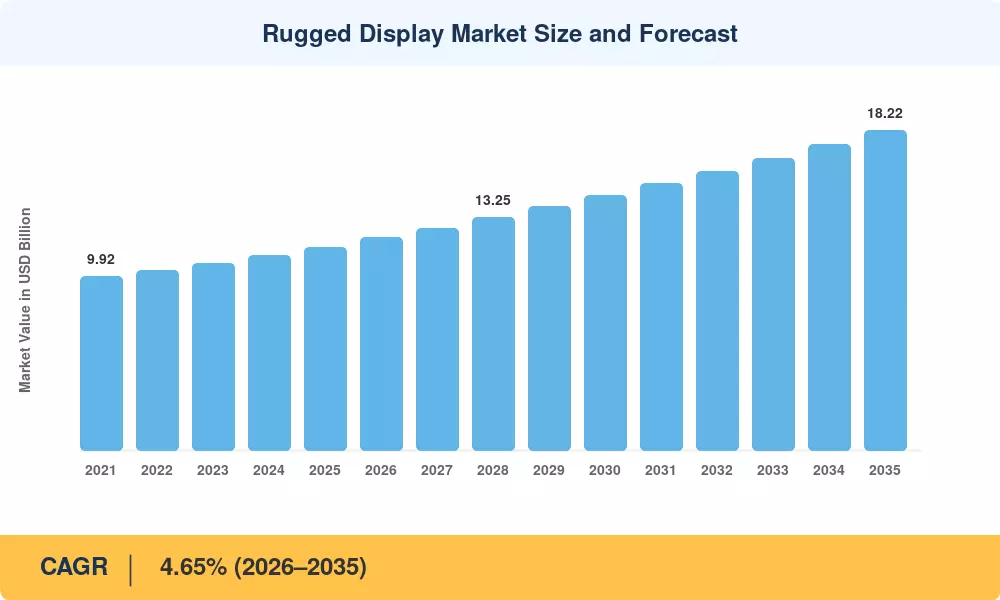
The Rugged Display Market reached an estimated USD 11.56 Billion in 2025 and is projected to grow from USD 12.10 Billion in 2026 to USD 18.22 Billion by 2035, registering a CAGR of 4.65% during the forecast period. Procurement decisions increasingly favor lifecycle-optimized display equipment that withstands vibration, thermal shock, and liquid ingress over disposable consumer-grade screens. Rising defense modernization expenditures — the U.S. Department of Defense alone allocated over USD 145 billion toward C4ISR and digital battlefield programs in FY 2025 [1] — anchor demand on the institutional side, while Industry 4.0 factory-floor digitization pushes commercial adoption forward.

A technology inflection point is redefining what buyers expect from ruggedized hardware. Legacy resistive-touch panels and dim LCD backlights are giving way to optically-bonded, high-nit displays engineered for direct-sunlight legibility, often paired with edge-AI chipsets that enable on-device anomaly detection without cloud round-trips. The European Commission's Machinery Regulation 2023/1230 [2], which tightens HMI safety requirements for hazardous-area equipment from 2027, is prompting early procurement cycles across oil refining, chemical processing, and mining operations.

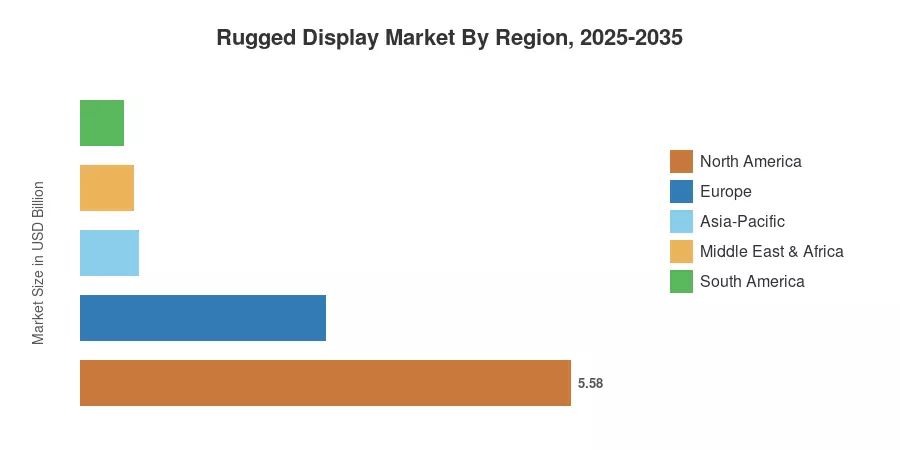
North America commands the largest share of the Rugged Display Market at roughly 48.3% of 2025 revenue, driven by federal defense procurement and a mature field-service ecosystem. Asia-Pacific is the fastest-growing region with a projected CAGR of 5.74% through 2035, propelled by infrastructure spending in India and smart-factory buildouts across China, Japan, and South Korea. Europe holds the second-largest position at approximately USD 2.79 billion, underpinned by rail modernization and offshore energy programs. The next decade will test whether niche innovators in augmented reality and autonomous logistics can erode the incumbents' qualification-cycle moats.


Key Report Takeaways

• By Product Type

  • Tablet PCs held 44.2% of the Rugged Display Market in 2025, reflecting their versatility across field inspection, warehouse management, and tactical operations.
  • Vehicle-mounted computers are expanding at a 5.96% CAGR through 2035, driven by fleet telematics and autonomous guided vehicle integration.

• By Ruggedness Level

  • Fully rugged systems captured 51.2% of shipments in 2025, as mission-critical end users continue to prioritize IP67+ and MIL-STD-810H compliance over semi-rugged alternatives.


• By Operating System


  • Android-based devices accounted for 48.9% of units shipped in 2025, as enterprise mobility platforms increasingly standardize on the Android ecosystem.

• By End User

  • The Rugged Display Market saw Government, Defense and Aerospace claim 33.6% of revenue in 2025.
  • The oil and gas sector recorded the fastest end-user growth at an 8.30% CAGR, reflecting accelerated digital oilfield deployments.


• By Region


  • Asia-Pacific is poised to grow at 5.74% CAGR through 2035, while North America retains its dominance at 48.3% of the global Rugged Display Market.


Rugged Display Market Size and Forecast (2021–2035)

This section draws on a triangulated methodology combining bottom-up shipment tracking, vendor revenue disclosures, and top-down macroeconomic modeling. Historical figures (2021–2024) are calibrated against customs databases and trade-association audits; forecast values (2026–2035) apply a compound annual growth rate of 4.65%, validated against procurement pipeline intelligence from defense and industrial verticals.
Rugged Display Market Size and Forecast
Our Impact
Enabled $4.3B Revenue Impact for Fortune 500 and Leading Multinationals
Partnering with 2000+ Global Organizations Each Year
30K+ Citations by Top-Tier Firms in the Industry

Driver Impact Analysis

Driver ~% Impact on CAGR Geographic Relevance Impact Timeline
Defense C4ISR modernization programs ~22% North America, Europe Medium-term
Industry 4.0 and smart-factory HMI rollouts ~19% Asia-Pacific, Europe Short-term
Hazardous-area safety regulation tightening ~16% Europe, Middle East Medium-term
5G and edge-AI integration into field devices ~14% Global Long-term
Digital oilfield and upstream automation ~12% Middle East, North America Short-term
Fleet telematics and autonomous vehicle guidance ~10% North America, Asia-Pacific Long-term
Public-safety first-responder device mandates ~7% North America, Europe Medium-term


Defense C4ISR Modernization Programs

Global defense expenditures crossed USD 2.4 trillion in 2024 [1], and a meaningful slice flows into tactical computing. The U.S. Army's Integrated Visual Augmentation System (IVAS) and the UK Ministry of Defence's Morpheus battlefield communications program both specify ruggedized displays as core interface components. These multi-year contracts lock in demand for five-to-seven-year refresh cycles, creating revenue visibility that few commercial verticals can match. Qualification requirements under MIL-STD-810H and DEF STAN 00-35 function as de facto barriers, channeling spend toward incumbents with certified production lines.

Industry 4.0 and Smart-Factory HMI Rollouts

Manufacturing execution systems increasingly rely on operator-facing touchscreens rated for shock, dust, and chemical exposure. A 2024 study estimated that 68% of discrete manufacturers plan to upgrade human-machine interfaces by 2027 [5]. Panel PCs and vehicle-mounted terminals embedded in automated guided vehicles represent a growing slice of the Rugged Display Market, particularly across automotive and semiconductor fabrication plants in Germany, Japan, and South Korea.

Hazardous-Area Safety Regulation Tightening

The EU's updated ATEX Directive 2014/34/EU and its companion Machinery Regulation 2023/1230 mandate intrinsically safe equipment in explosive atmospheres starting 2027 [2]. Compliance requires ATEX Zone 1/2 or IECEx certification, which adds twelve to eighteen months to product development timelines and raises unit costs by roughly 30–40%. These regulatory mandates effectively pull forward procurement among refineries and chemical plants that would otherwise delay upgrades.

5G and Edge-AI Integration

The convergence of 5G modems and edge-AI processors is reshaping performance benchmarks for ruggedized devices. Qualcomm's Snapdragon 6 Gen 3 and MediaTek's Dimensity 7300 now deliver on-device inferencing at under five watts [6], enabling predictive-maintenance dashboards and real-time anomaly detection without persistent cloud connectivity. For the Rugged Display Market, this shifts the value proposition from hardware durability alone to compute-enabled situational awareness.


Restraints Impact Analysis

Restraint ~% Drag on CAGR Geographic Relevance Impact Timeline
High certification and qualification costs ~−28% Global Ongoing
Capital premium over consumer-grade devices ~−24% Emerging markets Short-term
Extended procurement and testing cycles ~−20% North America, Europe Medium-term
Limited aftermarket and repair ecosystems ~−16% South America, MEA Ongoing
Technology obsolescence risk in long-cycle contracts ~−12% Global Long-term


High Certification and Qualification Costs

Obtaining MIL-STD-810H, IP67, and ATEX certifications for a single rugged device platform can cost USD 1.5–3.0 Million and take 14–20 months [10]. These expenses are especially burdensome for smaller OEMs and regional integrators, effectively concentrating market share among well-capitalized incumbents. The Rugged Display Market loses potential entrants — and the innovation they might bring — because qualification economics favor scale over agility.

Capital Premium Over Consumer-Grade Devices

Rugged laptops and tablets are priced at a premium of two to three times that of their commercial counterparts [11]. In price-sensitive emerging markets like Southeast Asia and Sub-Saharan Africa, this disparity encourages mid-tier enterprises to adopt protective cases for consumer devices rather than purpose-built robust hardware, thereby restricting the expansion of the addressable market.


Extended Procurement and Testing Cycles

Government and defense procurement in NATO countries follows multi-stage evaluation protocols that often stretch twenty-four months or longer from RFP to purchase order [12]. These timelines delay revenue recognition for vendors and create lumpiness in order books, making demand forecasting difficult and working-capital planning expensive for mid-size players in the Rugged Display Market.


Rugged Display Market Opportunities

Augmented Reality Overlay Devices

Head-mounted and wrist-mounted rugged displays with AR overlays are finding traction in aerospace MRO and utility field service. Boeing's use of AR-enabled rugged tablets for wiring-harness inspection reduced error rates by 25% in pilot programs [15]. The Rugged Display Market stands to capture incremental revenue as AR transitions from pilot to production-scale deployment.

Autonomous Logistics and Warehouse Automation

The global warehouse automation sector is expected to exceed USD 40 billion by 2030 [8]. Vehicle-mounted rugged displays serve as the primary interface for autonomous mobile robots and sortation systems. As e-commerce fulfillment centers scale in India, Brazil, and the Middle East, the Rugged Display Market benefits from greenfield installations that require purpose-built hardware from day one.

As-a-Service and Subscription Business Models

Device-as-a-Service (DaaS) programs allow fleet operators to shift rugged hardware from capital expenditure to operational expenditure. Panasonic's TOUGHBOOK-as-a-Service and Getac's Select platform demonstrate early traction, bundling hardware, software, and lifecycle management into monthly per-device fees. This model lowers adoption barriers in cost-conscious markets and generates recurring revenue streams for OEMs.

Emerging-Market Infrastructure Digitization

India's Smart Cities Mission has allocated over USD 7.5 billion toward urban digitization [16], and Saudi Arabia's NEOM project specifies ruggedized edge terminals across its industrial zones. These large-scale infrastructure programs create demand clusters that did not exist five years ago, opening geographic white space for the Rugged Display Market in regions with historically low penetration.

Data Monetization Through Embedded Telemetry

Operating data that can be monetized through analytics platforms is generated by rugged devices that are equipped with embedded sensors, such as accelerometers, ambient-light detectors, and gas analysers. Vendors who position their Rugged Display Market offerings as data-collection endpoints, rather than solely viewing terminals, have the potential to generate software-margin revenue in addition to hardware sales.


Rugged Display Market Future Outlook

AI-Enabled Autonomous Field Operations

Over the course of the next decade, the expectations of buyers regarding rugged hardware will be revolutionized by on-device AI inferencing. Ruggedized tablets are capable of performing defect detection, gauge reading, and hazard identification without cloud connectivity, thanks to edge processors that can run computer-vision models in sub-five-watt power envelopes [6]. Market Research Future predicts that by 2030, the Rugged Display Market will transition from a hardware-durability category to a compute-intelligence platform, as more than 40% of newly shipped rugged devices will incorporate dedicated neural-processing units.


Platform Economics and DaaS Expansion

The addressable buyer pool will be expanded, and upfront costs will be compressed by subscription-based deployment models. Panasonic, Getac, and Zebra will be able to enter the Rugged Display Market through operating-expense budgets as they expand their as-a-service programs. This will be done by mid-market enterprises that previously rejected the capital premium. By 2032, analysts anticipate that the DaaS segment will generate 15–20% of the total revenue generated by ruggedized devices [18].


Sustainability and Circular-Economy Mandates

The EU's Ecodesign for Sustainable Products Regulation (ESPR) will impose repairability scoring and recycled-content minimums on electronic equipment from 2027 [19]. Rugged devices — already designed for extended lifecycles of five to seven years — are well positioned against these mandates. OEMs that certify modular battery and screen replacements will strengthen their positioning within the Rugged Display Market by aligning product strategy with regulatory direction.

Convergence with Wearable and AR Form Factors

Head-mounted displays, smart glasses, and wrist-worn terminals rated to MIL-STD-810H are migrating from prototyping into production deployments. The U.S. Army's IVAS program and industrial pilots by RealWear and Vuzix demonstrate that ruggedized AR can reduce technician error rates and accelerate task completion by 20–30% [15]. This convergence will expand the definition — and the revenue perimeter — of the Rugged Display Market through 2035.


Rugged Display Market Segmentation

By Product Type

Segment Key Metric Primary Demand Driver
Smartphones and Handheld Computers CAGR 4.38% Field-service mobility, barcode scanning
Tablet PCs 44.2% share (2025) Versatility across defense, logistics, inspection
Laptops and Notebooks USD 2.54 Billion (2025) Engineering workstations, tactical planning
Others (vehicle-mounted, panel PCs) CAGR 5.96% Fleet telematics, factory-floor HMI


Tablet PCs dominate the Rugged Display Market because they strike the optimal balance between screen real estate, portability, and input flexibility. Ten-to-twelve-inch ruggedized tablets from Panasonic, Getac, and Dell serve dual roles as clipboard replacements in logistics and map-display terminals in tactical vehicles. The segment's breadth — spanning sub-USD-1,000 semi-rugged consumer-crossovers to USD-5,000 fully rugged military-grade units — gives it resilience across economic cycles.

Vehicle-mounted computers represent the fastest-growing product category, fueled by autonomous guided vehicle deployments in warehouses and fleet-management telematics upgrades in trucking and public transit. These fixed-install displays require wide operating-temperature ranges (−30°C to +60°C) and vibration resistance per SAE J1455, specifications that keep the competitive field narrow.

By Level of Ruggedness

Segment Key Metric Primary Demand Driver
Semi-Rugged USD 2.89 Billion (2025) Cost-conscious field workers, healthcare
Fully Rugged 51.2% share (2025) Defense, first responders, heavy industry
Ultra-Rugged CAGR 5.39% Explosive atmospheres, extreme-temperature ops


Fully rugged systems command the majority of the Rugged Display Market by volume, reflecting buyer preference for IP67-rated, MIL-STD-810H-certified devices that survive drops from 1.8 meters onto concrete. Defense procurement and public-safety agencies overwhelmingly specify fully rugged devices in their standard-issue kits. Ultra-rugged units — rated for ATEX Zone 1 or Class I Division 1 environments — are the fastest-growing tier as oil refineries and chemical plants digitize inspection workflows.

By Operating System

Segment Key Metric Primary Demand Driver
Android 48.9% share (2025) Enterprise mobility, lower licensing cost
Windows CAGR 4.12% Legacy enterprise software compatibility
Others (Linux, proprietary RTOS) USD 0.62 Billion (2025) Embedded industrial and military systems


Android's open-source licensing model and the maturation of enterprise management platforms such as Android Enterprise have made it the default operating system across the Rugged Display Market. Windows retains a loyal installed base among organizations running legacy x86 applications — CAD software, SCADA clients, and classified defense systems — ensuring steady demand for Windows-based rugged laptops.

By End User

Segment Key Metric Primary Demand Driver
Oil and Gas CAGR 8.30% Digital oilfield, ATEX mandates
Government, Defense and Aerospace 33.6% share (2025) C4ISR modernization, public safety
Industrial Manufacturing USD 2.18 Billion (2025) Smart-factory HMI, quality control
Others (utilities, transportation, healthcare) CAGR 4.45% Grid hardening, rail digitization


Government, Defense and Aerospace remains the anchor end-user segment of the Rugged Display Market, sustained by multi-year platform contracts and rigid specification requirements. Oil and gas is the standout growth vertical: upstream automation, digital twin platforms, and hazardous-area compliance are converging to accelerate device refresh rates well above the market average.


Regional Market Share Analysis

Region Key Metric Primary Investment Themes
North America 48.3% share (2025) Defense C4ISR, public safety, oil & gas
Europe USD 2.79 Billion (2025) Rail modernization, ATEX compliance, offshore wind
Asia-Pacific 5.74% CAGR (2026–2035) Smart factories, infrastructure digitization
South America 4.2% share (2025) Mining, oil exploration
Middle East & Africa 5.18% CAGR (2026–2035) Digital oilfields, smart city projects
Total USD 11.56 Billion (2025)

The Rugged Display Market exhibits strong geographic concentration, with North America and Europe together accounting for more than 70% of global revenue. Structural differences in defense spending, industrial regulation, and enterprise IT maturity create distinct adoption curves across regions.


North America

Country Key Metric Key Driver
US 78.4% of regional share DoD procurement, first-responder mandates
Canada CAGR 4.32% Mining and natural-resource operations
Mexico USD 0.28 Billion (2025) Automotive manufacturing expansion


The United States anchors the North American Rugged Display Market through sustained federal defense spending and a mature ecosystem of field-service integrators. Canada's oil-sands and mining sectors require devices certified for Class I Division 2 hazardous locations, while Mexico's automotive corridor increasingly deploys vehicle-mounted terminals on assembly lines tied to nearshoring investments [17].

Europe

Country Key Metric Key Driver
Germany 26.3% of regional share Automotive and discrete manufacturing HMI
UK CAGR 4.51% Defence digitization and rail upgrades
France USD 0.38 Billion (2025) Aerospace MRO and nuclear energy
Italy 9.1% of regional share Energy infrastructure and shipbuilding
Spain CAGR 4.28% Renewable-energy field operations
Nordic Countries USD 0.22 Billion (2025) Offshore wind and maritime logistics
Russia 5.4% of regional share Military and extractive industries
Rest of Europe CAGR 4.15% Mixed industrial and public-safety use


Germany's strength in precision manufacturing makes it the regional anchor for the Rugged Display Market in Europe. The UK Ministry of Defence's digital-backbone programs and Network Rail's signaling upgrades sustain double-digit institutional order books, while France's nuclear fleet maintenance and Airbus supply chain create steady demand for ATEX-rated tablets [2].

Asia-Pacific

Country Key Metric Key Driver
China 38.7% of regional share Smart-factory mandates, defense modernization
India CAGR 6.42% Smart Cities Mission, railway digitization
Japan USD 0.31 Billion (2025) Semiconductor fab HMI, disaster response
South Korea 14.2% of regional share Shipbuilding, battery manufacturing
ASEAN CAGR 5.89% Mining, palm-oil processing, logistics
Rest of Asia-Pacific USD 0.09 Billion (2025) Emerging industrial digitization


Asia-Pacific represents the fastest-growing corridor in the Rugged Display Market, propelled by China's "Made in China 2025" industrial policy and India's allocation of over USD 7.5 Billion to smart-city infrastructure [16]. Japan and South Korea sustain premium demand through semiconductor fabrication cleanroom HMI requirements and shipyard panel-PC installations.

South America

Country Key Metric Key Driver
Brazil 58.1% of regional share Pre-salt offshore oil, agribusiness
Argentina CAGR 4.78% Vaca Muerta shale development
Rest of South America USD 0.08 Billion (2025) Mining (Chile, Peru copper/lithium)


Brazil's pre-salt deepwater oil operations drive the bulk of South American demand in the Rugged Display Market, with Petrobras specifying ATEX-rated devices for offshore platforms. Argentina's Vaca Muerta shale basin is attracting upstream digital-oilfield investments that require ruggedized field terminals [7].

Middle East & Africa

Country Key Metric Key Driver
Saudi Arabia 32.5% of regional share NEOM, Saudi Aramco digitization
UAE CAGR 5.62% Smart-city programs, logistics hubs
South Africa USD 0.07 Billion (2025) Mining, utility grid hardening
Egypt CAGR 4.95% Infrastructure modernization
Rest of MEA 19.8% of regional share Oil extraction, defense procurement


Saudi Arabia's Vision 2030 agenda and Aramco's upstream digitization program anchor the MEA Rugged Display Market. The UAE's position as a logistics and aviation hub generates demand for vehicle-mounted and handheld ruggedized devices across port operations and airport ground handling.


Rugged Display Market By Region, 2025-2035

Competitive Benchmarking

The Rugged Display Market exhibits moderate concentration, with the top five vendors estimated to hold approximately 55–62% of global revenue. A Herfindahl-Hirschman Index in the 1,200–1,500 range reflects an oligopolistic core surrounded by specialist niche players. Barriers to entry — MIL-STD and ATEX certification cycles, global service networks, and channel partnerships with defense integrators — limit rapid new entrants but do not preclude innovation from adjacent technology vendors.

Company Est. Revenue Share Range Key Offerings for Rugged Display Market Strategic Positioning
Panasonic (TOUGHBOOK) ~14–18% Fully rugged tablets, laptops, vehicle-mounted terminals Global leader in defense and public-safety rugged computing
Getac Technology ~11–15% Rugged tablets, notebooks, vehicle docks Strong defense and utility channel; growing DaaS offering
Zebra Technologies ~8–12% Rugged handheld computers, enterprise tablets Warehouse and logistics specialist with deep Android ecosystem
Dell Technologies ~6–9% Latitude Rugged laptops and tablets Enterprise IT integration, broad service network
Honeywell ~5–8% Rugged mobile computers, vehicle-mounted units Strengths in supply chain and distribution environments
Datalogic ~3–5% Handheld scanners, rugged mobile terminals Retail and manufacturing automation focus
Durabook (Twinhead) ~3–5% Semi-rugged and fully rugged laptops, tablets Price-competitive positioning in Asia-Pacific markets
Juniper Systems ~2–4% Ultra-rugged handheld computers Niche focus on geospatial, agriculture, and utilities
MobileDemand ~2–3% Rugged tablets, vehicle-mount solutions North American field-service and fleet vertical
Handheld Group ~2–3% Ultra-rugged handheld devices, tablets Specialist in ATEX-rated devices for hazardous environments


Recent News & Developments


  • Getac Technology (November 2024): Expanded its Select DaaS program to twelve additional countries, bundling hardware lifecycle management with MDM software for utility-sector clients [21].
  • European Commission (March 2024): Published implementing guidelines for Machinery Regulation 2023/1230, clarifying HMI certification requirements for ATEX Zone 1 equipment effective January 2027 [2].
  • Honeywell (December 2023): Partnered with T-Mobile to offer private 5G connectivity pre-integrated into its CT45 XP and CT60 XP rugged mobile computers for distribution-center deployments [24].
  • Juniper Systems (August 2023): Released the Mesa 4 rugged tablet with integrated GNSS receiver, targeting precision-agriculture and geospatial survey applications across North America [25].


Rugged Display Market Report Scope

Parameter Detail
Market Scope Global Rugged Display Market — hardware devices including tablets, laptops, handheld computers, vehicle-mounted terminals, and panel PCs designed to meet MIL-STD, IP, and ATEX ruggedness standards
Study Period 2021–2035
CAGR (Forecast) 4.65% (2026–2035)
Market Size — 2025 (Base Year) USD 11.56 Billion
Market Size — 2035 (Forecast Endpoint) USD 18.22 Billion
Fastest Growing Segments Ultra-Rugged (by ruggedness); Oil and Gas (by end user); Asia-Pacific (by geography)
Companies Profiled Panasonic, Getac, Zebra Technologies, Dell, Honeywell, Datalogic, Durabook, Juniper Systems, MobileDemand, Handheld Group
Valuation Currency USD Billion


FAQs

What total cost of ownership factors should buyers weigh when evaluating rugged displays against consumer-grade alternatives?
Buyers should compare the five-to-seven-year failure rate, repair cost, and downtime penalty of rugged units against the two-year replacement cycle of consumer devices. The rugged capital premium typically breaks even within thirty months when field-failure costs exceed USD 500 per incident [10].
How do ATEX and IECEx certifications differ in practical procurement terms?
ATEX certification is mandatory for equipment sold within the European Economic Area, while IECEx is accepted across most non-EU jurisdictions. Vendors holding both certifications face fewer export restrictions and shorter qualification timelines with multinational operators [2].
What battery architecture trends are shaping next-generation rugged devices?
Hot-swappable dual-battery designs now dominate fully rugged tablets, enabling uninterrupted field use during twelve-hour shifts. Lithium-polymer cells with fast-charge protocols reaching 80% in under sixty minutes are becoming the baseline specification [20].
How does display bonding technology affect outdoor readability and durability?
Optical bonding eliminates the air gap between glass and LCD panel, reducing reflections by up to 70% and improving sunlight legibility above 1,000 nits. It also strengthens impact resistance by distributing force across the laminated stack [4].
What role do channel partners and value-added resellers play in rugged display procurement?
VARs configure devices with industry-specific software, mounts, and peripherals before deployment, reducing the buyer's integration burden. Roughly 60% of rugged device sales in North America flow through specialized resellers rather than direct OEM channels [13].
How are private 5G networks influencing rugged device specifications?
Private 5G deployments in warehouses and refineries require devices with integrated Sub-6 GHz and mmWave modems plus Wi-Fi 6E fallback. This dual-connectivity requirement is driving OEMs to redesign antenna architectures within IP67-sealed enclosures [24].
What cybersecurity considerations are unique to ruggedized field devices?
Rugged devices operating on tactical or industrial networks require hardware-rooted secure boot, TPM 2.0 chips, and remote-wipe capability. Firmware-level encryption is critical because these devices often store sensitive geospatial or operational data in disconnected environments [9].    
Author
Author
Author Profile
Nirmit Biswas LinkedIn
Senior Research Analyst
With 5+ years of expertise in Market Intelligence and Strategic Research, Nirmit Biswas specializes in ICT, Semiconductors, and BFSI. Backed by an MBA in Financial Services and a Computer Science foundation, Nirmit blends technical depth with business acumen. He has successfully led 100+ projects for global enterprises and startups, including Amazon, Cisco, L&T and Huawei, delivering market estimations, competitive benchmarking, and GTM strategies. His focus lies in transforming complex data into clear, actionable insights that drive growth, innovation, and investment decisions. Recognized for bridging engineering innovation with executive strategy, Nirmit helps businesses navigate dynamic markets with confidence.
Co-Author
Co-Author Profile
Aarti Dhapte LinkedIn
AVP - Research
A consulting professional focused on helping businesses navigate complex markets through structured research and strategic insights. I partner with clients to solve high-impact business problems across market entry strategy, competitive intelligence, and opportunity assessment. Over the course of my experience, I have led and contributed to 100+ market research and consulting engagements, delivering insights across multiple industries and geographies, and supporting strategic decisions linked to $500M+ market opportunities. My core expertise lies in building robust market sizing, forecasting, and commercial models (top-down and bottom-up), alongside deep-dive competitive and industry analysis. I have played a key role in shaping go-to-market strategies, investment cases, and growth roadmaps, enabling clients to make confident, data-backed decisions in dynamic markets.

Research Approach


Secondary Research

The secondary research process involved comprehensive analysis of regulatory databases, industry standards publications, defense procurement records, and authoritative technology organizations. Key sources included the US Department of Defense (DoD), Defense Logistics Agency (DLA), National Institute of Standards and Technology (NIST), International Electrotechnical Commission (IEC), Military Standardization (MIL-STD) databases, US General Services Administration (GSA), European Defense Agency (EDA), NATO Standardization Office (NSO), Occupational Safety and Health Administration (OSHA), Federal Aviation Administration (FAA), US Bureau of Labor Statistics (BLS), Eurostat Industrial Production Database, World Trade Organization (WTO) Trade Statistics, International Trade Administration (ITA), National Center for Science and Engineering Statistics (NCSES), US Census Bureau Manufacturing Data, Japan Ministry of Economy, Trade and Industry (METI), China Ministry of Industry and Information Technology (MIIT), and national defense procurement agencies from key markets. These sources were used to collect military specification standards, industrial procurement data, ruggedization certification requirements, display technology patents, sectoral adoption trends, and market landscape analysis for LCD, LED, OLED, and dot-matrix display technologies across semi-rugged, fully rugged, and ultra-rugged categories.


Primary Research

To gather both qualitative and quantitative information, the primary research process involved interviewing players from both the supply and demand sides. From the supply side, we heard from defense/aerospace sales directors, product line managers, and CEOs of rugged display makers, panel suppliers, and system integrators. On the demand side, we have government procurement executives, logistics company fleet managers, medical device engineering leads, industrial automation experts, and IT directors from aerospace, heavy industry, and the government. Market segmentation across Windows, Android, and iOS was established through primary research. Military and industrial certification schedules were also confirmed. Insights about procurement cycles, Total Cost of Ownership (TCO) considerations, and replacement dynamics for legacy equipment were acquired.

Primary Respondent Breakdown:

By Designation: C-level Primaries (32%), Director Level (31%), Others (37%)

By Region: North America (32%), Europe (30%), Asia-Pacific (28%), Rest of World (10%)


Market Size Estimation

Global market valuation was derived through revenue mapping and unit shipment analysis. The methodology included:

Identification of 50+ key manufacturers across North America, Europe, Asia-Pacific, and Latin America specializing in ruggedized display solutions

Product mapping across LCD, LED, OLED, and dot-matrix technologies with segmentation by semi-rugged, fully rugged, and ultra-rugged classifications

Analysis of reported and modeled annual revenues specific to rugged display portfolios, including military, industrial, healthcare, and commercial segments

Coverage of manufacturers representing 72-78% of global market share in 2024

Extrapolation using bottom

Download Free Sample

Kindly complete the form below to receive a free sample of this Report

Download PDF ×

We do not share your information with anyone. However, we may send you emails based on your report interest from time to time. You may contact us at any time to opt-out.