Safety Syringe Market (2026 - 2035)

Safety Syringe Market Research Report By Syringe Type (Auto-disable Syringes, Retractable Syringes, Passive Safety Syringes, Active Safety Syringes), By Material (Plastic, Glass, Metal), By Application (Vaccination, Drug Administration, Blood Sample Collection, Insulin Delivery), By End User (Hospitals, Clinics, Home Care Settings, Pharmaceutical Companies), By Needle Size (Low Gauge, Medium Gauge, High Gauge) and By Regional (North America, Europe, South America, Asia Pacific, Middle East and Africa) - Growth & Industry Forecast 2025 To 2035

Forecast Period
2026-2035
CAGR
9.7%
2025 Market Size
USD 9.02 Billion
2035 Market Size
USD 22.78 Billion
Healthcare ● Updated August 24, 2026 Report ID: MRFR/HC/30703-HCR | Pages: 128 | Author: Rahul Gotadki, Vikita Thakur

Safety Syringe Market Summary

The Safety Syringe Market reached USD 9.02 billion in 2025 and is projected to grow to USD 22.78 billion by 2035, expanding at a compound annual growth rate (CAGR) of 9.7% between 2026 and 2035. Market value is expected to reach USD 9.90 billion in 2026 as the first year of the forecast period. This growth is being driven primarily by enforced needlestick safety regulations in the United States and global injection safety policy, alongside a broader shift toward retractable and passive-activation safety syringes.

The U.S. Needlestick Safety and Prevention Act enforcement directive, refreshed by the Occupational Safety and Health Administration (OSHA) in 2024, keeps engineered sharps protection non-negotiable across roughly 6,100 registered American hospitals. This enforcement mandate ensures consistent institutional demand for safety-engineered syringes regardless of budget cycles. In parallel, the World Health Organization's (WHO) injection safety policy continues to push member states toward exclusive procurement of protected devices for therapeutic and immunization use, extending similar procurement pressure to global health programs.

Conventional hypodermic barrels are also losing ground quickly to safer alternatives. Facilities are replacing unprotected devices with retractable, shielded, and passive-activation formats that neutralize the needle before it leaves the patient's skin. Gavi channeled more than USD 1.2 billion into routine immunization delivery in 2024, and its supply specifications now favor protected devices almost exclusively. Biologics viscosity is adding a second driver of change: thicker drug formulations demand higher plunger force, which raises activation-failure risk and makes automatic retraction commercially defensible despite a 30 to 45% unit price premium.

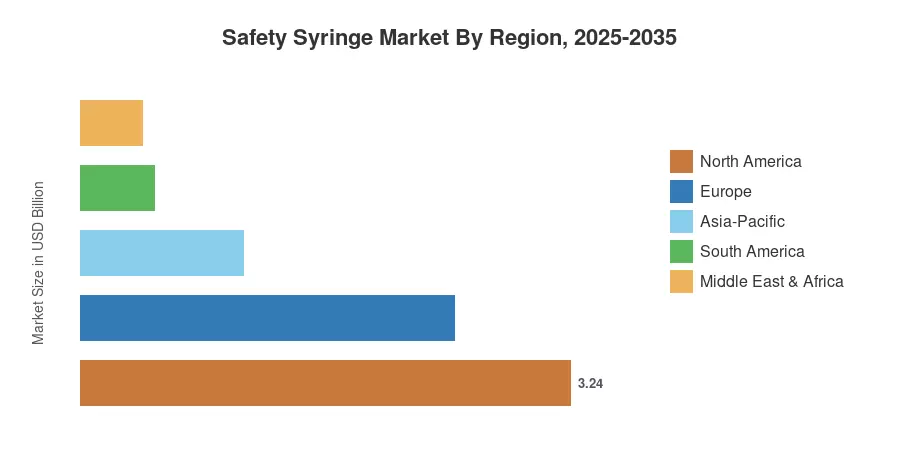
By region, North America holds the largest share of the Safety Syringe Market, at 35.9%, supported by group-purchasing scale and mature traceability infrastructure. Asia-Pacific is the fastest-growing region, with a projected CAGR of 12.0% annually, as China and India align procurement tenders with ISO 23908 standards. Europe holds the second-largest share, at 27.4%, sustained by enforcement of Directive 2010/32/EU. The revenue gap between North America and Europe is expected to narrow materially before 2032.


Key Report Takeaways

• By Product Type

  • Manual retractable devices hold 39.5% of the Safety Syringe Market, the single largest product pool worldwide.
  • Automatic retractable formats are the growth engine, advancing at a 13.3% CAGR through 2035
  • Shielded non-retractable designs contribute roughly USD 1.50 billion in annual revenue.

• By End User

  • Hospitals command 63.5% of demand across the Safety Syringe Market
  • Home-care and self-injection channels post a 12.6% CAGR, the fastest end-user trajectory
  • Ambulatory surgery centres generate close to USD 1.15 billion in 2025 spend

• By Region

  • North America accounts for USD 3.24 billion of 2025 revenue
  • Asia-Pacific grows at 12.0% CAGR, outpacing every other region
  • Europe holds 27.4% share, anchored by statutory sharps-injury prevention rules


Market Size and Forecast (2021–2035)

Figures below blend bottom-up device shipment modelling against national procurement disclosures, supplier revenue segmentation from audited filings, and hospital purchasing panels covering 41 countries. Historical years are reconciled to customs data; forecast years apply cohort-based conversion rates from unprotected to protected devices.
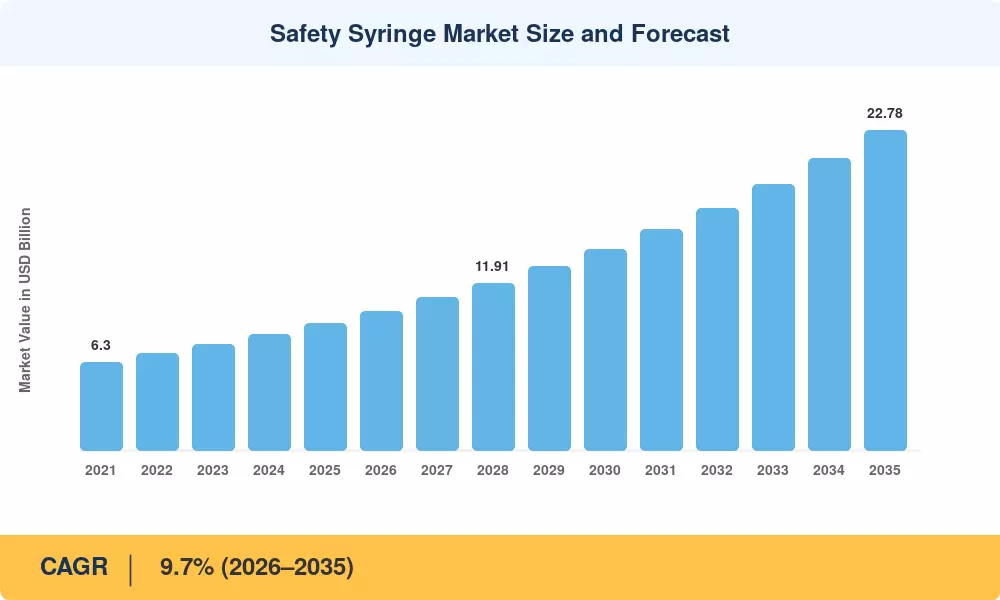
Safety Syringe Market Size and Forecast
Our Impact
Enabled $4.3B Revenue Impact for Fortune 500 and Leading Multinationals
Partnering with 2000+ Global Organizations Each Year
30K+ Citations by Top-Tier Firms in the Industry

Driver Impact Analysis

Driver ~% Impact on CAGR Geographic Relevance Impact Timeline
Statutory needlestick prevention mandates 2.4% North America, Europe Long-term (≥4 yr)
Biologics and self-administered therapy growth 2.0% Global Medium-term (2–4 yr)
Immunization programme financing 1.6% Asia-Pacific, Africa Long-term (≥4 yr)
Home-care and chronic disease shift 1.4% North America, Europe, Japan Medium-term (2–4 yr)
Hospital-acquired infection cost pressure 1.1% Global Short-term (≤2 yr)
WHO prequalification harmonization 0.9% Emerging markets Long-term (≥4 yr)
Group purchasing standardization 0.7% North America Short-term (≤2 yr)


Regulatory Enforcement Keeps Conversion Non-Optional

OSHA's bloodborne pathogens standard requires annual review of engineered sharps alternatives, and citation penalties now reach USD 16,131 per serious violation [1]. That figure is small against a hospital budget but large against a procurement manager's discretion, which is why compliance rarely slips. The Safety Syringe Market benefits from a rules regime that removes price as the deciding variable in acute-care tenders. European employers face parallel obligations under Directive 2010/32/EU, which bans recapping and mandates protected devices wherever risk assessment identifies exposure [6].

Biologics Reshape Device Specification

Roughly 40% of the pharmaceutical pipeline is now biologic, and viscosity above 15 centipoise changes everything about plunger design [10]. Manufacturers respond with wider barrels, lubricity-optimized elastomers, and passive shields that engage without added thumb force. Terumo reported double-digit growth in its pharmaceutical solutions segment during FY2024, attributing much of it to prefilled and protected delivery formats [11].

Immunization Financing Underwrites Emerging-Market Volume

Gavi's 5.1 strategic period commits multi-year funding for routine immunization across 54 lower-income countries, with device specifications tied to WHO PQS ST-001 [5][8]. UNICEF Supply Division tendered well over 1.4 billion protected devices in 2024 alone [9]. Volume of that magnitude lowers unit economics for suppliers and pulls adoption forward by several years in markets that would otherwise lag.

Home Care Rewrites the Buyer Profile

Self-injection is no longer niche. OECD data show chronic-condition prevalence rising across member states, and payers increasingly reimburse home administration over clinic visits [18]. Patients are not trained clinicians, which shifts design priority toward audible click confirmation, one-handed activation, and tamper-evident disposal. Pack sizes shrink from 100-unit hospital cases to 5- and 10-unit retail configurations.


Restraints Impact Analysis

Restraint ~% Impact on CAGR Geographic Relevance Impact Timeline
Unit price premium over conventional devices -1.5% Emerging markets Medium-term (2–4 yr)
Medical-grade polyolefin supply volatility -1.0% Global Short-term (≤2 yr)
Import alerts and quality enforcement actions -0.8% North America, Europe Short-term (≤2 yr)
Fragmented reimbursement for home devices -0.6% Europe, Asia-Pacific Medium-term (2–4 yr)
Clinician resistance to activation retraining -0.4% Global Long-term (≥4 yr)


Price Premiums Still Bite in Low-Income Tenders

A protected device typically costs three to five times a conventional barrel. Where health expenditure per capita sits below USD 100 — true across much of sub-Saharan Africa according to World Bank series — that multiple decides outcomes regardless of clinical merit [17]. Donor funding closes part of the gap, but domestically financed procurement often reverts to unprotected devices once a grant cycle ends.

Resin and Component Supply Remain Fragile

Supply of medical-grade polypropylene and cyclic olefin polymer will remain tight through 2024, while FDA import alerts on selected barrel shipments withdrew capacity from the U.S. channel with little notice[7]. Manufacturers qualified second and third sources of resin in response, a process that takes 12 to 18 months per grade. The partial pass-through of costs to margins has hurt mid-tier suppliers the most.


Training Friction Slows Conversion

Activation, rather than injection, is often the time at which sharps injuries occur, and EPINet surveillance indicates that a large proportion of reported occurrences include devices for which the safety mechanism was never activated [3]. Thus, hospitals view conversion as a training program, not a purchase order. The learning curve starts over with every makeover.


Safety Syringe Market Opportunities

Passive-Activation Platforms

Devices that automatically turn themselves off at the end of the plunger stroke remove the human variable entirely. Currently, adoption is focused on emergency departments and ICUs where the nursing workload is the greatest. The biggest single potential pocket for premium pricing lies in rolling passive designs out into general ward and outpatient portfolios.


Emerging-Market Local Manufacturing

India, Brazil and Egypt all provide procurement preference for locally manufactured products. Local capacity building or licensing translates a tariff disadvantage into a tender advantage. Hindustan Syringes has scaled up the strategy, and multi-national suppliers are following suit with collaborative ventures [19].


Connected Adherence and Data Services

Injection devices with RFID or NFC tags let payers verify adherence and let manufacturers monetize usage data through outcome-linked contracts. Recurring service revenue attached to a consumable is an unusual business model in this category and remains largely unclaimed.

Sustainability-Linked Device Redesign

Health systems in the Nordics and the UK now score tenders on embodied carbon and recyclability. Mono-material barrels and reduced-mass shields answer that scoring directly, opening a differentiation route that does not depend on clinical performance claims.

Pharmacy and Retail Channel Expansion

Vaccination administered in retail pharmacy settings grew sharply post-2021 and has not receded. Small-case packaging and simplified activation tailored to pharmacist workflows address a channel that hospital-oriented product lines serve poorly.


Safety Syringe Market Future Outlook

Passive Safety Becomes the Default Specification

Active mechanisms requiring a deliberate user step will be treated as legacy by the early 2030s. Regulators already prefer designs where protection is inherent, and EPINet incident patterns support that preference [3]. Suppliers that have not moved their volume platforms to passive activation by 2029 will face specification exclusion rather than price competition.

Connected Devices and Adherence Economics

Tagged injection devices allow payers to verify administration in real time. With OECD systems under sustained cost pressure, outcome-contingent contracting becomes plausible for high-cost biologics [18]. The device stops being a commodity and becomes the data capture point for a therapy contract, which changes who inside a health system owns the purchasing decision.

Regionalized Manufacturing Footprints

Import alerts and freight volatility have persuaded tier-one firms to build closer to demand [7]. Expect additional capacity announcements in India, Mexico, and Eastern Europe through 2030. Dual-sourced resin qualification becomes standard practice rather than contingency planning.

Sustainability Enters Tender Scoring

Health systems account for roughly 4–5% of global emissions, and procurement is the lever most under their control. The Safety Syringe Market will see mono-material construction, reduced polymer mass, and take-back schemes move from pilot to specification, particularly across Northern Europe and Australasia.


Safety Syringe Market Segmentation

Segment structure within the Safety Syringe Market follows product architecture, clinical application, and care setting.

By Product Type

Segment Metric Primary Demand Driver
Manual Retractable 39.5% share Familiar workflow, lowest protected-device cost
Automatic Retractable 13.3% CAGR Nursing shortage and activation-failure risk
Auto-Disable (Non-Retractable) USD 1.95 Billion Immunization campaign reuse prevention
Shielded / Hinged Non-Retractable 16.6% share Blood collection and phlebotomy workflows


Manual retractable variants remain the dominant product segment within the safety syringe market, driven by widespread clinical familiarity and cost-effective compliance with needlestick prevention mandates. Automatic retractable syringes represent the fastest-growing product category, propelled by nursing staff shortages and institutional demand for passive mechanisms that eliminate human activation error.

By Application

Segment Metric Primary Demand Driver
Drug Delivery 38.6% share Biologics and injectable therapy volume [10]
Vaccination 14.4% CAGR Routine immunization financing [8]
Blood Specimen Collection USD 1.47 Billion Diagnostic testing volume growth
Insulin Administration 13.9% share Diabetes prevalence and self-injection [18]
Others USD 0.59 Billion Dental, veterinary, research applications


Drug delivery leads on value because biologic therapies carry high administration frequency and premium device specifications. Vaccination grows faster on unit volume — donor-funded campaigns purchase in hundreds of millions of units, and protected-device specification is now near-universal in that channel [8]. Within the Safety Syringe Market, these two applications pull in opposite directions on price, one toward premium engineering and the other toward manufacturable cost.

By End User

Segment Metric Primary Demand Driver
Hospitals 63.5% share Statutory compliance and bulk contracting [1]
Home-care / Self-Injection 12.6% CAGR Chronic therapy shift to home settings
Ambulatory Surgery Centres USD 1.15 Billion Outpatient procedure migration
Diagnostic Labs & Others 9.5% share Specimen collection throughput


Hospitals remain the volume core of the Safety Syringe Market, buying through contracts that lock specifications for three to five years. Home care is the structural growth story. Patients self-administering biologics need packaging, instructions, and disposal answers that hospital product lines never had to provide, which creates room for entrants unencumbered by acute-care assumptions [18].


Regional Market Share Analysis

Region Metric (2025) Primary Investment Themes
North America 35.9% share GPO standardization, traceability, passive activation
Europe USD 2.47 Billion Directive compliance, sustainability scoring
Asia-Pacific 12.0% CAGR Local manufacturing, tender harmonization
South America USD 0.49 Billion PAHO pooled procurement
Middle East & Africa 4.5% share Donor-funded immunization, hospital build-out
Total USD 9.02 Billion

Geographic performance across the Safety Syringe Market diverges by regulatory maturity rather than by wealth alone.


North America

Country Metric Key Driver
US 84.2% of region OSHA enforcement and GPO contracting [1]
Canada USD 0.33 Billion Provincial sharps safety legislation
Mexico 9.4% CAGR IMSS procurement modernization


The United States anchors the Safety Syringe Market through sheer contracting scale — four group purchasing organizations influence the majority of acute-care device spend, and their standardization committees effectively set national product specifications [14]. Canada's provincial statutes mirror U.S. requirements with tighter reporting. Mexico's IMSS reform has consolidated tenders, favouring suppliers able to guarantee multi-year volume at fixed pricing.

Europe

Country Metric Key Driver
Germany 23.1% of region Hospital sharps compliance audits [6]
UK USD 0.42 Billion NHS Supply Chain framework awards
France 15.8% of region Public hospital tender centralization
Italy USD 0.24 Billion Regional procurement consortia
Spain 8.9% of region Ministry-level device catalogues
Nordic Countries 9.3% CAGR Carbon-scored tender criteria
Russia USD 0.14 Billion Domestic substitution policy
Rest of Europe 11.4% of region Accession-state hospital upgrades


Enforcement rather than novelty drives European volumes. Directive 2010/32/EU obliges employers to eliminate unnecessary sharps use and adopt protected devices where risk exists, and national labour inspectorates audit against it [6]. Nordic buyers have moved furthest on sustainability weighting, where recyclability now carries measurable tender points alongside price.

Asia-Pacific

Country Metric Key Driver
China 31.6% of region Volume-based procurement expansion [20]
India 14.8% CAGR PM-JAY coverage growth [19]
Japan USD 0.51 Billion Ageing population and home infusion
South Korea 8.4% of region National health insurance device listing
ASEAN 12.9% CAGR ISO 23908 alignment in tenders [4]
Rest of Asia-Pacific USD 0.19 Billion Donor immunization programmes


Asia-Pacific is where the Safety Syringe Market changes fastest. China's volume-based procurement rounds have begun including protected devices in nationally tendered categories, compressing prices while multiplying units [20]. India's approach differs — PM-JAY expansion pulls volume through public insurance while domestic manufacturers supply most of it [19]. ASEAN health ministries are converging on ISO 23908 language in tender documents, which removes a long-standing specification ambiguity [4].

South America

Country Metric Key Driver
Brazil 58.3% of region SUS national immunization programme
Argentina USD 0.08 Billion Provincial hospital procurement
Rest of South America 10.6% CAGR PAHO Revolving Fund purchasing [21]


Brazil's unified health system buys at national scale, and its immunization programme has specified protected devices for paediatric campaigns since the early 2020s. Smaller markets rely on the PAHO Revolving Fund, which aggregates demand and negotiates reference pricing that individual ministries could not achieve alone [21]. Currency volatility remains the principal commercial risk for importers.

Middle East & Africa

Country Metric Key Driver
Saudi Arabia 27.4% of region Vision 2030 hospital construction [22]
UAE USD 0.07 Billion Private hospital accreditation standards
South Africa 18.2% of region Public sector tender consolidation
Egypt 11.1% CAGR Local assembly incentives
Rest of MEA USD 0.13 Billion Gavi-supported immunization supply [8]


Gulf demand tracks construction. Saudi Arabia's Health Sector Transformation Program has commissioned new capacity that arrives specified for protected devices from day one [22]. Across sub-Saharan Africa, the picture inverts: donor-financed immunization carries protected-device volume while domestically funded curative care lags, producing a two-tier procurement environment within single national systems.


Safety Syringe Market By Region, 2025-2035

Competitive Benchmarking

Concentration sits in the moderate band. Analyst estimates place the Herfindahl-Hirschman Index near 950–1,050, with the top five suppliers holding roughly 48–52% of global revenue. That structure supports pricing discipline at the premium end while leaving space for regional specialists in high-volume, cost-sensitive tenders. Competition within the Safety Syringe Market turns on regulatory clearances, resin supply security, and installed contract position rather than on breakthrough technology.

Company Est. Revenue Share Range Key Offerings for Safety Syringe Market Strategic Positioning
Becton, Dickinson and Company ~18–22% Retractable and shielded hypodermic portfolios, prefillable systems Scale leader with deepest GPO contract coverage [10]
Terumo Corporation ~9–12% Passive-shield hypodermics, prefilled delivery systems Strong in Japan and biologics partnerships [11]
Cardinal Health ~6–8% Private-label protected devices, distribution integration Channel control across U.S. acute care [14]
ICU Medical (Smiths Medical) ~5–7% Shielded and retractable device lines Acute-care specialist post-integration [13]
B. Braun Melsungen AG ~5–7% Safety hypodermics, infusion-linked devices European institutional strength [16]
Nipro Corporation ~4–6% Retractable devices, dialysis-adjacent portfolio Asia-Pacific manufacturing depth [12]
Hindustan Syringes & Medical Devices ~3–5% High-volume auto-disable and retractable devices Cost leadership in donor-funded tenders [9]
Medtronic plc ~2–4% Protected injection devices within therapy portfolios Bundled with therapy franchises
Retractable Technologies, Inc. ~2–4% Purpose-built retractable device platforms U.S. domestic manufacturing positioning [15]
Sol-Millennium Medical Group ~2–3% Retractable and auto-disable device range Emerging-market tender specialist
Gerresheimer AG ~1–3% Safety systems for prefilled syringe platforms Component and platform supplier to pharma


Recent News & Developments

  • Becton Dickinson (March 2024): Announced expanded U.S. prefillable device capacity to reduce import dependence, directly addressing supply-continuity concerns raised by customers after 2023 shortages [10].
  • U.S. FDA (June 2024): Widened import alert coverage on selected imported syringe barrels following quality findings, removing capacity from the U.S. channel and tightening near-term pricing [7].
  • Terumo (September 2024): Launched an expanded passive-shield hypodermic range targeted at high-viscosity biologic administration, addressing activation force complaints from nursing staff [11].
  • UNICEF Supply Division (November 2024): Issued a multi-year framework tender for protected immunization devices covering more than 1.4 billion units, with WHO PQS specification compliance mandatory [9].
  • China NMPA / NHSA (February 2025): Included protected injection devices in a national volume-based procurement round, compressing unit prices while sharply increasing tendered volumes [20].
  • B. Braun (April 2025): Committed additional European production investment for safety-engineered injection devices, citing Directive 2010/32/EU audit-driven demand [16] [6].
  • Hindustan Syringes (July 2025): Expanded auto-disable manufacturing capacity in India to serve both PM-JAY domestic volume and Gavi-supported export tenders [19] [8].
  • ICU Medical (October 2025): Restructured its acute-care sharps portfolio following integration review, discontinuing overlapping legacy lines to focus on protected formats [13].


Safety Syringe Market Report Scope

Parameter Detail
Market Scope Global Safety Syringe Market by product type, application, end user, and geography
Study Period 2021–2035 (Historical 2021–2024; Base Year 2025; Forecast 2026–2035)
CAGR 9.7% (2026–2035)
Market Size Checkpoints USD 9.02 Billion (2025); USD 9.90 Billion (2026); USD 22.78 Billion (2035)
Fastest Growing Segments Automatic Retractable (product); Vaccination (application); Home-care / Self-Injection (end user)
Companies Profiled Becton Dickinson, Terumo, Cardinal Health, ICU Medical, B. Braun, Nipro, Hindustan Syringes, Medtronic, Retractable Technologies, Sol-Millennium, Gerresheimer
Valuation Currency USD Billion

FAQs

What procurement contract length should buyers negotiate in the Safety Syringe Market?
Three-year terms with annual resin-indexed price review balance supply security against cost exposure. Longer locks invite margin disputes when polymer prices move [7].
How should hospitals evaluate activation-failure risk between competing devices?
Request supplier-held field data on unengaged-mechanism incidents, then validate against your own reporting. Passive designs eliminate the variable; manual designs shift it onto training budgets [3].
Does dual sourcing make sense in the Safety Syringe Market?
Yes for high-volume commodity lines, where a qualified second supplier protects against import alerts. Single-source premium platforms remain defensible when clinical standardization matters more [7].
What regulatory pathway applies to a new protected device entering the EU?
MDR Class IIa conformity assessment through a notified body, with sharps protection performance evidenced against ISO 23908. Timelines commonly run 12–20 months [4][6].
Which entry route works best for suppliers new to the Safety Syringe Market in Asia?
Local manufacturing or licensed assembly, because tender preference rules favour domestic production. Pure import strategies lose on price and scoring simultaneously [19].
How do sustainability criteria actually affect award decisions?
Nordic and UK frameworks assign explicit scoring weight to recyclability and packaging mass. Where price bids cluster tightly, those points decide outcomes [18].
What integration challenge surprises health systems most?
Sharps container compatibility. Retractable and shielded devices occupy different disposal volumes, and container replacement cycles are rarely budgeted alongside device conversion [3].      
Author
Author
Author Profile
Rahul Gotadki LinkedIn
Research Manager
He holds an experience of about 9+ years in Market Research and Business Consulting, working under the spectrum of Life Sciences and Healthcare domains. Rahul conceptualizes and implements a scalable business strategy and provides strategic leadership to the clients. His expertise lies in market estimation, competitive intelligence, pipeline analysis, customer assessment, etc.
Co-Author
Co-Author Profile
Vikita Thakur LinkedIn
Senior Research Analyst
She holds an experience of about 5+ years in market research and business consulting projects for sectors such as life sciences, medical devices, and healthcare IT. She possesses a robust background in data analysis, market estimation, competitive intelligence, pipeline analysis market trend identification, and consumer behavior insights. Her expertise lies in technical Sales support, client interaction and project management, designing and implementing market research studies, conducting competitive analysis, and synthesizing complex data into actionable recommendations that drive business growth.
Share::
Request Free Sample
Download Free Sample

Kindly complete the form below to receive a free sample of this Report

* Please use a valid business email

Share::
Request Free Sample
Download PDF ×

We do not share your information with anyone. However, we may send you emails based on your report interest from time to time. You may contact us at any time to opt-out.
















