Saudi Arabia Renewable Energy Market (2026 - 2035)

Saudi Arabia Renewable Energy Market Research Report By Technology (Solar PV, Concentrated Solar Power (CSP), Onshore Wind, Green Hydrogen (Electrolysis), Others (Biomass, Waste-to-Energy)), By Sector (Utility-Scale, Commercial & Industrial (C&I), Residential), By End User (Government / Public Sector, Private Sector, Industrial) and By Regional (Saudi Arabia) - Forecast to 2035
ID: MRFR/EnP/12359-HCR
128 Pages
Anshula Mandaokar
Last Updated: August 24, 2026
Saudi Arabia Renewable Energy Market
Market Size
Forecast Period2026-2035
CAGR (2026-2035)12.2%
2025 Market SizeUSD 5.80 Billion
2035 Market SizeUSD 18.30 Billion
Key Players
ACWA Power
Masdar
EDF Renewables
Jinko Solar
LONGi Green Energy
Vestas
Opportunities
  • Utility-Scale Battery Energy Storage Systems (BESS)
  • Green Hydrogen and Ammonia Export
  • Commercial and Industrial Rooftop Solar

Saudi Arabia Renewable Energy Market Summary

The Saudi Arabia Renewable Energy Market reached an estimated USD 5.80 billion in 2025 and is projected to grow from USD 6.51 billion in 2026 to USD 18.30 billion by 2035, registering a CAGR of 12.2% during 2026–2035. Two catalysts underpin this trajectory: the National Renewable Energy Program (NREP), which targets 130 GW of renewable capacity by 2030 under Royal Decree mandates, and the Public Investment Fund's (PIF) commitment of over USD 50 billion toward clean-energy infrastructure across the Kingdom [1][2]. Together, these policy levers have transformed the Saudi Arabia Renewable Energy Market from a pilot-stage ecosystem into one of the Middle East's largest capital deployment pipelines for clean power.

A significant technological transformation is currently underway. The Kingdom's electricity blend, which has been historically dominated by crude-oil and natural-gas combustion turbines, is transitioning to utility-scale photovoltaic arrays, concentrated solar power towers, and onshore wind farms. The renewable energy project development office (REPDO) continues to issue competitive tenders, driving down the levelized cost of energy (LCOE) below USD 0.02/kWh in several rounds. At the same time, the Sudair Solar Plant, a 1.5 GW facility commissioned in 2024, exemplifies the scope of this transition [3][4].

The Western Region is home to high direct-normal irradiance corridors that extend from Makkah to Al Madinah, and it accounts for approximately 35% of the total installed capacity. As mega-projects in Tabuk and the NEOM corridor consume multi-billion-dollar investments, the Northern Region is the fastest-growing area, expanding at an estimated 14.8% CAGR. Riyadh's urbanization and government-backed procurement schedules are the primary factors contributing to the Central Region's approximately 28% market share. The Saudi Arabia Renewable Energy Market is poised to capitalize on grid-parity economics and sovereign-wealth-backed project financing in the coming decade, a combination that few other markets can match.


Key Report Takeaways

• By Technology

  • Solar PV holds over 62% of installed capacity in the Saudi Arabia Renewable Energy Market, led by utility-scale mono-PERC and TOPCon module deployments.
  • Concentrated Solar Power (CSP) is forecast to grow at 13.9% CAGR through 2035, supported by molten-salt storage integration.
  • Onshore wind accounts for an estimated USD 0.84 billion in 2025 revenue, concentrated in the Gulf of Aqaba and Dumat Al Jandal corridors.

• By Sector

  • Utility-scale projects represent approximately 78% of total Saudi Arabia Renewable Energy Market revenue, reflecting government mega-tender dominance.
  • The commercial and industrial (C&I) segment is growing at a 15.1% CAGR as private-sector power purchase agreements (PPAs) gain regulatory clarity.

• By Region

  • The Western Region accounts for 35% of installed capacity, supported by high irradiance and Red Sea coastal infrastructure.
  • The Northern Region is expected to surpass USD 2.50 billion in annual investment by 2035, driven by NEOM-adjacent gigawatt-scale builds.


Market Size and Forecast (2021–2035)

Market Research Future's sizing methodology combines bottom-up project-level tracking (REPDO tender awards, EPC contract disclosures, PIF portfolio filings) with top-down cross-validation against IRENA capacity databases and BloombergNEF investment trackers. Historical values (2021–2024) reflect audited project completions; 2025 is the base-year estimate; 2026–2035 values incorporate pipeline analysis, policy-scenario modeling, and LCOE learning-curve adjustments.
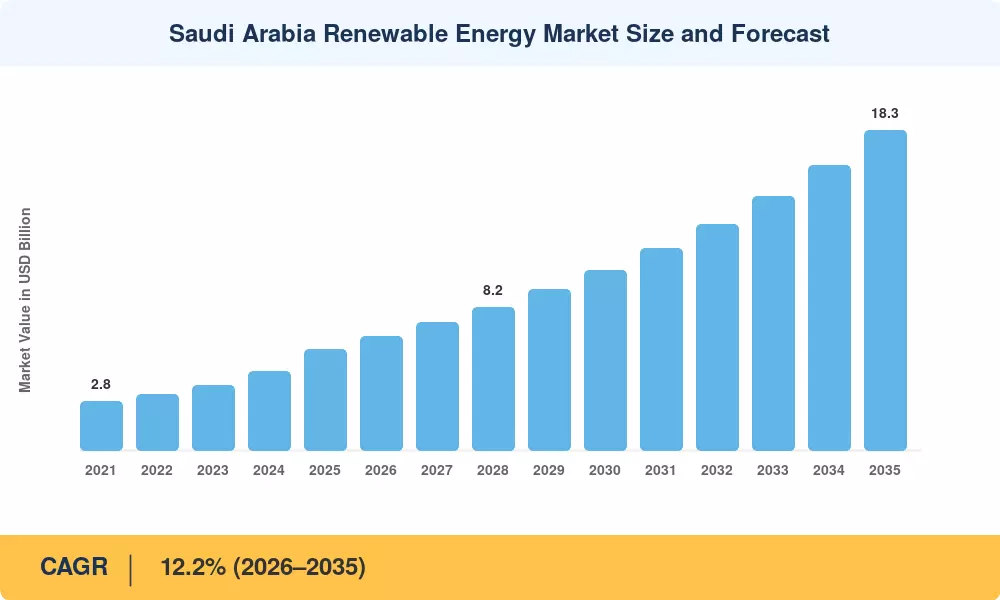
Saudi Arabia Renewable Energy Market Size and Forecast
Our Impact
Enabled $4.3B Revenue Impact for Fortune 500 and Leading Multinationals
Partnering with 2000+ Global Organizations Each Year
30K+ Citations by Top-Tier Firms in the Industry

Driver Impact Analysis

Driver ~% Impact on CAGR Geographic Relevance Impact Timeline
NREP policy mandates and sovereign tender pipeline +3.2% Kingdom-wide Long-term (≥4 yr)
LCOE cost deflation (solar modules < USD 0.02/kWh) +2.5% Western & Central Medium-term (2–4 yr)
PIF and sovereign-wealth capital deployment +2.0% Kingdom-wide Long-term (≥4 yr)
Green hydrogen export strategy +1.5% Northern Region Long-term (≥4 yr)
Grid modernization and smart-meter rollout +1.2% Central & Eastern Medium-term (2–4 yr)
Private-sector PPA deregulation +1.0% Urban centers Short-term (≤2 yr)
Carbon-credit and ESG compliance frameworks +0.8% Kingdom-wide Medium-term (2–4 yr)


NREP Policy Mandates

The Saudi Arabia Renewable Energy Market is driven by the National Renewable Energy Program, which is the single most consequential driver. Since 2017, REPDO’s competitive reverse auction methodology has awarded over 15 GW of solar PV and wind contracts, and the Round 4 tenders in 2024 cleared at record-low prices of USD 0.0161/kWh for the 1.1 GW Al Henakiyah project [1]. The program’s contractual capacity targets create long-duration demand visibility that de-risks project funding and attracts international EPC consortia.


LCOE Cost Deflation

The cost of crystalline-silicon modules declined by 42% from 2021 to 2024, pushing down utility-scale LCOE in the Kingdom to levels that beat combined-cycle gas turbines on a pure-energy basis. BloombergNEF predicts Saudi solar LCOE at USD 0.018-0.022/kWh for 2025-vintage projects, making solar the cheapest new-build power source and accelerating legacy thermal capacity retirement [4][14].


PIF Capital Deployment

The Public Investment Fund has allocated over USD 50 billion toward renewable energy and green-economy assets through its subsidiary portfolio, including a controlling stake in ACWA Power. PIF-backed entities benefit from sovereign credit ratings and access to concessional multilateral debt, enabling project-finance structures with 80–85% leverage ratios that compress equity return requirements and lower consumer tariffs [2][15].

Green Hydrogen Export Strategy

Saudi Arabia's ambition to become a top-three global exporter of green hydrogen by 2030 creates derivative demand for dedicated renewable capacity. The planned NEOM Green Hydrogen Plant — a USD 8.4 billion electrolyzer complex powered by 4 GW of co-located solar and wind — will require continuous renewable feedstock at scale, effectively reserving gigawatts of generation capacity for non-grid offtake [10].


Restraints Impact Analysis

Restraint ~% Impact on CAGR Geographic Relevance Impact Timeline
Grid-interconnection bottlenecks –1.5% Western & Northern Medium-term (2–4 yr)
Sand and dust soiling losses on PV arrays –0.8% Kingdom-wide Ongoing
Water scarcity for CSP cooling –0.6% Central & Southern Long-term (≥4 yr)
Skilled-labor shortages in EPC execution –0.5% Northern Region Short-term (≤2 yr)
Regulatory lag in distributed-generation frameworks –0.4% Urban centers Short-term (≤2 yr)


Grid-Interconnection Bottlenecks

To integrate remote renewable projects, the Saudi Electricity Company initiated a USD 58.7 billion grid upgrade through 2030. This program allocates USD 36 billion specifically for transmission backbone networks, featuring high-voltage substations and thousands of kilometers of new lines. These sweeping infrastructure enhancements mitigate historical interconnection and scheduling bottlenecks, stabilizing grid resilience as multi-gigawatt solar and wind generation scales up nationwide.


Sand and Dust Soiling

The Kingdom's harsh desert environment imposes soiling losses of 0.5–0.8% per day on unclean PV modules, translating to annual energy-yield reductions of 15–25% without active cleaning regimes. Robotic dry-cleaning systems add USD 3–5/kW to O&M budgets, partially offsetting the LCOE advantage that makes the Saudi Arabia Renewable Energy Market attractive to international developers [16].

Skilled-Labor Constraints

Mega-project construction in NEOM and the northern corridor competes for the same EPC labor pool serving NREP solar tenders, Red Sea tourism infrastructure, and Riyadh's expanding metro system. Saudization quotas require a minimum local-workforce share, yet the Kingdom's renewable-energy vocational pipeline graduates fewer than 3,000 technicians annually — well below the estimated 18,000 needed through 2030 [18].


Saudi Arabia Renewable Energy Market Opportunities

Utility-Scale Battery Energy Storage Systems (BESS)

Saudi Arabia's grid requires multi-hour-duration BESS co-located with solar and wind farms to shift peak generation into evening demand windows. The Ministry of Energy and the Saudi Power Procurement Company (SPPC) have established an aggressive national storage roadmap targeting 48 GWh of installed battery capacity by 2030, with initial procurement phases (such as SPPC's multi-site BESS tenders) structured around 4-hour continuous discharge configurations to support high-penetration renewable integration


Green Hydrogen and Ammonia Export

The Kingdom's proximity to European and East Asian hydrogen import markets, combined with the lowest-cost renewable electricity globally, positions Saudi Arabia as a green-ammonia export hub. Off-take agreements with Japanese and Korean utilities are already in negotiation, unlocking demand for an additional 10–15 GW of dedicated renewable generation capacity by 2035[10].

Commercial and Industrial Rooftop Solar

Regulatory frameworks overseen by the Electricity and Cogeneration Regulatory Authority (ECRA / EWR) enable C&I consumers to integrate behind-the-meter PV systems and benefit from formal net-accounting or net-billing frameworks. With commercial electricity retail tariffs acting as a baseline, falling hardware costs and high solar irradiation allow industrial parks, logistics hubs, and commercial real estate to achieve rapid payback periods, driving widespread corporate adoption of distributed generation.


Carbon-Credit Monetization

The Regional Voluntary Carbon Company (RVCMC) — established by the Public Investment Fund (PIF) and the Saudi Tadawul Group — orchestrates large-scale carbon credit auctions and trading infrastructure under regional green initiatives. This voluntary carbon market enables renewable-energy and energy-efficiency project developers to register and monetize verified emission-reduction certificates, creating an auxiliary revenue stream that improves project returns.


Saudi Arabia Renewable Energy Market Future Outlook


Green Hydrogen and the Electrification Supercycle

The convergence of sub-USD 0.02/kWh solar electricity with falling electrolyzer costs (projected below USD 300/kW by 2030) positions Saudi Arabia as a landed-cost leader in green hydrogen production. IEA scenarios indicate global clean-hydrogen trade could reach 12 million tonnes annually by 2035, with the Kingdom capturing 10–15% of seaborne export volumes [10][20].

ESG-Linked Project Finance

International lenders increasingly condition project-finance terms on robust ESG disclosures, benefiting the Saudi renewable energy market by attracting green capital. Backed by structured frameworks like the Public Investment Fund's multi-billion-dollar green bond program—which raised a combined USD 8.5 billion across landmark international issuances—developers are successfully channeling institutional liquidity toward National Renewable Energy Program (NREP) assets.


3 Cross-Border Electricity Interconnections

The GCC Interconnection Authority (GCCIA) is evaluating 3 GW HVDC links between Saudi Arabia and Egypt, Jordan, and Iraq. These interconnections would allow the Saudi Arabia Renewable Energy Market to export surplus midday solar generation and import evening hydroelectric power from Egypt's Aswan complex, improving system-level capacity utilization and unlocking new revenue for independent power producers [8].


Saudi Arabia Renewable Energy Market Segmentation

By Technology

Segment Key Metric Primary Demand Driver
Solar PV 62% of installed capacity REPDO mega-tenders and LCOE leadership
Concentrated Solar Power (CSP) 13.9% CAGR Dispatchable generation with thermal storage
Onshore Wind USD 0.84 B (2025) Northern corridor resource quality
Green Hydrogen (electrolysis) 16.2% CAGR NEOM and export-linked demand
Others (biomass, waste-to-energy) 2% of capacity Municipal waste management mandates


Solar PV dominates the Saudi Arabia Renewable Energy Market's technology mix because of the Kingdom's exceptional solar resource — annual global horizontal irradiance averages 2,200–2,400 kWh/m² — combined with aggressive reverse-auction pricing that has attracted tier-one module manufacturers including LONGi, Jinko Solar, and Trina Solar. Mono-PERC technology remains the workhorse, though TOPCon and heterojunction (HJT) modules are gaining specification share in 2025-vintage tenders as developers pursue efficiency premiums on constrained land parcels [4][14].

CSP with integrated molten-salt storage is emerging as the technology of choice for dispatchable renewable generation. The planned 700 MW DEWA-style tower-and-heliostat plants in the Kingdom's central corridor will deliver 12–15 hours of storage, enabling round-the-clock renewable electricity that serves baseload industrial demand — a capability that PV-only installations cannot provide without battery augmentation [17].

By Sector

Segment Key Metric Primary Demand Driver
Utility-Scale 78% of revenue Government REPDO tender pipeline
Commercial & Industrial (C&I) 15.1% CAGR Behind-the-meter economics and PPA frameworks
Residential USD 0.18 B (2025) Net-metering pilot programs


Utility-scale projects form the backbone of the Saudi Arabia Renewable Energy Market, with REPDO acting as the sole off-taker through 25-year power-purchase agreements backed by sovereign guarantees. The C&I segment, while smaller in absolute terms, is the fastest-growing sector as regulatory reforms unlock self-generation rights for private industrial consumers. Early adopters include cement, steel, and petrochemical facilities seeking to reduce Scope 2 emissions under emerging Saudi carbon-disclosure rules [12].

By End User

Segment Key Metric Primary Demand Driver
Government / Public Sector 70% of capacity NREP mandates and SEC procurement
Private Sector 14.3% CAGR Corporate ESG commitments
Industrial USD 0.61 B (2025) Aramco and SABIC decarbonization targets


Government entities remain the dominant end users in the Saudi Arabia Renewable Energy Market. SEC and the Water & Electricity Regulatory Authority (WERA) manage procurement for all grid-connected renewable capacity, while private-sector participation is growing as IPP and IWPP frameworks mature. Industrial end users — led by Saudi Aramco, SABIC, and Ma'aden — are integrating solar into refinery and smelter operations to meet internally mandated carbon-intensity reduction targets [15].


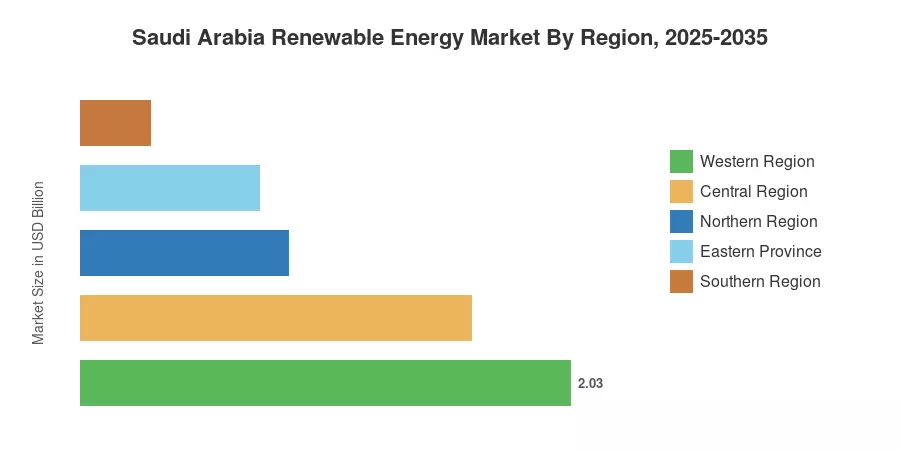
Regional Market Share Analysis

Region Key Metric Primary Investment Themes
Western Region 35% of installed capacity High-DNI solar corridors; Red Sea coastal wind
Central Region USD 1.62 B (2025 revenue) Government procurement; Riyadh demand center
Eastern Province 12.8% CAGR (2026–2035) Industrial desalination-solar hybrid
Northern Region 14.8% CAGR (2026–2035) NEOM mega-projects; green hydrogen
Southern Region 5% of installed capacity Early-stage CSP pilots
Total USD 5.80 B (2025)

The Saudi Arabia Renewable Energy Market spans five principal geographic zones, each defined by distinct irradiance profiles, wind corridors, grid topology, and proximity to demand centers.


Western Region

Zone Key Metric Key Driver
Makkah Province 20% of regional capacity Proximity to Jeddah load center
Al Madinah Province USD 0.48 B (2025) Shuaibah and Al Henakiyah projects
Tabuk (western corridor) 13.5% CAGR Red Sea tourism power demand


The Western Region benefits from annual direct-normal irradiance exceeding 2,500 kWh/m², among the highest globally. REPDO's largest awarded tenders — including the 2.6 GW Shuaibah complex — cluster here because grid-connection infrastructure to Jeddah and Makkah load centers already exists, reducing balance-of-system costs by an estimated 12–15% relative to greenfield northern sites [5].

Central Region

Zone Key Metric Key Driver
Riyadh Province 65% of regional revenue Capital-city demand and SEC headquarters
Al Qassim 10.5% CAGR Agricultural-sector solar irrigation


Riyadh's population, projected to exceed 10 million by 2030, drives peak electricity demand that Saudi Arabia Renewable Energy Market participants target through utility-scale solar farms within a 200 km radius. The Sudair Solar Plant, located 150 km north of Riyadh, feeds directly into the capital's 380 kV ring, demonstrating that central-region assets serve the Kingdom's largest single load pocket [6].

Eastern Province

Zone Key Metric Key Driver
Dammam–Dhahran–Khobar metro USD 0.42 B (2025) Industrial and petrochemical demand
Jubail Industrial City 13.2% CAGR Solar-powered desalination hybrids


Eastern Province hosts Saudi Aramco's refining and petrochemical complexes, which consume roughly 18% of national electricity output. Plant operators are co-locating solar PV to reduce Scope 2 emissions under Aramco's 2050 net-zero commitment, creating procurement volume for the Saudi Arabia Renewable Energy Market from the oil-and-gas sector itself [15].

Northern Region

Zone Key Metric Key Driver
NEOM corridor 14.8% CAGR Green hydrogen plant and gigawatt solar–wind
Dumat Al Jandal USD 0.21 B (2025) 400 MW operational wind farm


The Northern Region is the fastest-growing zone in the Saudi Arabia Renewable Energy Market, propelled by the NEOM megacity program and associated green hydrogen infrastructure. The 400 MW Dumat Al Jandal wind farm — Saudi Arabia's first utility-scale wind installation — demonstrated capacity factors above 30% in its inaugural year, validating the region's Class 3–4 wind resource [3][10].

Southern Region

Zone Key Metric Key Driver
Asir / Najran 5% of capacity CSP pilot projects and rural electrification


The Southern Region remains at an early stage, with investment concentrated in pilot CSP plants that leverage higher-altitude terrain for improved thermal efficiency. Rural electrification programs under SEC's distribution modernization plan are expected to introduce small-scale solar microgrids, gradually increasing the region's share of the Saudi Arabia Renewable Energy Market through the late 2020s [11].


Saudi Arabia Renewable Energy Market By Region, 2025-2035

Competitive Benchmarking

The Saudi Arabia Renewable Energy Market exhibits moderate concentration, with an estimated Herfindahl–Hirschman Index (HHI) of approximately 1,100–1,300. The top five firms hold a combined 38–45% revenue share, reflecting a mix of domestic sovereign-backed developers and international EPC-plus-equity participants. Market fragmentation is increasing as Chinese and European module suppliers establish local assembly facilities under Saudization incentive programs.

Company Est. Revenue Share Range Key Offerings for Saudi Arabia Renewable Energy Market Strategic Positioning
ACWA Power ~12–16% IPP development, O&M, green hydrogen Domestic anchor developer; PIF-backed
Saudi Electricity Company (SEC) ~8–11% Grid integration, off-take procurement Regulated monopoly off-taker
Masdar (ADQ subsidiary) ~5–8% Utility-scale solar and wind IPP Regional clean-energy champion
EDF Renewables ~4–6% EPC and long-term O&M services European technology partner
Jinko Solar ~3–5% Mono-PERC and TOPCon module supply Lowest-cost module supplier
LONGi Green Energy ~3–5% Hi-Mo series modules, cell technology Vertically integrated wafer-to-module
Vestas ~2–4% Onshore wind turbines (4–6 MW class) Dominant wind OEM in MENA
Siemens Gamesa ~2–4% Wind turbines and hybrid solutions Integrated onshore–offshore platform
First Solar ~2–3% Thin-film CdTe modules Differentiated technology for high-heat
ENGIE ~2–3% Green hydrogen, BESS, utility solar Diversified energy-transition portfolio


Recent News & Developments


ACWA Power—(July 2026)—secured an exclusive government mandate to export green hydrogen and develop cross-border renewable electricity infrastructure.

ACWA Power—(June, 2026)—advanced a 500-MW solar-plus-storage clean energy project partnership in New Clark City to expand international operations.

  • ACWA Power—(May, 2026)—reported expanding its global portfolio footprint to 455 billion SAR in total assets under management across multiple clean energy markets.


Saudi Arabia Renewable Energy Market Report Scope

Parameter Detail
Market Scope Saudi Arabia Renewable Energy Market — generation, EPC, equipment, and project development
Study Period 2021–2035
CAGR (Forecast Window) 12.2% (2026–2035)
Base Year Market Size USD 5.80 Billion (2025)
Forecast Endpoint USD 18.30 Billion (2035)
Fastest Growing Segment Green Hydrogen (electrolysis), 16.2% CAGR
Companies Profiled 10 (ACWA Power, SEC, Masdar, EDF Renewables, Jinko Solar, LONGi, Vestas, Siemens Gamesa, First Solar, ENGIE)
Valuation Currency USD (constant 2025 dollars)

FAQs

What due-diligence steps should investors prioritize before entering the Saudi Arabia Renewable Energy Market?
Investors should verify REPDO tender eligibility, SEC grid-connection timelines, and Saudization labor-quota compliance. Securing sovereign-backed PPA terms and confirming land-lease arrangements through the Royal Commission are equally critical [Ref 1].
How does the Saudi Arabia Renewable Energy Market compare to the UAE in project-finance terms?
Saudi Arabia offers lower solar LCOE due to superior irradiance but has longer grid-connection lead times. UAE projects benefit from faster permitting cycles, though PPA tenors and sovereign credit quality are comparable [Ref 3].
What technology risks affect long-duration energy storage deployment in the Saudi Arabia Renewable Energy Market?
Extreme ambient temperatures above 50°C degrade lithium-ion battery cycle life by 15–20%. Developers are evaluating iron-air and compressed-air alternatives better suited to desert thermal profiles [Ref 9].
Which procurement model dominates the Saudi Arabia Renewable Energy Market for new capacity?
REPDO's build-own-operate-transfer (BOOT) model with 25-year PPAs dominates. SEC acts as sole off-taker, providing sovereign payment guarantees that reduce counterparty risk for lenders [Ref 5].
How does sand-soiling mitigation affect O&M budgets in the Saudi Arabia Renewable Energy Market?
Robotic dry-cleaning systems add USD 3–5/kW annually to O&M costs. Unmitigated soiling can reduce annual energy yield by up to 25%, making cleaning economics critical to project returns [Ref 16].
What role does local content regulation play in shaping the Saudi Arabia Renewable Energy Market's supply chain?
REPDO mandates 30–40% local content by value, driving tier-one manufacturers to establish domestic module assembly. Jinko Solar's Riyadh plant is the first such facility [Ref 14].
Can distributed-generation participants access the Saudi Arabia Renewable Energy Market under current regulations?
WERA's draft net-metering rules permit C&I installations up to 10 MW, but residential frameworks remain pending. Full regulatory clarity is expected by late 2026 [Ref 12].    
Author
Author
Author Profile
Anshula Mandaokar LinkedIn
Team Lead - Research
Anshula Mandaokar holds an academic degree in Chemical Engineering and has been contributing to the field for more than 5 years. She has expertise in Market Research and Business Consulting and serves as a Team Lead for a reputed Market Research firm under the Chemicals and Materials domain spectrum. She has worked on multiple projects, generating explicit results in a quick turnaround time. Her understanding of data interpretation justifies her role as a leader.
Download Free Sample

Kindly complete the form below to receive a free sample of this Report

* Please use a valid business email

Download PDF ×

We do not share your information with anyone. However, we may send you emails based on your report interest from time to time. You may contact us at any time to opt-out.
















