Download Free Sample
Kindly complete the form below to receive a free sample of this Report
Seismic Engineering Consulting Services Market Research Report By Service Type (Consulting Services, Design Services, Inspection Services, Training Services, Research and Development), By Application (Structural Analysis, Seismic Risk Assessment, Design and Retrofitting, Site Characterization, Performance-Based Design), By Client Type (Government Agencies, Private Sector, Non-Profit Organizations, Educational Institutions, Construction Firms), By End Use (Residential Buildings, Commercial Buildings, Infrastructure Projects, Industrial Facilities, Public Works) And By Region (North America, Europe, Asia-Pacific, And Rest Of The World) – Market Forecast Till 2035.
As per MRFR analysis, the Seismic Engineering Consulting Services Market was estimated at 3.5 USD Billion in 2024. The seismic engineering industry is projected to grow from 3.63 USD Billion in 2025 to 5.2 USD Billion by 2035, exhibiting a compound annual growth rate (CAGR) of 3.66% during the forecast period 2025 - 2035.
The Seismic Engineering Consulting Services Market is poised for growth driven by technological advancements and increasing regulatory compliance.
| 2024 Market Size | 3.5 (USD Billion) |
| 2035 Market Size | 5.2 (USD Billion) |
| CAGR (2025 - 2035) | 3.66% |
AECOM (US), WSP Global Inc. (CA), Jacobs Engineering Group (US), Ramboll Group (DK), Golder Associates (CA), Stantec Inc. (CA), Mott MacDonald (GB), Tetra Tech (US), Arup Group (GB)
Our Impact
Enabled $4.3B Revenue Impact for Fortune 500 and Leading Multinationals
Partnering with 2000+ Global Organizations Each Year
30K+ Citations by Top-Tier Firms in the Industry
The Seismic Engineering Consulting Services Market is currently experiencing a notable evolution, driven by increasing awareness of seismic risks and the necessity for resilient infrastructure. As urbanization accelerates, cities are expanding into seismically active regions, prompting a heightened demand for specialized consulting services. These services encompass risk assessment, design optimization, and compliance with evolving building codes. Furthermore, the integration of advanced technologies, such as predictive modeling and simulation tools, appears to enhance the effectiveness of seismic evaluations, thereby fostering a more proactive approach to earthquake preparedness. In addition, the market seems to be influenced by a growing emphasis on sustainability and environmental considerations. Stakeholders are increasingly recognizing the importance of incorporating seismic resilience into sustainable development practices. This trend suggests a shift towards holistic approaches that not only address immediate safety concerns but also promote long-term environmental stewardship. As the Seismic Engineering Consulting Services Market continues to adapt to these dynamics, it is likely to witness further innovations and collaborations aimed at enhancing the safety and durability of structures in earthquake-prone areas.
The integration of cutting-edge technologies, such as artificial intelligence and machine learning, is transforming seismic analysis methodologies. These advancements enable more accurate predictions of seismic behavior, allowing engineers to design structures that can withstand potential earthquakes more effectively.
There is a growing trend towards stricter regulatory frameworks governing seismic safety. Governments and local authorities are implementing more rigorous building codes, which necessitate the expertise of seismic engineering consultants to ensure compliance and enhance public safety.
The emphasis on sustainability is reshaping the Seismic Engineering Consulting Services Market. Clients are increasingly seeking solutions that not only address seismic risks but also align with environmental goals, leading to innovative designs that prioritize both safety and ecological responsibility.
There is a growing awareness of earthquake risks among governments, businesses, and the general public, which seems to be significantly influencing the Seismic Engineering Consulting Services Market. As seismic events continue to pose threats to life and property, stakeholders are increasingly prioritizing risk mitigation strategies. This heightened awareness has led to an uptick in demand for seismic assessments, retrofitting, and engineering solutions. Data indicates that regions with a history of seismic activity are investing more in consulting services to develop comprehensive risk management plans. This trend suggests that the market for seismic engineering consulting services is likely to expand as entities seek to protect their investments and ensure compliance with safety regulations.
The emphasis on disaster resilience is becoming a pivotal driver for the Seismic Engineering Consulting Services Market. Governments and organizations are recognizing the importance of investing in infrastructure that can withstand seismic events. This trend is reflected in various initiatives aimed at enhancing the resilience of critical infrastructure, such as bridges, hospitals, and schools. Recent reports indicate that funding for disaster resilience projects is on the rise, with many countries allocating significant resources to improve their seismic preparedness. As a result, the demand for consulting services that specialize in seismic risk assessment and mitigation is likely to grow, presenting opportunities for firms to expand their service offerings and contribute to safer communities.
Regulatory changes and compliance requirements are exerting a considerable influence on the Seismic Engineering Consulting Services Market. As governments implement stricter building codes and safety regulations, the need for expert consulting services is becoming more pronounced. These regulations often mandate comprehensive seismic assessments and retrofitting for existing structures, particularly in high-risk areas. Data suggests that jurisdictions with stringent seismic codes are witnessing an increase in demand for consulting services to ensure compliance. This trend indicates that firms specializing in seismic engineering may experience growth opportunities as they assist clients in navigating the complexities of regulatory frameworks and achieving compliance with evolving standards.
Technological innovations in seismic engineering are transforming the landscape of the Seismic Engineering Consulting Services Market. Advancements in simulation software, data analytics, and real-time monitoring systems are enabling engineers to conduct more accurate assessments and develop effective mitigation strategies. For instance, the integration of machine learning algorithms into seismic analysis is enhancing predictive capabilities, allowing for better-informed decision-making. As these technologies become more accessible, consulting firms that leverage them may gain a competitive edge. Furthermore, the increasing adoption of Building Information Modeling (BIM) in construction projects is likely to drive demand for specialized seismic consulting services, as stakeholders seek to incorporate seismic considerations into the design phase.
The rapid pace of urbanization and infrastructure development appears to be a primary driver for the Seismic Engineering Consulting Services Market. As cities expand and new structures are erected, the need for seismic assessments and engineering solutions becomes increasingly critical. According to recent data, urban areas are projected to house over 68 percent of the world's population by 2050, necessitating robust seismic engineering practices to ensure safety and resilience. This trend is particularly evident in regions prone to seismic activity, where the demand for specialized consulting services is likely to surge. Consequently, firms offering seismic engineering consulting services may find ample opportunities to engage with urban planners and construction companies, thereby enhancing their market presence and driving growth.
In the Seismic Engineering Consulting Services Market, Seismic Risk Assessment holds the largest market share due to its critical role in identifying and mitigating risks related to seismic events. This service is indispensable for governments and private sector clients, ensuring that infrastructure is designed to withstand seismic impacts. Following closely are Structural Analysis and Design and Retrofitting, both essential for maintaining structural integrity during and after seismic incidents. Meanwhile, Site Characterization also plays a vital role, albeit with a smaller share, as it helps in understanding local geophysical conditions that can impact seismic design. Growth trends in the Seismic Engineering Consulting Services Market indicate a strong shift towards Performance-Based Design, which is emerging as the fastest-growing segment. This approach emphasizes not just adherence to code but also a structure's actual performance during seismic events. Increasing awareness of seismic risks and advancement in technology are key drivers behind this trend. Additionally, rising government regulations and emphasis on sustainability in construction projects are propelling growth across all segments, ensuring more robust and resilient infrastructures against seismic threats.
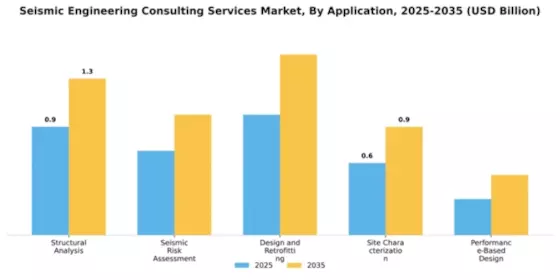
Seismic Risk Assessment (Dominant) vs. Performance-Based Design (Emerging)
Seismic Risk Assessment remains the dominant segment in the Seismic Engineering Consulting Services Market, primarily due to its comprehensive evaluation of potential damage and risks associated with seismic activities. This service is critical for various stakeholders, including construction companies and governmental agencies, as it informs decision-making regarding infrastructure safety and resource allocation. On the other hand, Performance-Based Design is emerging as a transformative approach, focusing on achieving specific performance objectives tailored to the unique conditions of a site. This technique fosters innovation in design and enables engineers to create structures that not only comply with regulations but also perform effectively during seismic events. As knowledge on seismic analysis evolves, both segments are expected to play increasingly integral roles in enhancing structural resilience.
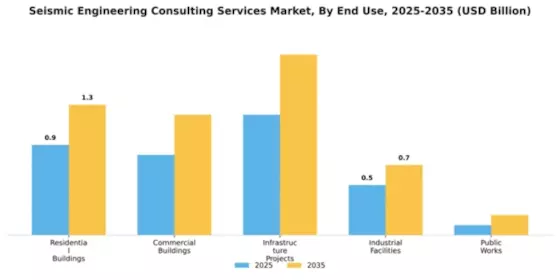
In the Seismic Engineering Consulting Services Market, the composition of the end-use segments reveals Residential Buildings as the largest contributor, commanding a significant share of demand. This sector is characterized by a consistent need for seismic assessments and retrofitting, driven by increasing urbanization and regulatory mandates for safety standards. In contrast, Infrastructure Projects, while currently smaller in share, are rapidly gaining traction due to heightened government investments in public infrastructure, aimed at improving resilience against natural disasters.
Residential Buildings (Dominant) vs. Industrial Facilities (Emerging)
Residential Buildings serve as the dominant segment within the seismic consulting landscape, benefiting from growing urban populations and stringent building codes focused on safety. This sector demands comprehensive seismic evaluations, risk assessments, and sustainable design practices. On the other hand, Industrial Facilities represent an emerging sector, with increased attention towards mitigating seismic risk in manufacturing and processing plants. The shift towards automated, high-capacity industrial operations requires specialized seismic consulting services to ensure structural integrity and business continuity, thereby creating compelling opportunities for growth in this segment.
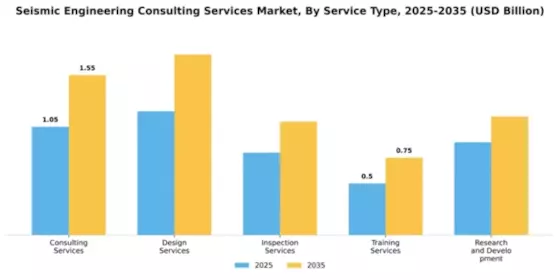
In the Seismic Engineering Consulting Services Market, Consulting Services hold the largest market share, driven by the increasing demand for expert analysis and strategic planning in various construction and engineering projects. This segment consists of on-site evaluations, risk assessments, and recommendations, making it essential for stakeholders needing to navigate seismic regulations and challenges. Following closely, Design Services are rapidly gaining traction, with a burgeoning interest in innovative solutions that integrate seismic design into new architectural projects. These services focus on developing safe structures that meet seismic codes while remaining aesthetically pleasing and functional.
Consulting Services: Dominant vs. Design Services: Emerging
Consulting Services have established themselves as the dominant segment in the Seismic Engineering Consulting Services Market due to their critical role in guiding clients through complex seismic evaluations and compliance requirements. These services encompass a wide range of expert consultations, including site assessments, risk mitigation strategies, and regulatory adherence. On the other hand, Design Services are emerging as a key player, increasingly appealing to architects and builders wanting to enhance structural integrity while complying with seismic safety standards. This segment emphasizes innovative design approaches, often utilizing technology to visualize and predict structural responses to seismic activity, positioning them as vital for modern construction needs.
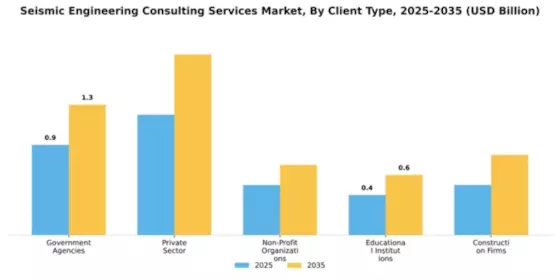
In the Seismic Engineering Consulting Services Market, Government Agencies hold the largest portion of market share, primarily due to their continuous investment in infrastructure and disaster preparedness initiatives. This sector benefits from regulatory requirements and a societal push for safer construction practices, leading to a stable demand for seismic consulting services. On the other hand, the Private Sector, while smaller in overall share, is emerging as the fastest-growing segment. This growth is largely driven by increased awareness of seismic risks and an expanding construction industry looking to incorporate advanced safety measures.
Government Agencies: (Dominant) vs. Private Sector (Emerging)
The Government Agencies segment is characterized by long-term contracts and consistent funding, fueling a steady stream of projects for seismic engineering consulting. These agencies prioritize safety and compliance, ensuring that all structures meet or exceed seismic standards, thereby creating high demand. In contrast, the Private Sector represents an emerging market influenced by innovation and technology adoption. Companies are increasingly recognizing the importance of seismic resilience in urban development, leading to greater investments in seismic risk assessment and consultation. This dual demand for cutting-edge solutions while adhering to safety regulations makes the Private Sector a dynamic player in the market.
Get more detailed insights about Seismic Engineering Consulting Services Market Request Free Sample
North America is poised to maintain its leadership in the Seismic Engineering Consulting Services Market, holding a market size of $1.75B in 2025. The region's growth is driven by stringent building codes, increased infrastructure investments, and heightened awareness of seismic risks. Regulatory frameworks, such as the International Building Code, further catalyze demand for specialized consulting services, ensuring structures are resilient against seismic events. The competitive landscape is robust, with key players like AECOM, Jacobs Engineering Group, and WSP Global Inc. leading the charge. The U.S. and Canada are the primary markets, benefiting from advanced technology and a skilled workforce. The presence of established firms fosters innovation and collaboration, enhancing service offerings and driving market growth. As urbanization continues, the demand for seismic consulting services is expected to rise significantly.
Europe's Seismic Engineering Consulting Services Market is projected to reach $1.0B by 2025, driven by increasing regulatory requirements and a focus on sustainable construction practices. Countries like Germany, France, and Italy are leading the charge, implementing stringent seismic regulations that necessitate expert consulting services. The European Union's commitment to enhancing infrastructure resilience against natural disasters further propels market growth, creating a favorable environment for seismic engineering firms. The competitive landscape features prominent players such as Ramboll Group and Arup Group, which are leveraging innovative technologies to enhance service delivery. The presence of these firms, along with a growing number of local consultancies, fosters a dynamic market environment. As awareness of seismic risks increases, the demand for specialized consulting services is expected to grow, positioning Europe as a key player in the global market.
The Asia-Pacific region is witnessing significant growth in the Seismic Engineering Consulting Services Market, projected to reach $0.6B by 2025. This growth is fueled by rapid urbanization, increased investment in infrastructure, and a rising awareness of seismic risks. Countries like Japan, China, and India are at the forefront, implementing stricter building codes and investing in disaster preparedness, which drives demand for specialized consulting services. The competitive landscape is evolving, with both The Seismic Engineering Consulting Services share. Key firms such as Golder Associates and Stantec Inc. are expanding their presence in the region, leveraging advanced technologies to offer innovative solutions. As governments prioritize infrastructure resilience, the demand for seismic consulting services is expected to surge, making Asia-Pacific a critical market for future growth.
The Middle East and Africa region is gradually developing its Seismic Engineering Consulting Services Market, with a projected size of $0.15B by 2025. The growth is primarily driven by increasing urbanization and infrastructure development, particularly in countries like the UAE and South Africa. However, the market faces challenges such as limited regulatory frameworks and varying levels of awareness regarding seismic risks, which can hinder growth. Despite these challenges, there is a growing interest in seismic resilience, with key players beginning to establish a foothold in the region. Firms like Tetra Tech and Mott MacDonald are exploring opportunities to provide consulting services tailored to local needs. As awareness of seismic risks increases, the demand for specialized consulting services is expected to grow, albeit at a slower pace compared to other regions.
The Seismic Engineering Consulting Services Market is characterized by a competitive landscape that is increasingly shaped by innovation, strategic partnerships, and a focus on sustainability. Key players such as AECOM (US), WSP Global Inc. (CA), and Jacobs Engineering Group (US) are at the forefront, leveraging their extensive expertise to address the growing demand for resilient infrastructure in seismically active regions. These companies are not only enhancing their service offerings through technological advancements but are also engaging in strategic mergers and acquisitions to bolster their market positions. The collective strategies of these firms indicate a trend towards a more integrated approach to seismic risk management, which is likely to redefine competitive dynamics in the market.In terms of business tactics, companies are increasingly localizing their operations to better serve regional markets, thereby optimizing their supply chains. The market structure appears moderately fragmented, with several players vying for market share while also collaborating on large-scale projects. This competitive environment is influenced by the need for specialized knowledge and localized expertise, which allows firms to tailor their services to meet specific regulatory and environmental requirements.In November WSP Global Inc. (CA) announced a strategic partnership with a leading technology firm to develop advanced seismic simulation software. This initiative aims to enhance predictive modeling capabilities, thereby improving the accuracy of seismic assessments. The strategic importance of this partnership lies in its potential to position WSP as a leader in digital transformation within the seismic engineering sector, enabling more efficient project delivery and risk mitigation.In October Jacobs Engineering Group (US) expanded its operations in the Asia-Pacific region by acquiring a local seismic consulting firm. This acquisition is expected to enhance Jacobs' regional expertise and strengthen its service offerings in a market that is witnessing increased investment in infrastructure resilience. The strategic move underscores Jacobs' commitment to expanding its footprint in high-growth areas, which is crucial for maintaining competitive advantage in a rapidly evolving market.In September AECOM (US) launched a new sustainability initiative aimed at integrating green building practices into seismic engineering projects. This initiative reflects a growing trend towards sustainability in engineering practices, as clients increasingly demand environmentally responsible solutions. AECOM's proactive approach not only enhances its market appeal but also aligns with global sustainability goals, potentially setting a benchmark for competitors.As of December the competitive trends in the Seismic Engineering Consulting Services Market are heavily influenced by digitalization, sustainability, and the integration of artificial intelligence (AI) into engineering practices. Strategic alliances are becoming more prevalent, as firms recognize the value of collaboration in addressing complex seismic challenges. Looking ahead, competitive differentiation is likely to evolve from traditional price-based competition to a focus on innovation, technological advancements, and supply chain reliability. This shift may redefine how companies position themselves in the market, emphasizing the importance of adaptability and forward-thinking strategies.




The Seismic Engineering Consulting Services Market is projected to grow at a 3.66% CAGR from 2025 to 2035, driven by increasing infrastructure investments and stringent safety regulations.
New opportunities lie in:
By 2035, the market is expected to be robust, driven by innovation and strategic partnerships.
| MARKET SIZE 2024 | 3.5(USD Billion) |
| MARKET SIZE 2025 | 3.63(USD Billion) |
| MARKET SIZE 2035 | 5.2(USD Billion) |
| COMPOUND ANNUAL GROWTH RATE (CAGR) | 3.66% (2025 - 2035) |
| REPORT COVERAGE | Revenue Forecast, Competitive Landscape, Growth Factors, and Trends |
| BASE YEAR | 2024 |
| Market Forecast Period | 2025 - 2035 |
| Historical Data | 2019 - 2024 |
| Market Forecast Units | USD Billion |
| Key Companies Profiled | AECOM (US), WSP Global Inc. (CA), Jacobs Engineering Group (US), Ramboll Group (DK), Golder Associates (CA), Stantec Inc. (CA), Mott MacDonald (GB), Tetra Tech (US), Arup Group (GB) |
| Segments Covered | Application, End Use, Service Type, Client Type |
| Key Market Opportunities | Integration of advanced simulation technologies enhances seismic risk assessment capabilities in the Seismic Engineering Consulting Services Market. |
| Key Market Dynamics | Rising demand for resilient infrastructure drives growth in seismic engineering consulting services amid evolving regulatory standards. |
| Countries Covered | North America, Europe, APAC, South America, MEA |
The market valuation was 3.5 USD Billion in 2024.
The market is projected to reach 5.2 USD Billion by 2035.
The expected CAGR is 3.66% during the forecast period 2025 - 2035.
Key players include AECOM, WSP Global Inc., Jacobs Engineering Group, and Ramboll Group.
The segment for Infrastructure Projects had the highest valuation at 1.2 USD Billion in 2024.
The Design and Retrofitting segment is projected to grow from 1.0 USD Billion in 2024 to 1.5 USD Billion by 2035.
The Consulting Services segment was valued at 1.05 USD Billion in 2024.
The Infrastructure Projects category is expected to grow from 1.2 USD Billion in 2024 to 1.8 USD Billion by 2035.
The Private Sector client type is projected to reach 1.8 USD Billion by 2035.
The Performance-Based Design segment is expected to grow from 0.3 USD Billion in 2024 to 0.5 USD Billion by 2035.


Kindly complete the form below to receive a free sample of this Report

“This is really good guys. Excellent work on a tight deadline. I will continue to use you going forward and recommend you to others. Nice job”


“Thanks. It’s been a pleasure working with you, please use me as reference with any other Intel employees.”


“Thanks for sending the report it gives us a good global view of the Betaïne market.”


“Thank you, this will be very helpful for OQS.”


“We found the report very insightful! we found your research firm very helpful. I'm sending this email to secure our future business.”


“I am very pleased with how market segments have been defined in a relevant way for my purposes (such as "Portable Freezers & refrigerators" and "last-mile"). In general the report is well structured. Thanks very much for your efforts.”


“I have been reading the first document or the study, ,the Global HVAC and FP market report 2021 till 2026. Must say, good info! I have not gone in depth at all parts, but got a good indication of the data inside!”


“We got the report in time, we really thank you for your support in this process. I also thank to all of your team as they did a great job.”


“The Automotive 48V ECU Components Procurement Intelligence Study” was a complex project, but the Market Research Future (MRFR) team handled it with quality, agility, and customer-centricity. They delivered all requested data on time and within the agreed scope. The team, including Shubhendra Anand and Rahul Gotadki, was always readily available to clarify questions and swiftly implement necessary adjustments, driving the project to a successful conclusion within a very demanding timeframe.
I would also like to specifically commend Akshay Agarwal for his responsiveness and support at every stage—from our initial inquiry on May 6th through to final delivery on June 18th. His dedication made the entire process seamless.”



