×
Request Free Sample ×

Kindly complete the form below to receive a free sample of this Report

* Please use a valid business email

Leading companies partner with us for data-driven Insights

clients tt-cursor
Hero Background

Selective Catalytic Reduction (SCR) Market

ID: MRFR/AT/3881-HCR
111 Pages
Swapnil Palwe
October 2025

Selective Catalytic Reduction (SCR) Market Research Report Information by Application (diesel powered vehicles and gasoline powered vehicles), Vehicle Type (passenger vehicle and commercial vehicle), Region (Tracking and Optimization), and by Regions - Global Forecast To 2035

Share:
Download PDF ×

We do not share your information with anyone. However, we may send you emails based on your report interest from time to time. You may contact us at any time to opt-out.

Selective Catalytic Reduction Market Infographic
Purchase Options

Selective Catalytic Reduction (SCR) Market Summary

As per MRFR analysis, the Selective Catalytic Reduction Market Size was estimated at 1200.0 USD Million in 2024. The Selective Catalytic Reduction industry is projected to grow from 1300.0 in 2025 to 2300.0 by 2035, exhibiting a compound annual growth rate (CAGR) of 5.87 during the forecast period 2025 - 2035.

Key Market Trends & Highlights

The Selective Catalytic Reduction Market is poised for substantial growth driven by regulatory pressures and technological advancements.

  • North America remains the largest market for Selective Catalytic Reduction systems, primarily due to stringent environmental regulations.
  • The Asia-Pacific region is currently the fastest-growing market, fueled by increasing industrialization and urbanization.
  • The automotive segment dominates the market, with light duty vehicles leading in SCR system adoption, while heavy duty vehicles exhibit the fastest growth.
  • Key market drivers include rising demand for diesel vehicles and increasing environmental regulations that necessitate advanced SCR technologies.

Market Size & Forecast

2024 Market Size 1200.0 (USD Million)
2035 Market Size 2300.0 (USD Million)
CAGR (2025 - 2035) 5.87%

Major Players

BASF (DE), Johnson Matthey (GB), Continental AG (DE), Umicore (BE), Haldor Topsoe (DK), Yara International (NO), Clariant (CH), SABIC (SA), Eaton Corporation (US)

Selective Catalytic Reduction (SCR) Market Trends

The Selective Catalytic Reduction Market is currently experiencing a notable transformation, driven by increasing environmental regulations and the growing emphasis on reducing nitrogen oxide emissions from various industrial processes. This market appears to be expanding as industries seek to comply with stringent emission standards, which are becoming more prevalent across the globe. The adoption of advanced technologies and innovative catalysts is likely to enhance the efficiency of selective catalytic reduction systems, thereby improving their overall performance. Furthermore, the rising demand for cleaner energy sources and sustainable practices is propelling investments in this sector, indicating a shift towards greener alternatives in industrial applications. In addition, the Selective Catalytic Reduction Market seems to be influenced by the automotive sector's transition towards electrification and hybrid technologies. As manufacturers strive to meet increasingly rigorous emission targets, the integration of selective catalytic reduction systems in diesel engines is becoming more common. This trend suggests a potential for growth in the market as automotive companies invest in research and development to optimize these systems. Overall, the Selective Catalytic Reduction Market is poised for continued evolution, reflecting broader trends in environmental sustainability and technological advancement.

Regulatory Pressures

The Selective Catalytic Reduction Market is significantly shaped by stringent environmental regulations aimed at reducing harmful emissions. Governments worldwide are implementing policies that mandate lower nitrogen oxide emissions, compelling industries to adopt selective catalytic reduction technologies to comply with these standards.

Technological Advancements

Innovations in catalyst materials and system designs are driving improvements in the Selective Catalytic Reduction Market. Enhanced efficiency and effectiveness of these systems are likely to emerge from ongoing research, leading to better performance and lower operational costs.

Automotive Sector Dynamics

The automotive industry is increasingly integrating selective catalytic reduction systems into diesel engines to meet emission regulations. This trend indicates a shift towards cleaner technologies, suggesting that the Selective Catalytic Reduction Market will continue to grow as manufacturers adapt to evolving standards.

Selective Catalytic Reduction (SCR) Market Drivers

Growth in Industrial Applications

The Global Selective Catalytic Reduction Market Industry is expanding due to the increasing adoption of SCR technology in various industrial applications, including power generation and manufacturing. Industries are recognizing the importance of reducing nitrogen oxide emissions to meet regulatory requirements and enhance their sustainability profiles. For example, power plants are increasingly integrating SCR systems to comply with environmental standards. This trend is expected to drive market growth, as industries invest in cleaner technologies to mitigate their environmental impact and improve air quality.

Rising Demand for Diesel Vehicles

The Global Selective Catalytic Reduction Market Industry is bolstered by the increasing demand for diesel vehicles, which are known for their fuel efficiency and lower CO2 emissions compared to gasoline counterparts. This trend is particularly evident in regions such as Europe and Asia, where diesel engines dominate the automotive market. The integration of SCR technology in these vehicles is essential for meeting stringent emission standards. As the automotive sector continues to evolve, the market is expected to grow significantly, with projections indicating a value of 28.1 USD Billion by 2035, driven by the sustained demand for cleaner diesel options.

Increasing Environmental Regulations

The Global Selective Catalytic Reduction Market Industry is experiencing growth due to stringent environmental regulations aimed at reducing nitrogen oxide emissions from vehicles and industrial sources. Governments worldwide are implementing policies that mandate the use of SCR technology in diesel engines, which is crucial for compliance with emission standards. For instance, the European Union's Euro 6 regulations and the United States' EPA standards necessitate the adoption of SCR systems. As a result, the market is projected to reach 15.3 USD Billion in 2024, reflecting the industry's response to these regulatory pressures.

Expansion of Global Automotive Market

The Global Selective Catalytic Reduction Market Industry is significantly impacted by the expansion of the global automotive market, particularly in emerging economies. As countries like India and China experience rapid urbanization and economic growth, the demand for vehicles, especially those equipped with diesel engines, is surging. This growth necessitates the implementation of SCR technology to adhere to evolving emission standards. Consequently, the market is poised for substantial growth, with projections indicating a robust trajectory as manufacturers adapt to the increasing demand for cleaner transportation solutions.

Technological Advancements in SCR Systems

The Global Selective Catalytic Reduction Market Industry is influenced by ongoing technological advancements in SCR systems, which enhance their efficiency and effectiveness. Innovations such as improved catalyst formulations and better system designs contribute to higher performance and lower operational costs. These advancements not only facilitate compliance with emission regulations but also appeal to manufacturers seeking to optimize their production processes. As a result, the market is likely to witness a compound annual growth rate of 5.66% from 2025 to 2035, reflecting the industry's commitment to continuous improvement and innovation.
Market Segment Insights

By Application: Automotive (Largest) vs. Industrial (Fastest-Growing)

In the Selective Catalytic Reduction (SCR) market, the automotive segment holds the largest market share, significantly driven by stringent emissions regulations. This segment is primarily fueled by advancements in vehicle technologies and increasing production of medium and heavy-duty vehicles that necessitate efficient SCR systems for NOx reduction. In contrast, the industrial sector is witnessing rapid growth, characterized by the increasing implementation of SCR technologies to comply with environmental standards across various industrial processes.

Automotive: SCR (Dominant) vs. Industrial (Emerging)

The automotive segment remains at the forefront, benefiting from continuous innovations in diesel and gasoline engine technologies that incorporate SCR. This dominance is supplemented by regulatory pressures to lower emissions, enhancing the adoption of SCR systems in passenger cars and commercial vehicles. On the other hand, the industrial segment is emerging robustly as industries seek to mitigate their environmental impact. With rising energy costs and environmental regulations, industrial players are increasingly adopting SCR solutions to not only comply with emission control standards but to also improve operational efficiencies, making this segment vital for future market expansion.

By End Use: Light Duty Vehicles (Largest) vs. Heavy Duty Vehicles (Fastest-Growing)

The Selective Catalytic Reduction Market shows a diverse distribution among its end use segments. Light Duty Vehicles (LDVs) take the lead as the largest segment, benefiting from the increasing adoption of stringent emission regulations and consumer preference for fuel-efficient vehicles. In contrast, Heavy Duty Vehicles (HDVs) are emerging rapidly, driven by the industrial demand for compliance with evolving environmental policies, thus attracting significant investments in SCR technology.

Light Duty Vehicles (Dominant) vs. Heavy Duty Vehicles (Emerging)

Light Duty Vehicles represent the dominant segment in the Selective Catalytic Reduction Market, characterized by a vast fleet of cars focusing on emission reduction technologies. These vehicles are typically equipped with SCR systems to meet regulatory standards and enhance fuel efficiency. Conversely, Heavy Duty Vehicles are an emerging segment experiencing rapid growth due to the heightened focus on minimizing diesel emissions in commercial transport. The adoption of SCR systems in HDVs is spurred by the need for sustainability in logistics and transportation, making them a significant player in the overall market landscape.

By Technology: Selective Catalytic Reduction (Largest) vs. Diesel Oxidation Catalyst (Fastest-Growing)

The Selective Catalytic Reduction (SCR) segment holds a commanding share in the Selective Catalytic Reduction Market, due to its effectiveness in reducing nitrogen oxide (NOx) emissions from diesel engines. Following SCR, the Diesel Oxidation Catalyst (DOC) is also gaining traction, primarily driven by regulatory pressures and the automotive industry’s shift towards cleaner technologies. Ammonia Slip Catalysts (ASC) and Lean NOx Traps (LNT) represent smaller portions of the market but are pivotal in specific applications where high levels of NOx reduction are mandated.

Technology: SCR (Dominant) vs. LNT (Emerging)

The Selective Catalytic Reduction (SCR) technology stands out as the dominant solution in the market due to its high efficiency and broad applicability across various diesel engine models. Its ability to handle wide-ranging NOx emissions and integrate seamlessly with existing systems makes it a preferred choice among manufacturers and operators. On the other hand, Lean NOx Traps (LNT) are emerging as a complementary technology, especially in light-duty diesel applications. While LNTs are not yet widely adopted as SCRs, their capability to reduce NOx without the need for additional urea injection places them as a valuable option for specific scenarios where simpler implementation is key.

By Component: Catalyst (Largest) vs. Ammonia Storage Tank (Fastest-Growing)

The Selective Catalytic Reduction Market is primarily driven by the Catalyst component, which holds the largest market share among other components such as Reactor, Control System, and Ammonia Storage Tank. Catalysts are essential for promoting the necessary chemical reactions to reduce nitrogen oxides in exhaust gases, making them crucial for regulatory compliance and emissions reduction strategies. Ammonia Storage Tanks also display significant importance, supporting the supply chain for ammonia, which is used in the catalytic process. These components play a vital role in defining the market landscape and catering to the growing environmental concerns.

Catalyst (Dominant) vs. Ammonia Storage Tank (Emerging)

The Catalyst segment stands out as the dominant force in the Selective Catalytic Reduction Market, primarily due to its critical role in enabling efficient NOx reduction across various applications, including automotive and industrial sectors. With advancements in catalyst technology, including improved formulations and durability, this segment is poised for sustained growth. In contrast, the Ammonia Storage Tank represents an emerging component, increasingly recognized for its necessity in the SCR process. As regulations tighten on emissions, the demand for ammonia as a reducing agent escalates, positioning storage tanks as pivotal infrastructure. Both segments complement each other, with catalysts driving immediate performance and ammonia storage tanks ensuring supply reliability.

By Fuel Type: Diesel (Largest) vs. Natural Gas (Fastest-Growing)

In the Selective Catalytic Reduction (SCR) market, Diesel remains the largest fuel type, driven by its widespread use in commercial and heavy-duty vehicles. It holds a significant portion of the market share due to its reliability and efficiency in reducing nitrogen oxides (NOx) emissions. Natural Gas, while currently smaller in market share, is rapidly gaining traction as an alternative fuel, thanks to environmental regulations and the push for cleaner energy solutions.

Diesel (Dominant) vs. Natural Gas (Emerging)

Diesel fuel dominates the Selective Catalytic Reduction market owing to its established infrastructure and extensive application in various industries. Its high energy density and efficiency make it a preferred choice for heavy-duty transportation. In contrast, Natural Gas is emerging as a significant fuel type due to its lower carbon emissions and growing adoption in the transportation sector. Governments are increasingly promoting Natural Gas as a cleaner alternative to Diesel, resulting in investments in fueling infrastructure and SCR technologies designed for this fuel type. This shift is aligned with global sustainability goals, making Natural Gas not only a viable option but a crucial component in the transition towards cleaner fuels.

Get more detailed insights about Selective Catalytic Reduction (SCR) Market

Regional Insights

North America : Market Leader in SCR Technology

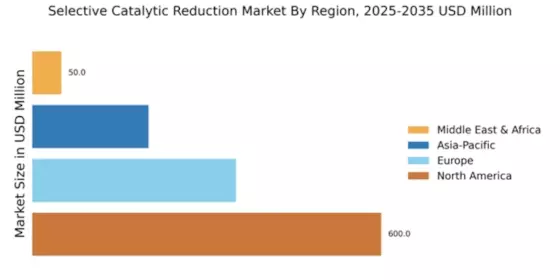
North America is poised to maintain its leadership in the Selective Catalytic Reduction (SCR) market, holding a significant share of 600.0. The region's growth is driven by stringent environmental regulations aimed at reducing NOx emissions, alongside increasing demand for cleaner technologies in transportation and industrial sectors. The push for sustainable practices and government incentives further catalyze market expansion. The United States stands as the primary market, supported by key players such as BASF, Johnson Matthey, and Eaton Corporation. The competitive landscape is characterized by innovation and strategic partnerships, with companies investing heavily in R&D to enhance SCR efficiency. The presence of established manufacturers and a robust supply chain contribute to North America's dominance in the SCR market.

Europe : Regulatory-Driven Market Growth

Europe's Selective Catalytic Reduction (SCR) market is projected to grow significantly, with a market size of 300.0. The region benefits from stringent EU regulations aimed at reducing vehicle emissions, which drive demand for SCR systems in automotive and industrial applications. The European Green Deal and other initiatives further support the transition to cleaner technologies, enhancing market prospects. Leading countries such as Germany, France, and the UK are at the forefront of this growth, with major players like Umicore and Clariant leading the charge. The competitive landscape is marked by innovation and collaboration among manufacturers, focusing on developing advanced SCR solutions. The presence of a well-established automotive industry bolsters the demand for SCR technologies across Europe.

Asia-Pacific : Emerging Market Potential

The Asia-Pacific region is witnessing a burgeoning Selective Catalytic Reduction (SCR) market, with a size of 250.0. Rapid industrialization, urbanization, and increasing vehicle production are key drivers of demand for SCR technologies. Governments are implementing stricter emission standards, which further propel the adoption of SCR systems in various sectors, including automotive and power generation. Countries like China, Japan, and India are leading the charge in this market, with significant investments from key players such as Haldor Topsoe and Yara International. The competitive landscape is evolving, with local manufacturers emerging alongside established global players. The region's focus on sustainable development and environmental protection is expected to enhance the growth of the SCR market in the coming years.

Middle East and Africa : Developing Market Landscape

The Middle East and Africa (MEA) region represents a nascent but growing market for Selective Catalytic Reduction (SCR) technologies, with a market size of 50.0. The growth is primarily driven by increasing industrial activities and the need for compliance with international environmental standards. Governments are beginning to recognize the importance of reducing emissions, which is expected to catalyze market development in the coming years. Countries like South Africa and the UAE are emerging as key players in the SCR landscape, with investments in cleaner technologies gaining momentum. The competitive environment is characterized by a mix of local and international players, with companies exploring partnerships to enhance their market presence. As awareness of environmental issues grows, the SCR market in MEA is set for gradual expansion.

Key Players and Competitive Insights

The Selective Catalytic Reduction Market is currently characterized by a dynamic competitive landscape, driven by stringent emissions regulations and the increasing demand for cleaner technologies. Key players such as BASF (DE), Johnson Matthey (GB), and Umicore (BE) are strategically positioned to leverage their technological expertise and extensive product portfolios. BASF (DE) focuses on innovation in catalyst formulations, while Johnson Matthey (GB) emphasizes sustainable solutions through its advanced materials. Umicore (BE) is actively pursuing partnerships to enhance its recycling capabilities, which collectively shapes a competitive environment that prioritizes sustainability and technological advancement.

In terms of business tactics, companies are increasingly localizing manufacturing to reduce costs and enhance supply chain efficiency. The market structure appears moderately fragmented, with several players vying for market share. However, the collective influence of major companies like Continental AG (DE) and Haldor Topsoe (DK) is notable, as they continue to optimize their operations and expand their global footprint, thereby intensifying competition.

In November 2025, BASF (DE) announced a strategic partnership with a leading automotive manufacturer to develop next-generation SCR systems aimed at reducing NOx emissions by up to 30%. This collaboration is significant as it not only reinforces BASF's commitment to innovation but also positions the company as a key player in the transition towards more sustainable automotive technologies. The partnership is expected to enhance BASF's market presence and drive growth in the SCR segment.

In October 2025, Johnson Matthey (GB) unveiled a new line of catalysts designed specifically for heavy-duty diesel engines, which are projected to improve fuel efficiency by 15%. This development underscores the company's focus on addressing the evolving needs of the automotive sector while adhering to stringent emissions standards. The introduction of these catalysts is likely to strengthen Johnson Matthey's competitive edge in the market.

In September 2025, Umicore (BE) expanded its recycling operations by acquiring a facility in North America, aimed at increasing its capacity to recover precious metals from spent catalysts. This strategic move is indicative of Umicore's commitment to sustainability and resource efficiency, aligning with global trends towards circular economy practices. The acquisition is expected to enhance Umicore's operational capabilities and market position.

As of December 2025, current competitive trends in the Selective Catalytic Reduction Market are heavily influenced by digitalization, sustainability initiatives, and the integration of AI technologies. Strategic alliances are increasingly shaping the landscape, as companies recognize the importance of collaboration in driving innovation. Looking ahead, competitive differentiation is likely to evolve from traditional price-based competition to a focus on technological advancements, supply chain reliability, and sustainable practices, reflecting the industry's shift towards a more environmentally conscious future.

Key Companies in the Selective Catalytic Reduction (SCR) Market market include

Industry Developments

  • Q1 2024: BASF launches new high-performance SCR catalyst for heavy-duty vehicles BASF announced the launch of a next-generation selective catalytic reduction (SCR) catalyst designed to help heavy-duty vehicle manufacturers meet stricter emission standards in Europe and North America. The new catalyst offers improved NOx reduction efficiency and durability.
  • Q2 2024: Johnson Matthey opens new SCR catalyst manufacturing facility in Poland Johnson Matthey inaugurated a new production plant in Poland dedicated to manufacturing selective catalytic reduction (SCR) catalysts for automotive and industrial applications, expanding its European supply capabilities.
  • Q2 2024: Cummins and Tenneco announce partnership to develop advanced SCR systems for commercial vehicles Cummins and Tenneco revealed a strategic partnership to co-develop advanced selective catalytic reduction (SCR) systems aimed at helping commercial vehicle OEMs comply with upcoming global emission regulations.
  • Q3 2024: Umicore secures major contract to supply SCR catalysts to Chinese truck manufacturer Umicore announced it has won a multi-year contract to supply selective catalytic reduction (SCR) catalysts to a leading Chinese truck manufacturer, supporting the rollout of vehicles compliant with China VI emission standards.
  • Q3 2024: Daimler Truck unveils new generation of trucks with integrated SCR technology Daimler Truck introduced its latest truck models featuring advanced integrated selective catalytic reduction (SCR) systems, designed to meet the Euro 7 emission standards set to take effect in 2025.
  • Q4 2024: BASF signs supply agreement with Volvo for SCR catalysts in electric-diesel hybrid buses BASF entered into a long-term supply agreement with Volvo to provide selective catalytic reduction (SCR) catalysts for the automaker’s new line of electric-diesel hybrid buses targeting European urban markets.
  • Q4 2024: Corning expands SCR substrate production capacity in Germany Corning announced the expansion of its manufacturing facility in Kaiserslautern, Germany, to increase production of ceramic substrates used in selective catalytic reduction (SCR) systems for European automakers.
  • Q1 2025: Faurecia acquires minority stake in SCR technology startup EcoCatalyst Faurecia acquired a 20% stake in EcoCatalyst, a startup specializing in next-generation selective catalytic reduction (SCR) technologies, aiming to accelerate innovation in emissions control solutions.
  • Q1 2025: Johnson Matthey wins contract to supply SCR catalysts for Indian railways Johnson Matthey secured a contract to supply selective catalytic reduction (SCR) catalysts for a major Indian railway project, supporting the country’s efforts to reduce NOx emissions from diesel locomotives.
  • Q2 2025: Toyota launches new diesel engines with advanced SCR systems for Asian markets Toyota introduced a new line of diesel engines equipped with advanced selective catalytic reduction (SCR) systems, targeting commercial vehicles in Asian markets to comply with tightening emission regulations.
  • Q2 2025: BASF announces investment in US SCR catalyst R&D center BASF announced a significant investment to establish a new research and development center in the United States focused on advancing selective catalytic reduction (SCR) catalyst technologies for automotive and industrial applications.
  • Q3 2025: Tenneco secures supply contract for SCR systems with major European bus manufacturer Tenneco announced it has secured a multi-year contract to supply selective catalytic reduction (SCR) systems to a leading European bus manufacturer, supporting the transition to cleaner public transportation fleets.

Future Outlook

Selective Catalytic Reduction (SCR) Market Future Outlook

The Selective Catalytic Reduction Market is projected to grow at a 5.87% CAGR from 2024 to 2035, driven by stringent emission regulations and technological advancements.

New opportunities lie in:

  • Development of advanced SCR catalysts for improved efficiency
  • Integration of SCR systems in electric vehicle manufacturing
  • Expansion into emerging markets with tailored solutions

By 2035, the market is expected to achieve robust growth, driven by innovation and regulatory compliance.

Market Segmentation

Selective Catalytic Reduction Market End Use Outlook

  • Light Duty Vehicles
  • Heavy Duty Vehicles
  • Commercial Vehicles
  • Off-Road Vehicles

Selective Catalytic Reduction Market Component Outlook

  • Catalyst
  • Reactor
  • Control System
  • Ammonia Storage Tank

Selective Catalytic Reduction Market Fuel Type Outlook

  • Diesel
  • Natural Gas
  • Biodiesel
  • Hydrogen

Selective Catalytic Reduction Market Technology Outlook

  • Selective Catalytic Reduction
  • Ammonia Slip Catalyst
  • Diesel Oxidation Catalyst
  • Lean NOx Trap

Selective Catalytic Reduction Market Application Outlook

  • Automotive
  • Industrial
  • Marine
  • Power Generation

Report Scope

MARKET SIZE 20241200.0(USD Million)
MARKET SIZE 20251300.0(USD Million)
MARKET SIZE 20352300.0(USD Million)
COMPOUND ANNUAL GROWTH RATE (CAGR)5.87% (2024 - 2035)
REPORT COVERAGERevenue Forecast, Competitive Landscape, Growth Factors, and Trends
BASE YEAR2024
Market Forecast Period2025 - 2035
Historical Data2019 - 2024
Market Forecast UnitsUSD Million
Key Companies ProfiledBASF (DE), Johnson Matthey (GB), Continental AG (DE), Umicore (BE), Haldor Topsoe (DK), Yara International (NO), Clariant (CH), SABIC (SA), Eaton Corporation (US)
Segments CoveredApplication, End Use, Technology, Component, Fuel Type
Key Market OpportunitiesIncreasing regulatory pressures drive demand for advanced Selective Catalytic Reduction technologies in automotive applications.
Key Market DynamicsRising regulatory pressures drive demand for Selective Catalytic Reduction systems in automotive and industrial applications.
Countries CoveredNorth America, Europe, APAC, South America, MEA

Market Highlights

Author
Swapnil Palwe
Team Lead - Research

With a technical background as Bachelor's in Mechanical Engineering, with MBA in Operations Management , Swapnil has 6+ years of experience in market research, consulting and analytics with the tasks of data mining, analysis, and project execution. He is the POC for our clients, for their consulting projects running under the Automotive/A&D domain. Swapnil has worked on major projects in verticals such as Aerospace & Defense, Automotive and many other domain projects. He has worked on projects for fortune 500 companies' syndicate and consulting projects along with several government projects.

Leave a Comment

FAQs

What is the primary driving factor of the global selective catalytic reduction (SCR) market?

Technological advancements, rapid urbanization, and increasing initiatives to crub vehicle emissions are driving the growth of the market.

What factor poses as a challenge for the players of the global selective catalytic reduction (SCR) market?

the high cost associated with SCR are likely to hamper the growth of the selective catalytic reduction (SCR) market over the review period.

What is the application segment of the global selective catalytic reduction (SCR) market expected to witness the highest growth?

The gasoline-powered vehicles segment is slated to expand as the fastest-growing segment.

What is the vehicle type segment of the global selective catalytic reduction (SCR) market expected to witness the highest growth?

The commercial vehicle segment is slated to expand as the fastest-growing segment.

Who are the key players operative in the global selective catalytic reduction (SCR) market?

A few major market players operating in the global selective catalytic reduction (SCR) market are Eberspacher Group (Germany), Faurecia SA (France), Tenneco, Inc. (U.S.), Benteler International AG (Germany), among others.

Download Free Sample

Kindly complete the form below to receive a free sample of this Report

Compare Licence

×
Features License Type
Single User Multiuser License Enterprise User
Price $4,950 $5,950 $7,250
Maximum User Access Limit 1 User Upto 10 Users Unrestricted Access Throughout the Organization
Free Customization
Direct Access to Analyst
Deliverable Format
Platform Access
Discount on Next Purchase 10% 15% 15%
Printable Versions