×
Request Free Sample ×

Kindly complete the form below to receive a free sample of this Report

* Please use a valid business email

Leading companies partner with us for data-driven Insights

clients tt-cursor
Hero Background

Shredder Blades Market

ID: MRFR/Equip/14650-HCR
128 Pages
Snehal Singh
October 2025

Shredder Blades Market Research Report Information By Blade Material (Carburizing Steel, Tool Steel, Case Hardened, and Chromium Low Alloy Steel), By Shaft Count (Single Shaft, Double Shaft, and Other Shafts), By Blade Design (Hook and Square), By Application (Plastic, Rubber, Metals, Wood, E-waste, Paper & Cardboard, and Other Applications), By End-use Industries (Waste Management & Recycling, Food, Pharmaceuticals, and Other End-use Industries), By Region (North America, Europe, Asia-Pacific, And Rest Of The World) –Market Forecast... read more

Share:
Download PDF ×

We do not share your information with anyone. However, we may send you emails based on your report interest from time to time. You may contact us at any time to opt-out.

Shredder Blades Market Infographic
Purchase Options

Shredder Blades Market Summary

As per MRFR analysis, the Shredder Blades Market Size was estimated at 531.5 USD Billion in 2024. The Shredder Blades industry is projected to grow from 562.87 in 2025 to 998.74 by 2035, exhibiting a compound annual growth rate (CAGR) of 5.9 during the forecast period 2025 - 2035.

Key Market Trends & Highlights

The Shredder Blades Market is poised for growth driven by sustainability and technological advancements.

  • The North American region remains the largest market for shredder blades, reflecting a strong demand for recycling solutions.
  • Asia-Pacific is emerging as the fastest-growing region, propelled by increasing industrial activities and waste management needs.
  • Plastic shredding continues to dominate the market, while wood shredding is rapidly gaining traction due to rising environmental concerns.
  • Key market drivers include the rising demand for recycling solutions and the expansion of the construction and demolition sector.

Market Size & Forecast

2024 Market Size 531.5 (USD Billion)
2035 Market Size 998.74 (USD Billion)
CAGR (2025 - 2035) 5.9%

Major Players

Weima (DE), Vecoplan (DE), SSI Shredding Systems (US), Eldan Recycling (DK), Shred-Tech (CA), Granutech-Saturn Systems (US), BCA Industries (US), Doppstadt (DE)

Shredder Blades Market Trends

The Shredder Blades Market is currently experiencing a dynamic evolution, driven by various factors that influence demand and innovation. The increasing emphasis on recycling and waste management has led to a heightened need for efficient shredding solutions across multiple industries. As organizations strive to enhance their sustainability practices, the role of shredder blades becomes increasingly critical. Furthermore, advancements in materials and manufacturing processes are likely to improve the performance and longevity of these blades, thereby attracting more users. This trend suggests a shift towards more durable and efficient products, which could reshape the competitive landscape of the market. In addition to sustainability, the Shredder Blades Market is also influenced by technological advancements. The integration of smart technologies into shredding equipment appears to enhance operational efficiency and safety. Companies are likely to invest in automated systems that utilize advanced sensors and controls, which may lead to improved productivity. Moreover, the growing demand for customized solutions tailored to specific applications indicates a potential shift in market dynamics. As industries evolve, the need for specialized shredder blades that cater to unique requirements may become more pronounced, further diversifying the market landscape.

Sustainability Focus

The emphasis on recycling and waste management is driving demand for efficient shredding solutions. Organizations are increasingly adopting shredders to enhance their sustainability practices, which is likely to boost the Shredder Blades Market.

Technological Integration

The incorporation of smart technologies into shredding equipment is enhancing operational efficiency. Automated systems with advanced sensors are expected to improve productivity and safety, influencing market growth.

Customization Trends

There is a growing demand for specialized shredder blades tailored to specific applications. This trend suggests that as industries evolve, the need for customized solutions may diversify the Shredder Blades Market.

Shredder Blades Market Drivers

Growth of the E-Waste Recycling Sector

The Global Shredder Blades Market Industry is significantly impacted by the rapid expansion of the e-waste recycling sector. With the increasing volume of electronic waste generated globally, there is a pressing need for efficient shredding solutions to recover valuable materials. In 2024, the e-waste recycling market is expected to contribute substantially to the overall recycling industry, which is projected to reach 531.5 USD Billion. Shredder blades designed specifically for e-waste applications are essential for processing complex materials, including circuit boards and batteries. This growth presents opportunities for manufacturers to innovate and develop specialized blades, thereby enhancing their market presence within the Global Shredder Blades Market Industry.

Regulatory Support for Waste Management

The Global Shredder Blades Market Industry benefits from increasing regulatory support aimed at enhancing waste management practices. Governments worldwide are implementing stricter regulations to promote recycling and reduce landfill waste, which in turn drives demand for shredding technologies. For instance, policies encouraging the recycling of plastics and electronic waste create a favorable environment for the adoption of advanced shredding solutions. As these regulations become more stringent, industries are compelled to invest in efficient shredding equipment, including high-performance blades. This regulatory landscape is likely to foster growth in the Global Shredder Blades Market Industry, as companies seek to comply with evolving standards and enhance their sustainability efforts.

Increasing Demand for Recycling Solutions

The Global Shredder Blades Market Industry experiences a surge in demand driven by the growing emphasis on recycling and waste management. As nations strive to meet environmental regulations and sustainability goals, the need for efficient shredding solutions becomes paramount. For instance, the global recycling market is projected to reach 531.5 USD Billion in 2024, indicating a robust growth trajectory. Shredder blades play a crucial role in this process, enabling the effective processing of various materials, including plastics and metals. Consequently, manufacturers are focusing on developing advanced blades that enhance shredding efficiency and durability, thereby supporting the overall growth of the Global Shredder Blades Market Industry.

Rising Industrialization and Urbanization

The Global Shredder Blades Market Industry is poised for growth due to the accelerating pace of industrialization and urbanization worldwide. As urban areas expand and industries proliferate, the volume of waste generated increases, necessitating efficient waste management solutions. This trend is particularly evident in developing countries, where urbanization rates are high. The demand for shredding equipment, including high-quality blades, is likely to rise as businesses seek to comply with environmental regulations and optimize waste disposal processes. The projected compound annual growth rate (CAGR) of 5.9% from 2025 to 2035 underscores the potential for growth in the Global Shredder Blades Market Industry as it adapts to these changing dynamics.

Technological Advancements in Blade Manufacturing

Technological innovations significantly influence the Global Shredder Blades Market Industry, as manufacturers adopt advanced materials and production techniques. The introduction of high-performance alloys and coatings enhances blade longevity and efficiency, catering to diverse shredding applications. For example, the integration of computer-aided design (CAD) and computer numerical control (CNC) machining allows for precision engineering of blades, resulting in improved performance. These advancements not only reduce operational costs but also contribute to the sustainability of shredding processes. As the industry evolves, the focus on innovation is likely to propel the market forward, aligning with the projected growth of the Global Shredder Blades Market Industry.
Market Segment Insights

By Application: Plastic Shredding (Largest) vs. Wood Shredding (Fastest-Growing)

In the Shredder Blades Market, the application segment is predominantly driven by plastic shredding, which holds the largest share. This sector is critical for recycling efforts, as the world grapples with increasing plastic waste. Metal shredding follows closely due to a consistent demand for recycling metals in industrial settings, while electronic waste and wood shredding are significant but represent smaller shares in the broader context. Each application plays a vital role in waste management and recycling strategies.

Plastic Shredding (Dominant) vs. Electronic Waste Shredding (Emerging)

Plastic shredding remains the dominant application in the Shredder Blades Market due to its crucial role in transforming plastic waste into recyclable materials. This segment benefits from stringent regulatory frameworks aimed at reducing plastic waste and increasing recycling rates. Conversely, electronic waste shredding is an emerging segment driven by rapid technological advancements and digital device proliferation. As e-waste becomes a significant environmental concern, the demand for efficient shredding solutions for electronics, including circuit boards and batteries, is projected to rise, presenting new opportunities for innovation and market growth.

By End Use: Recycling Industry (Largest) vs. Waste Management (Fastest-Growing)

The Shredder Blades Market is notably dominated by the Recycling Industry, which holds the largest share among various end-use segments. This industry relies heavily on effective shredding processes to recycle materials, thereby contributing significantly to sustainable practices. Meanwhile, the Waste Management segment is emerging rapidly, driven by increasing regulatory pressures and the growing emphasis on waste reduction and recycling initiatives, showcasing an upward trajectory within the market.

Recycling Industry (Dominant) vs. Waste Management (Emerging)

The Recycling Industry stands as the dominant force in the Shredder Blades Market, characterized by a robust demand for shredding equipment to process a wide range of materials for reuse. This sector focuses on optimizing material recovery, thus enhancing overall operational efficiency and sustainability. Conversely, the Waste Management segment is marked by its emerging status, propelled by innovations in waste processing technologies and rising public awareness regarding waste management practices. As regulations tighten and environmental concerns grow, investments in advanced shredding solutions are expected to escalate, making this segment increasingly vital for future market developments.

By Material Type: High Carbon Steel (Largest) vs. Stainless Steel (Fastest-Growing)

The Shredder Blades Market is primarily driven by various material types, which constitute a significant portion of the market share. Among them, High Carbon Steel remains the largest material type due to its excellent wear resistance and robust performance under high-stress conditions. This material is widely used in various industries, ensuring its leading position. On the other hand, Stainless Steel is gaining traction as an emerging material type, thanks to its corrosion-resistant properties and longevity, which make it ideal for applications requiring high hygiene standards.

High Carbon Steel (Dominant) vs. Stainless Steel (Emerging)

High Carbon Steel is a stalwart in the Shredder Blades Market, offering superior hardness and durability, making it the preferred choice for heavy-duty shredding applications. Its resilience against wear allows manufacturers to produce blades that withstand the rigors of agricultural, industrial, and municipal waste processing. In contrast, Stainless Steel is emerging rapidly, driven by sectors looking for enhanced corrosion resistance and hygiene, particularly in the food and medical industries. This growing preference for Stainless Steel blades reflects a shift towards materials that not only perform well but also improve operational longevity and product safety.

By Blade Type: Single Shaft Blades (Largest) vs. Double Shaft Blades (Fastest-Growing)

The Shredder Blades Market exhibits a diverse distribution in the blade type segment, where Single Shaft Blades dominate with a significant share due to their versatility and efficiency in processing various materials. Double Shaft Blades follow closely, gaining traction as industries increasingly adopt them for their enhanced shredding capabilities, allowing for a more powerful and effective shredding process.

Single Shaft Blades (Dominant) vs. Double Shaft Blades (Emerging)

Single Shaft Blades are recognized for their robust design and adaptability, making them the preferred choice in many applications, including waste reduction and material recycling. Their ability to handle different materials efficiently places them in a dominant position within the market. On the other hand, Double Shaft Blades are emerging rapidly, characterized by their dual-shaft design that provides increased torque and durability. This makes them suitable for tougher materials and enhances their appeal in industries focusing on heavy-duty shredding tasks.

By Size: Large Size Blades (Largest) vs. Medium Size Blades (Fastest-Growing)

The Shredder Blades Market showcases a diverse distribution among its size segments, with large size blades commanding the largest share of the market. These blades are favored in high-capacity industrial applications, leading to their strong market presence. On the other hand, medium size blades have emerged as a rapidly growing segment due to their versatility and adaptability in both small and medium-sized operations, catering to a broader range of customer needs in waste management.

Large Size Blades (Dominant) vs. Medium Size Blades (Emerging)

Large size blades are characterized by their robust construction, making them ideal for heavy-duty shredder machines used in large-scale industrial applications. Their dominance in the market stems from high processing efficiency for bulky materials, ensuring effective waste reduction and management. Meanwhile, medium size blades are gaining traction as an emerging alternative, appealing to businesses needing a balance between efficiency and cost. These blades offer flexibility to handle various materials and become increasingly popular as businesses seek sustainable waste management solutions without compromising on performance.

Get more detailed insights about Shredder Blades Market

Regional Insights

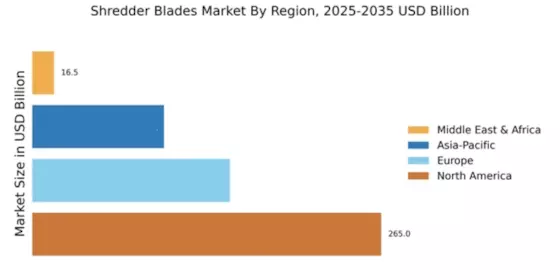
By region, the study provides the market insights into North America, Europe, Asia-Pacific and Rest of the World. The North American shredder blades market held the largest share due to factors such as increased recycling awareness, stringent waste management regulations, and advancements in shredder technology. The need for efficient waste management techniques and growing environmental consciousness are two factors driving the market's expansion. North America's shredder blade market is growing thanks in part to the region's strong industrial sector and continuous efforts to adopt cutting-edge gear.

Further, the major countries studied in the market report are The US, Canada, German, France, the UK, Italy, Spain, China, Japan, India, Australia, South Korea, and Brazil.

Figure 2: SHREDDER BLADES MARKET SHARE BY REGION 2022 (USD Billion)

Europe shredder blades market accounts for the second-largest market share owing to an increase in recycling initiatives, legislation supporting environmentally friendly conduct, and the expanding industrial sector. Modern shredder technology is in high demand because of the region's commitment to environmental conservation, which fosters market expansion. Further, the German shredder blades market held the largest market share, and the UK shredder blades market was the fastest growing market in the European region

The Asia-Pacific Shredder Blades Market is expected to grow at the fastest CAGR from 2025 to 2034 due to the rapid industrialization, urbanization, and remarkable technological advancements in the region. Since shredders are widely used in industry, particularly in countries like China and India, they are in great demand. Waste and recyclable material management is being driven by the rapid industrialization and urbanization that is taking place. Moreover, China's shredder blades market held the largest market share, and the Indian shredder blades market was the fastest growing market in the Asia-Pacific region.

Key Players and Competitive Insights

The Shredder Blades Market is characterized by a competitive landscape that is increasingly shaped by innovation, sustainability, and technological advancements. Key players such as Weima (DE), Vecoplan (DE), and SSI Shredding Systems (US) are actively pursuing strategies that emphasize product development and market expansion. For instance, Weima (DE) has focused on enhancing its product line with eco-friendly materials, which aligns with the growing demand for sustainable solutions. Similarly, Vecoplan (DE) has been investing in digital transformation initiatives to optimize operational efficiency and customer engagement, thereby reinforcing its market position. These strategies collectively contribute to a dynamic competitive environment where differentiation is increasingly based on technological capabilities and sustainability initiatives.

In terms of business tactics, companies are localizing manufacturing to reduce lead times and enhance supply chain resilience. The market structure appears moderately fragmented, with several players vying for market share while also collaborating on technological advancements. This fragmentation allows for a diverse range of products and services, catering to various customer needs across different regions.

In November 2025, SSI Shredding Systems (US) announced a strategic partnership with a leading recycling technology firm to develop advanced shredding solutions tailored for the automotive industry. This collaboration is expected to leverage both companies' expertise, enhancing product offerings and expanding market reach. The strategic importance of this partnership lies in its potential to address the increasing demand for efficient recycling processes in the automotive sector, which is undergoing significant transformation towards sustainability.

In October 2025, Doppstadt (DE) launched a new line of high-performance shredder blades designed specifically for heavy-duty applications. This product introduction is indicative of Doppstadt's commitment to innovation and meeting the evolving needs of industrial clients. By focusing on high-performance materials and engineering, the company aims to capture a larger share of the market that requires robust and reliable shredding solutions.

In September 2025, Granutech-Saturn Systems (US) expanded its operations by opening a new manufacturing facility in Texas, aimed at increasing production capacity and reducing delivery times. This strategic move not only enhances Granutech's operational efficiency but also positions the company to better serve its North American clientele. The establishment of this facility reflects a broader trend in the industry towards optimizing supply chains and ensuring timely product availability.

As of December 2025, the Shredder Blades Market is witnessing trends that emphasize digitalization, sustainability, and the integration of artificial intelligence in operational processes. Strategic alliances are becoming increasingly prevalent, allowing companies to pool resources and expertise to drive innovation. The competitive landscape is shifting from traditional price-based competition to a focus on technological differentiation and supply chain reliability. This evolution suggests that companies that prioritize innovation and sustainable practices will likely emerge as leaders in the market.

Key Companies in the Shredder Blades Market market include

Future Outlook

Shredder Blades Market Future Outlook

The Shredder Blades Market is projected to grow at a 5.9% CAGR from 2024 to 2035, driven by increasing recycling demands, technological advancements, and industrial growth.

New opportunities lie in:

  • Expansion into emerging markets with tailored shredder solutions.
  • Development of high-durability blades for specialized applications.
  • Integration of IoT technology for predictive maintenance in shredding equipment.

By 2035, the Shredder Blades Market is expected to achieve robust growth and innovation.

Market Segmentation

Shredder Blades Market Size Outlook

  • Small Size Blades
  • Medium Size Blades
  • Large Size Blades

Shredder Blades Market End Use Outlook

  • Recycling Industry
  • Manufacturing Industry
  • Construction Industry
  • Waste Management

Shredder Blades Market Blade Type Outlook

  • Single Shaft Blades
  • Double Shaft Blades
  • Granulator Blades
  • Rotary Blades

Shredder Blades Market Application Outlook

  • Plastic Shredding
  • Metal Shredding
  • Wood Shredding
  • Electronic Waste Shredding

Shredder Blades Market Material Type Outlook

  • High Carbon Steel
  • Alloy Steel
  • Stainless Steel
  • Tool Steel

Report Scope

MARKET SIZE 2024531.5(USD Billion)
MARKET SIZE 2025562.87(USD Billion)
MARKET SIZE 2035998.74(USD Billion)
COMPOUND ANNUAL GROWTH RATE (CAGR)5.9% (2024 - 2035)
REPORT COVERAGERevenue Forecast, Competitive Landscape, Growth Factors, and Trends
BASE YEAR2024
Market Forecast Period2025 - 2035
Historical Data2019 - 2024
Market Forecast UnitsUSD Billion
Key Companies ProfiledWeima (DE), Vecoplan (DE), SSI Shredding Systems (US), Eldan Recycling (DK), Shred-Tech (CA), Granutech-Saturn Systems (US), BCA Industries (US), Doppstadt (DE)
Segments CoveredApplication, End Use, Material Type, Blade Type, Size
Key Market OpportunitiesAdoption of advanced materials enhances durability and efficiency in the Shredder Blades Market.
Key Market DynamicsTechnological advancements and sustainability concerns drive innovation and competition in the shredder blades market.
Countries CoveredNorth America, Europe, APAC, South America, MEA

Market Highlights

Author
Snehal Singh
Assistant Manager - Research

High acumen in analyzing complex macro & micro markets with more than 6 years of work experience in the field of market research. By implementing her analytical skills in forecasting and estimation into market research reports, she has expertise in Packaging, Construction, and Equipment domains. She handles a team size of 20-25 resources and ensures smooth running of the projects, associated marketing activities, and client servicing.

Leave a Comment

FAQs

How much is the shredder blades market?

The Shredder Blades Market size was valued at USD 531.50 Billion in 2024.

What is the growth rate of the shredder blades market?

The global market is projected to grow at a CAGR of 5.90% during the forecast period, 2025-2034.

Which region held the largest market share in the shredder blades market?

North America had the largest share in the global market

Who are the key players in the shredder blades market?

The key players in the market are KAMADUR industrial knives B.V (Netherlands), SATURN MACHINE KNIVES LTD (UK), Servo International (India), Anhui Yafei Machine Tool Co. Ltd (China), Fordura China (China), WANROOE MACHINERY CO., LTD. (China), Povelato srl (Italy), Miheu d.o.0. (Slovenia), Fernite Of Sheffield Ltd. (UK), BKS Knives (Belgium), and Nanjing Huaxin Machinery Tool Manufacturing Co., Ltd. (China).

Which application led the shredder blades market?

The e-waste category dominated the market in 2022.

Which end-user industries had the largest market share in the shredder blades market?

The waste management & recycling had the largest share in the global market.

Download Free Sample

Kindly complete the form below to receive a free sample of this Report

Compare Licence

×
Features License Type
Single User Multiuser License Enterprise User
Price $4,950 $5,950 $7,250
Maximum User Access Limit 1 User Upto 10 Users Unrestricted Access Throughout the Organization
Free Customization
Direct Access to Analyst
Deliverable Format
Platform Access
Discount on Next Purchase 10% 15% 15%
Printable Versions