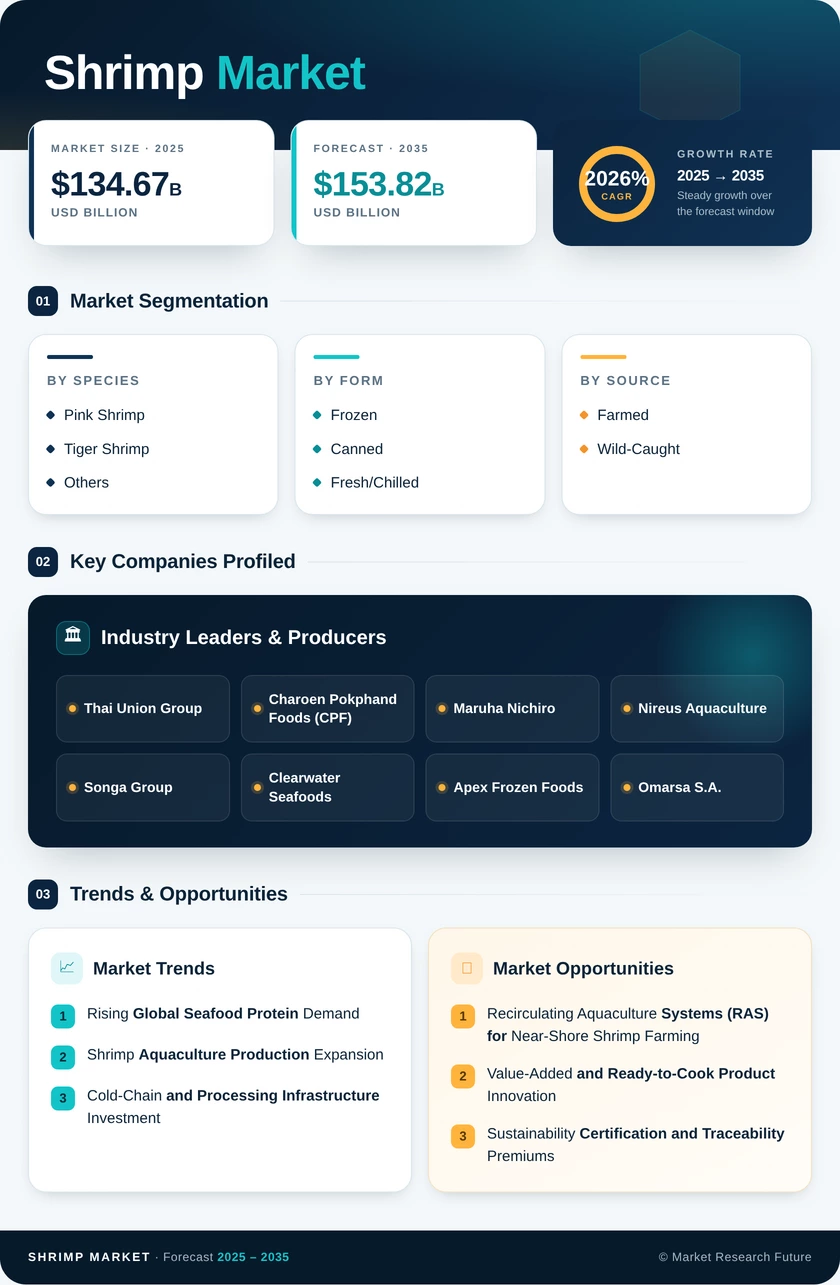
Shrimp Market

ID: MRFR/FnB/10000-HCR
128 Pages
Tejas Chaudhary
Last Updated: June 12, 2026
Shrimp Market Size, Share, Industry Trend & Analysis Research Report By Species (Pink Shrimp, Tiger Shrimp, Others), By Form (Frozen, Canned, Fresh/Chilled), By Source (Farmed, Wild-Caught), By Distribution Channel (On-Trade, Off-Trade)- Forecast to 2035
Download PDF ×

We do not share your information with anyone. However, we may send you emails based on your report interest from time to time. You may contact us at any time to opt-out.

  1. 1 Market Overview |
    1. 1.1 Study Assumptions & Market Definition |
    2. 1.2 Scope of the Study |
    3. 1.3 Research Methodology
  2. 2 Market Summary & Key Takeaways
  3. 3 Market Dynamics |
    1. 3.1 Market Drivers Analysis | |
      1. 3.1.1 Rising Global Seafood Protein Demand | |
      2. 3.1.2 Shrimp Aquaculture Production Expansion | |
      3. 3.1.3 Cold-Chain and Processing Infrastructure Investment | |
      4. 3.1.4 E-Commerce and Off-Trade Channel Penetration | |
      5. 3.1.5 Growth of Peeled and Deveined Shrimp Retail SKUs | |
      6. 3.1.6 RAS and Biosecurity Technology Adoption | |
      7. 3.1.7 Sustainability Certification and ESG Procurement |
    2. 3.2 Market Restraints Analysis | |
      1. 3.2.1 Disease Outbreaks (EMS, WSSV, EHP) | |
      2. 3.2.2 Environmental Regulation and Pond Conversion Limits | |
      3. 3.2.3 Import Tariff Volatility and Trade Disputes | |
      4. 3.2.4 Feed Cost Inflation (Fishmeal, Soybean) | |
      5. 3.2.5 Consumer Concerns Over Antibiotic Residues |
    3. 3.3 Market Opportunity Analysis | |
      1. 3.3.1 Recirculating Aquaculture Systems (RAS) for Near-Shore Shrimp Farming | |
      2. 3.3.2 Value-Added and Ready-to-Cook Product Innovation | |
      3. 3.3.3 Sustainability Certification and Traceability Premiums | |
      4. 3.3.4 Emerging Markets in Africa and the Middle East | |
      5. 3.3.5 Data-Driven Aquaculture and Precision Feeding |
    4. 3.4 Industry Value Chain Analysis |
    5. 3.5 Porter's Five Forces Analysis
  4. 4 Global Shrimp Market Size & Forecast (2021–2035) |
    1. 4.1 Historical Market Size (2021–2025) |
    2. 4.2 Current & Forecast Market Size (2026–2035) |
    3. 4.3 Market Size by Revenue (USD Billion) |
    4. 4.4 Year-over-Year Growth Analysis
  5. 5 Segmentation Analysis |
    1. 5.1 By Species | |
      1. 5.1.1 Pink Shrimp | |
      2. 5.1.2 Tiger Shrimp | |
      3. 5.1.3 Others |
    2. 5.2 By Form | |
      1. 5.2.1 Frozen | |
      2. 5.2.2 Canned | |
      3. 5.2.3 Fresh/Chilled |
    3. 5.3 By Source | |
      1. 5.3.1 Farmed | |
      2. 5.3.2 Wild-Caught |
    4. 5.4 By Distribution Channel | |
      1. 5.4.1 On-Trade | |
      2. 5.4.2 Off-Trade
  6. 6 Regional Analysis |
    1. 6.1 North America | |
      1. 6.1.1 United States | |
      2. 6.1.2 Canada | |
      3. 6.1.3 Mexico |
    2. 6.2 Europe | |
      1. 6.2.1 Germany | |
      2. 6.2.2 United Kingdom | |
      3. 6.2.3 France | |
      4. 6.2.4 Italy | |
      5. 6.2.5 Spain | |
      6. 6.2.6 Nordic Countries | |
      7. 6.2.7 Russia | |
      8. 6.2.8 Rest of Europe |
    3. 6.3 Asia-Pacific | |
      1. 6.3.1 China | |
      2. 6.3.2 India | |
      3. 6.3.3 Japan | |
      4. 6.3.4 South Korea | |
      5. 6.3.5 ASEAN | |
      6. 6.3.6 Rest of Asia-Pacific |
    4. 6.4 South America | |
      1. 6.4.1 Brazil | |
      2. 6.4.2 Argentina | |
      3. 6.4.3 Rest of South America |
    5. 6.5 Middle East & Africa | |
      1. 6.5.1 Saudi Arabia | |
      2. 6.5.2 UAE | |
      3. 6.5.3 South Africa | |
      4. 6.5.4 Egypt | |
      5. 6.5.5 Rest of MEA
  7. 7 Competitive Landscape |
    1. 7.1 Market Share Analysis (2025) |
    2. 7.2 Competitive Benchmarking Matrix |
    3. 7.3 Company Profiles | |
      1. 7.3.1 Thai Union Group | |
      2. 7.3.2 Charoen Pokphand Foods (CPF) | |
      3. 7.3.3 Maruha Nichiro | |
      4. 7.3.4 Nireus Aquaculture | |
      5. 7.3.5 Mazzetta Company | |
      6. 7.3.6 Songa Group | |
      7. 7.3.7 Clearwater Seafoods | |
      8. 7.3.8 Apex Frozen Foods | |
      9. 7.3.9 Omarsa S.A. | |
      10. 7.3.10 Grupo Ibérica
  8. 8 Future Outlook & Strategic Recommendations (2026–2035) |
    1. 8.1 Precision Aquaculture and AI-Driven Farming |
    2. 8.2 Supply Chain Digitalization and Traceability |
    3. 8.3 Climate Adaptation and Resilient Production Models |
    4. 8.4 ESG Integration and Sustainable Sourcing Mandates
  9. 9 Recent Developments & News
  10. 10 Frequently Asked Questions (FAQs)
  11. 11 Report Scope & Methodology |
    1. 11.1 Study Period & Base Year |
    2. 11.2 Data Sources & Citations |
    3. 11.3 Abbreviations
  12. 12 LIST OF TABLES |
  13. TABLE 1 Global Shrimp Market Size & Forecast, by Revenue (USD Billion), 2021–2035 |
  14. TABLE 2 Global Shrimp Market – Year-over-Year Growth Analysis, 2021–2035 |
  15. TABLE 3 Global Shrimp Market – Driver Impact Analysis, 2026–2035 |
  16. TABLE 4 Global Shrimp Market – Restraint Impact Analysis, 2026–2035 |
  17. TABLE 5 Global Shrimp Market Size, by Species, 2021–2035 (USD Billion) |
  18. TABLE 6 Global Shrimp Market Size, by Form, 2021–2035 (USD Billion) |
  19. TABLE 7 Global Shrimp Market Size, by Source, 2021–2035 (USD Billion) |
  20. TABLE 8 Global Shrimp Market Size, by Distribution Channel, 2021–2035 (USD Billion) |
  21. TABLE 9 Global Shrimp Market Size, by Region, 2021–2035 (USD Billion) |
  22. TABLE 10 North America Shrimp Market Size, by Country, 2021–2035 (USD Billion) |
  23. TABLE 11 Europe Shrimp Market Size, by Country, 2021–2035 (USD Billion) |
  24. TABLE 12 Asia-Pacific Shrimp Market Size, by Country, 2021–2035 (USD Billion) |
  25. TABLE 13 South America Shrimp Market Size, by Country, 2021–2035 (USD Billion) |
  26. TABLE 14 Middle East & Africa Shrimp Market Size, by Country, 2021–2035 (USD Billion) |
  27. TABLE 15 Competitive Benchmarking Matrix – Global Shrimp Market, 2025 |
  28. TABLE 16 Company Profiles – Key Players, Global Shrimp Market |
  29. TABLE 17 Recent Developments & Strategic Announcements, 2023–2025 |
  30. TABLE 18 Report Scope & Methodology Summary |
  31. TABLE 19 Detailed Sources and Citations |
  32. TABLE 20 North America Shrimp Market Size, by Species, 2021–2035 (USD Billion) |
  33. TABLE 21 North America Shrimp Market Size, by Form, 2021–2035 (USD Billion) |
  34. TABLE 22 North America Shrimp Market Size, by Source, 2021–2035 (USD Billion) |
  35. TABLE 23 North America Shrimp Market Size, by Distribution Channel, 2021–2035 (USD Billion) |
  36. TABLE 24 Europe Shrimp Market Size, by Species, 2021–2035 (USD Billion) |
  37. TABLE 25 Europe Shrimp Market Size, by Form, 2021–2035 (USD Billion) |
  38. TABLE 26 Europe Shrimp Market Size, by Source, 2021–2035 (USD Billion) |
  39. TABLE 27 Europe Shrimp Market Size, by Distribution Channel, 2021–2035 (USD Billion) |
  40. TABLE 28 Asia-Pacific Shrimp Market Size, by Species, 2021–2035 (USD Billion) |
  41. TABLE 29 Asia-Pacific Shrimp Market Size, by Form, 2021–2035 (USD Billion) |
  42. TABLE 30 Asia-Pacific Shrimp Market Size, by Source, 2021–2035 (USD Billion) |
  43. TABLE 31 Asia-Pacific Shrimp Market Size, by Distribution Channel, 2021–2035 (USD Billion) |
  44. TABLE 32 South America Shrimp Market Size, by Species, 2021–2035 (USD Billion) |
  45. TABLE 33 South America Shrimp Market Size, by Form, 2021–2035 (USD Billion) |
  46. TABLE 34 South America Shrimp Market Size, by Source, 2021–2035 (USD Billion) |
  47. TABLE 35 South America Shrimp Market Size, by Distribution Channel, 2021–2035 (USD Billion) |
  48. TABLE 36 Middle East & Africa Shrimp Market Size, by Species, 2021–2035 (USD Billion) |
  49. TABLE 37 Middle East & Africa Shrimp Market Size, by Form, 2021–2035 (USD Billion) |
  50. TABLE 38 Middle East & Africa Shrimp Market Size, by Source, 2021–2035 (USD Billion) |
  51. TABLE 39 Middle East & Africa Shrimp Market Size, by Distribution Channel, 2021–2035 (USD Billion)
  52. 13 LIST OF FIGURES |
  53. FIGURE 1 Global Shrimp Market Dynamics — Drivers, Restraints, and Opportunities |
  54. FIGURE 2 Global Shrimp Market — Industry Value Chain Analysis |
  55. FIGURE 3 Global Shrimp Market — Porter's Five Forces Analysis |
  56. FIGURE 4 Global Shrimp Market Size Trend & Forecast (USD Billion), 2021–2035 |
  57. FIGURE 5 Global Shrimp Market Share, by Species (%), 2025 |
  58. FIGURE 6 Global Shrimp Market Share, by Form (%), 2025 |
  59. FIGURE 7 Global Shrimp Market Share, by Source (%), 2025 |
  60. FIGURE 8 Global Shrimp Market Share, by Distribution Channel (%), 2025 |
  61. FIGURE 9 Global Shrimp Market Share, by Region (%), 2025 |
  62. FIGURE 10 North America Shrimp Market Size (USD Billion), 2021–2035 |
  63. FIGURE 11 Europe Shrimp Market Size (USD Billion), 2021–2035 |
  64. FIGURE 12 Asia-Pacific Shrimp Market Size (USD Billion), 2021–2035 |
  65. FIGURE 13 South America Shrimp Market Size (USD Billion), 2021–2035 |
  66. FIGURE 14 Middle East & Africa Shrimp Market Size (USD Billion), 2021–2035 |
  67. FIGURE 15 Competitive Landscape — Global Shrimp Market Share Analysis, 2025

Segmentation Quick Reference

DimensionSub-SegmentsDominant SegmentFastest Growing Segment
SpeciesPink Shrimp, Tiger Shrimp, OthersPink Shrimp (42.3% share, 2025)Tiger Shrimp (2.55% CAGR)
FormFrozen, Canned, Fresh/ChilledFrozen (59.8% share, 2025)Canned (3.95% CAGR)
SourceFarmed, Wild-CaughtFarmed (55.8% share, 2025)Wild-Caught (3.40% CAGR)
Distribution ChannelOn-Trade, Off-TradeOn-Trade (58.7% share, 2025)Off-Trade (2.65% CAGR)


Market Segmentation Overview

By Species

Sub-SegmentKey Trend
Pink ShrimpDominant globally due to established vannamei farming systems and competitive pricing across major aquaculture production regions.
Tiger ShrimpRe-emerging as a premium product following SPF broodstock breakthroughs, white and black tiger shrimp are gaining traction in European and Japanese retail.
OthersSpecialty species (e.g., rock shrimp, royal red shrimp) serve niche culinary and regional demand.


Pink shrimp retain market leadership due to decades of genetic selection and optimized farming protocols, particularly in Ecuador, India, and China. Tiger shrimp's resurgence reflects improved disease management and growing consumer interest in larger, firmer shrimp formats for premium dining applications.

By Form

Sub-SegmentKey Trend
FrozenIQF technology and expanded cold-chain infrastructure drive dominance; peeled and deveined shrimp packs are gaining retail share.
CannedShelf-stable convenience fuels growth in emerging markets with limited refrigeration.
Fresh/ChilledPremium segment driven by wet-market traditions in Asia and high-end foodservice in Europe and Japan.


Frozen shrimp remains the backbone of international trade, with IQF processing enabling year-round retail availability. Canned shrimp's strong growth trajectory reflects unmet demand in African and Southeast Asian markets, where ambient-temperature distribution remains the primary logistics model.

By Source

Sub-SegmentKey Trend
FarmedShrimp aquaculture production intensification continues; vertically integrated operators are expanding.
Wild-CaughtPremium positioning maintained; sustainability certifications increasingly required for market access.


Farmed shrimp drives the majority of global supply, while wild-caught shrimp retain a quality-driven premium, particularly in markets where traceability and origin labeling influence purchasing decisions.

By Distribution Channel

Sub-SegmentKey Trend
On-TradeRestaurant, hotel, and institutional demand remains the largest channel.
Off-TradeRetail and e-commerce expansion accelerates, driven by consumer-ready peeled and deveined shrimp formats.


On-trade channels continue to dominate, but the structural shift toward home cooking and online grocery purchasing is steadily expanding off-trade share, particularly in North America and China.