×
Request Free Sample ×

Kindly complete the form below to receive a free sample of this Report

* Please use a valid business email

Leading companies partner with us for data-driven Insights

clients tt-cursor
Hero Background

Small Animal Imaging Market

ID: MRFR/MED/4716-CR
124 Pages
Rahul Gotadki
May 2024

Small Animal Imaging Market Size, Growth Research Report By Product Optical Imaging [Photoacoustic Tomography and Optical Coherence Tomography), Nuclear Imaging (Micro PET System, Micro SPECT System, Micro MRI System, Micro CT System, and Others), Reagent (Optical Image Reagent, Contrast Agent, Pet Tracers, and SPECT Probe), by Application (Monitoring Drug Treatment Programme, Bio Distribution Studies, Cancer Cell Detection, Biomarkers, and Longitudinal Studies) - Competitor Industry Analysis and Trends Forecast Till 2035

Share:
Download PDF ×

We do not share your information with anyone. However, we may send you emails based on your report interest from time to time. You may contact us at any time to opt-out.

Small Animal Imaging Market Infographic
Purchase Options

Small Animal Imaging Market Summary

As per MRFR analysis, the Small Animal Imaging Market Size was estimated at 1271.78 USD Million in 2024. The Small Animal Imaging industry is projected to grow from 1359.17 USD Million in 2025 to 2641.89 USD Million by 2035, exhibiting a compound annual growth rate (CAGR) of 6.87 during the forecast period 2025 - 2035.

Key Market Trends & Highlights

The Small Animal Imaging Market is experiencing robust growth driven by technological advancements and increasing research activities.

  • Technological advancements are enhancing imaging modalities, leading to improved diagnostic capabilities.
  • North America remains the largest market, while Asia-Pacific is recognized as the fastest-growing region in small animal imaging.
  • Oncology continues to dominate the market, whereas neurology is emerging as the fastest-growing segment.
  • Rising demand for non-invasive imaging techniques and growing investment in biomedical research are key drivers propelling market expansion.

Market Size & Forecast

2024 Market Size 1271.78 (USD Million)
2035 Market Size 2641.89 (USD Million)
CAGR (2025 - 2035) 6.87%

Major Players

Bruker (DE), PerkinElmer (US), Miltenyi Biotec (DE), Fujifilm (JP), GE Healthcare (US), Siemens Healthineers (DE), Mediso (HU), Biospace Lab (FR), Aspect Imaging (IL)

Small Animal Imaging Market Trends

The Small Animal Imaging Market is currently experiencing a notable evolution, driven by advancements in imaging technologies and an increasing focus on preclinical research. This market encompasses a variety of imaging modalities, including magnetic resonance imaging, computed tomography, and positron emission tomography, which are essential for studying small animals in research settings. The growing demand for non-invasive imaging techniques is likely to enhance the understanding of disease mechanisms and therapeutic responses, thereby facilitating the development of new treatments. Furthermore, the integration of artificial intelligence and machine learning into imaging processes appears to be streamlining data analysis, potentially leading to more accurate and efficient outcomes in research. In addition, the Small Animal Imaging Market is influenced by the rising prevalence of chronic diseases and the need for innovative solutions in drug discovery and development. As researchers seek to minimize the use of larger animal models, small animal imaging provides a viable alternative, allowing for detailed observation of biological processes in real-time. The collaboration between academic institutions and industry players seems to be fostering innovation, which may further propel market growth. Overall, the Small Animal Imaging Market is poised for continued expansion, driven by technological advancements and a growing emphasis on ethical research practices.

Technological Advancements

The Small Animal Imaging Market is witnessing rapid technological advancements that enhance imaging capabilities. Innovations in imaging modalities, such as hybrid imaging systems, are improving the precision and efficiency of preclinical studies. These advancements enable researchers to obtain high-resolution images, facilitating better understanding of biological processes.

Increased Focus on Preclinical Research

There is a growing emphasis on preclinical research within the Small Animal Imaging Market, as it plays a crucial role in drug development. Researchers are increasingly utilizing small animal models to evaluate the efficacy and safety of new therapies, which is driving demand for advanced imaging techniques.

Integration of AI and Machine Learning

The integration of artificial intelligence and machine learning into imaging processes is transforming the Small Animal Imaging Market. These technologies are streamlining data analysis, improving image interpretation, and enhancing the overall efficiency of research, thereby contributing to more accurate results.

Small Animal Imaging Market Drivers

Market Growth Projections

The Global Small Animal Imaging Market Industry is projected to experience significant growth over the coming years. With a market value of 1.27 USD Billion in 2024, it is anticipated to reach 2.64 USD Billion by 2035, reflecting a robust CAGR of 6.88% from 2025 to 2035. This growth trajectory indicates a strong demand for advanced imaging technologies and methodologies in preclinical research. The increasing recognition of the importance of small animal models in understanding human diseases and testing new therapies is likely to drive this upward trend.

Regulatory Support for Animal Research

The Global Small Animal Imaging Market Industry is supported by regulatory frameworks that promote the use of animal models in research. Regulatory bodies are increasingly recognizing the value of small animal imaging in the development of new therapies and drugs. This support is likely to enhance the credibility of research findings, encouraging more institutions to invest in imaging technologies. As regulations evolve to facilitate ethical research practices, the market is expected to benefit from increased adoption of small animal imaging techniques, further solidifying its role in biomedical research.

Rising Demand for Preclinical Research

The Global Small Animal Imaging Market Industry is significantly influenced by the increasing demand for preclinical research in drug development and disease modeling. Researchers are increasingly utilizing small animal models to study human diseases, which necessitates advanced imaging techniques for accurate data collection. This trend is expected to contribute to the market's expansion, with projections indicating a growth to 2.64 USD Billion by 2035. The ability to visualize the effects of new therapies in real-time enhances the research process, making small animal imaging an essential component of modern biomedical research.

Growing Investments in Biomedical Research

The Global Small Animal Imaging Market Industry benefits from the growing investments in biomedical research. Governments and private entities are allocating substantial funds to support research initiatives that utilize small animal models for studying complex diseases. This influx of funding is likely to drive the adoption of advanced imaging technologies, as researchers seek to enhance their capabilities. With a projected CAGR of 6.88% from 2025 to 2035, the market is poised for sustained growth, reflecting the increasing recognition of the importance of small animal imaging in advancing medical science.

Technological Advancements in Imaging Modalities

The Global Small Animal Imaging Market Industry is experiencing rapid growth due to continuous technological advancements in imaging modalities. Innovations such as high-resolution MRI, PET, and CT imaging are enhancing the precision and accuracy of small animal studies. These advancements facilitate better visualization of biological processes, which is crucial for preclinical research. In 2024, the market is projected to reach 1.27 USD Billion, driven by the demand for sophisticated imaging techniques that improve research outcomes. As these technologies evolve, they are likely to attract more investments, further propelling market growth.

Increase in Chronic Diseases and Aging Population

The Global Small Animal Imaging Market Industry is also propelled by the rising incidence of chronic diseases and the aging population. As the prevalence of conditions such as cancer, cardiovascular diseases, and neurological disorders increases, there is a heightened need for effective research methodologies. Small animal imaging plays a crucial role in understanding disease mechanisms and testing new treatments. This growing focus on chronic disease research is expected to contribute to the market's growth, aligning with the broader trends in healthcare and research priorities.
Market Segment Insights

By Application: Oncology (Largest) vs. Neurology (Fastest-Growing)

The Small Animal Imaging Market is experiencing a diverse distribution of market shares across various applications. Oncology leads the pack, capturing the largest share due to its critical role in cancer research and treatment strategies. Following closely are Cardiology and Orthopedics, with substantial contributions to overall growth driven by rising prevalence of cardiovascular diseases and orthopedic conditions in small animals. Respiratory and Neurology applications, while crucial, currently hold smaller shares in comparison. Growth trends within this market indicate a significant interest in Neurology, now recognized as the fastest-growing segment. This surge is attributed to advancements in imaging technologies and increasing investment in neurological disease research. The spike in respiratory conditions among small animals also showcases emerging opportunities as owners seek better diagnostic options, thus pushing the segment's growth forward.

Oncology (Dominant) vs. Neurology (Emerging)

Oncology's dominance in the Small Animal Imaging Market is affirmed by its well-established applications in diagnosing and managing cancers in pets. Methods such as MRI and PET scans have become integral in ensuring early detection and effective treatment plans that cater to complex cases. Meanwhile, Neurology stands out as an emerging application, fueled by rapidly evolving imaging techniques. The growing awareness of neurological disorders in small animals and the demand for innovative treatments are propelling technological advancements in this domain. As vets seek to address neurological challenges, including seizures and behavioral disorders, Neurology is solidifying its position as an essential part of the Small Animal Imaging Market.

By Technology: Magnetic Resonance Imaging (Largest) vs. Positron Emission Tomography (Fastest-Growing)

In the Small Animal Imaging Market, Magnetic Resonance Imaging (MRI) holds the largest market share due to its non-invasive nature and high-resolution imaging capabilities. MRI is particularly favored for soft tissue imaging and neurological studies, making it a staple in veterinary diagnostics. Computed Tomography (CT) and Ultrasound also contribute significantly to the market, catering to different imaging needs, while Optical Imaging and Positron Emission Tomography (PET) represent specialized segments with unique advantages. As the market evolves, Positron Emission Tomography is emerging as the fastest-growing segment within the Small Animal Imaging Market. This growth is driven by increasing demand for advanced imaging techniques that enhance diagnostic accuracy and treatment planning. Furthermore, the integration of PET with other imaging modalities is expanding its application in both research and clinical settings, highlighting a shift towards multi-modal imaging solutions for small animal health assessment.

Technology: MRI (Dominant) vs. PET (Emerging)

Magnetic Resonance Imaging (MRI) stands out as the dominant technology in the Small Animal Imaging Market, known for its unparalleled ability to produce detailed images of soft tissues and organs. Its widespread acceptance among veterinary professionals stems from MRI's non-invasive nature and safety profile, allowing for effective diagnosis without the risks associated with radiation. In contrast, Positron Emission Tomography (PET) is recognized as an emerging technology, primarily due to its capability to provide metabolic and functional imaging information. The increasing adoption of PET in conjunction with other imaging modalities showcases its potential to revolutionize small animal diagnostics, particularly in oncology and neurology, where early detection and treatment planning are crucial.

By End Use: Research Institutions (Largest) vs. Pharmaceutical Companies (Fastest-Growing)

In the Small Animal Imaging Market, the end use segments are predominantly dominated by Research Institutions, which hold the largest market share due to their extensive focus on preclinical research and development activities. This segment benefits from a growing number of studies and experiments that utilize advanced imaging technologies to study small animals, leading to various breakthroughs in medical research. In contrast, Pharmaceutical Companies are rapidly scaling their use of small animal imaging techniques, driven by the need for efficient drug development and validation processes, reflecting their status as the fastest-growing segment within the market.

End Use: Research Institutions (Dominant) vs. Pharmaceutical Companies (Emerging)

Research Institutions play a crucial role in the Small Animal Imaging Market, serving as the backbone for innovation and research advancements. They are equipped with cutting-edge imaging technologies that facilitate studies in diverse fields, including oncology, neurology, and cardiology. Their robust infrastructure and funding enable comprehensive exploration of small animal models, fostering significant contributions to scientific knowledge. On the other hand, Pharmaceutical Companies are emerging as key players in this market segment due to their increasing reliance on small animal imaging for drug discovery and development. They leverage these imaging techniques to streamline research processes and reduce time-to-market for new therapeutics, positioning themselves as proactive participants in the evolving landscape of medical innovation.

Get more detailed insights about Small Animal Imaging Market

Regional Insights

North America : Market Leader in Innovation

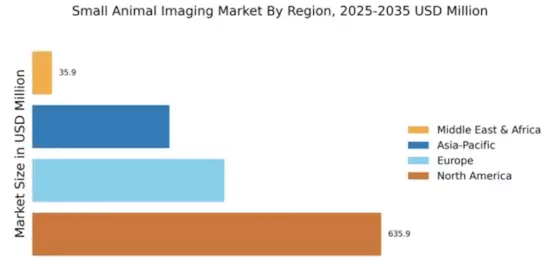
North America continues to lead the Small Animal Imaging Market, holding a significant share of 635.89 million in 2024. The growth is driven by advancements in imaging technologies, increasing research activities in biomedical fields, and supportive regulatory frameworks. The demand for non-invasive imaging techniques is rising, particularly in preclinical research, which is further bolstered by government funding and initiatives aimed at enhancing healthcare outcomes. The competitive landscape in North America is robust, with key players like GE Healthcare, PerkinElmer, and Bruker dominating the market. The U.S. is the primary contributor, benefiting from a strong focus on R&D and a well-established healthcare infrastructure. Collaborations between academic institutions and industry players are fostering innovation, ensuring that North America remains at the forefront of small animal imaging advancements.

Europe : Emerging Market with Growth Potential

Europe's Small Animal Imaging Market is valued at 350.0 million, reflecting a growing interest in advanced imaging technologies. The region is witnessing increased investments in research and development, particularly in countries like Germany and the UK. Regulatory support from the European Medicines Agency (EMA) is facilitating the adoption of innovative imaging solutions, which are crucial for preclinical studies and drug development. Germany leads the market, supported by a strong presence of key players such as Siemens Healthineers and Bruker. The competitive landscape is characterized by collaborations between research institutions and industry, enhancing the development of cutting-edge imaging technologies. The focus on personalized medicine and the growing need for efficient drug discovery processes are expected to drive further growth in the European market.

Asia-Pacific : Rapidly Growing Market Segment

The Asia-Pacific Small Animal Imaging Market, valued at 250.0 million, is experiencing rapid growth driven by increasing investments in healthcare and research. Countries like Japan and China are at the forefront, with rising demand for advanced imaging technologies in preclinical research. Government initiatives aimed at improving healthcare infrastructure and funding for biomedical research are significant growth catalysts in the region. Japan is a key player, with companies like Fujifilm leading the market. The competitive landscape is evolving, with both established firms and startups innovating to meet the growing demand. The focus on enhancing research capabilities and improving healthcare outcomes is expected to propel the Asia-Pacific market further, making it a vital area for future investments in small animal imaging technologies.

Middle East and Africa : Emerging Market with Challenges

The Middle East and Africa Small Animal Imaging Market, valued at 35.89 million, is in its nascent stages but shows potential for growth. The region faces challenges such as limited funding and infrastructure, yet there is a growing interest in advanced imaging technologies for research purposes. Increasing collaborations between local institutions and international organizations are helping to overcome these barriers and promote the adoption of small animal imaging solutions. Countries like South Africa and the UAE are emerging as key players in the market, with a focus on enhancing research capabilities. The presence of international companies is also growing, contributing to the competitive landscape. As the region invests in healthcare and research, the small animal imaging market is expected to expand, driven by the need for innovative solutions in biomedical research.

Key Players and Competitive Insights

The Small Animal Imaging Market is currently characterized by a dynamic competitive landscape, driven by advancements in imaging technologies and increasing demand for preclinical research. Key players such as Bruker (DE), PerkinElmer (US), and GE Healthcare (US) are at the forefront, each adopting distinct strategies to enhance their market presence. Bruker (DE) focuses on innovation, particularly in the development of high-resolution imaging systems, which positions it as a leader in the market. Meanwhile, PerkinElmer (US) emphasizes partnerships with research institutions to expand its product offerings and enhance its technological capabilities. GE Healthcare (US) is actively pursuing digital transformation initiatives, integrating AI into its imaging solutions to improve diagnostic accuracy and operational efficiency. Collectively, these strategies contribute to a competitive environment that is increasingly centered around technological advancement and collaborative efforts.

In terms of business tactics, companies are localizing manufacturing and optimizing supply chains to enhance operational efficiency and reduce costs. The market appears moderately fragmented, with several players vying for market share. However, the influence of major companies is substantial, as they set industry standards and drive innovation. This competitive structure suggests that while smaller firms may struggle to compete on a technological level, they can still carve out niches through specialized offerings or regional focus.

In November 2025, Siemens Healthineers (DE) announced a strategic partnership with a leading biotechnology firm to develop next-generation imaging solutions tailored for small animal research. This collaboration is expected to leverage Siemens' advanced imaging technologies and the biotechnology firm's expertise in molecular biology, potentially leading to groundbreaking advancements in preclinical studies. The strategic importance of this partnership lies in its potential to accelerate product development cycles and enhance the efficacy of imaging solutions in research settings.

In October 2025, Fujifilm (JP) launched a new line of small animal imaging systems that incorporate cutting-edge AI algorithms for enhanced image analysis. This move is indicative of Fujifilm's commitment to integrating AI into its product offerings, which may significantly improve the accuracy and speed of imaging processes. The introduction of these systems is likely to strengthen Fujifilm's competitive position by appealing to research institutions seeking state-of-the-art technology.

Lastly, in September 2025, Miltenyi Biotec (DE) expanded its product portfolio by acquiring a small imaging technology startup. This acquisition is seen as a strategic maneuver to bolster Miltenyi's capabilities in small animal imaging, allowing it to offer more comprehensive solutions to its clients. The strategic importance of this acquisition lies in its potential to enhance Miltenyi's innovation pipeline and market reach, thereby solidifying its position in the competitive landscape.

As of December 2025, current trends in the Small Animal Imaging Market include a pronounced shift towards digitalization, sustainability, and the integration of AI technologies. Strategic alliances are increasingly shaping the competitive landscape, enabling companies to pool resources and expertise to drive innovation. Looking ahead, it is anticipated that competitive differentiation will evolve, with a greater emphasis on technological innovation and supply chain reliability rather than solely on price. This shift suggests that companies that prioritize R&D and strategic partnerships will likely emerge as leaders in the market.

Key Companies in the Small Animal Imaging Market market include

Industry Developments

  • Q1 2024: PerkinElmer Launches IVIS Lumina S5 and X5 High Throughput Benchtop 2D Optical In Vivo Imaging Systems PerkinElmer announced the launch of its IVIS Lumina S5 and X5, new high throughput benchtop 2D optical in vivo imaging systems designed for small animal imaging applications, expanding its portfolio for preclinical research.
.webp

Future Outlook

Small Animal Imaging Market Future Outlook

The Small Animal Imaging Market is projected to grow at a 6.87% CAGR from 2024 to 2035, driven by technological advancements, increasing research activities, and rising demand for preclinical studies.

New opportunities lie in:

  • Development of advanced imaging agents for enhanced diagnostic accuracy.
  • Integration of AI-driven analytics for real-time imaging interpretation.
  • Expansion of imaging services in veterinary practices for improved patient care.

By 2035, the Small Animal Imaging Market is expected to achieve substantial growth and innovation.

Market Segmentation

Small Animal Imaging Market End Use Outlook

  • Research Institutions
  • Pharmaceutical Companies
  • Contract Research Organizations
  • Academic Institutions
  • Diagnostic Laboratories

Small Animal Imaging Market Technology Outlook

  • Magnetic Resonance Imaging
  • Computed Tomography
  • Positron Emission Tomography
  • Ultrasound
  • Optical Imaging

Small Animal Imaging Market Application Outlook

  • Oncology
  • Cardiology
  • Neurology
  • Orthopedics
  • Respiratory

Report Scope

MARKET SIZE 20241271.78(USD Million)
MARKET SIZE 20251359.17(USD Million)
MARKET SIZE 20352641.89(USD Million)
COMPOUND ANNUAL GROWTH RATE (CAGR)6.87% (2024 - 2035)
REPORT COVERAGERevenue Forecast, Competitive Landscape, Growth Factors, and Trends
BASE YEAR2024
Market Forecast Period2025 - 2035
Historical Data2019 - 2024
Market Forecast UnitsUSD Million
Key Companies ProfiledBruker (DE), PerkinElmer (US), Miltenyi Biotec (DE), Fujifilm (JP), GE Healthcare (US), Siemens Healthineers (DE), Mediso (HU), Biospace Lab (FR), Aspect Imaging (IL)
Segments CoveredApplication, Technology, End Use
Key Market OpportunitiesAdvancements in imaging technologies enhance preclinical research capabilities in the Small Animal Imaging Market.
Key Market DynamicsTechnological advancements in imaging modalities drive innovation and competition in the Small Animal Imaging Market.
Countries CoveredNorth America, Europe, APAC, South America, MEA

Market Highlights

Author
Rahul Gotadki
Assistant Manager

He holds an experience of about 7+ years in Market Research and Business Consulting, working under the spectrum of Life Sciences and Healthcare domains. Rahul conceptualizes and implements a scalable business strategy and provides strategic leadership to the clients. His expertise lies in market estimation, competitive intelligence, pipeline analysis, customer assessment, etc. In addition to the above, his other responsibility includes strategic tracking of high growth markets & advising clients on the potential areas of focus they could direct their business initiatives

Leave a Comment

FAQs

What is the projected growth of the Small Animal Imaging market?

The Small Animal Imaging market is the expected increase in total market value of 2.64 USD billion over a defined forecast period 2025–2035. It is driven by factors such as demand trends, technological advances, regulatory changes, and geographic expansion.

What is the size of the Small Animal Imaging market?

Small Animal Imaging market size was valued at approximately 1.27 billion USD in 2024. This figure will reach 2.64 billion USD covering all regions (America, Europe, Asia, MEA and ROW), focusing its segments / services / distribution channels till 2035.

What is the CAGR of the Small Animal Imaging market?

Small Animal Imaging market is expected to grow at a CAGR of 6.87% between 2025 and 2035.

How much will the Small Animal Imaging market be worth by 2035?

Small Animal Imaging market is expected to be worth of 2.64 billion USD, reflecting growth driven by usage, technology and global demands by the end of 2035.

How will the Small Animal Imaging market perform over the next 10 years?

Over the next 10 years the Small Animal Imaging market is expected to shift from usd billion 1.27 to 2.64 billion USD, led by adoption of advanced tech, demographic trends, regulatory approvals, with potential headwinds from 2025 to 2035.

How big is the US small animal imaging market?

The US held over 67.89% share of the North America market for the small animal imaging market during the forecast period of 2024-2035.

Which region held the largest market share in the small animal imaging market?

The North America region market held the largest market share in the small animal imaging market.

Download Free Sample

Kindly complete the form below to receive a free sample of this Report

Compare Licence

×
Features License Type
Single User Multiuser License Enterprise User
Price $4,950 $5,950 $7,250
Maximum User Access Limit 1 User Upto 10 Users Unrestricted Access Throughout the Organization
Free Customization
Direct Access to Analyst
Deliverable Format
Platform Access
Discount on Next Purchase 10% 15% 15%
Printable Versions