Smart Home Projector Market Summary
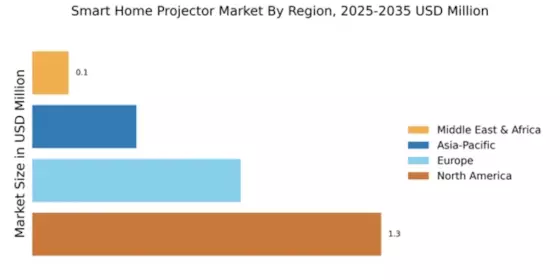
As per MRFR analysis, the Smart Home Projector Market Size was estimated at 2.68 USD Million in 2024. The Smart Home Projector industry is projected to grow from 3.09 in 2025 to 15.78 by 2035, exhibiting a compound annual growth rate (CAGR) of 17.7% during the forecast period 2025 - 2035.
Key Market Trends & Highlights
The Smart Home Projector Market is experiencing robust growth driven by technological advancements and evolving consumer preferences.
- The market is increasingly integrating with smart home ecosystems, enhancing user convenience and functionality.
- Portability and compact design are becoming essential features, appealing to consumers seeking versatile entertainment solutions.
- Enhanced image quality and resolution are critical factors influencing consumer purchasing decisions, particularly in the home theater segment.
- Rising demand for home entertainment solutions and advancements in projection technology are key drivers propelling growth in North America and Asia-Pacific, particularly in the DLP and gaming segments.
Market Size & Forecast
| 2024 Market Size | 2.68 (USD Million) |
| 2035 Market Size | 15.78 (USD Million) |
| CAGR (2025 - 2035) | 17.7% |
Major Players
Epson (JP), BenQ (TW), LG Electronics (KR), Samsung (KR), Sony (JP), ViewSonic (US), Anker (CN), XGIMI (CN), Kodak (US)
MAJOR FACTORS INFLUENCING CONSUMER BEHAVIOR
Psychological FactorsPsychological factors talk about the psychology of an individual that drives his actions to seek satisfaction. There are four important psychological factors such as Motivation, Perception, Learning and Attitudes, and Beliefs. These are some of the psychological factors that the marketer must take into consideration before undertaking the strategic marketing decision. When a customer sees advertisements, promotions, customer reviews, social media feedback, etc., relating to a product, they develop an impression about the product. Consumers have certain attitudes and beliefs which influence the buying decisions of a consumer.
Social Factors
Humans are social beings, and they live around many people who influence their buying behavior. Humans try to imitate other humans and be socially accepted. Hence their buying behavior is influenced by other people around them. These factors are considered social factors. Some of the social factors are family, reference group roles, and status. Family plays a significant role in shaping the buying behavior of a person.
Cultural factors
Cultural factors have a strong influence on consumer behavior. Cultural factors include the basic values, needs, wants, preferences, perceptions, and behaviors observed and learned by consumers from their nearby family members and other important people around them. Cultural factors have a significant effect on an individual's buying decision. Every individual has different sets of habits, beliefs, and principles, which the user develops from his family status and background.
Personal Factors
Personal factors are the individual factors to the consumers that strongly influence their buying behaviors. Some of the personal factors are age, income, occupation, lifestyle. These personal factors differ from person to person, producing different perceptions, attitudes, and consumer behavior towards certain goods and services.
Economic Factors
Economic factors are the fundamental data about the market and economy taken into consideration when an investment or business value is calculated. Economic factors may include costs such as wages, interest rates, governmental activity, laws, policies, tax rates, and unemployment. Economic factors may include costs such as wages, interest rates, governmental activity, laws, policies, tax rates, and unemployment