Download Free Sample
Kindly complete the form below to receive a free sample of this Report
Smart Led Lighting Market Size, Share and Research Report By Light Source Type (LEDs, Organic LEDs (OLEDs), Quantum Dots (QDs)), By Control Method (Wired, Wireless (Wi-Fi, Bluetooth, Zigbee)), By Application (Residential, Commercial, Industrial, Outdoor), By Functionality (Dimming, Color Changing, Motion Sensing, Smart Home Integration), By Form Factor (Bulbs, Panels, Strips, Downlights) and By Regional (North America, Europe, South America, Asia-Pacific, Middle East and Africa) - Industry Forecast Till 2035
As per MRFR analysis, the Smart LED lighting market was estimated at 39.29 USD Billion in 2024. The Smart LED lighting industry is projected to grow from 43.79 USD Billion in 2025 to 129.49 USD Billion by 2035, exhibiting a compound annual growth rate (CAGR) of 11.45% during the forecast period 2025 - 2035.
The Smart LED lighting market is experiencing robust growth driven by technological advancements and increasing energy efficiency demands.
| 2024 Market Size | 39.29 (USD Billion) |
| 2035 Market Size | 129.49 (USD Billion) |
| CAGR (2025 - 2035) | 11.45% |
The Smart LED lighting market is currently experiencing a transformative phase characterized by rapid technological advancements and increasing consumer awareness regarding energy efficiency. This sector is witnessing a shift towards smart technologies that integrate seamlessly with home automation systems, thereby enhancing user convenience and control. The proliferation of Internet of Things (IoT) devices has further catalyzed the adoption of smart lighting solutions, as consumers seek to optimize their energy consumption while enjoying customizable lighting experiences. Additionally, the growing emphasis on sustainability and environmental responsibility is driving demand for energy-efficient lighting options, which Smart LED products inherently provide. Moreover, the Smart LED lighting market is likely to benefit from ongoing innovations in design and functionality. Manufacturers are increasingly focusing on developing products that not only meet aesthetic preferences but also offer advanced features such as remote control, scheduling, and adaptive lighting. This trend suggests a potential for significant growth as consumers become more inclined to invest in smart lighting solutions that align with their lifestyle needs. As the market evolves, it appears that the integration of artificial intelligence and machine learning into lighting systems may further enhance user experience, making Smart LED lighting an integral component of modern living spaces.
The Smart LED lighting market is increasingly aligning with smart home ecosystems, allowing users to control lighting through voice commands and mobile applications. This integration enhances user convenience and promotes energy efficiency.
There is a growing emphasis on energy-efficient solutions within the Smart LED lighting market. Consumers are becoming more environmentally conscious, leading to a preference for products that reduce energy consumption and lower utility bills.
Manufacturers are prioritizing innovative designs and advanced functionalities in Smart LED products. Features such as customizable colors, adaptive brightness, and remote access are becoming standard, appealing to a broader consumer base.
The Global Smart Led Lighting Market Industry is poised for substantial growth in the coming years. With a projected market value of 39.3 USD Billion in 2024, the industry is anticipated to expand significantly, reaching 129.4 USD Billion by 2035. This growth trajectory is underpinned by a compound annual growth rate (CAGR) of 11.45% from 2025 to 2035. Such projections indicate a robust demand for smart LED lighting solutions, driven by factors such as energy efficiency, technological advancements, and urbanization. The market's expansion reflects a broader shift towards sustainable and intelligent lighting systems across various applications.
The Global Smart Led Lighting Market Industry is experiencing a surge in demand for energy-efficient lighting solutions. As energy costs continue to rise, consumers and businesses alike are increasingly seeking ways to reduce their energy consumption. Smart LED lighting Market systems, which offer features such as dimming and scheduling, allow users to optimize their energy use. In 2024, the market is projected to reach 39.3 USD Billion, reflecting a growing awareness of sustainability and energy savings. This trend is likely to continue, as energy efficiency regulations become more stringent globally, further driving the adoption of smart LED technologies.
Government policies and regulations play a pivotal role in shaping the Global Smart Led Lighting Market Industry. Many countries are implementing stringent energy efficiency standards and providing incentives for the adoption of smart lighting technologies. These initiatives aim to reduce carbon emissions and promote sustainable practices. For example, various governments are offering tax rebates and subsidies for businesses and homeowners who invest in energy-efficient lighting solutions. Such supportive measures are likely to accelerate the transition to smart LED lighting, fostering market growth. As regulations evolve, the demand for compliant lighting solutions will further drive the industry.
The growing awareness of environmental sustainability is influencing consumer preferences in the Global Smart Led Lighting Market Industry. As individuals and organizations become more conscious of their ecological footprint, there is a marked shift towards eco-friendly lighting options. Smart LED lights, which consume less energy and have a longer lifespan compared to traditional lighting, are increasingly favored. This trend is reflected in the market's projected growth, as consumers seek products that align with their sustainability goals. The emphasis on reducing waste and energy consumption is expected to bolster the adoption of smart LED technologies in various sectors.
Technological innovations are propelling the Global Smart Led Lighting Market Industry forward. Advances in IoT and smart home technologies have enabled the development of sophisticated lighting systems that can be controlled remotely via smartphones or voice-activated devices. These systems not only enhance user convenience but also improve energy management. The integration of sensors and automation features allows for adaptive lighting that responds to environmental changes. As these technologies evolve, they are expected to attract more consumers, contributing to the market's growth. The projected CAGR of 11.45% from 2025 to 2035 indicates a robust future for smart LED lighting solutions.
Urbanization is a significant driver of the Global Smart Led Lighting Market Industry. As cities expand, the demand for efficient and sustainable lighting solutions becomes critical. Smart city initiatives are increasingly incorporating smart LED lighting to enhance public safety, reduce energy consumption, and improve the quality of urban life. For instance, cities are deploying smart streetlights that adjust brightness based on pedestrian and vehicular traffic. This not only conserves energy but also reduces light pollution. The market is expected to grow substantially, reaching 129.4 USD Billion by 2035, as urban areas continue to adopt these innovative lighting solutions.
The Smart LED lighting market showcases a diverse application landscape, with the residential segment currently holding the largest share. This dominance can be attributed to the increasing awareness of energy efficiency and the rising adoption of smart home technologies. Meanwhile, the commercial sector, driven by innovations in office spaces and retail environments, is quickly gaining traction as a significant contributor to market growth. Growth in the Smart LED lighting sector is primarily propelled by evolving consumer preferences towards energy conservation and smart solutions. The push for sustainable practices within industrial and outdoor spaces is also fostering the adoption of smart lighting solutions. Moreover, the emergence of smart cities, integrating advanced lighting systems into urban planning, stands out as a crucial factor in enhancing overall market dynamics and future growth prospects.
Residential (Dominant) vs. Smart City (Emerging)
The residential segment in the Smart LED lighting market is characterized by a strong emphasis on energy savings, aesthetic flexibility, and the convenience offered by smart home ecosystems. This segment enjoys significant consumer interest as households increasingly prioritize eco-friendly solutions in their lighting choices. Conversely, the Smart City initiative represents an emerging application of smart LED lighting, designed to enhance urban livability. It leverages advanced technologies to improve energy efficiency, reduce operational costs, and enhance public safety through intelligent street lighting systems. As cities worldwide aim for sustainability and innovation, the integration of smart LED lighting in urban infrastructure is gaining attention as a transformative component for future urban landscapes.
The Smart LED lighting market is witnessing significant distribution across various end-use sectors. Retail holds the largest share, leveraging Smart LED technologies to enhance consumer experience through dynamic lighting solutions. Meanwhile, the Hospitality sector is rapidly adopting smart lighting solutions, contributing to its fast-growing position in the market, as it seeks to improve ambiance and reduce energy consumption.
Retail: Dominant vs. Hospitality: Emerging
Retail stands out as the dominant segment in the Smart LED lighting market, utilizing intelligent lighting systems to attract customers and optimize display spaces. Enhanced visualization in retail stores not only boosts sales but also supports energy efficiency. Conversely, the Hospitality sector is emerging with rapid implementations of smart lighting concepts. With hotels seeking personalized guest experiences and energy-saving options, the demand for advanced LED solutions in hospitality is escalating. As properties incorporate smart technologies for better lighting control and ambiance setting, this segment is poised for considerable growth.
In the Smart LED lighting market, the distribution of technologies is diverse, with Wi-Fi leading as the largest segment. This dominance is attributed to the widespread adoption of Wi-Fi technology in homes and commercial spaces, facilitating easy integration with other smart devices. On the other hand, Bluetooth is gaining traction as a fast-growing segment due to its simplicity and low energy consumption, appealing particularly to environmentally conscious consumers.
Wi-Fi: Dominant vs. Bluetooth: Emerging
Wi-Fi technology remains the dominant force in the Smart LED lighting segment, driven by its ability to seamlessly connect with a multitude of smart home devices. This connectivity allows users to control lighting through smartphones and voice-assisted devices, enhancing user experience. Conversely, Bluetooth is emerging as a popular alternative for its ease of use and energy efficiency, particularly in smaller setups where simplicity is key. As technology progresses, Bluetooth's growth is fueled by increasing consumer preference for personal area networks and the rise of portable smart lighting solutions that require minimal setup.
In the Smart LED lighting market, the distribution of market share among different light source types reveals a significant preference for LED technology due to its energy efficiency and longevity. LED lights have captured a considerable share, outpacing traditional options like incandescent and fluorescent lamps. Incandescent lights continue to hold a smaller portion of the market, primarily due to their higher energy consumption, while fluorescent lights, though once popular, are being replaced by more efficient alternatives. The growth trends in this segment indicate a robust shift towards Smart LED solutions, driven by increasing consumer demand for energy-efficient and smart home technologies. As smart lighting becomes integrated with home automation, Smart LEDs are gaining traction, highlighting their innovative features like remote control and adjustable brightness. The rising awareness of sustainability further propels the shift towards these advanced lighting solutions, positioning Smart LEDs as a mainstay in future residential and commercial applications.
LED (Dominant) vs. Smart LED (Emerging)
LED lighting technology stands as the dominant player in the Smart LED lighting market, known for its remarkable energy efficiency, longer lifespan, and low heat emission. This legacy product has become synonymous with modern lighting solutions, leading to a drastic reduction in traditional light sources like incandescent and fluorescent types. Meanwhile, Smart LED lights represent an emerging segment, integrating advanced features such as connectivity to smart home systems and adaptive lighting capabilities. These innovations cater to a more tech-savvy consumer base seeking convenience and customization. The appeal of Smart LEDs lies in their ability to enhance living spaces through integrated technologies, making them increasingly popular among consumers looking for efficiency coupled with modern lifestyle needs.
In the Smart LED lighting market, the control system segment exhibits a diverse distribution of preferences among consumers. Manual Control stands out as the largest segment, representing a significant portion of user interactions. As traditional methods remain popular, Remote Control and Automated Control also claim noteworthy shares, appealing to varying preferences for user engagement. However, Voice Control is gaining traction with its innovative features, appealing to tech-savvy consumers looking for seamless interaction with their lighting systems. Growing demand for convenience and energy-efficient solutions fuels the evolution of control systems in Smart LED lighting. The rise of smart homes and advancements in Internet of Things (IoT) technology are driving the increased adoption of Automated Control and Voice Control systems. Consumer trends indicate a shift towards solutions that offer flexibility and hands-free operation, propelling Voice Control as the fastest-growing segment. Additionally, the integration of smartphone applications further enhances user experience, positioning it as a vital player in this competitive landscape.
Manual Control (Dominant) vs. Voice Control (Emerging)
Manual Control serves as the dominant player in the Smart LED lighting market, primarily due to its simplicity and familiarity among users. It allows consumers to directly influence their lighting environment without relying on technological interfaces. However, the growing inclination towards modern solutions has led to the emerging presence of Voice Control. This segment is characterized by its hands-free operation and integration with other smart devices, positioning it as a forward-looking choice for consumers. The rise of artificial intelligence and advances in voice recognition technology are enhancing Voice Control's appeal. As smart homes become more prevalent, the convenience and autonomy offered by Voice Control are likely to attract a broader consumer base, setting a promising trajectory for its market growth.
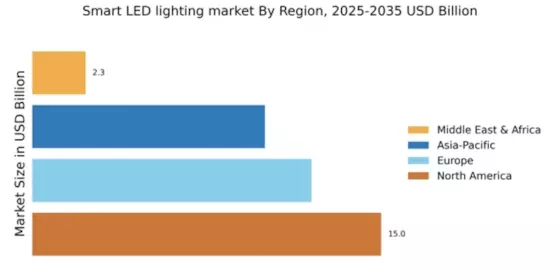
North America is poised to maintain its leadership in the Smart LED lighting market, holding a significant market share of 15.0 in 2024. The growth is driven by increasing energy efficiency regulations, rising consumer awareness about sustainability, and advancements in smart home technologies. The demand for smart lighting solutions is further fueled by the integration of IoT and AI technologies, enhancing user experience and energy management. The competitive landscape in North America is robust, with key players like Signify, Cree, and Acuity Brands leading the charge. The U.S. is the primary market, supported by favorable government initiatives promoting energy-efficient lighting solutions. Companies are investing heavily in R&D to innovate and expand their product offerings, ensuring they remain at the forefront of this rapidly evolving market.
Europe is emerging as a significant player in the Smart LED lighting market, with a market size of 12.0 in 2024. The region's growth is propelled by stringent EU regulations aimed at reducing carbon emissions and promoting energy efficiency. The increasing adoption of smart technologies in residential and commercial sectors is also driving demand, as consumers seek sustainable and cost-effective lighting solutions. Leading countries such as Germany, France, and the UK are at the forefront of this transformation, with major companies like Osram and Philips Hue actively participating. The competitive landscape is characterized by innovation and collaboration, as firms strive to meet regulatory standards and consumer expectations. The European market is expected to continue its upward trajectory, supported by government incentives and a strong focus on sustainability.
The Asia-Pacific region is witnessing rapid growth in the Smart LED lighting market, with a market size of 10.0 in 2024. This growth is driven by urbanization, increasing disposable incomes, and a rising demand for energy-efficient lighting solutions. Governments in countries like China and India are implementing policies to promote smart technologies, further boosting market demand. The region's focus on smart city initiatives is also a significant catalyst for growth. China is the leading market in the region, with major players like Samsung and LG Electronics investing heavily in R&D and production capabilities. The competitive landscape is dynamic, with both local and international companies vying for market share. As the region continues to embrace smart technologies, the Smart LED lighting market is expected to flourish, driven by innovation and consumer demand for advanced lighting solutions.
The Middle East and Africa region is gradually emerging in the Smart LED lighting market, with a market size of 2.29 in 2024. The growth is primarily driven by increasing urbanization, infrastructure development, and a growing awareness of energy efficiency. Governments are beginning to recognize the importance of sustainable lighting solutions, leading to favorable policies and investments in smart technologies. Countries like South Africa and the UAE are leading the charge, with local and international companies exploring opportunities in this nascent market. The competitive landscape is still developing, but there is significant potential for growth as more players enter the market. As awareness and demand for smart lighting solutions increase, the region is expected to see substantial advancements in its Smart LED lighting sector.
The Smart LED lighting market is currently characterized by a dynamic competitive landscape, driven by technological advancements, sustainability initiatives, and increasing consumer demand for energy-efficient solutions. Key players such as Signify (NL), Osram (DE), and Cree (US) are strategically positioned to leverage innovation and digital transformation to enhance their market presence. Signify (NL), for instance, focuses on expanding its portfolio of connected lighting solutions, while Osram (DE) emphasizes its commitment to sustainability through the development of eco-friendly products. These strategies collectively shape a competitive environment that is increasingly focused on technological differentiation and environmental responsibility.In terms of business tactics, companies are localizing manufacturing and optimizing supply chains to enhance operational efficiency and reduce costs. The market structure appears moderately fragmented, with several key players exerting influence over various segments. This fragmentation allows for niche players to emerge, yet the collective strength of major companies like GE Lighting (US) and Acuity Brands (US) ensures that competition remains robust and innovation-driven.
In November Signify (NL) announced a partnership with a leading smart home technology firm to integrate its lighting solutions with advanced home automation systems. This strategic move is likely to enhance user experience and expand market reach, positioning Signify as a frontrunner in the smart home segment. The collaboration underscores the importance of interoperability in the smart lighting ecosystem, potentially driving further adoption among consumers.
In October Osram (DE) launched a new line of energy-efficient LED products designed specifically for commercial applications. This initiative not only aligns with global sustainability goals but also caters to the growing demand for energy-efficient solutions in the commercial sector. By focusing on this market segment, Osram is likely to strengthen its competitive position and appeal to environmentally conscious businesses.
In September Cree (US) unveiled its latest smart LED technology, which incorporates AI-driven features for enhanced energy management. This innovation is indicative of a broader trend towards integrating artificial intelligence into lighting solutions, allowing for smarter energy consumption and improved user control. Such advancements may provide Cree with a competitive edge in a market increasingly driven by technological sophistication.
As of December current competitive trends in the Smart LED lighting market are heavily influenced by digitalization, sustainability, and AI integration. Strategic alliances are becoming increasingly pivotal, as companies seek to enhance their technological capabilities and market reach. The competitive differentiation is likely to evolve from traditional price-based competition towards a focus on innovation, technology, and supply chain reliability. This shift suggests that companies that prioritize R&D and sustainable practices will be better positioned to thrive in the future.



Recent advancements in smart LED lighting technology include the integration of sensors and controls for enhanced energy efficiency and user convenience. For instance, smart LED bulbs with motion and daylight sensors automatically adjust brightness levels based on occupancy and ambient light, leading to significant energy savings. Moreover, the growing adoption of voice-activated smart home assistants like Amazon Alexa and Google Home is driving demand for smart LED lighting solutions that can be controlled hands-free.
Additionally, the increasing popularity of smart city initiatives is creating opportunities for smart LED lighting systems that can enhance public safety, optimize traffic flow, and improve overall urban infrastructure.
The Smart LED lighting market is projected to grow at 11.45% CAGR from 2025 to 2035, driven by energy efficiency, IoT integration, and increasing consumer demand for smart home solutions.
New opportunities lie in:
By 2035, the Smart LED lighting market is poised for substantial growth and innovation.
| MARKET SIZE 2024 | 39.29(USD Billion) |
| MARKET SIZE 2025 | 43.79(USD Billion) |
| MARKET SIZE 2035 | 129.49(USD Billion) |
| COMPOUND ANNUAL GROWTH RATE (CAGR) | 11.45% (2025 - 2035) |
| REPORT COVERAGE | Revenue Forecast, Competitive Landscape, Growth Factors, and Trends |
| BASE YEAR | 2024 |
| Market Forecast Period | 2025 - 2035 |
| Historical Data | 2019 - 2024 |
| Market Forecast Units | USD Billion |
| Key Companies Profiled | Signify (NL), Osram (DE), Cree (US), Acuity Brands (US), GE Lighting (US), Philips Hue (NL), Samsung (KR), LG Electronics (KR), Eaton (US) |
| Segments Covered | Application, Technology, End Use, Control System, Light Source Type |
| Key Market Opportunities | Integration of smart home technology enhances consumer demand in the Smart LED lighting market. |
| Key Market Dynamics | Rising consumer demand for energy-efficient solutions drives innovation and competition in the Smart LED lighting market. |
| Countries Covered | North America, Europe, APAC, South America, MEA |
The Smart LED lighting market is projected to reach a valuation of 129.49 USD Billion by 2035.
In 2024, the Smart LED lighting market was valued at 39.29 USD Billion.
The expected CAGR for the Smart LED lighting market during the forecast period 2025 - 2035 is 11.45%.
Key players in the Smart LED lighting market include Philips Lighting, Osram, Cree, GE Lighting, Signify, Acuity Brands, Zumtobel Group, Samsung Electronics, LG Electronics, and Eaton.
The main applications include Residential (30.0 USD Billion), Commercial (35.0 USD Billion), Industrial (25.0 USD Billion), Outdoor (20.0 USD Billion), and Smart City (19.49 USD Billion).
In the healthcare sector, the Smart LED lighting market is projected to reach 21.43 USD Billion by 2035.
Technologies include Bluetooth (16.0 USD Billion), Wi-Fi (35.0 USD Billion), Zigbee (25.0 USD Billion), Powerline Communication (20.0 USD Billion), and DALI (33.49 USD Billion).
The Smart LED lighting market in the education sector is expected to reach 30.0 USD Billion by 2035.
Control systems include Manual Control (15.0 USD Billion), Remote Control (25.0 USD Billion), Automated Control (35.0 USD Billion), Smartphone Application (25.0 USD Billion), and Voice Control (29.49 USD Billion).
The outdoor application segment of the Smart LED lighting market is projected to reach 20.0 USD Billion by 2035.



Kindly complete the form below to receive a free sample of this Report

“This is really good guys. Excellent work on a tight deadline. I will continue to use you going forward and recommend you to others. Nice job”


“Thanks. It’s been a pleasure working with you, please use me as reference with any other Intel employees.”


“Thanks for sending the report it gives us a good global view of the Betaïne market.”


“Thank you, this will be very helpful for OQS.”


“We found the report very insightful! we found your research firm very helpful. I'm sending this email to secure our future business.”


“I am very pleased with how market segments have been defined in a relevant way for my purposes (such as "Portable Freezers & refrigerators" and "last-mile"). In general the report is well structured. Thanks very much for your efforts.”


“I have been reading the first document or the study, ,the Global HVAC and FP market report 2021 till 2026. Must say, good info! I have not gone in depth at all parts, but got a good indication of the data inside!”


“We got the report in time, we really thank you for your support in this process. I also thank to all of your team as they did a great job.”


“The Automotive 48V ECU Components Procurement Intelligence Study” was a complex project, but the Market Research Future (MRFR) team handled it with quality, agility, and customer-centricity. They delivered all requested data on time and within the agreed scope. The team, including Shubhendra Anand and Rahul Gotadki, was always readily available to clarify questions and swiftly implement necessary adjustments, driving the project to a successful conclusion within a very demanding timeframe.
I would also like to specifically commend Akshay Agarwal for his responsiveness and support at every stage—from our initial inquiry on May 6th through to final delivery on June 18th. His dedication made the entire process seamless.”



