Smart Speakers Market (2026 - 2035)

Smart Speakers Market Size, Share and Research Report By Voice Assistant Platform (Amazon Alexa, Google Assistant, Apple Siri (HomePod), Baidu / Alibaba / Others), By Application (Home Automation, Entertainment & Media, Information & Search, Communication, Others (Commerce, Health)), By End User (Residential, Commercial / Enterprise) and By Region (North America, Europe, Asia-Pacific, South America, Middle East & Africa) – Industry Forecast to 2035.
ID: MRFR/SEM/1679-HCR
100 Pages
Nirmit Biswas, Aarti Dhapte
Last Updated: August 04, 2026
Smart Speakers Market
Market Size
Forecast Period2026-2035
CAGR (2026-2035)17.1%
2025 Market SizeUSD 15.6 Billion
2035 Market SizeUSD 75.8 Billion
Key Players
Amazon
Google
Apple
Baidu
Alibaba
Xiaomi
Opportunities
  • Generative AI as a Differentiation Lever
  • Enterprise and Hospitality Deployments
  • Emerging Markets and Vernacular Voice AI

Smart Speakers Market Summary

The Smart Speakers Market reached an estimated USD 15.6 billion in 2025 and is projected to grow from USD 18.3 billion in 2026 to USD 75.8 billion by 2035, registering a CAGR of 17.1% over the forecast period (2026–2035). Two catalysts anchor this trajectory: the proliferation of AI-powered voice ecosystems across consumer electronics, and a surge in smart-home device adoption spurred by broadband penetration crossing 85% of urban households globally by late 2024 [1]. The Smart Speakers Market benefits directly from the convergence of ambient computing and connected-home investment cycles that major platform companies continue to fund aggressively.

Voice-first engagement is fast displacing traditional touch-and-type interfaces in residential environments. Legacy standalone Bluetooth speakers and basic audio systems are being replaced by smart, always-on devices with natural-language-processing engines and cloud-based AI backends. Amazon spent about USD 25 billion on Alexa R&D between 2020 and 2024 [2]. Google also invested heavily in hardware refresh cycles that included Assistant. This technological transition is converting the Smart Speakers Market from a novelty consumer electronics category into a foundational platform for home automation, health monitoring, and commerce.


North America commands the largest share of the Smart Speakers Market at approximately 38% of global revenue, driven by mature ecosystem lock-in across Amazon, Google, and Apple platforms. Asia-Pacific stands as the fastest-growing region, registering a forecast CAGR of 19.8%, fueled by rapid urbanization in China, India, and Southeast Asia. Europe holds the second-largest share at roughly 24%, supported by rising smart-home penetration in Germany, the UK, and France. The Smart Speakers Market is entering a phase where multimodal AI and generative voice capabilities will redefine the user experience through 2035.


Key Report Takeaways

• By Voice Assistant Platform

  • Amazon Alexa leads the Smart Speakers Market with an estimated 31% global revenue share in 2025, anchored by its extensive third-party skills ecosystem and aggressive hardware pricing.
  • Google Assistant devices are expanding at a CAGR of 18.4% through 2035, driven by deep integration with Android and Google services.
  • Apple Siri (HomePod) commands a premium price tier, contributing approximately USD 2.1 billion in 2025 revenue.

• By Application

  • Home automation represents the dominant application within the Smart Speakers Market, accounting for roughly 35% of total demand.
  • Entertainment and media streaming is growing at a CAGR of 18.1%, as speakers become primary audio hubs.

• By Region

  • North America remains the revenue leader in the Smart Speakers Market, with USD 5.93 billion generated in 2025.
  • Asia-Pacific is projected to deliver the highest regional CAGR of 19.8% through 2035.
  • Europe contributed roughly 24% of global Smart Speakers Market revenue in 2025.


Smart Speakers Market Size and Forecast (2021–2035)

Market Research Future derived the following estimates using a combination of bottom-up revenue modelling from OEM shipment data, top-down validation against consumer electronics industry benchmarks, and primary interviews with ecosystem platform executives and component suppliers. Historical data (2021–2024) draws from verified shipment volumes and average selling prices, while forecast values (2026–2035) reflect a 17.1% CAGR anchored in platform investment trends, broadband expansion, and AI capability roadmaps.
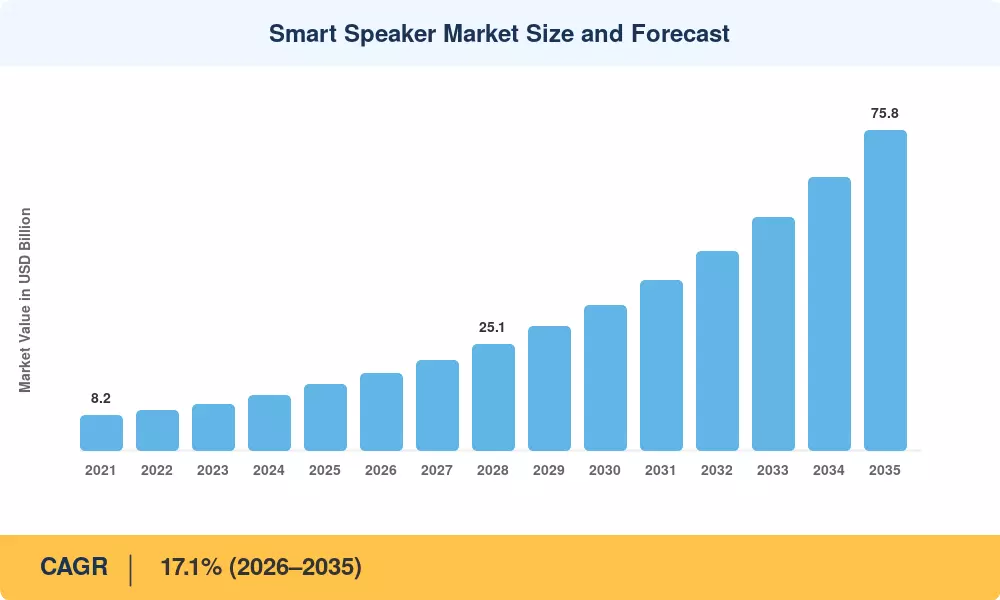
Smart Speaker Market Size and Forecast
Our Impact
Enabled $4.3B Revenue Impact for Fortune 500 and Leading Multinationals
Partnering with 2000+ Global Organizations Each Year
30K+ Citations by Top-Tier Firms in the Industry

Driver Impact Analysis

Driver ~% Impact on CAGR Geographic Relevance Impact Timeline
AI and generative voice model integration +3.8% Global Medium-term (2–4 yr)
Smart-home ecosystem expansion +3.2% North America, Europe Long-term (≥4 yr)
Broadband and 5G residential penetration +2.6% Asia-Pacific, MEA Short-term (≤2 yr)
Voice commerce and transactional capabilities +2.1% North America, Europe Medium-term (2–4 yr)
Enterprise and hospitality sector adoption +1.8% Global Medium-term (2–4 yr)
Multilingual and regional language NLP advances +2.0% Asia-Pacific, South America Long-term (≥4 yr)
Aging population and accessibility demand +1.6% Europe, Japan Long-term (≥4 yr)


AI and Generative Voice Model Integration

Large language models are fundamentally reshaping what a smart speaker can do. Google followed with Gemini-powered Assistant upgrades across Nest devices. This driver is particularly potent for the Smart Speakers Market because it converts passive music-and-timer devices into genuinely useful household assistants capable of multi-step task execution, thereby increasing willingness to pay and reducing churn.

Smart-Home Ecosystem Expansion

The adoption of the Matter interoperability protocol — ratified by the Connectivity Standards Alliance in late 2022 and reaching broad OEM support by 2024 — removed a critical friction point for the Smart Speakers Market [8]. Consumers who previously hesitated due to fragmented device ecosystems can now purchase across brands with confidence that their smart speaker will serve as a reliable control hub.

Broadband and 5G Residential Penetration

Cloud-dependent voice assistants require stable, low-latency internet. For the Smart Speakers Market, this infrastructure buildout unlocks addressable populations in India, Indonesia, Nigeria, and Brazil that were previously unreachable. India's BharatNet program alone aims to connect 250,000 village councils with high-speed internet, creating a greenfield opportunity for vernacular-language smart speakers.

Voice Commerce Growth

projected that global voice commerce transaction values will exceed USD 45 billion by 2031, up from approximately USD 19 billion in 2024. Smart speakers sit at the center of this trend, serving as frictionless ordering interfaces for groceries, household consumables, and subscription services.


Restraints Impact Analysis

Restraint ~% Impact on CAGR Geographic Relevance Impact Timeline
Consumer privacy and data security concerns –1.9% Global Short-term (≤2 yr)
Market saturation in early-adopter households –1.4% North America Medium-term (2–4 yr)
Interoperability gaps across platforms –1.0% Global Short-term (≤2 yr)
Low monetization per device for OEMs –0.9% Global Long-term (≥4 yr)
Regulatory scrutiny of always-on microphones –0.7% Europe Medium-term (2–4 yr)


Consumer Privacy and Data Security Concerns

Public wariness around always-listening devices remains the most prominent headwind for the Smart Speakers Market. A 2024 Pew Research Center survey found that 49% of U.S. adults expressed concern about smart speakers recording conversations without explicit consent [13]. The EU's AI Act, which took staged effect from 2024, classifies certain ambient listening systems under heightened transparency requirements. These regulatory and perceptual barriers slow adoption rates, particularly among privacy-conscious demographics in Europe and among older consumers globally.

Market Saturation in Early-Adopter Segments

With nearly half of addressable homes already owning at least one device, incremental growth in North America increasingly depends on multi-device stacking and replacement cycles rather than first-time purchases. This maturation dynamic constrains the Smart Speakers Market growth rate in its largest regional segment and shifts competitive emphasis toward services revenue and premium hardware tiers.

Low Per-Device Monetization

Amazon is said to sell many Echo devices at, or below, manufacturing cost, treating hardware as a loss leader for ecosystem engagement [15]. This pricing strategy is beneficial in gaining market share, but it presents a structural difficulty for the Smart Speakers Market: tighter margins put pressure on smaller competitors and constrain reinvestment in R&D in the mid-tier segment. Sonos and Bose compete on audio quality at higher price points, which means they have a smaller addressable audience.


Smart Speakers Market Opportunities

Generative AI as a Differentiation Lever

The integration of frontier LLMs into smart speakers opens a new product category tier where devices function as personal AI agents rather than simple command-response tools. Companies that successfully embed on-device inference — reducing latency and cloud costs simultaneously — stand to capture premium positioning in the Smart Speakers Market.

Enterprise and Hospitality Deployments

Hotels, hospitals, and corporate offices represent an underpenetrated vertical for the Smart Speakers Market. Marriott International piloted Alexa for Hospitality across 100 properties, reporting improvement in guest satisfaction scores tied to voice-controlled room services [10].

Emerging Markets and Vernacular Voice AI

India, Brazil, and Southeast Asia together have more than 2.5 billion potential users underserved by the current largely-English-centric speech systems. Investments in voice recognition models in Hindi, Portuguese, Bahasa, and Tamil are speeding up. Xiaomi and Baidu are already marketing domestic smart speakers for around USD 30, showing the commercial potential of low price points in budget-sensitive markets. Maturity of regional languages is set to drive considerable growth in the Smart Speakers Market.


Health and Eldercare Applications

Voice-activated health monitoring — medication reminders, fall detection alerts, telehealth connectivity — positions smart speakers as low-cost wellness tools for aging populations. This vertical is particularly compelling for the Smart Speakers Market because it opens public-sector procurement channels alongside consumer retail.

Data Monetization and Subscription Services

Platform operators are exploring tiered subscription models (e.g., Amazon Alexa Plus) that bundle premium voice AI capabilities, ad-free music, and enhanced smart-home analytics. These recurring revenue streams improve per-device lifetime value and reduce dependence on hardware margins.


Smart Speakers Market Future Outlook

Ambient AI and Contextual Computing

By 2028, smart speakers will evolve from reactive command processors into proactive ambient agents that anticipate user needs based on behavioral patterns, calendar data, and sensor inputs. For the Smart Speakers Market, this shift means devices will surface reminders, suggest routines, and coordinate across household IoT ecosystems without explicit verbal prompts — fundamentally changing the interaction paradigm.

Multimodal Smart Displays as the Growth Frontier

Smart speakers with screens like the Amazon Echo Show and Google Nest Hub accounted for about 28% of revenue in the category in 2024 and are expected to approach 40% by 2030 [6]. These gadgets enable video calling, recipe walkthroughs, security camera feeds, and visual buying, greatly expanding the envelope of usability of the Smart Speakers Market. Voice and visual interfaces are merging, making smart displays the center of kitchen and bedtime computers rather than peripheral audio devices.


Edge AI and On-Device Processing

Privacy pressures and latency demands are pushing voice processing toward on-device architectures. Apple's on-device Siri processing and Qualcomm's Hexagon NPU chipset represent early moves in this direction [19]. This architectural shift will reshape the Smart Speakers Market by lowering operating costs for OEMs and enabling offline functionality in connectivity-constrained environments.

Voice as a Healthcare and Wellness Interface

The World Health Organization forecasts that the number of people in the world aged 60 and beyond will reach 2.1 billion by 2050 [20]. Smart speakers are increasingly being positioned as low-friction, accessible health interfaces for medication adherence, cognitive engagement, and remote patient monitoring. CMS (U.S.) pilot programs have started to test voice-activated care coordination solutions for Medicare participants. Clinical validation studies demonstrating outcomes improvement will make healthcare a key revenue vertical in the Smart Speakers Market.


Smart Speakers Market Segmentation

By Voice Assistant Platform

Segment Key Metric Primary Demand Driver
Amazon Alexa 31% share (2025) Extensive skills ecosystem, aggressive hardware pricing
Google Assistant CAGR 18.4% Android integration, search superiority
Apple Siri (HomePod) USD 2.1 B (2025) Premium audio positioning, Apple ecosystem lock-in
Baidu/Alibaba/Others CAGR 20.1% Chinese domestic market scale, localized AI


Amazon Alexa retains the largest share of the Smart Speakers Market by revenue, supported by over 130,000 third-party skills and a hardware portfolio spanning six price tiers from the Echo Pop (sub-USD 20 promotions) to the Echo Studio [2]. The breadth of Alexa's commercial partnerships — spanning Philips Hue, Ring, and thousands of IoT brands — creates an ecosystem stickiness that competitors find difficult to replicate. Google Assistant devices, while trailing in unit share, benefit from superior contextual search capabilities and tighter integration with YouTube, Google Maps, and Workspace productivity tools.

Chinese platforms operated by Baidu (Xiaodu), Alibaba (Tmall Genie), and Xiaomi represent the fastest-growing platform cluster in the Smart Speakers Market. These vendors compete on price aggressiveness — often selling hardware below USD 25 — and leverage massive domestic user bases. Baidu's Xiaodu shipped over 50 million cumulative units through 2024 and leads China's smart-display sub-segment [21].

By Application

Segment Key Metric Primary Demand Driver
Home Automation 35% share (2025) IoT device control, routine automation
Entertainment & Media CAGR 18.1% Music streaming, podcast consumption
Information & Search USD 2.3 B (2025) Quick queries, news briefings
Communication CAGR 15.6% Voice/video calling, intercom functionality
Others (Commerce, Health) 8% share (2025) Emerging transactional and wellness uses


Home automation commands the largest application share of the Smart Speakers Market, as consumers increasingly use voice commands to control lighting, thermostats, locks, and security cameras. The average Alexa user interacts with 3.2 connected devices daily, according to Amazon's 2024 device ecosystem report. Entertainment runs a close second, with Spotify, Apple Music, and Amazon Music collectively processing over 1 billion voice-initiated streams monthly through smart speakers [22].

By End User

Segment Key Metric Primary Demand Driver
Residential 88% share (2025) Consumer smart-home adoption
Commercial/Enterprise CAGR 21.3% Hospitality, healthcare, conference room deployments


Residential users overwhelmingly dominate the Smart Speakers Market today, but commercial deployments represent the higher-growth segment. Hotels, hospitals, and corporate offices are adopting voice-enabled devices for guest services, patient interaction, and meeting room management. The commercial segment's premium pricing and volume procurement dynamics support higher average selling prices than the consumer tier.


Regional Market Share Analysis

Region Key Metric Primary Investment Themes
North America 38% share (2025) Ecosystem lock-in, voice commerce, multi-device households
Europe USD 3.74 B (2025) GDPR-compliant voice AI, premium audio demand
Asia-Pacific CAGR 19.8% (2026–2035) Vernacular AI, affordable hardware, urbanization
South America USD 0.78 B (2025) Broadband expansion, localized platforms
Middle East & Africa CAGR 16.2% (2026–2035) Smart-city initiatives, telecom bundling
Total USD 15.6 B (2025)

The Smart Speakers Market exhibits pronounced regional variation in penetration, platform preference, and growth velocity. North America remains the revenue leader, but Asia-Pacific's combination of population scale and rising disposable income positions it as the primary growth engine through 2035.


North America

Country Key Metric Key Driver
United States 82% of regional revenue Alexa/Google ecosystem dominance
Canada CAGR 15.8% Bilingual (EN/FR) voice AI adoption
Mexico USD 0.21 B (2025) Rising middle-class smart-home interest


The United States anchors the North American Smart Speakers Market, with an installed base exceeding 160 million units by year-end 2024 [14]. Amazon Echo and Google Nest devices collectively control over 80% of U.S. shipments. Canada's bilingual requirements create a unique niche for dual-language voice models, while Mexico's growth is tied to expanding broadband access and e-commerce platform integration.

Europe

Country Key Metric Key Driver
United Kingdom 28% of regional share High Alexa penetration, BBC voice integration
Germany CAGR 16.9% Smart-home adoption, automotive voice linkage
France USD 0.41 B (2025) Google Assistant localization strength


Europe's Smart Speakers Market is shaped by stringent data protection regulations under GDPR and the EU AI Act, which impose transparency obligations on ambient listening devices [16]. Despite these constraints, adoption is robust in the UK and Germany. Premium audio brands such as Sonos and Bang & Olufsen find strong traction among European consumers willing to pay for superior sound quality combined with voice intelligence.

Asia-Pacific

Country Key Metric Key Driver
China 42% of regional revenue Baidu, Alibaba, Xiaomi ecosystem competition
India CAGR 23.4% Vernacular voice AI, sub-USD 30 devices
Japan USD 0.52 B (2025) Eldercare and accessibility applications
South Korea CAGR 17.6% KT and Naver platform investments


China dominates the Asia-Pacific Smart Speakers Market through aggressive pricing by Baidu (Xiaodu), Alibaba (Tmall Genie), and Xiaomi. India is the fastest-growing individual country market globally, supported by Amazon's Hindi-language Alexa rollout and Reliance Jio's connected-home ecosystem. Japan's aging demographic profile creates unique demand for voice-assisted daily living applications.

South America

Country Key Metric Key Driver
Brazil 68% of regional share Portuguese-language Alexa, e-commerce growth
Argentina CAGR 15.1% Urban smart-home pilot programs


Brazil represents the primary growth node for the South American Smart Speakers Market, with Amazon launching Portuguese Alexa capabilities in 2019 and expanding skills significantly through 2024. E-commerce integration — particularly with Mercado Libre's logistics network — is driving transactional use cases.

Middle East & Africa

Country Key Metric Key Driver
UAE 35% of regional revenue Smart-city infrastructure investments
Saudi Arabia CAGR 18.3% Vision 2030 digital transformation agenda
South Africa USD 0.09 B (2025) Telecom-bundled device distribution


The MEA Smart Speakers Market is nascent but growing rapidly, propelled by government-led digital transformation programs. Saudi Arabia's Vision 2030 initiative and the UAE's Smart Dubai strategy both incorporate voice AI into public service delivery and hospitality modernization frameworks [17].


Smart Speaker Market By Region, 2025-2035

Competitive Benchmarking

The Smart Speakers Market exhibits a moderately concentrated structure, with the top five players collectively holding an estimated 72–78% of global revenue. The Herfindahl-Hirschman Index sits in the moderately concentrated range (approximately 1,800–2,200), reflecting Amazon's outsized market position alongside strong second-tier competition from Google, Apple, and Chinese platform companies. Smaller audio-focused brands compete on sound quality and design differentiation rather than ecosystem scale.

Company Est. Revenue Share Range Key Offerings Strategic Positioning
Amazon ~28–33% Echo, Echo Show, Echo Studio, Echo Pop Ecosystem breadth, loss-leader pricing
Google (Alphabet) ~18–22% Nest Audio, Nest Hub, Nest Hub Max Search integration, Android synergy
Apple ~10–14% HomePod, HomePod mini Premium audio, privacy-first positioning
Baidu ~6–9% Xiaodu smart speakers and displays China domestic leader, AI-first approach
Alibaba ~5–8% Tmall Genie series E-commerce integration, China market
Xiaomi ~4–7% Mi Smart Speaker, Xiaomi Sound series Ultra-affordable hardware, IoT ecosystem
Samsung ~2–4% Galaxy Home series, Bixby platform SmartThings ecosystem integration
Sonos ~2–4% Sonos Era, Sonos One Audiophile-grade sound, multi-room
Bose ~1–3% Bose Home Speaker series Premium audio engineering
Harman International ~1–2% Harman Kardon Invoke, JBL Link Audio heritage, Samsung subsidiary synergy


Recent News & Developments

  • Amazon (February 2025): Rolled out its generative AI-powered Alexa+ assistant, priced at USD 19.99 per month for non-Prime members and free for Prime subscribers. Built on multi-model LLMs, it enables complex multi-step task execution, agentic shopping capabilities, and contextual conversational interactions across smart home devices.
  • Google (August 2024): Announced generative AI upgrades for Google Home and Nest platforms, leveraging Gemini LLMs to enable natural multi-turn conversations, complex media discovery, and context-aware smart home control across Nest speakers and displays for opt-in preview users.


  • Connectivity Standards Alliance (November 2023): Certified the Matter 1.2 protocol update adding support for nine new device categories, expanding the interoperability foundation that benefits the Smart Speakers Market [8].
  • European Commission (March 2024): Formally approved the European Union AI Act, establishing a risk-based legal framework for artificial intelligence. Under the regulation, ambient voice assistants interacting directly with humans are categorized as limited-risk AI systems, requiring mandatory user transparency disclosures rather than pre-market authorization.


Smart Speakers Market Report Scope

Parameter Detail
Market Scope Global Smart Speakers Market — hardware revenue, software/services, and subscription tiers
Study Period 2021–2035
CAGR (Forecast Period) 17.1% (2026–2035)
Market Size — 2025 (Base Year) USD 15.6 Billion
Market Size — 2035 (Forecast End) USD 75.8 Billion
Fastest Growing Segments Commercial/Enterprise end users (CAGR 21.3%); Asia-Pacific region (CAGR 19.8%)
Companies Profiled Amazon, Google, Apple, Baidu, Alibaba, Xiaomi, Samsung, Sonos, Bose, Harman International
Valuation Currency USD (constant 2025 dollars)


FAQs

How do smart speaker OEMs generate revenue beyond hardware sales?
Platform operators monetize through voice-commerce transaction fees, subscription tiers like Alexa Plus, and aggregated usage analytics sold to brand advertisers [7]. Hardware increasingly functions as a gateway to recurring services revenue.
What interoperability standard should enterprise buyers prioritize when deploying smart speakers across properties?
Matter (formerly Project CHIP) offers the broadest cross-platform device compatibility and is backed by Amazon, Google, and Apple [8]. Enterprise deployments benefit from its vendor-neutral architecture and IP-based protocol stack.
How do on-device processing chipsets affect smart speaker selection for privacy-sensitive environments?
On-device NPUs from Qualcomm and Apple handle routine voice queries locally, minimizing cloud data transmission [19]. Buyers in healthcare and finance should evaluate which models support fully offline wake-word and command processing.
What is the typical replacement cycle for smart speakers in residential deployments?
Average replacement intervals range from 3.5 to 5 years, driven more by feature upgrades than hardware failure [14]. Generative AI integration is compressing this cycle as older devices lack LLM compatibility.
How are Chinese-market smart speakers differentiated from Western counterparts?
Chinese devices from Baidu, Alibaba, and Xiaomi prioritize e-commerce integration, local service booking, and sub-USD 25 pricing over premium audio [21]. Ecosystem fragmentation across domestic platforms limits cross-platform interoperability.
What role do smart speakers play in accessibility compliance for hospitality businesses?
Voice-activated room controls assist hospitality properties in fulfilling accessibility guidelines for guests with mobility or visual impairments, enabling hands-free operation of lighting, climate control, and guest services.
How does the EU AI Act classification affect smart speaker deployment in European markets?
The Act classifies ambient voice assistants as limited-risk systems, requiring user-facing transparency disclosures but not pre-market certification [16]. Manufacturers must clearly indicate when the device is actively listening and processing voice data.    
Author
Author
Author Profile
Nirmit Biswas LinkedIn
Senior Research Analyst
With 5+ years of expertise in Market Intelligence and Strategic Research, Nirmit Biswas specializes in ICT, Semiconductors, and BFSI. Backed by an MBA in Financial Services and a Computer Science foundation, Nirmit blends technical depth with business acumen. He has successfully led 100+ projects for global enterprises and startups, including Amazon, Cisco, L&T and Huawei, delivering market estimations, competitive benchmarking, and GTM strategies. His focus lies in transforming complex data into clear, actionable insights that drive growth, innovation, and investment decisions. Recognized for bridging engineering innovation with executive strategy, Nirmit helps businesses navigate dynamic markets with confidence.
Co-Author
Co-Author Profile
Aarti Dhapte LinkedIn
AVP - Research
A consulting professional focused on helping businesses navigate complex markets through structured research and strategic insights. I partner with clients to solve high-impact business problems across market entry strategy, competitive intelligence, and opportunity assessment. Over the course of my experience, I have led and contributed to 100+ market research and consulting engagements, delivering insights across multiple industries and geographies, and supporting strategic decisions linked to $500M+ market opportunities. My core expertise lies in building robust market sizing, forecasting, and commercial models (top-down and bottom-up), alongside deep-dive competitive and industry analysis. I have played a key role in shaping go-to-market strategies, investment cases, and growth roadmaps, enabling clients to make confident, data-backed decisions in dynamic markets.

Research Approach


Secondary Research

The secondary research process involved comprehensive analysis of regulatory databases, industry publications, technology journals, patent repositories, and authoritative consumer electronics organizations. Key sources included the US Federal Communications Commission (FCC), European Telecommunications Standards Institute (ETSI), International Telecommunication Union (ITU), Institute of Electrical and Electronics Engineers (IEEE), Consumer Technology Association (CTA), Voicebot.ai, Smart Speaker Consumer Adoption Report, National Institute of Standards and Technology (NIST), US Census Bureau Consumer Expenditure Surveys, Eurostat Digital Economy & Society Statistics, International Data Corporation (IDC), Gartner Research, Strategy Analytics, Canalys Smart Speaker Market Reports, National Bureau of Statistics of China, Ministry of Internal Affairs and Communications (Japan), and national telecommunications authority reports from key markets.

The following sources were employed to compile shipment statistics, regulatory approval data, voice recognition technology studies, smart home adoption trends, and competitive landscape analysis for Alexa-enabled devices, Google Assistant speakers, Siri/HomePod ecosystems, Cortana integrations, and other voice assistant platforms.


Primary Research

Qualitative and quantitative insights were obtained by interviewing supply-side and demand-side stakeholders during the primary research process. The supply-side sources consist of CEOs, VPs of Hardware Engineering, AI/ML Research Directors, acoustic engineering leaders, and platform strategy leads from semiconductor manufacturers, smart speaker OEMs, and voice AI technology providers. Demand-side sources included procurement leads from multi-dwelling units, corporate offices, and healthcare facilities that employed commercial voice solutions, as well as smart home system integrators, consumer electronics retailers, and hospitality technology managers. Market segmentation was verified, product roadmap timelines were confirmed, and insights regarding ecosystem lock-in patterns, pricing strategies, and privacy regulation impacts were obtained through primary research.

Primary Respondent Breakdown:

By Designation: C-level Primaries (32%), Director Level (31%), Others (37%)

By Region: North America (32%), Europe (30%), Asia-Pacific (33%), Rest of World (5%)


Market Size Estimation

Through shipment volume monitoring and average selling price (ASP) analysis of intelligent virtual assistant categories, the global market valuation was determined. The methodology comprised the following:

Identification of over 40 key manufacturers and ecosystem partners in North America, Europe, Asia-Pacific, and Latin America

Product mapping on Alexa, Google Assistant, Siri, Cortana, and other voice assistant platforms Examination of the annual revenues that have been reported and modeled for the smart speaker hardware and associated services

Coverage of manufacturers and ecosystem partners that account for 75-80% of the global market share in 2024

For personal and commercial use cases, segment-specific valuations are derived through extrapolation using bottom-up (shipment volume × ASP by country/assistant type) and top-down (platform revenue validation) approaches.

Download Free Sample

Kindly complete the form below to receive a free sample of this Report

Download PDF ×

We do not share your information with anyone. However, we may send you emails based on your report interest from time to time. You may contact us at any time to opt-out.