Smart Ticketing Market Summary
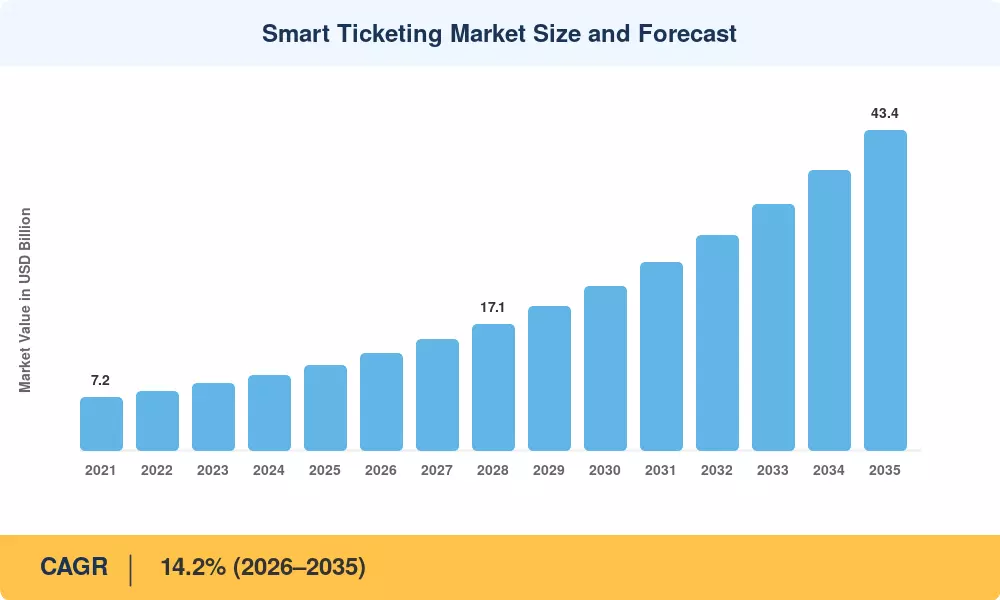
The global Smart Ticketing Market reached an estimated USD 11.5 billion in 2025 and is projected to grow from USD 13.1 billion in 2026 to USD 43.4 billion by 2035, registering a compound annual growth rate of 14.2% during the forecast period (2026–2035). Two catalysts are accelerating this trajectory: the European Union's ITS Directive mandating interoperable fare collection across member states by 2028, and a cumulative USD 48 billion in U.S. federal transit modernization allocations under the Bipartisan Infrastructure Law [1][2]. Together, these policy commitments are pulling investment into open-loop payment infrastructure and account-based ticketing platforms at an unprecedented pace.
Legacy magnetic-stripe and paper-based ticketing systems — still operational in roughly 35% of global transit networks — are being displaced by contactless EMV card readers, QR-code validators, and cloud-hosted fare engines [3]. London's Transport for London processed over 60% of all Tube journeys via contactless bank cards in 2024, a benchmark that transit agencies from São Paulo to Sydney now target [4]. The shift saves operators an estimated 25–30% in per-transaction processing costs while reducing passenger boarding times by up to 40% [5].
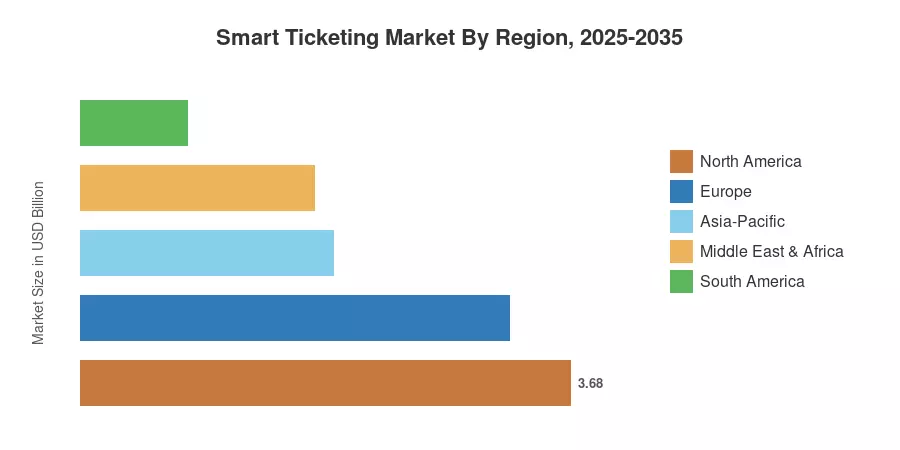
North America holds the dominant position in the Smart Ticketing Market, accounting for approximately 32% of global revenue in 2025, driven by extensive OMNY and TAP card rollouts across major metropolitan areas. Asia-Pacific is the fastest-growing region, expanding at a CAGR of 16.5% as India's National Common Mobility Card program and China's transit super-app ecosystem push adoption into tier-2 and tier-3 cities [6]. Europe commands approximately 28% market share, anchored by the U.K., Germany, and France. As open-payment standards mature and biometric validation pilots scale, the Smart Ticketing Market is poised for sustained double-digit expansion through 2035.
Key Report Takeaways
• By Technology
- NFC/RFID-based ticketing leads the Smart Ticketing Market with approximately 34% revenue share in 2025, supported by mature transit card ecosystems in East Asia and Western Europe.
- Open-payment EMV technology is the fastest-growing technology segment, registering a projected CAGR of 17.8% as transit agencies retire proprietary closed-loop cards.
- QR-code ticketing holds approximately USD 2.7 billion in 2025 revenue, driven by low deployment costs in emerging markets.
• By Application
- Transportation is the largest application vertical in the Smart Ticketing Market, representing roughly 58% of total revenue.
- Sports and entertainment venues are adopting smart ticketing at a CAGR of 15.1%, propelled by stadium digitization investments in North America and the Middle East.
• By Region
- North America generated approximately USD 3.7 billion in Smart Ticketing Market revenue in 2025.
- Asia-Pacific leads all regions with a projected CAGR of 16.5% through 2035, fueled by government-mandated interoperable mobility platforms.
- Europe's share stands at roughly 28%, with the EU's ITS Directive acting as a cross-border standardization catalyst.
Smart Ticketing Market Size and Forecast (2021–2035)
Market sizing draws on a triangulated methodology combining bottom-up fare-system deployment data from 120+ transit agencies, top-down vendor revenue analysis across eight publicly listed solution providers, and regulatory-impact modelling based on announced infrastructure investment programs. Historical figures (2021–2024) reflect actual deployment volumes; the base year (2025) integrates validated Q1–Q3 transactional data; and the forecast period (2026–2035) applies a demand-driven growth model calibrated to announced policy commitments and technology replacement cycles.