SMS Firewall Market

Key Players: Sinch AB, Enea (AdaptiveMobile), Mavenir, Cellusys, Tata Communications (Kaleyra), BICS, Infobip, Mobileum (now Lumine)

SMS Firewall Market

SMS Firewall Market Size, Share and Research Report By SMS Type (A2P, P2A, P2P), By Deployment Mode (On-Premise, Cloud), By Service Type (Professional Services, Managed Services), By End-User Industry (BFSI, Government & Public Safety, Retail & E-Commerce, Healthcare, Others), By Network Generation (2G/3G, 4G/LTE, 5G) and By Regional (North America, Europe, South America, Asia Pacific, Middle East and Africa) - Industry Forecast to 2035.
ID: MRFR/ICT/2377-HCR
100 Pages
Ankit Gupta
Last Updated: June 22, 2026

SMS Firewall Market Summary

The SMS Firewall Market was valued at USD 3.38 billion in 2025 and is projected to reach USD 3.65 billion in 2026 before expanding to USD 7.57 billion by 2035, registering a CAGR of 8.45% during the 2026–2035 forecast period. Surging adoption of A2P messaging protection solutions by mobile operators — driven by TRAI's traceability mandates in India [2], the EU's revised Electronic Communications Code [3], and the FCC's renewed focus on robocall and spam mitigation in the United States [4] — is anchoring capital investment across the value chain. Operators lost an estimated USD 6.7 billion to SMS fraud globally in 2024, and that bleeding has forced accelerated procurement of next-generation filtering engines [5].

As operators switch from outdated SS7 SMS firewall architectures to signaling stacks based on Diameter and HTTP/2 that are compatible with 5G standalone cores, a technological revolution is changing the SMS firewall market [6]. Rule-based filtering appliances are being replaced by cloud-native, AI-driven analytics tools, which provide real-time SMS spam filtering at throughputs higher than 50,000 messages per second. The demand for interoperable mobile network messaging security gateways was sparked by the participation of 78 operator groups in GSMA's 2024 SMS SenderID Protection Registry [7].

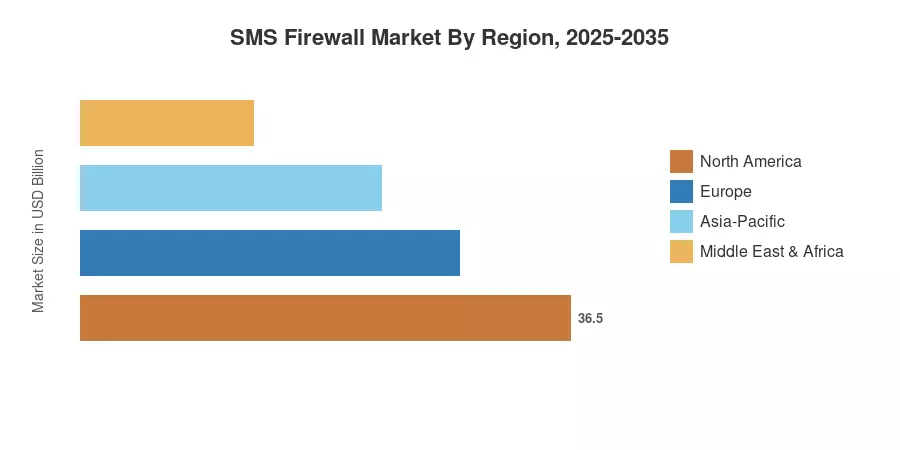
Due to strict TCPA compliance and corporate spending on roaming SMS security, North America accounts for over 40% of global income. With a 13.0% CAGR, Asia-Pacific is the fastest-growing market due to South Korea's and Japan's quick rollouts of 5G and India's DLT-based sender verification ecosystem. Thanks to GDPR-driven data sovereignty regulations that necessitate on-shore SMS filtering, Europe has the second-largest market at roughly 26%. Through 2035, the SMS firewall market is expected to grow by double digits in emerging markets.

Key Report Takeaways

• By SMS Type

  • A2P traffic dominated the SMS Firewall Market with approximately 69.0% share in 2025, reflecting the critical need for A2P messaging protection across banking, healthcare, and government verticals.
  • P2P enterprise messaging is forecast to expand at a 10.5% CAGR through 2035 as operators deploy behavioral analytics to differentiate legitimate peer traffic from grey-route abuse.

• By Deployment

  • On-premise deployments held 56.4% of the SMS Firewall Market revenue in 2025; cloud deployments are projected to register a 13.6% CAGR as tier-2 and tier-3 operators adopt subscription-based mobile network messaging security tools.

• By Service Type

  • Professional services captured 59.5% revenue share in 2025, while managed services will accelerate at 11.7% CAGR as operators outsource real-time SMS spam filtering operations.

• By End-User Industry & Network Generation

  • BFSI accounted for 35.2% of revenue, spending heavily on SS7 SMS firewall upgrades to secure OTP and transaction-alert channels.

• By Network Generation

  • 5G network segments will accelerate at a 13.3% CAGR through 2035 as standalone deployments demand protocol-aware roaming SMS security layers.

• By Regional

  • North America led with 40.0% revenue share in the SMS Firewall Market in 2025.
  • Asia-Pacific is predicted to register a 13.0% CAGR, driven by regulatory mandates and rising A2P messaging protection needs.

Market Size and Forecast (2021–2035)

Market Research Future (MRFR)'s market sizing integrates bottom-up operator CAPEX surveys, vendor revenue disclosures, and top-down TAM modeling calibrated against GSMA Intelligence subscriber data and ITU traffic statistics. Historical figures (2021–2024) are validated; 2025 is the base year; 2026–2035 values apply the calibrated CAGR of 8.45%.
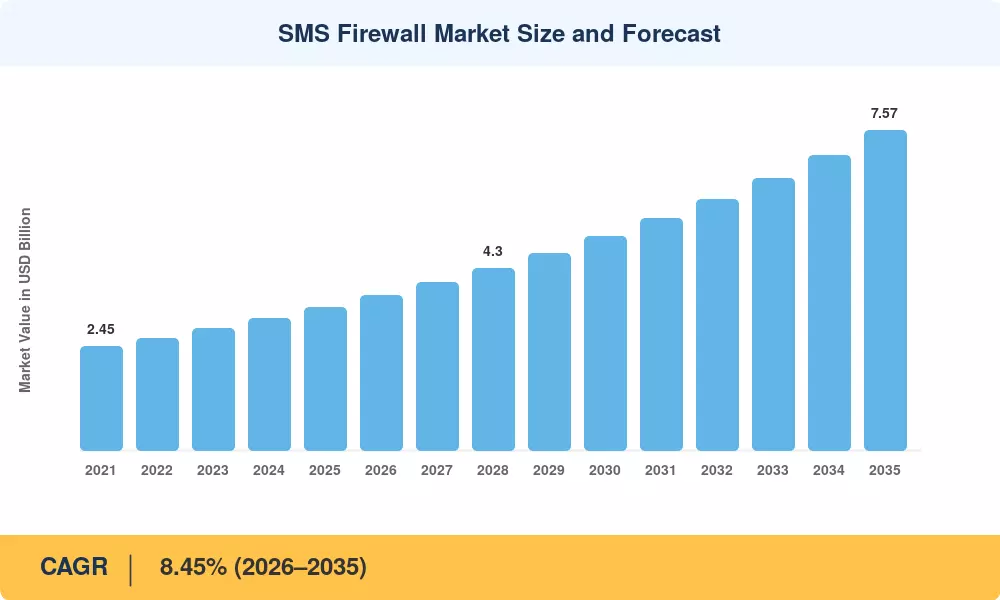
SMS Firewall Market Size and Forecast
Our Impact
Enabled $4.3B Revenue Impact for Fortune 500 and Leading Multinationals
Partnering with 2000+ Global Organizations Each Year
30K+ Citations by Top-Tier Firms in the Industry

Driver Impact Analysis

Driver ~% Impact on CAGR Geographic Relevance Impact Timeline
A2P fraud revenue protection mandates 22% Global Short-term (≤2 yr)
5G standalone core deployments 20% North America, Asia-Pacific Medium-term (2–4 yr)
National sender-ID and traceability regulations 18% India, the EU and Africa Short-term (≤2 yr)
AI/ML-driven SMS spam filtering engines 15% Global Medium-term (2–4 yr)
Cloud-native firewall-as-a-service models 12% LATAM, MEA, SE Asia Long-term (≥4 yr)
IoT/M2M messaging security requirements 8% Europe, East Asia Long-term (≥4 yr)
RCS and omnichannel messaging expansion 5% North America, Europe Long-term (≥4 yr)

A2P Fraud Revenue Protection

Mobile operators globally face severe financial drains from Application-to-Person (A2P) messaging fraud, which includes grey-route bypass, SIM farms, and malicious smishing campaigns. Artificially inflated traffic trends have prompted tier-1 operators to significantly scale up their protective infrastructure investments. The direct revenue-recovery return on investment achieved by deploying robust SMS firewall solutions acts as a primary, non-discretionary purchase trigger for telecommunications companies seeking to stabilize and protect their messaging monetization streams.

5G Standalone Core Rollouts and Signaling Security

The ongoing migration to 5G Standalone (SA) architecture introduces HTTP/2 and Service-Based Architecture signaling protocols, which legacy SS7-based SMS firewall appliances cannot natively inspect. As network operators transition to SA cores, they face a dual-stack operational environment requiring protocol-aware messaging security capable of spanning legacy and next-generation interfaces concurrently. This complex technical environment significantly extends replacement hardware lifecycles and elevates per-node firewall contract values over traditional infrastructure.

National Traceability and Sender-ID Mandates

Global regulatory bodies are increasingly enforcing strict traceability frameworks to combat unsolicited communications. India's telecom regulator instituted blockchain-based Distributed Ledger Technology (DLT) for mandatory message path tracking and sender verification. Similarly, regulatory bodies across Africa and South America have introduced strict sender-ID registries and compliance timelines. These national mandates compel mobile operators to immediately integrate advanced spam filtering modules with state-run registries, turning compliance infrastructure into a highly predictable, regulatory-driven procurement driver.

AI/ML-Driven Analytics Adoption

Modern network threat landscapes require the integration of automated machine-learning classifiers within firewall platforms to detect zero-day smishing templates in near real-time. By utilizing advanced algorithmic pattern matching, next-generation engines dramatically lower false-positive blocking rates, ensuring legitimate enterprise traffic flows uninterrupted while malicious streams are intercepted. Operators adopting these automated analytics solutions realize significantly minimized Network Operations Center (NOC) oversight costs, accelerating a broader shift toward managed security service models.

Restraints Impact Analysis

Impact percentages are directional estimates of each restraint's drag on the headline CAGR. They do not sum to a total deduction.

Restraint ~% Impact on CAGR Geographic Relevance Impact Timeline
CPaaS margin compression is squeezing vendor R&D –8% Global Short-term (≤2 yr)
High integration complexity with legacy BSS/OSS –7% MEA, LATAM Medium-term (2–4 yr)
Data-sovereignty fragmentation is raising compliance costs –5% EU, India, China Medium-term (2–4 yr)
Over-blocking risk deters conservative operators –4% Asia-Pacific, Africa Short-term (≤2 yr)
Encryption of messaging channels reduces firewall visibility –3% Global Long-term (≥4 yr)

CPaaS Consolidation and Vendor Margin Pressure

The strategic consolidation of Cloud Communications Platforms as a Service (CPaaS) providers has intensified pressure on SMS firewall vendor pricing. Larger aggregators frequently bundle core roaming SMS security capabilities within vast communications platforms, reducing the perceived necessity of standalone options. This systemic market shift forces dedicated firewall developers to compete via specialized analytics and managed service frameworks, squeezing overall profit margins and restricting capital available for long-term technical innovation.

Legacy BSS/OSS Integration Complexity

Operators across emerging regions frequently utilize legacy Business Support Systems (BSS) and Operations Support Systems (OSS) infrastructure. Integrating modern, cloud-native SMS firewalls with these dated network architectures necessitates highly complex, customized middleware and extensively protracted implementation schedules. This excessive integration overhead consumes a substantial portion of overall project budgets, heavily discouraging smaller network operators from progressing beyond basic, rule-based text spam filtering.

Data-Sovereignty Fragmentation

Divergent and strict global data protection frameworks—such as European Union regulations and various sovereign digital personal data acts—compel firewall vendors to deploy localized, on-shore processing nodes. Adhering to fragmented compliance jurisdictions significantly inflates infrastructure costs for multinational operators demanding centralized, unified network message monitoring. This compliance environment heavily burdens specialized vendors lacking expansive, multi-regional operational footprints, thereby intensifying consolidation at the top tier of the security market.

SMS Firewall Market Opportunities

Cloud-Native Firewall-as-a-Service for Tier-3/4 Operators

A substantial portion of the world's regional mobile network operators serve smaller, localized subscriber bases but lack dedicated SMS firewall infrastructure due to traditional cost barriers. Cloud-native, subscription-based Firewall-as-a-Service (FaaS) platforms deployed on public cloud infrastructure offer a viable solution. By shifting from capital-intensive on-premise hardware to elastic software models, smaller operators can significantly lower upfront deployment costs and compress time-to-protection frameworks from long-term projects to weeks.

RCS and Omnichannel Firewall Extensions

The international integration of Rich Communication Services (RCS) protocols across major smartphone operating systems introduces a highly interactive messaging ecosystem that demands parallel, protocol-level security. Mobile network operators establishing multi-channel anti-spam frameworks early can monetize these secure communication paths. As enterprise communications evolve from classic SMS to media-rich verified streams, adaptive firewall systems capable of scanning complex RCS payloads represent a primary expansion avenue for modern telecom security providers.

IoT and M2M Messaging Security

According to the International Telecommunication Union (ITU), the massive expansion of global cellular infrastructure increasingly connects automated machinery, smart utilities, and remote sensors. A significant volume of these machine-to-machine (M2M) networks relies directly on specialized SMS protocols for initial over-the-air device provisioning and essential control commands. Securing these high-frequency, low-latency machine channels requires automated firewall architectures optimized to isolate non-human traffic anomalies and prevent systemic device hijacking.

AI-Powered Threat Intelligence Monetization

Network security engines processing heavy global messaging volumes aggregate immense repositories of raw traffic patterns, malicious sender behavior, and text fraud signatures. Transitioning this metadata into anonymized, subscription-based threat intelligence feeds provides vendors with secondary, high-margin revenue streams. Telecommunication providers and enterprise cloud communication hubs utilize these continuous, cross-network data feeds to proactively update network edge policies, neutralizing coordinated global smishing waves before they reach subscriber devices.

Emerging-Market Regulatory Catalysts

National telecommunications regulatory authorities are actively enforcing structured sender-verification frameworks to protect digital banking, public information portals, and local mobile commerce ecosystems. These state-mandated compliance schedules convert messaging security from a discretionary infrastructure preference into an immediate, legally binding network operational requirement. For security vendors, this global regulatory alignment converts highly volatile emerging markets into stable, long-term software licensing pipelines anchored by mandatory domestic security standards.

SMS Firewall Market Future Outlook

AI-Autonomous Threat Detection and Response

By 2030, a clear majority of SMS firewall deployments will rely on fully autonomous AI detection engines capable of identifying, classifying, and blocking zero-day smishing campaigns without manual administrative overrides. These advanced systems compress threat-response cycles down to a matter of seconds, shifting telecom protection frameworks from static, rule-based infrastructure to self-optimizing security perimeters.

Platform Economics and Firewall-as-a-Service

The transition toward flexible, cloud-delivered A2P messaging protection models is structurally redefining vendor economics over the coming decade. Predictable, annual recurring software licensing fees are rapidly replacing traditional, capital-intensive upfront procurement structures, effectively lowering market entry barriers for smaller regional network operators.

Convergence with RCS, WhatsApp Business, and Omnichannel Security

As global enterprise communications scale past classic SMS into Rich Communication Services (RCS) and unified over-the-top (OTT) business channels, threat protection platforms are evolving into multi-protocol security hubs. Telecom providers require consolidated policy engines capable of enforcing uniform content inspection, sender verification, and cryptographic tracking across diverse channels simultaneously. Official guidelines from bodies like the International Telecommunication Union (ITU) emphasize standardized cross-channel anti-spam mechanisms, accelerating this push toward unified communications security architectures.

Zero-Trust Messaging Architectures and Regulatory Harmonization

The international adoption of zero-trust network principles is driving telecommunication authorities toward unified global sender-verification frameworks where every inbound text must be securely authenticated, tracked, and audited. This compliance shift transforms traditional perimeter firewalls into core components of domestic digital identity protection systems.

SMS Firewall Market Segmentation

By SMS Type

Segment Key Metric Primary Demand Driver
A2P 69.0% share (2025) Enterprise OTP, marketing, and transactional SMS volumes
P2A CAGR 7.8% Customer-initiated service messages, surveys
P2P 10.5% CAGR Grey-route abuse detection, behavioral analytics

The SMS Firewall Market is overwhelmingly driven by A2P traffic, which accounted for 69.0% of revenue in 2025. Enterprises across BFSI, healthcare, and government rely on A2P messaging protection to secure OTPs, appointment reminders, and fraud alerts — channels where message failure or interception carries direct financial liability. Firewall vendors generate the bulk of recurring revenue from A2P filtering licenses tied to per-message throughput tiers.

P2P messaging, though a smaller share, is the fastest-growing SMS type segment at 10.5% CAGR. Operators are deploying behavioral analytics engines to distinguish legitimate peer-to-peer communication from SIM-farm-originated bulk traffic disguised as P2P. This segment's growth reflects the evolving sophistication of SMS fraud, where attackers increasingly mimic P2P patterns to bypass rule-based SMS spam filtering systems.

By Deployment Mode

Segment Key Metric Primary Demand Driver
On-Premise 56.4% share (2025) Data sovereignty, legacy integration, tier-1 operator preference
Cloud 13.6% CAGR Cost efficiency, scalability, tier-2/3 operator adoption

On-premise deployments dominate the SMS Firewall Market today because tier-1 operators with more than 50 million subscribers prefer the control and data-residency assurance of locally hosted mobile network messaging security infrastructure. Cloud-based deployments, however, are accelerating at a 13.6% CAGR as hyperscaler partnerships and container-native architectures make cloud firewalls viable even for operators subject to strict roaming SMS security and data-localization regulations.

By Service Type

Segment Key Metric Primary Demand Driver
Professional Services 59.5% share (2025) Custom integration, consulting, deployment support
Managed Services 11.7% CAGR Outsourced operations, 24/7 SOC, AI-driven monitoring

Professional services hold the majority share because initial SMS firewall deployments require extensive BSS/OSS integration, policy configuration, and staff training. Managed services represent the faster-growing segment as operators seek to outsource continuous SMS spam filtering operations to specialized vendors offering AI-augmented security operations centers.

By End-User Industry

Segment Key Metric Primary Demand Driver
BFSI 35.2% share (2025) OTP security, transaction alerts and regulatory compliance
Government & Public Safety CAGR 9.3% Citizen notification systems, emergency alerts
Retail & E-Commerce 11.2% CAGR Promotional A2P campaigns, order notifications
Healthcare USD 0.29 Billion (2025) Appointment reminders, prescription alerts
Others 8.6% of share (2025) Education, travel, logistics


BFSI dominates the SMS Firewall Market end-user landscape because banks and financial institutions face regulatory mandates — from PSD2 in Europe to RBI directives in India — requiring secure SMS-based multi-factor authentication. Retail and e-commerce is the fastest-growing vertical at 11.2% CAGR, reflecting explosive growth in promotional A2P messaging protection campaigns and the need to filter fraudulent brand-impersonation SMS.

By Network Generation

Segment Key Metric Primary Demand Driver
2G/3G USD 0.48 Billion (2025) Legacy network persistence in emerging markets
4G/LTE 50.0% share (2025) Dominant network layer, Diameter signaling
5G 13.3% CAGR SA core rollouts, HTTP/2 signaling, network slicing security

The 4G/LTE segment commands the largest share of the SMS Firewall Market because the majority of global mobile traffic still traverses LTE networks, requiring SS7 SMS firewall and Diameter-based inspection at scale. The 5G segment's 13.3% CAGR reflects operator investments in next-generation mobile network messaging security architectures capable of inspecting Service-Based Architecture signaling and protecting network slices dedicated to enterprise messaging.

Regional Market Share Analysis

Region Key Metric Primary Investment Themes
North America 40.0% share (2025) TCPA enforcement, roaming SMS security upgrades, 5G SA migration
Europe 26.0% share (2025) GDPR-driven on-shore filtering, RCS readiness
Asia-Pacific 13.0% CAGR (2026–2035) DLT mandates, SS7 SMS firewall modernization, IoT scale
South America 9.8% CAGR (2026–2035) Anatel regulations, cloud-native adoption
Middle East & Africa 10.4% CAGR (2026–2035) Sender-ID registries, mobile-money SMS security
Total USD 3.38 Billion (2025)

The SMS Firewall Market exhibits significant geographic variation, driven by divergent regulatory environments, 5G deployment timelines, and A2P messaging protection maturity levels. North America maintains the largest revenue share, while Asia-Pacific leads in growth velocity due to massive subscriber bases and aggressive traceability mandates.

North America

Country Key Metric Key Driver
United States 78.3% of regional share FCC robocall/spam orders, enterprise A2P spend [4]
Canada CAGR 7.9% CRTC anti-spam mandates, banking OTP security
Mexico USD 0.09 Billion (2025) IFT messaging regulations, fintech growth


North America's dominance in the SMS Firewall Market traces directly to the FCC's 2023 strengthened rules on SMS spam filtering and the TCPA's per-violation penalty structure, which incentivizes operators and enterprises to invest aggressively in mobile network messaging security [4]. The US alone accounts for over USD 1.06 billion in firewall spending, underpinned by major operator contracts from AT&T, T-Mobile, and Verizon with tier-1 vendors. Canada's CRTC continues to tighten its anti-spam framework, and Mexico's IFT is expected to introduce SMS sender-registration requirements in 2026.

Europe

Country Key Metric Key Driver
Germany 22.5% of regional share BaFin banking-SMS compliance, 5G rollout
United Kingdom CAGR 8.7% Ofcom smishing crackdown, A2P messaging protection mandates
France USD 0.11 Billion (2025) ARCEP messaging rules, digital identity programs
Italy CAGR 8.2% Banking-sector OTP security spending
Spain 7.8% of sub-regional share Enterprise A2P adoption acceleration
Nordic Countries CAGR 7.5% Advanced 5G networks, low-fraud baseline
Russia USD 0.06 Billion (2025) National data-sovereignty requirements
Rest of Europe CAGR 8.0% EU eIDAS2 digital wallet SMS authentication

Europe's SMS Firewall Market benefits from GDPR's strict data-localization requirements that compel operators to deploy on-premise roaming SMS security infrastructure rather than routing traffic through offshore cloud nodes [3]. The UK's Ofcom issued enhanced anti-smishing guidance in 2024, while Germany's BaFin mandates multi-factor authentication, including SMS OTP for all retail banking transactions, sustaining SMS spam filtering investment across financial institutions.

Asia-Pacific

Country Key Metric Key Driver
China 28.4% of regional share MIIT regulations, massive subscriber base
India CAGR 14.8% TRAI DLT mandate, A2P messaging protection scale [2]
Japan USD 0.07 Billion (2025) 5G SA deployments, enterprise security culture
South Korea CAGR 12.1% Advanced 5G, government anti-phishing initiatives
ASEAN 13.5% CAGR Fintech-driven OTP volumes, new sender-ID rules
Rest of Asia-Pacific 8.2% of regional share Emerging operator modernization

Asia-Pacific's position as the fastest-growing region in the SMS Firewall Market reflects India's TRAI DLT framework, which processes sender verification for over 1.8 billion commercial messages daily [2]. China's MIIT enforces strict mobile network messaging security standards across all three state carriers, and South Korea's KISA has launched national-scale SS7 SMS firewall upgrades in partnership with domestic vendors.

South America

Country Key Metric Key Driver
Brazil 62.5% of regional share Anatel sender-ID proposal, banking A2P volume
Argentina CAGR 10.1% Fintech expansion, SMS spam filtering demand
Rest of South America USD 0.04 Billion (2025) Mobile-money messaging, operator modernization

Brazil anchors the South American SMS Firewall Market, with Anatel's proposed mandatory sender-verification framework expected to drive USD 0.22 billion in cumulative firewall procurement through 2030 [11]. Argentina's booming fintech sector generates rapidly growing OTP and transactional SMS volumes that demand robust A2P messaging protection infrastructure.

Middle East & Africa

Country Key Metric Key Driver
Saudi Arabia 30.7% of regional share Vision 2030 digital transformation, banking SMS security
UAE CAGR 9.6% Smart-government messaging programs
South Africa USD 0.03 Billion (2025) Mobile-money fraud prevention
Egypt CAGR 11.3% NTRA regulations, subscriber growth
Rest of MEA 10.8% CAGR Pan-African sender-ID registries [11]

The MEA SMS Firewall Market is driven by mobile-money ecosystems that rely on SMS for transaction authentication. Nigeria's NCC sender-ID registry, launched in 2025, and Kenya's Communications Authority anti-fraud rules are unlocking budget-backed demand for roaming SMS security and SMS spam filtering solutions across Sub-Saharan operators [11].


SMS Firewall Market By Region, 2025-2035

Competitive Benchmarking

The SMS Firewall Market exhibits moderate concentration, with the top five vendors collectively holding an estimated 45–52% revenue share. The Herfindahl-Hirschman Index sits in the 800–1,200 range, indicating a competitive but not highly fragmented landscape. Differentiation increasingly hinges on AI-driven analytics capabilities, managed-service depth, and the ability to support multi-protocol roaming SMS security across 4G and 5G networks.

Company Est. Revenue Share Range Key Offerings for SMS Firewall Market Strategic Positioning
Sinch AB ~10–14% Cloud-native A2P firewall, CPaaS-integrated messaging security Largest CPaaS player with integrated SMS spam filtering
Enea (AdaptiveMobile) ~8–12% Signaling firewall, threat intelligence, SS7/Diameter/5G protection Pioneer in SS7 SMS firewall and threat-intelligence monetization
Mavenir ~7–10% Open RAN-integrated messaging firewall, AI analytics Cloud-native approach targeting disaggregated 5G networks
Cellusys ~5–8% Roaming firewall, SMS filtering, signaling security Specialist in roaming SMS security for tier-1 operators
Tata Communications (Kaleyra) ~5–7% Enterprise A2P platform, embedded firewall, managed services Emerging-market reach with India/APAC operator relationships
BICS ~4–7% International messaging hub, A2P fraud protection Global inter-carrier settlement and A2P messaging protection
Infobip ~4–6% Omnichannel CPaaS, integrated SMS firewall, API gateway Full-stack communications platform with built-in filtering
Mobileum (now Lumine) ~3–5% Roaming analytics, fraud management, signaling firewall Deep analytics focus for mobile network messaging security
Openmind Networks (Anam) ~3–5% A2P monetization platform, grey-route detection Niche specialist in A2P revenue assurance
SAP (Digital Interconnect) ~2–4% Enterprise messaging security, carrier-grade firewall Enterprise IT integration and global carrier partnerships

Recent News & Developments

Sinch – (November 2025) – Upgraded its Sinch Engage platform with AI-driven spam filters, allowing enterprise clients to detect and block fraud on high-volume A2P messaging routes automatically.

Mobileum – (February 2025) – Launched RAID 9, an advanced telecom risk management platform featuring an integrated SMS firewall designed for multi-protocol threat detection and cross-network fraud prevention.

Infobip – (March 2025) – Successfully integrated next-generation network protection firewalls into its global messaging core to secure enterprise application-to-person communication channels against cross-border grey routing.

SMS Firewall Market Report Scope

Parameter Detail
Market Scope Global SMS Firewall Market across all deployment modes, SMS types, service types, end-user industries, and network generations
Study Period 2021–2035
CAGR (Forecast Period) 8.45% (2026–2035)
Market Size (2025) USD 3.38 Billion
Market Size (2035) USD 7.57 Billion
Fastest Growing Segments Cloud deployment (13.6% CAGR); 5G network generation (13.3% CAGR); Asia-Pacific (13.0% CAGR)
Companies Profiled Sinch, Enea, Mavenir, Cellusys, Tata Communications, BICS, Infobip, Mobileum, Openmind Networks, SAP
Valuation Currency USD Billion


FAQs

How does an SMS firewall differ from a standard network firewall?

An SMS firewall inspects message-layer signaling (SS7 MAP, Diameter, HTTP/2) rather than IP packets, applying content analysis and sender-identity verification specific to A2P messaging protection. Standard network firewalls cannot parse SMS-specific protocols or detect grey-route abuse patterns [15].

What ROI can a tier-2 operator expect from deploying an SMS firewall?

Tier-2 operators typically recover 6–10× their firewall investment within the first year through blocked grey-route revenue leakage and reduced SMS spam filtering complaints. Payback periods average 4–7 months, depending on A2P traffic volume [5].

How do 5G standalone cores change SMS firewall requirements?

5G SA cores use HTTP/2-based Service-Based Architecture signaling that legacy SS7 SMS firewall appliances cannot natively inspect. Operators must deploy dual-stack firewalls covering both legacy and 5G protocols to maintain mobile network messaging security [6].

What procurement criteria should enterprises prioritize when selecting an SMS firewall vendor?

Enterprises should evaluate AI-based threat detection accuracy, false-positive rates below 0.5%, multi-protocol support including roaming SMS security, and vendor willingness to offer outcome-based managed-service SLAs [9].

Can SMS firewalls protect RCS and OTT messaging channels?

Leading vendors are extending firewall engines to inspect RCS content and WhatsApp Business API traffic alongside traditional SMS. Multi-channel A2P messaging protection requires protocol-specific parsers and unified policy management [10].

How do data-sovereignty regulations affect SMS firewall deployment architecture?

Regulations like GDPR and India's DPDP Act mandate on-shore message processing, forcing operators to deploy localized firewall nodes rather than centralized cloud instances. This increases infrastructure costs but ensures compliant mobile network messaging security [3].

What role does machine learning play in reducing SMS firewall false positives?

ML classifiers trained on billions of message samples reduce false-positive blocking from ~3.2% to under 0.4% by distinguishing legitimate transactional SMS from fraudulent patterns. This preserves A2P messaging protection revenue without disrupting customer communications [9].    
Author
Author
Author Profile
Ankit Gupta LinkedIn
Team Lead - Research
Ankit Gupta is a seasoned market intelligence and strategic research professional with over six plus years of experience in the ICT and Semiconductor industries. With academic roots in Telecom, Marketing, and Electronics, he blends technical insight with business strategy. Ankit has led 200+ projects, including work for Fortune 500 clients like Microsoft and Rio Tinto, covering market sizing, tech forecasting, and go-to-market strategies. Known for bridging engineering and enterprise decision-making, his insights support growth, innovation, and investment planning across diverse technology markets.

Research Approach


Secondary Research

The secondary research process involved comprehensive analysis of telecommunications regulatory databases, cybersecurity threat intelligence repositories, industry association reports, and authoritative ICT publications. Key sources included the International Telecommunication Union (ITU) Statistics Database, Federal Communications Commission (FCC) Wireline Competition Bureau, European Telecommunications Network Operators' Association (ETNO), GSMA Intelligence Database, CTIA Wireless Industry Trade Association, Mobile Ecosystem Forum (MEF) Trust in Messaging Reports, Internet Corporation for Assigned Names and Numbers (ICANN) Security Reports, European Union Agency for Cybersecurity (ENISA) Threat Reports, National Institute of Standards and Technology (NIST) Cybersecurity Framework Guidelines, Telecom Regulatory Authority of India (TRAI) Performance Indicators, Ofcom UK Communications Market Reports, OECD Digital Economy Outlook, and national cybersecurity center advisories from key markets. These sources were used to collect SMS traffic volume statistics, fraud incident reports, regulatory compliance mandates, carrier infrastructure deployment data, and threat landscape analysis for A2P messaging security, SMS filtering protocols, and signaling firewalls.


Primary Research

To gather both qualitative and quantitative insights, supply-side and demand-side stakeholders were interviewed during the primary research process. CEOs, CTOs, VPs of network security, heads of messaging product development, and regulatory compliance officers from cloud communications platform firms, telecom infrastructure providers, and SMS firewall solution vendors were among the supply-side sources. Demand-side sources included procurement leads from government digital communications agencies, telecom regulatory consultants, heads of enterprise messaging security at financial institutions and healthcare organizations, and Chief Information Security Officers (CISOs) from tier-1 mobile network operators. Primary research confirmed AI-driven threat detection pipeline timelines, validated market segmentation across on-premises and cloud deployment models, and collected information on enterprise adoption patterns for rich communication services (RCS) security integrations, grey route traffic management tactics, and vulnerabilities in SS7/Diameter signaling.

Primary Respondent Breakdown:

By Designation: C-level Primaries (40%), Director Level (30%), Others (30%)

By Region: North America (38%), Europe (25%), Asia-Pacific (32%), Rest of World (5%)


Market Size Estimation

Global market valuation was derived through revenue mapping and SMS traffic volume analysis across mobile network operators and enterprise messaging gateways. The methodology included:

Identification of 25+ key SMS firewall solution vendors and middleware providers across North America, Europe, Asia-Pacific, and Latin America

Product mapping across cloud-based, on-premises, and hybrid deployment architectures, spanning SMS filtering, anti-spam engines, fraud detection systems, and signaling layer security (SS7/Diameter/5G) solutions

Analysis of reported and modeled annual revenues specific to messaging security portfolios, including standalone firewall solutions and integrated communication platform revenues

Coverage of vendors representing 75-80% of global market share in 2024

Extrapolation using bottom-up (active subscriber base × SMS firewall penetration rate × ARPU by country/region) and top-down (vendor revenue validation against total operator security spending) approaches to derive segment-specific valuations for A2P, P2P, and P2A messaging protection segments

Triangulation was achieved by cross-referencing primary interview data against GSMA Mobile Money Fraud Reports, Telecom Regulatory Authority implementation timelines, and enterprise messaging gateway traffic analytics. Analysts validated market assumptions through scenario analysis of 5G network slicing security requirements and CPaaS (Communications Platform as a Service) integration trends impacting SMS firewall deployment architectures.

Download Free Sample

Kindly complete the form below to receive a free sample of this Report

Download PDF ×

We do not share your information with anyone. However, we may send you emails based on your report interest from time to time. You may contact us at any time to opt-out.
















