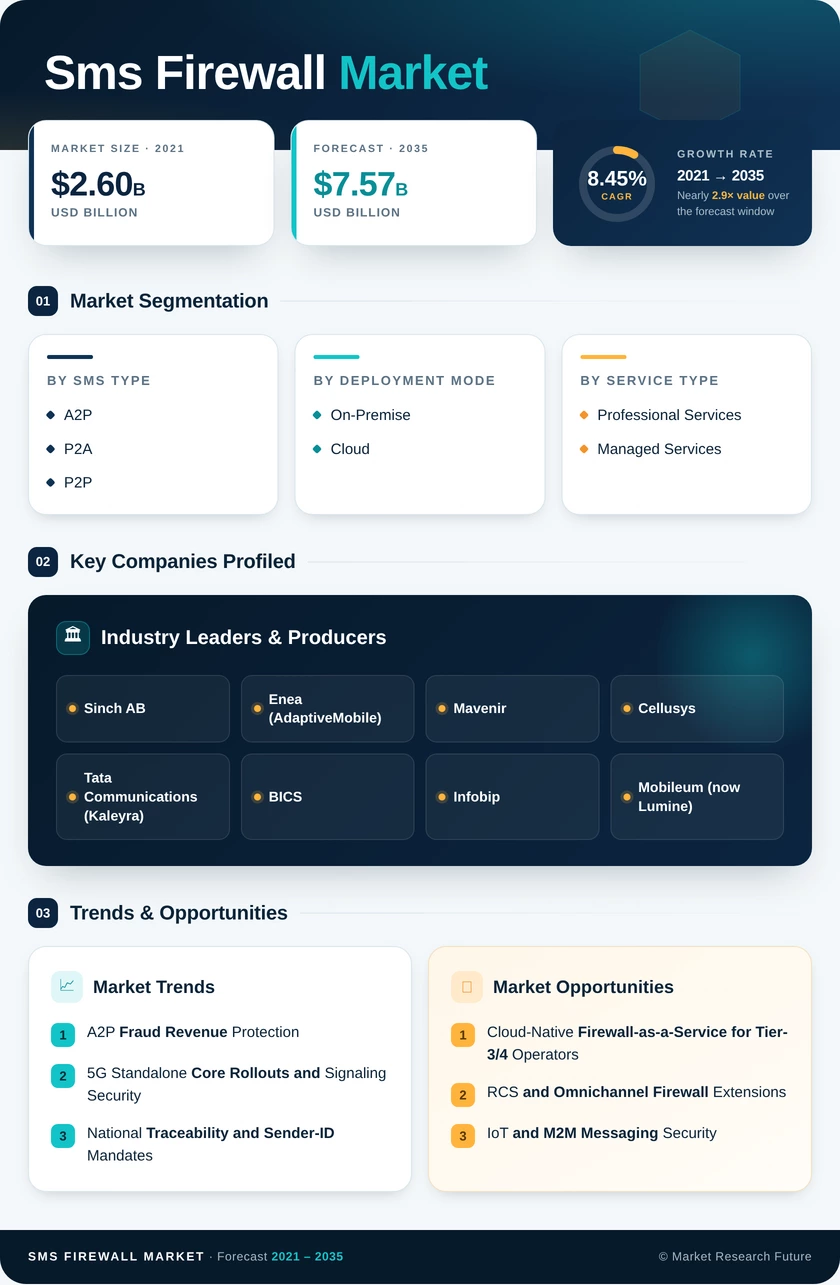
Segmentation Quick Reference
| Dimension | Sub-Segments | Dominant Segment (2025) | Fastest Growing Segment |
| SMS Type | A2P, P2A, P2P | A2P (69.0% share) | P2P (10.5% CAGR) |
| Deployment Mode | On-Premise, Cloud | On-Premise (56.4% share) | Cloud (13.6% CAGR) |
| Service Type | SMS Firewall Market, Managed Services | SMS Firewall Market (59.5% share) | Managed Services (11.7% CAGR) |
| End-User Industry | BFSI, Government & Public Safety, Retail & E-Commerce, Healthcare, Others | BFSI (35.2% share) | Retail & E-Commerce (11.2% CAGR) |
| Network Generation | 2G/3G, 4G/LTE, 5G | 4G/LTE (50.0% share) | 5G (13.3% CAGR) |
| Geography | North America, Europe, Asia-Pacific, South America, Middle East & Africa | North America (40.0% share) | Asia-Pacific (13.0% CAGR) |
Market Segmentation Overview
By SMS Type
| Sub-Segment | Key Trend |
| A2P | Enterprise OTP, transactional alerts, and promotional campaigns drive dominant share; grey-route monetization remains the primary firewall use case. |
| P2A | Growing customer-initiated service interactions via SMS create new inspection requirements. |
| P2P | Behavioral analytics engines deployed to detect SIM-farm and grey-route traffic disguised as peer messaging |
A2P messaging represents the core revenue driver for SMS firewall deployments, as enterprises across banking, government, and retail rely on secure application-to-person channels for time-critical notifications. P2P filtering is emerging as a high-growth niche where AI-based behavioral analysis distinguishes legitimate personal communication from fraudulent bulk traffic.
By Deployment Mode
| Sub-Segment | Key Trend |
| On-Premise | Preferred by tier-1 operators requiring data sovereignty and low-latency processing at the network edge |
| Cloud | Subscription-based, hyperscaler-hosted firewalls enabling rapid deployment for smaller operators |
On-premise remains the default choice for operators managing over 50 million subscribers due to regulatory data-residency requirements. Cloud-native deployments are gaining traction among tier-2 and tier-3 operators seeking capital-light alternatives with automatic scaling and vendor-managed updates.
By Service Type
| Sub-Segment | Key Trend |
| SMS Firewall Market | Custom integration, deployment consulting, and training dominate initial firewall rollouts. |
| Managed Services | Outsourced 24/7 security operations with AI-augmented monitoring are growing rapidly. |
Professional services lead in revenue share because every SMS firewall deployment requires tailored BSS/OSS integration. Managed services are expanding as operators outsource continuous threat monitoring to vendors operating AI-enhanced security operations centers.
By End-User Industry
| Sub-Segment | Key Trend |
| BFSI | Regulatory-mandated OTP and transaction-alert security drives the highest spend per operator. |
| Government & Public Safety | Citizen notification systems and emergency alerts require verified sender channels. |
| Retail & E-Commerce | Explosive promotional A2P volumes create demand for high-throughput filtering. |
| Healthcare | Patient appointment reminders and prescription alerts necessitate HIPAA/GDPR-compliant filtering. |
| Others | Education, travel, and logistics verticals adopt SMS firewall solutions for transactional messaging. |
BFSI remains the largest spender on SMS firewall solutions due to stringent multi-factor authentication mandates. Retail and e-commerce are accelerating fastest as brands scale promotional A2P campaigns and require protection against brand-impersonation smishing.
By Network Generation
| Sub-Segment | Key Trend |
| 2G/3G | Legacy network persistence in emerging markets sustains base-level SS7 firewall demand. |
| 4G/LTE | Dominant network layer globally; Diameter signaling inspection drives the majority of deployments |
| 5G | SA core rollouts require HTTP/2 and SBA-aware firewall engines; the fastest-growing segment |
4G/LTE networks carry the majority of global SMS traffic today, making Diameter-capable firewalls essential. The 5G segment is accelerating as standalone core deployments demand next-generation signaling security that bridges legacy and new protocol stacks.