Sodium Lauryl Sulfate Market
Sodium Lauryl Sulfate Market Summary
As per Market Research Future analysis, the Sodium Lauryl Sulfate Market Size was estimated at 3.421 USD Billion in 2024. The Sodium Lauryl Sulfate Market SLS industry is projected to grow from 3.558 USD Billion in 2025 to 5.273 USD Billion by 2035, exhibiting a compound annual growth rate (CAGR) of 4.01% during the forecast period 2025 - 2035
Key Market Trends & Highlights
The Sodium Lauryl Sulfate Market is experiencing a notable shift towards milder formulations and sustainable practices.
- The market is witnessing a significant shift towards mild formulations, particularly in personal care products, which dominate the sector.
- Sustainability initiatives are increasingly influencing product development, especially in the Asia-Pacific region, which is the fastest-growing market.
- Innovation in product development is driving growth in the household cleaning products segment, which is expanding rapidly.
- Rising demand in personal care products and increasing regulatory support for safe ingredients are key drivers propelling market growth.
Market Size & Forecast
| 2024 Market Size | 3.421 (USD Billion) |
| 2035 Market Size | 5.273 (USD Billion) |
| CAGR (2025 - 2035) | 4.01% |
Major Players
BASF SE (DE), Croda International Plc (GB), Solvay SA (BE), Stepan Company (US), Huntsman Corporation (US), Galaxy Surfactants Ltd (IN), Clariant AG (CH), Kraton Corporation (US), Evonik Industries AG (DE)
Sodium Lauryl Sulfate Market Trends
The Sodium Lauryl Sulfate Market is currently experiencing notable shifts driven by various factors. This surfactant, widely utilized in personal care products, household cleaners, and industrial applications, is gaining traction due to its effectiveness in creating foam and enhancing cleaning properties. As consumer awareness regarding ingredient safety increases, there is a growing demand for alternatives that are perceived as less harsh. This trend is prompting manufacturers to explore formulations that balance efficacy with gentleness, potentially reshaping product offerings in the market. Furthermore, sustainability concerns are influencing production practices, with companies seeking to adopt eco-friendly sourcing and manufacturing processes. Increasing consumer demand for transparency is encouraging honest sodium lauryl sulfate marketing, where manufacturers clearly communicate formulation safety, sourcing practices, and regulatory compliance.
Sodium Lauryl Sulfate Market Drivers
Growth in the Pharmaceutical Sector
The Sodium Lauryl Sulfate Market is also benefiting from growth in the pharmaceutical sector. SLS is utilized as an excipient in various pharmaceutical formulations, enhancing the solubility and bioavailability of active ingredients. The increasing prevalence of chronic diseases and the subsequent rise in pharmaceutical product development are contributing to the demand for Sodium Lauryl Sulfate Market. Market analysis suggests that the pharmaceutical segment is expanding, with a focus on developing innovative drug delivery systems. This trend is likely to bolster the Sodium Lauryl Sulfate Market, as pharmaceutical companies seek effective solutions to improve patient outcomes and product efficacy.
Rising Demand in Personal Care Products
The Sodium Lauryl Sulfate Market is experiencing a notable increase in demand, particularly within the personal care sector. This surge is attributed to the growing consumer preference for effective cleansing agents in shampoos, body washes, and facial cleansers. According to recent data, the personal care segment accounts for a substantial share of the SLS market, driven by the rising awareness of hygiene and grooming. As consumers seek products that deliver superior cleansing without compromising skin health, manufacturers are increasingly incorporating Sodium Lauryl Sulfate Market into their formulations. This trend is likely to continue, as the personal care industry evolves to meet the needs of a more discerning consumer base, thereby propelling the growth of the Sodium Lauryl Sulfate Market.
Expansion in Household Cleaning Products
The Sodium Lauryl Sulfate Market is witnessing significant growth due to the expansion of household cleaning products. With an increasing focus on cleanliness and sanitation, consumers are gravitating towards effective cleaning agents that can tackle tough stains and dirt. SLS is favored for its excellent foaming and emulsifying properties, making it a popular choice in various household cleaners. Market data indicates that the household cleaning segment is projected to grow at a robust rate, driven by heightened consumer awareness regarding hygiene. As manufacturers innovate and develop new cleaning solutions, the demand for Sodium Lauryl Sulfate Market is expected to rise, further solidifying its position in the Sodium Lauryl Sulfate Market.
Technological Advancements in Manufacturing
Technological advancements in manufacturing processes are playing a crucial role in the Sodium Lauryl Sulfate Market. Innovations in production techniques are enabling manufacturers to enhance the quality and efficiency of SLS production. These advancements not only reduce production costs but also improve the environmental footprint of SLS manufacturing. As companies adopt more sustainable practices, the appeal of Sodium Lauryl Sulfate Market as a versatile ingredient in various applications is likely to increase. Furthermore, the integration of automation and digital technologies in manufacturing processes may lead to higher output and consistency in product quality, thereby supporting the growth of the Sodium Lauryl Sulfate Market.
Increasing Regulatory Support for Safe Ingredients
The Sodium Lauryl Sulfate Market is benefiting from increasing regulatory support for safe and effective ingredients. Regulatory bodies are emphasizing the importance of consumer safety, leading to a more stringent evaluation of cosmetic and personal care products. This regulatory environment encourages manufacturers to utilize Sodium Lauryl Sulfate Market, which has been extensively studied and deemed safe for use in various applications. As regulations evolve, the Sodium Lauryl Sulfate Market is likely to see a shift towards products that comply with safety standards, thereby enhancing consumer trust and driving market growth. The alignment of SLS with regulatory requirements may further solidify its position in the market.
Market Segment Insights
By Application: Personal Care Products (Largest) vs. Household Cleaning Products (Fastest-Growing)
In the Sodium Lauryl Sulfate Market (SLS) market, Personal Care Products represent the largest application segment, capturing a significant portion of the overall market share. This dominance can be attributed to the extensive use of SLS in shampoos, body washes, and various cosmetic formulations. Following closely, Household Cleaning Products are also notable, reflecting a growing tendency among consumers towards efficient cleaning solutions and environmentally-friendly formulations that incorporate SLS for its surface-active properties. As consumers seek quality alongside affordability, these segments are poised to drive substantial market activity.
Personal Care Products (Dominant) vs. Household Cleaning Products (Emerging)
Personal Care Products dominate the application segment of the Sodium Lauryl Sulfate Market due to their essential role in personal hygiene and beauty products. The demand for SLS in shampoos, cleansers, and lotions ensures a steady market presence. On the other hand, Household Cleaning Products are emerging as a key segment, driven by increasing consumer awareness around sanitation and the efficacy of SLS as a surfactant. As households continue to prioritize effective cleaning solutions amid evolving consumer habits, this segment is set to experience rapid growth. The formulation of safer, eco-conscious products further enhances the market potential for SLS in this category.
By Formulation Type: Liquid (Largest) vs. Powder (Fastest-Growing)
The Sodium Lauryl Sulfate Market (SLS) market is characterized by a diversified formulation type distribution. Currently, liquid formulations hold the largest share due to their versatility and ease of use in various applications such as personal care and industrial products. On the other hand, powder formulations, while less popular currently, are rapidly gaining traction, especially in segments demanding concentrated forms of sodium lauryl sulfate for efficient mixing and application. Growth trends in the SLS formulation segment are driven by increasing consumer preferences for customizable solutions, with liquid formulations appealing due to their ready-to-use nature. The rise of eco-friendly and concentrated products is propelling the powder segment as manufacturers shift towards options that minimize packaging waste and conserve resources. Innovations in processing and application techniques further stimulate growth across both segments, highlighting their unique advantages in meeting consumer and industry needs.
Liquid (Dominant) vs. Powder (Emerging)
In the Sodium Lauryl Sulfate Market, liquid formulations are currently dominant due to their established presence and versatility across various industries, including cosmetics, personal care, and cleaning products. They easily mix with other ingredients, enhancing usability, making them a preferred choice for manufacturers. Meanwhile, powder formulations present an emerging opportunity, primarily appealing to manufacturers looking for concentrated solutions that provide efficient shipping and reduced packaging waste. The shift towards sustainability and cost-effectiveness further boosts the demand for powder SLS, as they often require less material for packaging and handling. Both formulations cater to distinct consumer needs, positioning themselves uniquely within the competitive landscape.
By End Use Industry: Cosmetics (Largest) vs. Detergents and Cleaners (Fastest-Growing)
The Sodium Lauryl Sulfate Market (SLS) market exhibits significant distribution across end use industries, with the cosmetics sector leading the charge. This industry holds a prominent share, driven by the increasing consumer demand for personal care products. In contrast, the detergents and cleaners segment is witnessing rapid growth, fueled by the heightened awareness of cleanliness and hygiene practices globally. This growth is also supported by innovations in product formulations that enhance the effectiveness of cleaning agents.
Cosmetics (Dominant) vs. Detergents and Cleaners (Emerging)
The cosmetics segment remains the dominant player in the SLS market, characterized by its diverse applications in skincare, haircare, and makeup products. The continued emphasis on personal grooming and increased consumer spending in beauty products contribute substantially to its market position. On the other hand, the detergents and cleaners segment is emerging as a critical growth area, driven by rising consumer expectations for cleaning efficacy and eco-friendly formulations. As this segment evolves, companies are focusing on developing sustainable products that align with consumer preferences, positioning themselves favorably in a competitive landscape.
By Source: Synthetic (Largest) vs. Natural (Fastest-Growing)
In the Sodium Lauryl Sulfate Market, the source segment is predominantly dominated by synthetic options, which account for a vast majority of market share. Synthetic SLS is favored for its cost-effectiveness and efficiency in various applications, from cosmetics to detergents. However, the natural segment is gradually carving out a significant niche, appealing to eco-conscious consumers and brands emphasizing natural ingredients. This shift indicates a growing recognition of the benefits associated with natural sources, such as sustainability and skin-friendly properties. The growth trends in the source segment are increasingly leaning towards natural SLS due to heightened awareness about environmental issues and health concerns linked to synthetic chemicals. Factors such as the rise in clean beauty products and the demand for sustainably sourced ingredients are accelerating the natural segment's growth. As consumers become more informed, manufacturers may face pressure to innovate and expand their natural offerings to keep pace with this emerging trend.
Source: Synthetic (Dominant) vs. Natural (Emerging)
Synthetic Sodium Lauryl Sulfate Market is currently the dominant player in the market due to its widespread usage across various industries such as personal care, cleaning products, and industrial applications. Its cost-effectiveness and reliability make it a staple in formulations. Meanwhile, the natural SLS segment is emerging, driven by consumer preferences shifting towards more sustainable and environmentally friendly products. Natural SLS is derived from plant sources, appealing to customers who prioritize natural ingredients for their lower environmental impact and potential skin benefits. As the demand for natural products continues to grow, manufacturers are increasingly investing in research and development to enhance the efficiency and application of natural SLS, positioning it as a key player in the future of the market.

Regional Insights
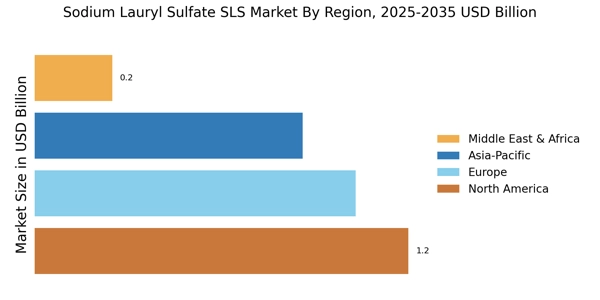
The Sodium Lauryl Sulfate Market demonstrates significant regional diversity, with North America, Europe, APAC, South America, and MEA contributing uniquely to its dynamics. In 2023, North America leads with a valuation of 1.03 USD Billion, indicating a robust demand driven by its vast cosmetics and personal care industry. Europe follows with a valuation of 0.85 USD Billion, supported by stringent regulations promoting the use of safe surfactants.
APAC holds a notable position with a valuation of 1.05 USD Billion, reflecting a rising middle class and increasing awareness regarding personal hygiene, which fuels market growth.South America, although smaller with a valuation of 0.17 USD Billion, presents significant potential due to its emerging markets, while MEA's valuation of 0.06 USD Billion indicates an evolving landscape with opportunities amid growing industrial applications.
The regional segmentation of the Sodium Lauryl Sulfate Market revenue emphasizes that North America and APAC dominate primarily because of their established manufacturing facilities and rising consumer trends, reflecting substantial growth opportunities across the globe as industries adapt to regional demands.
Key Players and Competitive Insights
Key Companies in the Sodium Lauryl Sulfate Market include
Industry Developments
Recent developments in the Global Sodium Lauryl Sulfate Market (SLS) Market reflect a dynamic landscape with several notable currents. BASF has been focusing on expanding its production capabilities to meet the rising demand for eco-friendly surfactants. Meanwhile, Clariant has launched new formulations targeting green chemistry applications, enhancing its product portfolio in response to shifting consumer preferences. Croda International continues to innovate with sustainable sourcing practices, reflecting a commitment to environmental responsibility. Kao Corporation is investing in advanced technologies to improve efficiency in SLS production, reinforcing its competitive position.
Sudarshan Chemicals and Solvay are also updating their operations to enhance sustainability in their manufacturing processes. In terms of mergers and acquisitions, Evonik Industries has recently completed the acquisition of a specialty chemical division aimed at strengthening its market presence. Additionally, Huntsman Corporation has entered into a strategic partnership to enhance its distribution network in Asia, particularly focusing on growth in the personal care segment. The overall market is witnessing positive valuation growth, driven by increased consumer awareness regarding sustainable products, thereby benefiting key players like Stepan Company and Galaxy Surfactants as they adapt to changing regulations and market demands.
Future Outlook
Sodium Lauryl Sulfate Market Future Outlook
The Sodium Lauryl Sulfate Market is projected to grow at a 4.01% CAGR from 2025 to 2035, driven by increasing demand in personal care and industrial applications.
New opportunities lie in:
- Expansion into eco-friendly SLS alternatives for sustainable product lines.
- Development of customized SLS formulations for niche markets.
- Strategic partnerships with e-commerce platforms for direct-to-consumer sales.
By 2035, the Sodium Lauryl Sulfate Market is expected to achieve robust growth and diversification.
Market Segmentation
Sodium Lauryl Sulfate Market Source Outlook
- Synthetic
- Natural
Sodium Lauryl Sulfate Market Application Outlook
- Personal Care Products
- Household Cleaning Products
- Industrial Applications
- Cosmetic Products
Sodium Lauryl Sulfate Market End Use Industry Outlook
- Cosmetics
- Detergents and Cleaners
- Pharmaceuticals
Sodium Lauryl Sulfate Market Formulation Type Outlook
- Liquid
- Powder
- Paste
Report Scope
| MARKET SIZE 2024 | 3.421(USD Billion) |
| MARKET SIZE 2025 | 3.558(USD Billion) |
| MARKET SIZE 2035 | 5.273(USD Billion) |
| COMPOUND ANNUAL GROWTH RATE (CAGR) | 4.01% (2025 - 2035) |
| REPORT COVERAGE | Revenue Forecast, Competitive Landscape, Growth Factors, and Trends |
| BASE YEAR | 2024 |
| Market Forecast Period | 2025 - 2035 |
| Historical Data | 2019 - 2024 |
| Market Forecast Units | USD Billion |
| Key Companies Profiled | BASF SE (DE), Croda International Plc (GB), Solvay SA (BE), Stepan Company (US), Huntsman Corporation (US), Galaxy Surfactants Ltd (IN), Clariant AG (CH), Kraton Corporation (US), Evonik Industries AG (DE) |
| Segments Covered | Application, Formulation Type, End Use Industry, Source, Regional |
| Key Market Opportunities | Growing demand for eco-friendly formulations in the Sodium Lauryl Sulfate SLS Market presents significant opportunities. |
| Key Market Dynamics | Rising consumer preference for natural ingredients drives innovation and regulatory scrutiny in the Sodium Lauryl Sulfate market. |
| Countries Covered | North America, Europe, APAC, South America, MEA |
FAQs
What is the projected market valuation of the Sodium Lauryl Sulfate SLS Market by 2035?
The Sodium Lauryl Sulfate SLS Market is projected to reach a valuation of 5.273 USD Billion by 2035.
What was the market valuation of Sodium Lauryl Sulfate SLS in 2024?
In 2024, the Sodium Lauryl Sulfate SLS Market was valued at 3.421 USD Billion.
What is the expected CAGR for the Sodium Lauryl Sulfate SLS Market during the forecast period 2025 - 2035?
The expected CAGR for the Sodium Lauryl Sulfate SLS Market during the forecast period 2025 - 2035 is 4.01%.
Which application segment is projected to have the highest valuation in 2035?
The Personal Care Products segment is projected to reach a valuation of 1.8 USD Billion by 2035.
What are the projected valuations for the Household Cleaning Products segment by 2035?
The Household Cleaning Products segment is expected to reach a valuation of 1.3 USD Billion by 2035.
Which formulation type is anticipated to dominate the Sodium Lauryl Sulfate SLS Market by 2035?
The Liquid formulation type is anticipated to dominate, with a projected valuation of 2.3 USD Billion by 2035.
What is the expected valuation for the Detergents and Cleaners end-use industry by 2035?
The Detergents and Cleaners end-use industry is expected to reach a valuation of 2.2 USD Billion by 2035.
How does the market for synthetic Sodium Lauryl Sulfate compare to natural sources by 2035?
By 2035, the market for synthetic Sodium Lauryl Sulfate is projected to reach 3.086 USD Billion, compared to 2.187 USD Billion for natural sources.
Who are the key players in the Sodium Lauryl Sulfate SLS Market?
What is the projected valuation for the Cosmetic Products segment by 2035?
Research Approach
Secondary Research
The secondary research process involved comprehensive analysis of regulatory databases, peer-reviewed chemical engineering journals, surfactant industry publications, and authoritative chemical safety organizations. Key sources included the US Environmental Protection Agency (EPA), US Food & Drug Administration (FDA), European Chemicals Agency (ECHA), Registration, Evaluation, Authorization and Restriction of Chemicals (REACH), American Cleaning Institute (ACI), Soap and Detergent Association (SDA), Personal Care Products Council (PCPC), National Institute of Standards and Technology (NIST), Occupational Safety and Health Administration (OSHA), National Center for Biotechnology Information (NCBI/PubMed), World Health Organization (WHO) Chemical Safety Program, Organisation for Economic Co-operation and Development (OECD) Chemicals Portal, EU Eurostat Industrial Production Database, US Census Bureau Chemical Manufacturing Reports, China National Chemical Information Center, and national chemical industry associations from key markets. These sources were used to collect production statistics, regulatory compliance data, safety assessment studies, pricing trends, and market landscape analysis for sodium lauryl sulfate liquid, dry powder, industrial grade, cosmetic grade, pharmaceutical grade, and food grade variants.
Primary Research
Qualitative and quantitative insights were obtained by interviewing supply-side and demand-side stakeholders during the primary research process. CEOs, VPs of Manufacturing, R&D chiefs, regulatory affairs managers, and commercial directors from specialty chemical manufacturers, surfactant producers, and contract manufacturers comprised supply-side sources. Pharmaceutical excipient buyers, industrial cleaning product developers, formulation scientists from personal care companies, procurement heads from detergent and cleaning product manufacturers, and oilfield chemical procurement specialists from upstream petroleum operations comprised demand-side sources. Market segmentation was validated, capacity expansion timelines were confirmed, and insights regarding formulation substitution patterns, pricing strategies, raw material sourcing dynamics, and sustainability transition trends were garnered through primary research.
Primary Respondent Breakdown:
By Designation: C-level Primaries (32%), Director Level (31%), Others (37%)
By Region: North America (32%), Europe (29%), Asia-Pacific (33%), Rest of World (6%)
Market Size Estimation
Global market valuation was derived through revenue mapping and production volume analysis. The methodology included:
Identification of 50+ key manufacturers across North America, Europe, Asia-Pacific, Latin America, and Middle East & Africa
Product mapping across sodium lauryl sulfate liquid, dry powder, needles, and granules
Grade-wise analysis covering industrial grade (≥93% active), cosmetic/personal care grade, pharmaceutical grade, and food grade
Production process segmentation between inorganic-based and coco-based manufacturing routes
End-use industry coverage spanning detergents and household cleaners, personal care products, industrial cleaners, dishwashing liquids, oilfield chemicals, and enhanced oil recovery applications
Analysis of reported and modeled annual revenues specific to SLS product portfolios
Coverage of manufacturers representing 75-80% of global market share in 2024
Extrapolation using bottom-up (production volume × ASP by country/grade) and top-down (manufacturer revenue validation) approaches to derive segment-specific valuations
Cross-validation with surfactant industry trade flow data and import/export statistics from customs databases
Kindly complete the form below to receive a free sample of this Report
Customer Stories
“This is really good guys. Excellent work on a tight deadline. I will continue to use you going forward and recommend you to others. Nice job”
“Thanks. It’s been a pleasure working with you, please use me as reference with any other Intel employees.”
“Thanks for sending the report it gives us a good global view of the Betaïne market.”
“Thank you, this will be very helpful for OQS.”
“We found the report very insightful! we found your research firm very helpful. I'm sending this email to secure our future business.”
“I am very pleased with how market segments have been defined in a relevant way for my purposes (such as "Portable Freezers & refrigerators" and "last-mile"). In general the report is well structured. Thanks very much for your efforts.”
“I have been reading the first document or the study, ,the Global HVAC and FP market report 2021 till 2026. Must say, good info! I have not gone in depth at all parts, but got a good indication of the data inside!”
“We got the report in time, we really thank you for your support in this process. I also thank to all of your team as they did a great job.”