Software Defined Storage Market (2026 - 2035)

Software-Defined Storage Market Research Report Information By Components (Platforms and Services), Application (Telecom and ITES, Logistics and Warehouse, Healthcare, Media and Others), organization size (large enterprises and small and medium enterprises), And By Region (North America, Europe, Asia-Pacific, And Rest Of The World) – Market Forecast Till 2035
ID: MRFR/ICT/1426-HCR
110 Pages
Aarti Dhapte
Last Updated: July 16, 2026
Software Defined Storage Market
Market Size
Forecast Period2026-2035
CAGR (2026-2035)23.3%
2025 Market SizeUSD 21.10 Billion
2035 Market SizeUSD 171.35 Billion
Key Players
Dell Technologies
IBM Corporation
VMware
NetApp
Hewlett Packard Enterprise
Microsoft
Opportunities
  • AI-Driven Autonomous Storage Management
  • Storage-as-a-Service and Consumption-Based Models
  • Emerging Market Data Center Buildouts

Software Defined Storage Market Summary

The global Software Defined Storage Market reached an estimated USD 21.10 billion in 2025 and is projected to grow from USD 26.02 billion in 2026 to USD 171.35 billion by 2035, registering a CAGR of 23.3% during the forecast period (2026–2035). This expansion is anchored in the accelerating shift from proprietary hardware-based storage arrays to programmable, hardware-agnostic storage architectures. Enterprise IT budgets for storage modernization surpassed USD 45 billion globally in 2024, driven by mandates from regulators and CIOs alike to reduce capital expenditure on inflexible legacy systems [1].

The underlying transformation involves replacing traditional SAN and NAS appliances with software layers that abstract storage intelligence from the physical disks beneath them. Hyperscale cloud providers have already demonstrated the economics — Amazon, Microsoft, and Google collectively manage exabytes of data through software-defined architectures at a fraction of comparable hardware-defined costs [2]. Governments in the EU and the U.S. have begun requiring cloud-native storage solutions in public-sector IT procurement frameworks, further catalyzing adoption across regulated industries [3].

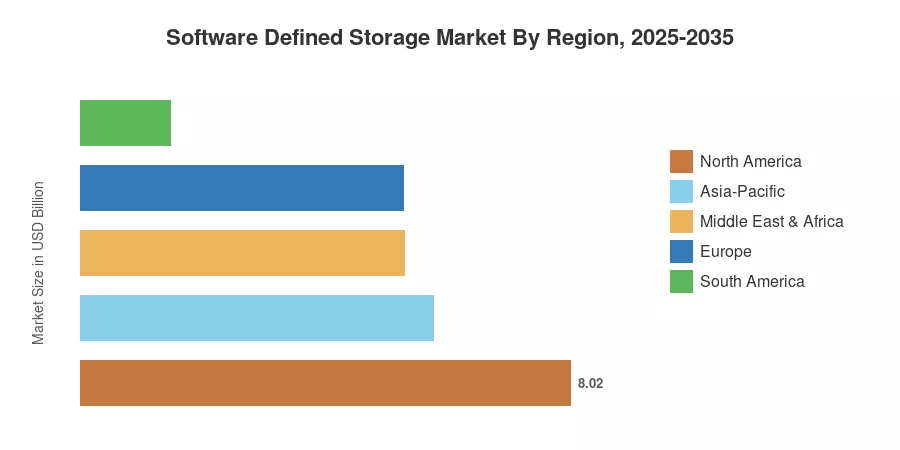
North America commands roughly 38% of the global Software Defined Storage Market, supported by early enterprise adoption and a mature cloud ecosystem. Asia-Pacific is the fastest-growing region with a projected CAGR of 27.4%, fueled by data center construction in India, China, and Southeast Asia. Europe holds the second-largest share at approximately 25%, propelled by GDPR-related data management requirements and sovereign cloud investments. The next decade will reshape how organizations purchase, manage, and scale storage at every tier.


Key Report Takeaways

• By Storage Type

  • Object storage is the fastest-growing segment within the Software Defined Storage Market, expanding at a CAGR of 26.8% through 2035, driven by unstructured data from AI training pipelines and media workloads.
  • Block storage accounts for the largest revenue share, anchoring mission-critical databases and transactional applications.

• By End-User Industry

  • The Telecom and IT vertical represents approximately 28% of total market revenue, reflecting heavy investment in virtualized network infrastructure.
  • BFSI remains a high-growth vertical within the Software Defined Storage Market, as real-time analytics and regulatory archiving requirements push banks toward scalable storage layers.

• By Region

  • North America generated an estimated USD 8.02 billion in 2025, reinforcing its position as the dominant region.
  • Asia-Pacific is projected to surpass USD 55 billion by 2035, making it the most dynamic growth corridor in the Software Defined Storage Market.


Market Size and Forecast (2021–2035)

Market Research Future employs a triangulated methodology combining primary interviews with enterprise storage architects, secondary analysis of vendor financial disclosures, and proprietary demand modeling across 32 countries. Historical figures reflect actual vendor revenues; forecast values apply the calibrated 23.3% CAGR with adjustments for adoption maturity curves in each region.
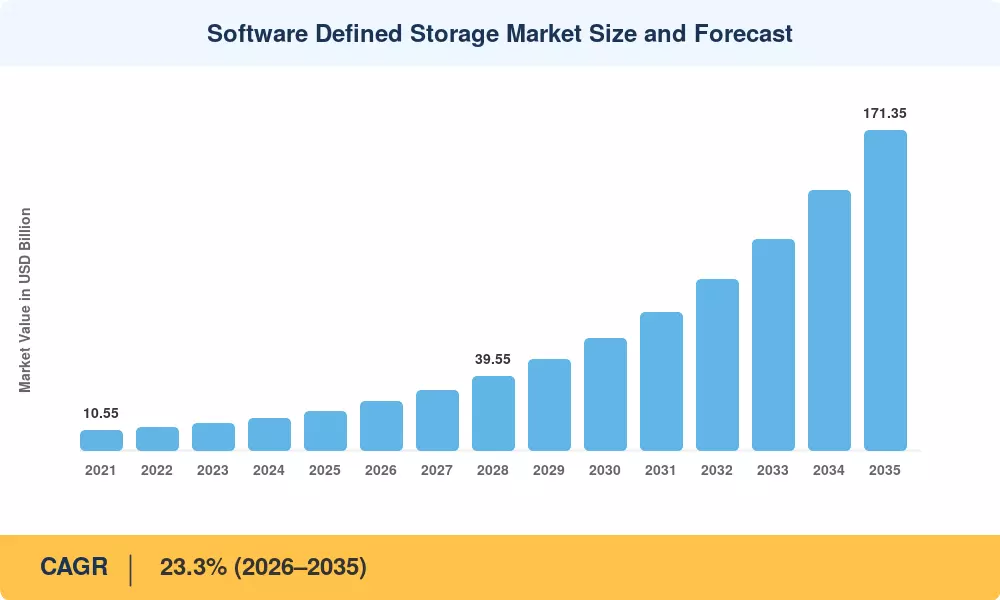
Software Defined Storage Market Size and Forecast
Our Impact
Enabled $4.3B Revenue Impact for Fortune 500 and Leading Multinationals
Partnering with 2000+ Global Organizations Each Year
30K+ Citations by Top-Tier Firms in the Industry

Driver Impact Analysis

Driver ~% Impact on CAGR Geographic Relevance Impact Timeline
Explosive unstructured data growth 22% Global Short-term (≤2 yr)
Hybrid and multi-cloud adoption 20% North America, Europe Medium-term (2–4 yr)
Kubernetes and container orchestration 18% Global Medium-term (2–4 yr)
Cost advantage over legacy SAN/NAS 15% Global Short-term (≤2 yr)
AI/ML data pipeline requirements 12% North America, Asia-Pacific Long-term (≥4 yr)
Edge computing and IoT proliferation 8% Asia-Pacific, MEA Long-term (≥4 yr)
Data sovereignty and compliance mandates 5% Europe, Asia-Pacific Medium-term (2–4 yr)


Explosive Unstructured Data Growth

Global data creation is expected to exceed 180 zettabytes annually by 2026, according to projections, with unstructured data — video, sensor telemetry, genomic sequences — comprising over 80% of that volume [7]. Traditional hardware-defined arrays were never architected for this scale. The Software Defined Storage Market benefits directly because SDS platforms can scale storage pools by adding commodity hardware without forklift upgrades, reducing cost-per-terabyte by 40–60% compared to monolithic arrays.

Hybrid and Multi-Cloud Adoption

Flexera's 2024 State of the Cloud Report found that 89% of enterprises operate in multi-cloud environments, yet only 34% have a unified storage management layer across those clouds [8]. This gap is a primary purchase trigger for the Software Defined Storage Market. Enterprises adopting hybrid architectures need consistent data services — snapshots, replication, tiering — that work identically whether data resides on-premises or in AWS, Azure, or GCP.

Kubernetes and Container Orchestration

The Cloud Native Computing Foundation reported over 5.6 million Kubernetes developers globally by mid-2024, a 67% increase from 2022 [9]. Container-native storage through CSI (Container Storage Interface) drivers has become table stakes. The Software Defined Storage Market is seeing vendors like Red Hat (OpenShift Data Foundation) and Portworx (Pure Storage) embedding persistent volume management directly into orchestration platforms.

Cost Advantage Over Legacy Infrastructure

estimates that enterprises spend an average of USD 3,200 per terabyte annually on traditional SAN, compared to USD 800–1,400 per terabyte on SDS-managed commodity storage [10]. For a mid-sized bank managing 5 petabytes, this difference translates to annual savings of USD 9–12 million — a compelling CFO-level argument that continues to accelerate migration timelines across the Software Defined Storage Market.


Restraints Impact Analysis

The restraint estimates below reflect drag effects on the market's growth trajectory. They represent headwinds, not absolute reductions, and are directional in nature.

Restraint ~% Drag on CAGR Geographic Relevance Impact Timeline
Legacy migration complexity –6% Global Short-term (≤2 yr)
Performance latency concerns –5% North America, Europe Medium-term (2–4 yr)
Vendor interoperability fragmentation –4% Global Medium-term (2–4 yr)
Skills shortage in software-defined infrastructure –3% Asia-Pacific, MEA Long-term (≥4 yr)
Security vulnerabilities in abstracted storage layers –2% Global Long-term (≥4 yr)


Legacy Migration Complexity

Many businesses have storage environments that are 10 to 15 years old, with data paths that are tightly linked to specific hardware controllers. A poll by Enterprise Strategy Group in 2024 revealed that 52% of IT leaders cited migration risk as the top factor for postponing deployment of SDS, despite the economic rationale being evident [14]. This is further exacerbated by the retraining load. Storage admins who are experts in proprietary array management skills usually lack Linux and API-driven automation capabilities.


Performance Latency Concerns

For ultra-low-latency applications, such as high-frequency trading platforms and real-time fraud detection, the software abstraction layer adds microseconds of overhead that some architects consider intolerable [15]. NVMe-oF and RDMA have closed most of this gap, yet perception remains behind the reality. In 2024, still about 18% of financial services businesses surveyed cited latency as a reason to keep specialized all-flash arrays rather than migrating to the Software Defined Storage Market.


Vendor Interoperability Fragmentation

Despite industry efforts through SNIA (Storage Networking Industry Association), no universal API standard governs cross-vendor SDS interoperability. Organizations running mixed SDS environments from multiple vendors report 30–40% higher operational overhead due to inconsistent management interfaces and incompatible replication protocols [16].


Software Defined Storage Market Opportunities

AI-Driven Autonomous Storage Management

For example, machine learning algorithms may forecast disk failures 72 hours in advance and auto-tier data based on access patterns, decreasing storage management effort by up to 60% [11]. “There is a lot of value to be unlocked in the Software Defined Storage Market as a result of autonomous operations becoming the norm, freeing IT teams to innovate on the application level rather than provisioning volumes.


Storage-as-a-Service and Consumption-Based Models

Enterprises have shown they will pay for storage on a per-terabyte-consumed basis rather than making an up-front capital investment using HPE GreenLake, Dell APEX and NetApp Keystone. This change in consumption might constitute 35% of the Software Defined Storage Market by 2030, blurring the lines between on-premises and cloud economics.


Emerging Market Data Center Buildouts

India added 210 MW of colocation capacity in 2024 alone, while Indonesia, Vietnam, and Saudi Arabia attracted over USD 12 billion in combined data center investment commitments [12]. Each new facility requires a storage software layer — presenting a greenfield opportunity for SDS vendors unburdened by legacy hardware installed bases.

Data Monetization Through Intelligent Tiering

Organizations that implement automated data lifecycle policies can reduce cold-storage costs by 70% while simultaneously improving analytics access to warm data [19]. The Software Defined Storage Market enables new revenue models where enterprises monetize data assets — medical imaging datasets, retail transaction logs — through controlled partner access layers.

Sovereign Cloud and Data Residency Compliance

The EU Data Act (effective September 2025) and India's DPDP Act create legal mandates for in-country data storage [13]. SDS platforms that offer policy-driven storage management across distributed nodes are uniquely positioned to address these requirements without duplicating entire infrastructure stacks.


Software Defined Storage Market Future Outlook

AI-Integrated Autonomous Storage Operations

By 2030, predicts that 60% of enterprise storage environments will be managed through AI-driven automation, up from 15% in 2024 [11]. The Software Defined Storage Market will increasingly embed inference engines that make real-time placement, tiering, and replication decisions — transforming storage administrators from operators into policy architects.

Platform Economics and Storage Marketplaces

The next decade will see SDS vendors shift from selling software licenses to operating platform marketplaces where third-party data services — encryption, deduplication, analytics — plug into a shared storage substrate. This platform model, already visible in VMware's vSAN ecosystem and Red Hat's ODF marketplace, could generate 25–30% of vendor revenues by 2033.

Sustainability-Driven Storage Optimization

Data centers consumed 460 TWh of electricity in 2024, with storage subsystems accounting for approximately 15% of that load [22]. The Software Defined Storage Market will play a central role in sustainability reporting as SDS platforms enable intelligent data retirement and cold-tier migration — reducing active disk counts and associated energy draw by up to 40%.

Quantum-Resistant Data Protection

Post-quantum cryptography standards finalized by NIST in 2024 will begin influencing storage encryption by 2028 [23]. SDS platforms, because they manage encryption at the software layer rather than the hardware controller, can adopt quantum-resistant algorithms through software updates — a flexibility advantage that hardware-defined arrays cannot match.


Software Defined Storage Market Segmentation

By Storage Type

Segment Key Metric Primary Demand Driver
Block ~35% market share (2025) Mission-critical databases and transactional systems
Object CAGR of 26.8% AI/ML training data, media, and backup
File USD 5.07 B (2025) Enterprise file services and NAS replacement
Others CAGR of 19.5% Emerging hybrid and unified storage models


Block storage remains the backbone of the Software Defined Storage Market, serving latency-sensitive applications like Oracle databases, SAP HANA, and VMware virtual machines. Enterprises with heavy transactional workloads continue to prioritize block-based SDS for its familiar LUN provisioning model and consistent IOPS delivery. Object storage, however, is rapidly closing the gap. The explosion of unstructured data — video surveillance feeds, genomic datasets, and large language model training corpora — has made object architectures the default for petabyte-scale deployments where cost efficiency outweighs latency requirements [7].

By Deployment Mode

Segment Key Metric Primary Demand Driver
On-Premises ~44% market share (2025) Regulated industries requiring local control
Private Cloud CAGR of 25.9% Hybrid IT strategies with dedicated cloud resources
Others (Public/Hybrid) USD 3.59 B (2025) Multi-cloud data mobility and disaster recovery


On-premises deployments continue to lead the Software Defined Storage Market in absolute revenue terms, particularly among financial institutions and defense organizations bound by strict data residency rules. Private cloud is the fastest-growing deployment mode, as enterprises seek cloud-like agility within their own data centers — a trend reinforced by VMware Cloud Foundation and Nutanix Cloud Platform adoption.

By Organisation Size

Segment Key Metric Primary Demand Driver
Large Enterprises ~62% market share (2025) Complex multi-site storage consolidation
Small and Medium Enterprises CAGR of 26.5% Cloud-first strategies and managed SDS offerings


Large enterprises dominate spending in the Software Defined Storage Market, but SMEs are adopting faster in relative terms. Managed SDS offerings from cloud providers and channel partners have lowered the entry barrier, allowing mid-market firms to access enterprise-grade storage automation without maintaining specialized infrastructure teams.

By End-User Industry

Segment Key Metric Primary Demand Driver
Telecom and IT ~28% market share (2025) NFV, 5G core, and service provider infrastructure
Banking, Financial Services and Insurance CAGR of 25.2% Real-time analytics and regulatory archiving
Healthcare USD 1.90 B (2025) Medical imaging (DICOM) and EHR modernization
Government CAGR of 24.1% Sovereign cloud and citizen services digitization
Manufacturing ~9% market share (2025) IoT sensor data and MES integration
Retail CAGR of 23.6% Omnichannel inventory and personalization
Others USD 1.75 B (2025) Media, education, energy, and transportation


Telecom and IT firms are the largest consumers in the Software Defined Storage Market, driven by the virtualization of network functions (NFV) that underpins 5G rollouts. BFSI is the second-largest vertical by revenue and among the fastest growing, as banks modernize data warehouses and comply with regulations like Basel III's operational resilience requirements and the SEC's data retention mandates [3].


Regional Market Share Analysis

Region Key Metric Primary Investment Themes
North America ~38% market share (2025) Cloud-native transformation, AI infrastructure
Europe ~25% market share (2025) Data sovereignty, GDPR compliance
Asia-Pacific CAGR of 27.4% (2026–2035) Data center construction, digital government
South America USD 1.48 B (2025) Financial services modernization
Middle East & Africa CAGR of 25.1% (2026–2035) Smart city programs, oil & gas digitization
Total USD 21.10 B (2025)

The Software Defined Storage Market exhibits distinct regional dynamics shaped by cloud maturity, regulatory environments, and data center investment cycles.


North America

Country Key Metric Key Driver
United States ~78% of regional revenue Hyperscaler capex and federal IT modernization [20]
Canada CAGR of 22.5% Government cloud-first mandates
Mexico USD 0.31 B (2025) Nearshoring-driven data center demand


The United States alone accounts for nearly four-fifths of North America's Software Defined Storage Market revenue, anchored by hyperscaler storage build-outs from Amazon, Microsoft, and Google, each exceeding USD 50 billion in annual capex. Canada's federal cloud-first policy, mandating that all new government IT procurement favor cloud-compatible solutions, is driving SDS adoption in Ottawa and Toronto-based agencies [20].

Europe

Country Key Metric Key Driver
Germany ~22% of regional share Industry 4.0 manufacturing digitization
United Kingdom CAGR of 23.8% Financial services cloud migration
France USD 1.05 B (2025) Sovereign cloud (Bleu, S3NS)
Italy CAGR of 21.5% Public administration digitization
Spain ~6% of regional share Telecom infrastructure renewal
Nordic Countries CAGR of 22.0% Green data center initiatives
Russia USD 0.42 B (2025) Import substitution in IT
Rest of Europe ~12% of regional share Varied digital transformation programs


Europe's Software Defined Storage Market is shaped heavily by regulatory frameworks. The EU Data Act and GDPR require granular control over data placement — exactly the capability that SDS platforms deliver through policy engines that automate compliance across jurisdictions [13].

Asia-Pacific

Country Key Metric Key Driver
China ~40% of regional revenue Domestic cloud giants (Alibaba, Tencent, Huawei)
India CAGR of 29.2% Digital India and data center incentives [21]
Japan USD 0.92 B (2025) Enterprise hybrid cloud adoption
South Korea CAGR of 25.6% 5G and AI-driven storage demand
ASEAN ~11% of regional share Cross-border e-commerce growth
Rest of Asia-Pacific CAGR of 24.3% Government digitization programs


Asia-Pacific represents the most dynamic growth corridor in the Software Defined Storage Market. India's government allocated USD 1.2 billion under the Digital India programme for cloud infrastructure upgrades between 2024 and 2027, while China's "East Data, West Computing" project is channeling storage workloads to western provinces through SDS-enabled data hubs [21].

South America

Country Key Metric Key Driver
Brazil ~58% of regional revenue Open banking and fintech expansion
Argentina CAGR of 21.8% Financial sector digitization
Rest of South America USD 0.34 B (2025) Cloud adoption in mid-tier enterprises


Brazil's open banking regulation, which now covers over 40 million users, has forced banks to rearchitect data infrastructure for real-time API access — creating pull-through demand for the Software Defined Storage Market in Latin America's largest economy.

Middle East & Africa

Country Key Metric Key Driver
Saudi Arabia ~32% of regional share Vision 2030 smart city investments
UAE CAGR of 26.3% Dubai and Abu Dhabi data hub ambitions
South Africa USD 0.18 B (2025) Financial services and telecom modernization
Egypt CAGR of 23.9% New Administrative Capital data infrastructure
Rest of MEA ~22% of regional share Oil & gas digital oilfield programs


Saudi Arabia's NEOM project and the UAE's AI Strategy 2031 are funneling billions into digital infrastructure, creating a receptive environment for the Software Defined Storage Market as both nations build greenfield data centers with no legacy hardware baggage.


Software Defined Storage Market By Region, 2025-2035

Competitive Benchmarking

The Software Defined Storage Market exhibits medium concentration, with the top five vendors holding an estimated 45–52% combined revenue share. The HHI index sits in the 600–900 range, indicating a competitive but not fragmented landscape. Competition centers on integration depth with hypervisor platforms, Kubernetes-native capabilities, and consumption-based pricing models.

Company Est. Revenue Share Range Key Offerings Strategic Positioning
Dell Technologies ~12–15% PowerFlex, ObjectScale, ECS Full-stack infrastructure with HCI integration
IBM Corporation ~9–12% Spectrum Virtualize, Fusion HCI Enterprise hybrid cloud with AI Ops
VMware (Broadcom) ~8–11% vSAN, vSphere Virtual Volumes Hypervisor-native SDS for virtualized estates
NetApp ~7–10% ONTAP, StorageGRID, BlueXP Unified hybrid multi-cloud data management
Hewlett Packard Enterprise ~6–9% Alletra, GreenLake for Storage Consumption-based as-a-service delivery
Microsoft ~5–8% Azure Stack HCI, Storage Spaces Direct Cloud-adjacent SDS for Azure-centric estates
Nutanix ~4–7% Nutanix Unified Storage, AOS Hyperconverged-first with multi-cloud portability
Pure Storage ~3–6% Portworx, Pure Cloud Block Store Kubernetes-native and Evergreen subscription
DataCore Software ~2–4% SANsymphony, vFilO, Swarm Software-only virtualization across heterogeneous hardware
Red Hat (IBM) ~2–4% OpenShift Data Foundation, Ceph Open-source SDS for container-native environments


Recent News & Developments

  • NetApp (August 2024): Expanded BlueXP platform with integrated ransomware detection and autonomous remediation across ONTAP-managed volumes, responding to rising cybersecurity requirements in the Software Defined Storage Market [18].
  • NIST (July 2024): Published final post-quantum cryptography standards (FIPS 203, 204, 205), prompting SDS vendors to begin integrating lattice-based encryption into data-at-rest protection layers [23].
  • VMware/Broadcom (April 2024): Restructured vSAN licensing under the VMware Cloud Foundation bundle, shifting the competitive dynamic for hypervisor-native SDS offerings [16].
  • HPE (November 2023): Expanded GreenLake for Block Storage with NVMe-oF support, offering sub-100-microsecond latency on consumption-based contracts — addressing performance objections in the Software Defined Storage Market [15].


Software Defined Storage Market Report Scope

Parameter Detail
Market Scope Global Software Defined Storage Market — software revenue only (excludes standalone hardware)
Study Period 2021–2035
CAGR 23.3% (2026–2035)
Base Year Size USD 21.10 Billion (2025)
Forecast Endpoint USD 171.35 Billion (2035)
Fastest Growing Segment Object storage (by type); Asia-Pacific (by region)
Companies Profiled 10 (Dell, IBM, VMware/Broadcom, NetApp, HPE, Microsoft, Nutanix, Pure Storage, DataCore, Red Hat)
Valuation Currency USD (constant 2025 dollars)


FAQs

How does SDS licensing typically work — perpetual or subscription?
Most vendors now default to subscription or consumption-based pricing, charging per terabyte managed per month. Perpetual licenses still exist but represent a shrinking share of new contracts.
Can SDS platforms handle NVMe-oF for sub-millisecond latency workloads?
Leading platforms from Dell, NetApp, and HPE support NVMe-oF natively, achieving latencies under 100 microseconds. This has largely closed the performance gap with dedicated all-flash arrays.
What role does Kubernetes play in the Software Defined Storage Market?
CSI drivers now enable persistent storage provisioning directly within Kubernetes clusters. This integration is a primary purchase driver for container-native enterprises.
How should enterprises evaluate SDS vendor lock-in risk?
Prioritize vendors supporting open APIs and SNIA standards. Multi-vendor interoperability testing during proof-of-concept phases reduces long-term switching costs significantly.
Is the Software Defined Storage Market affected by semiconductor supply constraints?
SDS runs on commodity hardware, diversifying supply risk. However, NVMe SSD shortages can delay deployments even when the software layer is hardware-agnostic.
What compliance frameworks specifically mandate software-defined storage adoption?
No framework mandates SDS by name, but GDPR, the EU Data Act, and India's DPDP Act require granular data placement controls that SDS policy engines uniquely deliver.
How does the Software Defined Storage Market intersect with edge computing deployments?
Edge sites lack dedicated storage administrators, making SDS platforms with autonomous management essential. Lightweight SDS nodes from Nutanix and Red Hat are designed specifically for remote edge locations.    
Author
Author
Author Profile
Aarti Dhapte LinkedIn
AVP - Research
A consulting professional focused on helping businesses navigate complex markets through structured research and strategic insights. I partner with clients to solve high-impact business problems across market entry strategy, competitive intelligence, and opportunity assessment. Over the course of my experience, I have led and contributed to 100+ market research and consulting engagements, delivering insights across multiple industries and geographies, and supporting strategic decisions linked to $500M+ market opportunities. My core expertise lies in building robust market sizing, forecasting, and commercial models (top-down and bottom-up), alongside deep-dive competitive and industry analysis. I have played a key role in shaping go-to-market strategies, investment cases, and growth roadmaps, enabling clients to make confident, data-backed decisions in dynamic markets.

Research Approach


Secondary Research

The secondary research process involved comprehensive analysis of technology regulatory databases, enterprise IT publications, cloud computing research, and authoritative technology organizations. Key sources included the National Institute of Standards and Technology (NIST) Cybersecurity and Cloud Computing Standards, International Organization for Standardization (ISO/IEC 27001, ISO/IEC 17788), Storage Networking Industry Association (SNIA.org), International Data Corporation (IDC), Gartner Research, IEEE Computer Society, Cloud Native Computing Foundation (CNCF), US Department of Commerce Bureau of Economic Analysis, European Commission Digital Economy Reports, China Ministry of Industry and Information Technology (MIIT), India Ministry of Electronics and Information Technology (MeitY), Japan Ministry of Internal Affairs and Communications (MIC), and national digital transformation agencies from key markets. These sources were used to collect enterprise storage adoption statistics, data center infrastructure trends, hybrid cloud deployment data, software licensing frameworks, and competitive landscape analysis for block storage, file storage, object storage, and hyperconverged infrastructure segments.


Primary Research

Qualitative and quantitative insights were obtained by interviewing supply-side and demand-side stakeholders during the primary research process. The supply-side sources consisted of CEOs, CTOs, VPs of Engineering, product leaders, and revenue officers from software-defined storage vendors, cloud infrastructure providers, and enterprise storage solution OEMs. Chief Information Officers (CIOs), Chief Technology Officers (CTOs), IT infrastructure directors, storage architects, and procurement leads from large enterprises, data center operators, cloud service providers, and telecommunications companies constituted demand-side sources. Primary research verified market segmentation, confirmed product development roadmaps, and collected insights on enterprise adoption patterns, pricing models, open-source versus proprietary preferences, and integration challenges with legacy infrastructure.

Primary Respondent Breakdown:

By Designation: C-level Primaries (22%), Director Level (35%), Others (43%)

By Region: North America (42%), Europe (22%), Asia-Pacific (28%), Rest of World (8%)


Market Size Estimation

Global market valuation was derived through revenue mapping and enterprise deployment volume analysis. The methodology included:

Identification of 55+ key vendors across North America, Europe, Asia-Pacific, and Latin America

Product mapping across block storage, file storage, object storage, and hyperconverged infrastructure categories

Analysis of reported and modeled annual revenues specific to software-defined storage portfolios

Coverage of vendors representing 75-80% of global market share in 2024

Extrapolation using bottom-up (deployment volume × licensing/subscription value by country) and top-down (vendor revenue validation) approaches to derive segment-specific valuations

Data Triangulation

Market data was cross-validated through triangulation of secondary research findings, primary interview insights, and vendor financial disclosures. Analysts reconciled discrepancies between supply-side revenue estimates and demand-side budget allocation data to ensure accuracy within a ±5% variance threshold.

Download Free Sample

Kindly complete the form below to receive a free sample of this Report

Download PDF ×

We do not share your information with anyone. However, we may send you emails based on your report interest from time to time. You may contact us at any time to opt-out.