×
Request Free Sample ×

Kindly complete the form below to receive a free sample of this Report

* Please use a valid business email

Leading companies partner with us for data-driven Insights

clients tt-cursor
Hero Background

Soil Conditioners Market

ID: MRFR/Agri/3514-HCR
110 Pages
Pradeep Nandi
October 2025

Soil Conditioners Market Research Report Information By Type (Natural and Synthetic), By Solubility (Water-Soluble and Hydrogels), By Application (Cereals & Grains, Oilseeds & Pulses, Fruits & Vegetables, and Others), and By Region (North America, Europe, Asia-Pacific, and Rest Of The World) – Market Forecast Till 2035

Share:
Download PDF ×

We do not share your information with anyone. However, we may send you emails based on your report interest from time to time. You may contact us at any time to opt-out.

Soil Conditioners Market Infographic
Purchase Options

Soil Conditioners Market Summary

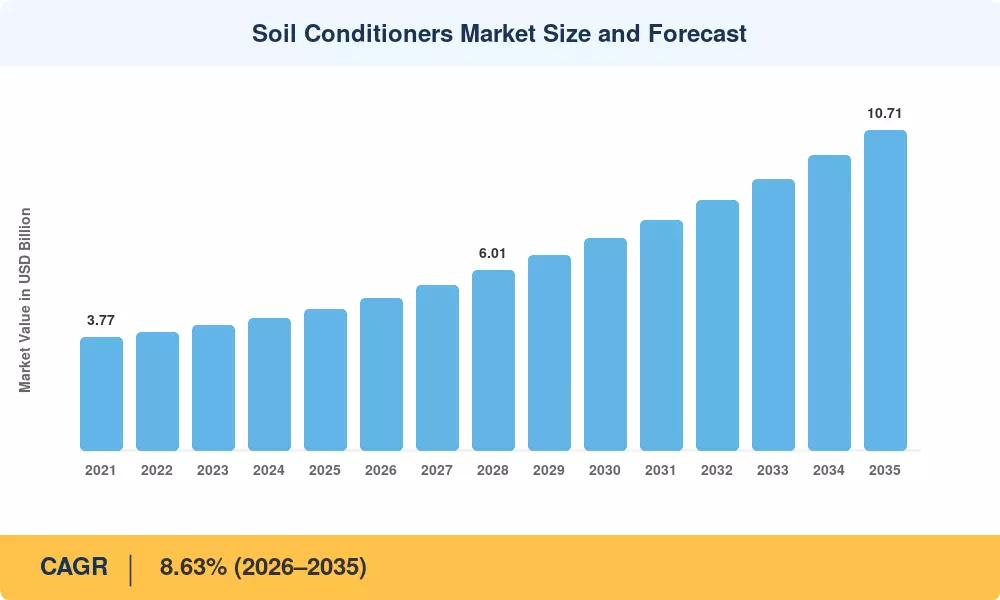
As per MRFR analysis, the Soil Conditioners Market Size was estimated at 2442.31 USD Million in 2024. The Soil Conditioners industry is projected to grow from 2602.17 USD Million in 2025 to 4374.65 USD Million by 2035, exhibiting a compound annual growth rate (CAGR) of 5.4 during the forecast period 2025 - 2035.

Key Market Trends & Highlights

The Soil Conditioners Market is experiencing a robust shift towards sustainable practices and technological advancements.

  • The market is increasingly influenced by sustainable agriculture practices, particularly in North America, which remains the largest market.
  • Technological innovations are driving efficiency and effectiveness in soil conditioning, especially in the rapidly growing Asia-Pacific region.
  • The rise of organic farming is notable, with the organic segment being the largest contributor to market growth.
  • Key market drivers include the increasing demand for sustainable agriculture and government initiatives supporting soil health awareness.

Market Size & Forecast

2024 Market Size 2442.31 (USD Million)
2035 Market Size 4374.65 (USD Million)
CAGR (2025 - 2035) 5.4%

Major Players

BASF SE (DE), Nutrien Ltd (CA), Yara International ASA (NO), The Mosaic Company (US), K+S AG (DE), FMC Corporation (US), Syngenta AG (CH), Novozymes A/S (DK), Haifa Group (IL)

Soil Conditioners Market Trends

The Soil Conditioners Market is currently experiencing a notable transformation, driven by increasing awareness regarding sustainable agricultural practices and the necessity for soil health improvement. As global agricultural demands escalate, the focus on enhancing soil quality through conditioners has intensified. These products, which include organic and inorganic materials, are being recognized for their ability to improve soil structure, enhance nutrient availability, and promote water retention. This shift towards sustainable farming methods appears to be influencing the market dynamics significantly, as stakeholders seek to adopt practices that not only boost productivity but also ensure environmental sustainability. Moreover, the Soil Conditioners Market is likely to witness a surge in innovation, with manufacturers exploring advanced formulations and technologies. The integration of biotechnological advancements into soil conditioners may enhance their effectiveness and appeal to a broader range of consumers. Additionally, the growing trend of organic farming is expected to further propel the demand for natural soil conditioners, as farmers increasingly prioritize eco-friendly solutions. Overall, the market seems poised for growth, driven by evolving agricultural practices and a heightened focus on sustainability.

Sustainable Agriculture Practices

The Soil Conditioners Market is increasingly influenced by the adoption of sustainable agriculture practices. Farmers are recognizing the importance of maintaining soil health, which is essential for long-term productivity. This trend indicates a shift towards using conditioners that enhance soil quality while minimizing environmental impact.

Technological Innovations

Technological advancements are playing a crucial role in the evolution of the Soil Conditioners Market. Manufacturers are exploring new formulations and delivery methods that improve the efficacy of soil conditioners. This trend suggests a potential for enhanced performance and broader market acceptance.

Rise of Organic Farming

The growing popularity of organic farming is significantly impacting the Soil Conditioners Market. As consumers demand more organic produce, farmers are increasingly turning to natural soil conditioners. This trend highlights a shift towards eco-friendly solutions that align with consumer preferences.

Soil Conditioners Market Drivers

Increasing Demand for Sustainable Agriculture

The Global Soil Conditioners Industry is experiencing a notable shift towards sustainable agricultural practices. Farmers are increasingly adopting soil conditioners to enhance soil health and fertility, thereby improving crop yields. This trend is driven by the rising awareness of environmental issues and the need for sustainable food production. As a result, the market is projected to reach 7.6 USD Billion in 2024, reflecting a growing preference for eco-friendly solutions. The integration of organic soil conditioners, such as compost and biochar, is becoming more prevalent, indicating a significant transformation in agricultural practices worldwide.

Market Segment Insights

By Application: Agricultural (Largest) vs. Horticultural (Fastest-Growing)

The Soil Conditioners Market is segmented into various applications, with the agricultural sector holding the largest share. This segment’s prominence is fueled by its essential role in enhancing soil fertility and structure, which are critical for improving crop yields. On the other hand, the horticultural segment is gaining traction, driven by the increasing demand for gardening products among consumers and the rising trend of urban gardening. As a result, these two segments dominate the application landscape within the soil conditioners market.

Agricultural (Dominant) vs. Horticultural (Emerging)

In the Soil Conditioners Market, the agricultural application emerges as the dominant force due to its extensive use of soil conditioners for crop production. Farmers recognize that soil conditioners significantly improve soil health, leading to better water retention, nutrient availability, and overall plant resilience. Conversely, the horticultural application is considered an emerging market segment, energized by a growing interest in gardening and landscaping activities among urban dwellers. This segment exhibits a stronger rate of growth, as consumers increasingly seek high-quality soil conditioners tailored for specific plant needs, creating new opportunities for innovative products that cater to the aesthetic and functional aspects of gardening.

By Type: Organic (Largest) vs. Chemical (Fastest-Growing)

The Soil Conditioners Market reveals a diverse distribution of types, with Organic conditioners holding the largest market share due to their sustainable nature and growing consumer preferences for environmentally friendly products. In contrast, Chemical conditioners, although traditionally used, are evolving as they integrate advanced formulations that enhance efficiency and effectiveness, attracting segments of the market seeking quick results. Growth trends in the Soil Conditioners Market are influenced by the increasing awareness of soil health and the demand for sustainable agriculture practices. Organic conditioners are experiencing steady growth as more farmers switch to eco-friendly alternatives, while Chemical conditioners are becoming faster-growing due to innovations that improve their application and mitigate environmental impacts. The shift towards more sustainable farming practices creates opportunities for both segments to thrive in the evolving market landscape.

Organic (Dominant) vs. Biological (Emerging)

Organic soil conditioners have established themselves as the dominant type in the market, appealing to environmentally conscious consumers and farmers who prioritize sustainability. Organic options contribute significantly to soil fertility and structure, enhancing microbial activity and nutrient availability, which are vital for healthy crop production. Meanwhile, Biological conditioners are emerging as a promising alternative, characterized by their reliance on natural organisms to improve soil quality. As technological advancements propel research in biological solutions, these conditioners are gaining traction for their potential to offer ecological benefits without chemical residues. The synergy between Organic and Biological products indicates a shifting paradigm towards holistic approaches in soil management.

By Form: Granular (Largest) vs. Liquid (Fastest-Growing)

The Soil Conditioners Market showcases a diverse array of product forms, with granular conditioners commanding the largest market share due to their widespread usage and effectiveness. Liquid form conditioners are gaining traction rapidly as they offer ease of application and enhanced nutrient availability, thus capturing the attention of farmers and agricultural professionals. Powder and pellet forms also contribute to the overall market, but their shares remain significantly lower compared to their granular and liquid counterparts. As agriculture increasingly shifts towards more efficient practices, the growth of liquid soil conditioners appears promising. This trend is driven by a rising demand for quick-acting solutions that can be easily applied and integrated into modern farming techniques. Moreover, the focus on sustainable agricultural practices and the need to improve soil health further propels interest in various formulations, suggesting potential for substantial growth in both the liquid and granular segments of this market.

Granular: Dominant vs. Liquid: Emerging

Granular soil conditioners are characterized by their ease of storage and application, making them the preferred choice among many farmers. Their slow-release properties also allow for prolonged effects on soil health, appealing to those looking to enhance soil fertility over time. In contrast, liquid conditioners are emerging as a viable alternative, particularly for their ability to penetrate the soil quickly and provide fast results. This form is especially appealing to growers looking to make immediate improvements in soil condition. Both forms serve critical roles in the Soil Conditioners Market, with granular products currently dominating due to their established presence, while liquid options are quickly gaining popularity for their innovative formulation and responsive application.

By Functionality: Moisture Retention (Largest) vs. Nutrient Supply (Fastest-Growing)

In the soil conditioners market, the functionality segment is primarily dominated by moisture retention products, which play a critical role in enhancing soil's ability to hold water. Following closely are nutrient supply solutions, which are increasingly recognized for their importance in maintaining soil fertility. Other functionalities like soil aeration and pH adjustment have smaller shares but contribute significantly to a comprehensive soil management strategy.

Moisture Retention (Dominant) vs. Nutrient Supply (Emerging)

Moisture retention products are a dominant force in the soil conditioners market, recognized for their effectiveness in improving the water-holding capacity of soil, leading to better crop yields and reduced irrigation needs. They are commonly composed of organic materials such as polymers or gels that expand in the presence of water. In contrast, nutrient supply products, while emerging, are rapidly gaining attention for their role in enhancing nutrient availability and soil health. These products often contain a mix of macronutrients and micronutrients, tailored to various soil types and agricultural requirements.

Get more detailed insights about Soil Conditioners Market

Regional Insights

North America : Market Leader in Soil Conditioners

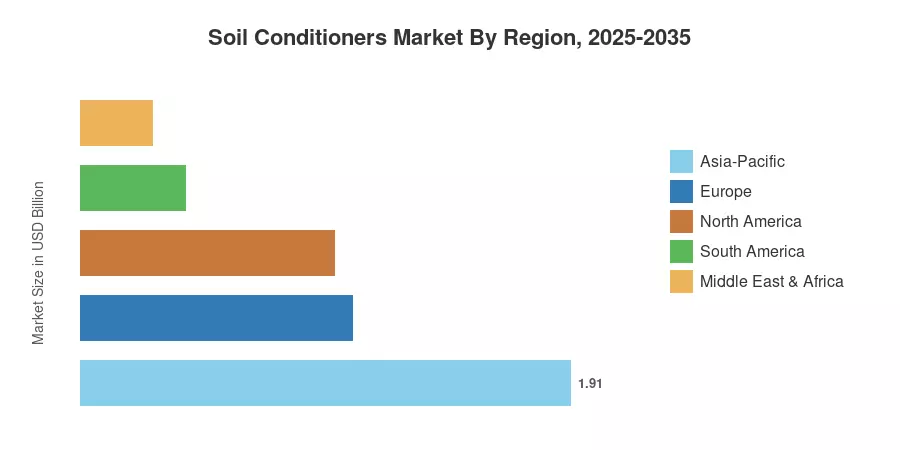
North America is poised to maintain its leadership in the soil conditioners market, holding a significant share of 1000.0. The region's growth is driven by increasing agricultural productivity demands, innovative farming practices, and supportive government policies aimed at sustainable agriculture. Regulatory frameworks are evolving to promote the use of eco-friendly soil conditioners, enhancing market dynamics and encouraging investment in research and development. The United States and Canada are the leading countries in this region, with major players like BASF SE, Nutrien Ltd, and The Mosaic Company driving competition. The presence of advanced agricultural technologies and a strong distribution network further solidifies North America's position. As farmers increasingly adopt soil conditioners to improve crop yields and soil health, the market is expected to grow steadily, supported by a robust competitive landscape.

Europe : Sustainable Practices Drive Growth

Europe's soil conditioners market is projected to reach 800.0, fueled by a strong emphasis on sustainable agricultural practices and environmental regulations. The European Union's Green Deal and Farm to Fork Strategy are pivotal in promoting the use of organic and eco-friendly soil conditioners, driving demand. Additionally, increasing awareness of soil health and its impact on food security is propelling market growth across the region. Leading countries such as Germany, France, and the Netherlands are at the forefront of this market, with key players like Yara International ASA and K+S AG actively participating. The competitive landscape is characterized by innovation and collaboration among companies to develop advanced soil conditioning solutions. As the market evolves, regulatory support and consumer demand for sustainable products will continue to shape the industry's future.

Asia-Pacific : Rapid Growth in Emerging Markets

The Asia-Pacific soil conditioners market is estimated at 550.0, reflecting rapid growth driven by increasing agricultural activities and the need for improved soil fertility. Countries like China and India are witnessing a surge in demand for soil conditioners as they strive to enhance crop yields and ensure food security. Government initiatives promoting sustainable farming practices are also contributing to market expansion, creating a favorable regulatory environment. China and India are the leading markets in this region, with significant contributions from companies like FMC Corporation and Syngenta AG. The competitive landscape is evolving, with local and international players vying for market share. As awareness of soil health grows, the adoption of innovative soil conditioning solutions is expected to rise, further boosting the market's growth trajectory.

Middle East and Africa : Emerging Market Potential

The Middle East and Africa soil conditioners market is valued at 92.31, with significant growth potential driven by increasing agricultural investments and the need for sustainable farming solutions. The region faces challenges such as arid climates and soil degradation, prompting a shift towards soil conditioners that enhance water retention and nutrient availability. Government initiatives aimed at improving agricultural productivity are also catalyzing market growth. Countries like South Africa and Kenya are leading the way in adopting soil conditioners, with local and international players entering the market. The competitive landscape is characterized by a mix of established companies and emerging startups, all focused on addressing the unique agricultural challenges of the region. As the market matures, the demand for innovative and effective soil conditioning products is expected to rise, presenting numerous opportunities for growth.

Key Players and Competitive Insights

The Soil Conditioners Market is currently characterized by a dynamic competitive landscape, driven by increasing agricultural productivity demands and a growing emphasis on sustainable farming practices. Key players such as BASF SE (DE), Nutrien Ltd (CA), and Yara International ASA (NO) are strategically positioning themselves through innovation and regional expansion. For instance, BASF SE (DE) has focused on developing advanced biostimulants that enhance soil health, while Nutrien Ltd (CA) has been expanding its product portfolio to include organic soil conditioners, thereby catering to the rising consumer preference for sustainable solutions. These strategies collectively shape a competitive environment that is increasingly focused on sustainability and technological advancement.

In terms of business tactics, companies are localizing manufacturing and optimizing supply chains to enhance efficiency and responsiveness to market demands. The Soil Conditioners Market appears moderately fragmented, with a mix of large multinational corporations and smaller regional players. The collective influence of these key players is significant, as they drive innovation and set industry standards, thereby shaping market dynamics.

In November 2025, Yara International ASA (NO) announced a partnership with a leading agricultural technology firm to develop precision agriculture solutions that integrate soil conditioners with digital farming tools. This strategic move is likely to enhance Yara's product offerings and position it as a leader in the digital transformation of agriculture, aligning with the growing trend towards data-driven farming practices.

In October 2025, The Mosaic Company (US) launched a new line of eco-friendly soil conditioners aimed at improving soil fertility while minimizing environmental impact. This initiative not only reflects the company's commitment to sustainability but also addresses the increasing regulatory pressures regarding environmental practices in agriculture. Such innovations may provide Mosaic with a competitive edge in a market that is progressively leaning towards environmentally responsible products.

In September 2025, K+S AG (DE) expanded its operations in North America by acquiring a regional soil conditioner manufacturer. This acquisition is expected to enhance K+S's market presence and distribution capabilities in a key growth region, indicating a strategic focus on regional expansion to capture emerging market opportunities. The integration of local expertise could also facilitate the development of tailored products that meet specific regional agricultural needs.

As of December 2025, current competitive trends in the Soil Conditioners Market are heavily influenced by digitalization, sustainability, and the integration of artificial intelligence (AI) in product development. Strategic alliances are increasingly shaping the landscape, as companies collaborate to leverage technology and enhance product offerings. The shift from price-based competition to a focus on innovation, technology, and supply chain reliability is evident, suggesting that future competitive differentiation will hinge on the ability to deliver sustainable and technologically advanced solutions.

Key Companies in the Soil Conditioners Market market include

Future Outlook

Soil Conditioners Market Future Outlook

The Soil Conditioners Market is projected to grow at a 5.4% CAGR from 2024 to 2035, driven by increasing agricultural productivity, sustainable farming practices, and rising soil health awareness.

New opportunities lie in:

  • Development of bio-based soil conditioners for organic farming
  • Integration of precision agriculture technologies for soil management
  • Expansion of e-commerce platforms for direct consumer sales

By 2035, the Soil Conditioners Market is expected to achieve robust growth, reflecting evolving agricultural practices.

Market Segmentation

Soil Conditioners Market Form Outlook

  • Granular
  • Liquid
  • Powder
  • Pellet

Soil Conditioners Market Type Outlook

  • Organic
  • Inorganic
  • Biological
  • Chemical

Soil Conditioners Market Application Outlook

  • Agricultural
  • Horticultural
  • Landscaping
  • Forestry

Soil Conditioners Market Functionality Outlook

  • Soil Aeration
  • Nutrient Supply
  • Moisture Retention
  • pH Adjustment

Report Scope

MARKET SIZE 20242442.31(USD Million)
MARKET SIZE 20252602.17(USD Million)
MARKET SIZE 20354374.65(USD Million)
COMPOUND ANNUAL GROWTH RATE (CAGR)5.4% (2024 - 2035)
REPORT COVERAGERevenue Forecast, Competitive Landscape, Growth Factors, and Trends
BASE YEAR2024
Market Forecast Period2025 - 2035
Historical Data2019 - 2024
Market Forecast UnitsUSD Million
Key Companies ProfiledBASF SE (DE), Nutrien Ltd (CA), Yara International ASA (NO), The Mosaic Company (US), K+S AG (DE), FMC Corporation (US), Syngenta AG (CH), Novozymes A/S (DK), Haifa Group (IL)
Segments CoveredApplication, Type, Form, Functionality
Key Market OpportunitiesGrowing demand for sustainable agriculture practices drives innovation in the Soil Conditioners Market.
Key Market DynamicsRising demand for sustainable agriculture drives innovation and competition in the soil conditioners market.
Countries CoveredNorth America, Europe, APAC, South America, MEA

Market Highlights

Author
Pradeep Nandi
Senior Research Analyst

I have a bachelor's degree in mechanical engineering and an MBA. I have more than two years of expertise in the retail, food, and beverage, chemical, and material industries, and hence have developed a sound cross-domain expertise. A firm believer in lifelong learning and sharing of knowledge. Having a proclivity for hatching ideas and trying to absorb as much information as possible in a short amount of time. Introducing corporates to the data and insight, which enables them to move from probability to possibility, has been my key areas of interest. 

Leave a Comment

FAQs

How much is the Soil Conditioners Market?

The Soil Conditioners Market Solubility was valued at USD 6.3 Billion in 2022.

What is the growth rate of the Soil Conditioners Market?

The market is projected to grow at a CAGR of 8.48% during the forecast period, 2025-2035.

Which region held the largest market share in the Soil Conditioners Market?

North America had the largest share in the market.

Who are the key players in the Soil Conditioners Market?

The key players in the market are BASF SE, Syngenta AG, Novozymes A/S, The DOW Chemical Company, Adeka Corporation, Croda International PLC, Clariant International AG, Vantage Specialty Chemicals, Inc., Eastman Chemical Company, Evonik Industries AG, Akzo Nobel N.V, Solvay S.A., Lambent Corp., TIMAC AGRO International, and Loveland Products, Inc.

Which Type led the Soil Conditioners Market?

The Natural Type dominated the market in 2022.

Which Solubility had the largest market share in the Soil Conditioners Market?

The Water-Soluble Solubility had the largest share in the market.

Download Free Sample

Kindly complete the form below to receive a free sample of this Report

Compare Licence

×
Features License Type
Single User Multiuser License Enterprise User
Price $4,950 $5,950 $7,250
Maximum User Access Limit 1 User Upto 10 Users Unrestricted Access Throughout the Organization
Free Customization
Direct Access to Analyst
Deliverable Format
Platform Access
Discount on Next Purchase 10% 15% 15%
Printable Versions