Solar Photovoltaic System Market
Solar Photovoltaic System Market Summary
As per Market Research Future analysis, the Solar Photovoltaic System Market was estimated at 235.94 USD Billion in 2024. The Solar Photovoltaic System industry is projected to grow from 254.44 USD Billion in 2025 to 541.34 USD Billion by 2035, exhibiting a compound annual growth rate (CAGR) of 7.8% during the forecast period 2025 - 2035
Key Market Trends & Highlights
The Solar Photovoltaic System Market is experiencing robust growth driven by technological advancements and increasing adoption in emerging markets.
- Technological advancements are enhancing the efficiency and affordability of solar photovoltaic systems.
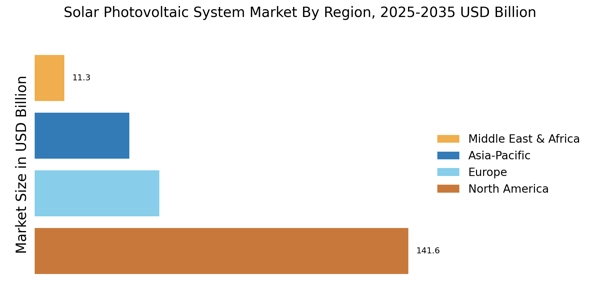
- North America remains the largest market, while Asia-Pacific is recognized as the fastest-growing region in solar energy adoption.
- Mono-crystalline silicon dominates the market, whereas thin-film silicon is emerging as the fastest-growing segment.
- Government incentives and rising energy demand are key drivers propelling the growth of the solar photovoltaic system market.
Market Size & Forecast
| 2024 Market Size | 235.94 (USD Billion) |
| 2035 Market Size | 541.34 (USD Billion) |
| CAGR (2025 - 2035) | 7.84% |
Major Players
First Solar (US), Trina Solar (CN), Canadian Solar (CA), JA Solar (CN), LONGi Green Energy (CN), SunPower(US), Hanwha Q CELLS (KR), Risen Energy (CN), Enphase Energy (US), Vivint Solar (US)
Solar Photovoltaic System Market Trends
The Solar Photovoltaic System Market is currently experiencing a transformative phase characterized by rapid technological advancements and increasing adoption across various sectors. The shift towards renewable energy sources is becoming more pronounced, as governments and organizations worldwide recognize the necessity of sustainable energy solutions. This market is witnessing a surge in investments, driven by favorable policies and incentives aimed at reducing carbon footprints. Furthermore, the integration of solar technologies into residential, commercial, and industrial applications is expanding, indicating a broader acceptance of solar energy as a viable alternative to traditional power sources. In addition to technological innovations, the Solar Photovoltaic System Market is influenced by evolving consumer preferences and heightened awareness regarding environmental issues. As individuals and businesses seek to lower energy costs and enhance energy independence, the demand for solar photovoltaic systems is likely to grow. The emergence of energy storage solutions and smart grid technologies further complements this trend, enabling more efficient energy management. Overall, the Solar Photovoltaic System Market appears poised for sustained growth, driven by a combination of regulatory support, technological progress, and changing societal attitudes towards energy consumption.
Technological Advancements
The Solar Photovoltaic System Market is witnessing continuous innovations in technology, enhancing efficiency and reducing costs. New materials and designs are being developed, which may lead to higher energy conversion rates and longer system lifespans. This trend suggests that advancements in solar technology could significantly impact market dynamics.
Increased Adoption in Emerging Markets
Emerging economies are increasingly embracing solar photovoltaic systems as a means to address energy shortages and promote sustainable development. This trend indicates a growing recognition of solar energy's potential to provide reliable power in regions with limited access to traditional energy sources.
Integration with Energy Storage Solutions
The integration of solar photovoltaic systems with energy storage technologies is becoming more prevalent. This trend may enhance the reliability and efficiency of solar energy, allowing users to store excess energy for later use. Such developments could transform how solar energy is utilized, making it a more attractive option for consumers.
Solar Photovoltaic System Market Drivers
Rising Energy Demand
The Solar Photovoltaic System Market is significantly influenced by the rising global energy demand. As populations grow and economies expand, the need for sustainable energy sources becomes more pressing. Projections indicate that energy consumption could increase by over 25% by 2030, necessitating a shift towards renewable energy solutions. Solar photovoltaic systems offer a viable alternative to traditional fossil fuels, providing clean energy that can be harnessed locally. This shift is particularly evident in regions with abundant sunlight, where solar energy can be efficiently captured and utilized. The increasing demand for energy, coupled with the declining costs of solar technology, positions the Solar Photovoltaic System Market for substantial growth in the coming years.
Technological Innovations
Technological innovations play a pivotal role in shaping the Solar Photovoltaic System Market. Advances in solar panel efficiency, such as the development of bifacial and perovskite solar cells, are enhancing energy output and reducing costs. As of 2025, the average efficiency of commercial solar panels has reached approximately 20%, with some cutting-edge models exceeding 25%. These innovations not only improve the performance of solar systems but also contribute to lower installation and maintenance costs. Additionally, the integration of smart technologies, such as IoT and AI, is optimizing energy management and consumption patterns. This continuous evolution in technology is likely to attract more investors and consumers to the Solar Photovoltaic System Market, driving its expansion.
Government Incentives and Policies
The Solar Photovoltaic System Market is experiencing a surge in growth due to favorable government incentives and policies. Many countries are implementing tax credits, rebates, and grants to encourage the adoption of solar energy. For instance, in several regions, feed-in tariffs guarantee fixed payments for solar energy producers, enhancing the financial viability of solar projects. As of 2025, it is estimated that these incentives could account for up to 30% of the total installation costs, making solar energy more accessible to both residential and commercial users. Furthermore, regulatory frameworks are increasingly supportive, streamlining the permitting process and reducing bureaucratic hurdles. This supportive environment is likely to drive further investments in the Solar Photovoltaic System Market, fostering innovation and expansion.
Decentralization of Energy Production
The decentralization of energy production is transforming the Solar Photovoltaic System Market. With advancements in technology, consumers are increasingly able to generate their own electricity through solar installations. This shift towards distributed energy resources empowers individuals and communities, reducing reliance on centralized power grids. As of 2025, it is estimated that residential solar installations could account for over 40% of new solar capacity additions. This trend is particularly pronounced in urban areas, where rooftops can be utilized for solar panels. Furthermore, the rise of community solar projects allows multiple stakeholders to benefit from shared solar resources. This decentralization not only enhances energy security but also fosters local economic development, thereby driving further growth in the Solar Photovoltaic System Market.
Environmental Concerns and Sustainability
The growing awareness of environmental concerns is a significant driver for the Solar Photovoltaic System Market. As climate change becomes an increasingly urgent issue, there is a collective push towards sustainable energy solutions. Solar energy, being renewable and clean, presents a compelling alternative to fossil fuels, which are major contributors to greenhouse gas emissions. Reports suggest that transitioning to solar energy could reduce carbon emissions by millions of tons annually. This shift is not only beneficial for the environment but also aligns with corporate sustainability goals, prompting businesses to invest in solar technologies. The heightened focus on sustainability is likely to propel the Solar Photovoltaic System Market forward, as both consumers and corporations seek to minimize their ecological footprints.
Market Segment Insights
By Technology: Mono-Crystalline Silicon (Largest) vs. Thin-Film Silicon (Fastest-Growing)
In the Solar Photovoltaic System Market, Mono-Crystalline Silicon has emerged as the dominant technology, accounting for a significant share of the market due to its high efficiency and performance. Following closely, Poly-Crystalline Silicon also holds a commendable market position but trails behind Mono-Crystalline. Thin-Film Silicon and Concentrated Solar Photovoltaic, while smaller in market share, are gaining traction as innovations enhance their efficiency and applicability in diverse settings, leading to a dynamic market landscape.
Technology: Mono-Crystalline Silicon (Dominant) vs. Thin-Film Silicon (Emerging)
Mono-Crystalline Silicon is recognized for its superior efficiency and longevity, making it the preferred choice for large-scale solar installations and residential applications. Its ability to perform better under low-light conditions and its sleek aesthetics contribute to its dominance in the market. On the other hand, Thin-Film Silicon is gaining momentum as an emerging technology, particularly in niche applications where flexibility and lightweight design are essential. Although generally less efficient, advancements in production techniques are reducing costs and enhancing performance, positioning Thin-Film Silicon as a viable alternative in specific scenarios.
By System Type: Grid-Connected (Largest) vs. Off-Grid (Fastest-Growing)
In the Solar Photovoltaic System Market, Grid-Connected systems hold the largest share, dominating the landscape due to their integration with existing power grids and reliable energy supply. These systems primarily benefit residential and commercial sectors, offering increased energy efficiency and lower electricity costs. As more consumers and businesses opt for renewable energy sources, Grid-Connected installations continue to expand their market presence.
System Type: Grid-Connected (Dominant) vs. Off-Grid (Emerging)
Grid-Connected systems are recognized as the dominant force in the Solar Photovoltaic System Market, providing consistent power through connectivity to the electrical grid. These systems are favored for their ability to leverage net metering, allowing users to sell excess power back to the grid. On the other hand, Off-Grid systems are seen as an emerging trend, particularly in remote areas lacking grid infrastructure. These systems are gaining traction due to advancements in battery storage technology and an increasing desire for energy independence, especially in regions prone to power shortages.
By Application: Residential (Largest) vs. Utility-Scale (Fastest-Growing)
The Solar Photovoltaic System Market is predominantly led by the Residential sector, which boasts the largest market share due to increasing consumer adoption of solar energy solutions for home use. Residential applications are favored for their ability to reduce energy bills and enhance energy independence. Meanwhile, the Utility-Scale segment is gaining credibility and swiftly capturing market attention, fueled by higher investments in large-scale renewable projects and advancement in solar technologies.
Application: Residential (Dominant) vs. Utility-Scale (Emerging)
The Residential segment stands out as the dominant force in the Solar Photovoltaic System Market, characterized by a decentralized energy approach tailored for individual homes. This segment benefits from supportive government incentives and increasing consumer awareness of environmental sustainability. In contrast, the Utility-Scale segment is emerging rapidly, marked by significant investments in large-scale solar farms that benefit from economies of scale and the ability to generate cleaner energy for thousands of homes. This segment is vital for the transition towards renewable energy, driven by utility companies and governmental policies aimed at reducing carbon footprints.

By Mounting Type: Rooftop (Largest) vs. Ground-Mounted (Fastest-Growing)
The Solar Photovoltaic System Market is increasingly dominated by the Rooftop mounting type, which captures a significant share due to its suitability for urban environments and the rising trend of residential solar installations. Ground-Mounted systems, while traditionally popular in larger energy projects, are expanding their share as more organizations and utilities invest in larger-capacity installations, contributing to the diversification of the market.
Rooftop (Dominant) vs. Ground-Mounted (Emerging)
Rooftop solar systems represent the dominant segment in the Solar Photovoltaic System Market, favored for their accessibility and efficiency in utilizing unused space on homes and buildings. Their integration into residential solar initiatives and commercial projects makes them a preferred choice for consumers looking to reduce energy costs. Meanwhile, Ground-Mounted systems are emerging rapidly, driven by installations on larger open sites and utility-scale projects. These systems allow for higher capacity outputs and flexibility in design, appealing to developers seeking to maximize energy production and return on investment.
Regional Insights
North America : Renewable Energy Leader
North America is witnessing a robust growth in the solar photovoltaic (PV) system market, driven by favorable government policies, technological advancements, and increasing environmental awareness. The United States holds the largest market share at approximately 60%, followed by Canada at around 15%. Regulatory incentives such as the Investment Tax Credit (ITC) and state-level renewable energy mandates are significant catalysts for this growth. The competitive landscape is dominated by key players such as First Solar, SunPower, and Enphase Energy, which are leading innovations in solar technology. The U.S. market is characterized by a mix of large-scale solar farms and residential installations, while Canada is focusing on utility-scale projects. The presence of established companies and new entrants is fostering a dynamic market environment, enhancing competition and driving down costs.
Europe : Sustainable Energy Transition
Europe is at the forefront of the solar photovoltaic system market, propelled by ambitious renewable energy targets and stringent climate policies. Germany and France are the largest markets, holding approximately 30% and 20% of the market share, respectively. The European Union's Green Deal and national initiatives are pivotal in driving solar adoption, aiming for a significant reduction in carbon emissions by 2030. Leading countries like Germany, Spain, and Italy are enhancing their solar capacities, supported by a competitive landscape featuring companies such as Trina Solar and Canadian Solar. The region is witnessing a surge in both residential and commercial solar installations, with innovative financing models and community solar projects gaining traction. This collaborative approach is expected to further accelerate market growth and technological advancements.
Asia-Pacific : Emerging Solar Powerhouse
The Asia-Pacific region is emerging as a powerhouse in the solar photovoltaic system market, driven by rapid industrialization, urbanization, and government support for renewable energy. China is the largest market, accounting for over 40% of global solar installations, followed by Japan and India, which hold approximately 10% and 8% respectively. Government policies, such as feed-in tariffs and renewable energy certificates, are crucial in promoting solar energy adoption across the region. China's dominance is reflected in its extensive manufacturing capabilities and the presence of major players like JA Solar and LONGi Green Energy. Japan and India are also expanding their solar capacities, focusing on both utility-scale and rooftop installations. The competitive landscape is characterized by a mix of domestic and international companies, fostering innovation and cost reductions in solar technologies.
Middle East and Africa : Emerging Market Potential
The Middle East and Africa region is witnessing a burgeoning interest in solar photovoltaic systems, driven by abundant sunlight and the need for energy diversification. Countries like South Africa and the UAE are leading the market, with South Africa holding approximately 15% of the market share. Government initiatives and international investments are crucial in developing solar infrastructure, aiming to reduce reliance on fossil fuels and enhance energy security. The competitive landscape is evolving, with local and international players entering the market. South Africa's Renewable Energy Independent Power Producer Procurement Programme (REIPPPP) has attracted significant investments, while the UAE is focusing on large-scale solar projects like the Mohammed bin Rashid Al Maktoum Solar Park. This growth is expected to create numerous opportunities for innovation and collaboration in the solar sector.
Key Players and Competitive Insights
Key Companies in the Solar Photovoltaic System Market include
Industry Developments
Recent developments in the global solar photovoltaic system market indicate a surge in demand for renewable energy solutions. Governments worldwide are implementing supportive policies, including incentives and tax breaks, to promote solar adoption.
Technological advancements, such as the development of high-efficiency solar panels and cost reductions in manufacturing, are making solar energy more accessible and cost-effective. The market is witnessing strategic partnerships and acquisitions among key players to strengthen their market position and expand their product offerings. Ongoing research and development efforts are focused on improving solar cell efficiency, reducing system costs, and enhancing energy storage capabilities. These advancements are expected to drive the growth of the solar photovoltaic system market in the coming years.
In December 2023, Nio, the top producer of electric vehicles, announced a partnership with Longi Solar, an important participant in the global PV market, to furnish its battery swap stations with photovoltaic systems. This cooperative venture is likely to assist in the promotion of sunlight energy utilization in the automotive industry, thereby improving the functionality of Nio’s battery charging facilities. By 2025, the corporation sets a more ambitious target to deploy photovoltaic systems on over 3,000 battery swapping stations with an envisaged cumulative capacity of 300 MW.
In the year 2023, Microsoft continued its sustainability quest by collaborating with Pivot Energy for up to 500 MW of community-scale solar projects. They are one of the measures taken by Microsoft as part of a more general effort to attain its clean energy targets, including supplying 100% of its data center operations with renewable sources by 2025.
In June 2023 Starbucks worked together with Nexamp, where they aim to deploy 40 MW of community solar projects in Illinois. This will enable more sources of energy, bettering Starbucks's operations as well as helping local communities by providing energy credits to more than 1,100 small businesses and residents.
In June 2024, EcoFlow presented its new hybrid inverter which is called PowerOcean Plus that can support up to 40 kW solar input. Much like its predecessors, the inverter is engineered to serve larger domestic photovoltaic systems which is what the clients need larger and more efficient solar systems
Future Outlook
Solar Photovoltaic System Market Future Outlook
The Solar Photovoltaic System Market is projected to grow at a 7.84% CAGR from 2025 to 2035, driven by technological advancements, regulatory support, and increasing energy demand.
New opportunities lie in:
- Development of integrated solar-plus-storage solutions for residential markets.
- Expansion into emerging markets with tailored financing options.
- Partnerships with electric vehicle manufacturers for solar charging infrastructure.
By 2035, the market is expected to be robust, driven by innovation and strategic partnerships.
Market Segmentation
Solar Photovoltaic System Market Technology Outlook
- Mono-Crystalline Silicon
- Poly-Crystalline Silicon
- Thin-Film Silicon
- Concentrated Solar Photovoltaic
Solar Photovoltaic System Market Application Outlook
- Residential
- Commercial
- Industrial
- Utility-Scale
Solar Photovoltaic System Market System Type Outlook
- Grid-Connected
- Off-Grid
Solar Photovoltaic System Market Mounting Type Outlook
- Rooftop
- Ground-Mounted
- Building-Integrated
Report Scope
| MARKET SIZE 2024 | 235.94(USD Billion) |
| MARKET SIZE 2025 | 254.44(USD Billion) |
| MARKET SIZE 2035 | 541.34(USD Billion) |
| COMPOUND ANNUAL GROWTH RATE (CAGR) | 7.84% (2025 - 2035) |
| REPORT COVERAGE | Revenue Forecast, Competitive Landscape, Growth Factors, and Trends |
| BASE YEAR | 2024 |
| Market Forecast Period | 2025 - 2035 |
| Historical Data | 2019 - 2024 |
| Market Forecast Units | USD Billion |
| Key Companies Profiled | First Solar (US), Trina Solar (CN), Canadian Solar (CA), JA Solar (CN), LONGi Green Energy (CN), SunPower (US), Hanwha Q CELLS (KR), Risen Energy (CN), Enphase Energy (US), Vivint Solar (US) |
| Segments Covered | Technology, System Type, Application, Mounting Type, Regional |
| Key Market Opportunities | Integration of energy storage solutions enhances efficiency in the Solar Photovoltaic System Market. |
| Key Market Dynamics | Technological advancements and regulatory incentives drive rapid growth in the Solar Photovoltaic System market. |
| Countries Covered | North America, Europe, APAC, South America, MEA |
FAQs
What is the projected market valuation of the Solar Photovoltaic System Market by 2035?
The projected market valuation for the Solar Photovoltaic System Market is 541.34 USD Billion by 2035.
What was the market valuation of the Solar Photovoltaic System Market in 2024?
The overall market valuation of the Solar Photovoltaic System Market was 235.94 USD Billion in 2024.
What is the expected CAGR for the Solar Photovoltaic System Market during the forecast period 2025 - 2035?
The expected CAGR for the Solar Photovoltaic System Market during the forecast period 2025 - 2035 is 7.84%.
Which technology segment is projected to have the highest valuation by 2035?
The Mono-Crystalline Silicon technology segment is projected to reach 230.0 USD Billion by 2035.
What are the projected valuations for the Grid-Connected and Off-Grid system types by 2035?
The Grid-Connected system type is projected to reach 392.0 USD Billion, while the Off-Grid system type is expected to reach 149.34 USD Billion by 2035.
How does the Utility-Scale application segment compare to others in terms of projected valuation by 2035?
The Utility-Scale application segment is projected to reach 311.34 USD Billion, making it the largest segment by 2035.
What is the expected valuation for the Rooftop mounting type by 2035?
The Rooftop mounting type is expected to reach a valuation of 160.0 USD Billion by 2035.
Which companies are considered key players in the Solar Photovoltaic System Market?
Key players in the Solar Photovoltaic System Market include First Solar, Trina Solar, Canadian Solar, and SunPower, among others.
What is the projected valuation for the Thin-Film Silicon technology segment by 2035?
The Thin-Film Silicon technology segment is projected to reach 70.0 USD Billion by 2035.
How does the projected valuation of the Commercial application segment compare to the Residential segment by 2035?
The Commercial application segment is projected to reach 70.0 USD Billion, while the Residential segment is expected to reach 100.0 USD Billion by 2035.
Kindly complete the form below to receive a free sample of this Report
Customer Stories
“This is really good guys. Excellent work on a tight deadline. I will continue to use you going forward and recommend you to others. Nice job”
“Thanks. It’s been a pleasure working with you, please use me as reference with any other Intel employees.”
“Thanks for sending the report it gives us a good global view of the Betaïne market.”
“Thank you, this will be very helpful for OQS.”
“We found the report very insightful! we found your research firm very helpful. I'm sending this email to secure our future business.”
“I am very pleased with how market segments have been defined in a relevant way for my purposes (such as "Portable Freezers & refrigerators" and "last-mile"). In general the report is well structured. Thanks very much for your efforts.”
“I have been reading the first document or the study, ,the Global HVAC and FP market report 2021 till 2026. Must say, good info! I have not gone in depth at all parts, but got a good indication of the data inside!”
“We got the report in time, we really thank you for your support in this process. I also thank to all of your team as they did a great job.”