×
Request Free Sample ×

Kindly complete the form below to receive a free sample of this Report

* Please use a valid business email

Leading companies partner with us for data-driven Insights

clients tt-cursor
Hero Background

Soup Brands Market

ID: MRFR/FnB/66083-HCR
200 Pages
Garvit Vyas
December 2025

Soup Brands Market Size, Share, Industry Trend & Analysis Research Report Information By Ingredients (Vegetable Based, Meat Based, Seafood Based, Organic Ingredients, Gluten Free), By Product Type (Canned Soup, Dry Soup Mix, Frozen Soup, Chilled Soup, Instant Soup), By Packaging Type (Single Serve, Family Size, Bulk Packaging, Eco-Friendly Packaging, Ready-to-Drink), By Distribution Channel (Supermarkets, Online Retail, Convenience Stores, Specialty Stores, Food Service), By Consumer Demographics (Age Group, Income Level, Health Consciousness, Lifestyle Choices, Dietary Preferences), And By Region (North America, Europe, Asia-Pacific, And Rest Of The World) – Forecast Till 2035

Share:
Download PDF ×

We do not share your information with anyone. However, we may send you emails based on your report interest from time to time. You may contact us at any time to opt-out.

Soup Brands Market Infographic
Purchase Options

Soup Brands Market Summary

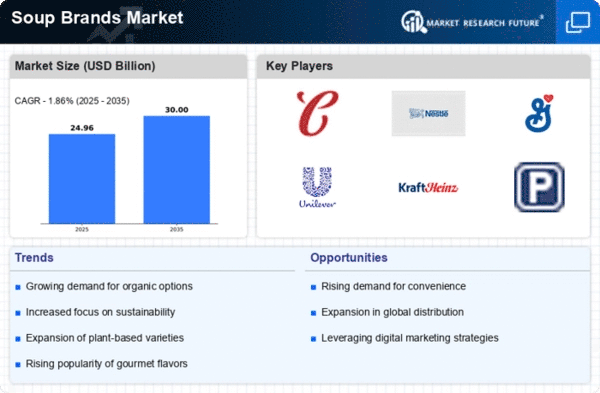
As per MRFR analysis, the Soup Brands market was estimated at 24.5 USD Billion in 2024. The soup brands industry is projected to grow from 24.96 USD Billion in 2025 to 30.0 USD Billion by 2035, exhibiting a compound annual growth rate (CAGR) of 1.86 during the forecast period 2025 - 2035.

Key Market Trends & Highlights

The soup brands market is experiencing a dynamic shift towards health-conscious and sustainable options.

  • The North American market remains the largest, driven by a strong demand for convenient and ready-to-eat soup options.
  • In the Asia-Pacific region, the soup market is rapidly expanding, fueled by increasing urbanization and changing consumer preferences.
  • Canned soup continues to dominate the market, while instant soup is emerging as the fastest-growing segment due to its convenience.
  • Health-conscious consumer trends and sustainability initiatives are key drivers, influencing the popularity of vegetable-based and organic ingredient soups.

Market Size & Forecast

2024 Market Size 24.5 (USD Billion)
2035 Market Size 30.0 (USD Billion)
CAGR (2025 - 2035) 1.86%

Major Players

Campbell Soup Company (US), Nestle S.A. (CH), General Mills, Inc. (US), Unilever PLC (GB), Kraft Heinz Company (US), Progresso (US), Amy's Kitchen, Inc. (US), Hain Celestial Group, Inc. (US), Baxters Food Group (GB)

Our Impact
Enabled $4.3B Revenue Impact for Fortune 500 and Leading Multinationals
Partnering with 2000+ Global Organizations Each Year
30K+ Citations by Top-Tier Firms in the Industry

Soup Brands Market Trends

The soup brands market is currently experiencing a dynamic evolution, characterized by shifting consumer preferences and an increasing demand for convenience. As lifestyles become busier, individuals are gravitating towards ready-to-eat options that offer both nutrition and flavor. This trend is further fueled by a growing awareness of health and wellness, prompting brands to innovate with organic and natural ingredients. Additionally, the rise of plant-based diets is influencing product development, leading to a broader array of vegetarian and vegan soups that cater to diverse dietary needs. Moreover, sustainability has emerged as a pivotal factor in the soup brands market. Consumers are increasingly concerned about environmental impact, prompting brands to adopt eco-friendly packaging and sourcing practices. This shift not only aligns with consumer values but also enhances brand loyalty. As the market continues to evolve, companies are likely to focus on transparency and ethical practices, which may further shape the competitive landscape. Overall, the soup brands market appears poised for growth, driven by health-conscious choices and a commitment to sustainability.

Health and Wellness Focus

The soup brands market is witnessing a pronounced emphasis on health and wellness. Consumers are increasingly seeking products that align with their nutritional goals, leading brands to incorporate organic, low-sodium, and nutrient-rich ingredients into their offerings. This trend reflects a broader societal shift towards healthier eating habits.

Plant-Based Innovations

There is a notable rise in plant-based soup options within the soup brands market. As more individuals adopt vegetarian and vegan lifestyles, brands are responding by developing innovative recipes that highlight vegetables, legumes, and grains. This trend not only caters to dietary preferences but also appeals to environmentally conscious consumers.

Sustainability Initiatives

Sustainability is becoming a critical consideration in the soup brands market. Companies are increasingly adopting eco-friendly practices, such as using recyclable packaging and sourcing ingredients responsibly. This commitment to sustainability resonates with consumers, fostering brand loyalty and encouraging environmentally responsible purchasing decisions.

Market Segment Insights

By Product Type: Canned Soup (Largest) vs. Instant Soup (Fastest-Growing)

In the soup brands market, Canned Soup is the largest segment, holding a significant share of the overall market. This segment benefits from long shelf life, convenience, and a wide variety of flavors and formulations catering to consumer preferences. Dry Soup Mix and Frozen Soup follow, albeit to a lesser extent, appealing primarily to consumers seeking quick meal solutions or gourmet options. Chilled Soup and Instant Soup are increasingly gaining traction among health-conscious and on-the-go consumers, marking a shift in consumer dining habits toward more convenient yet nutritious options.

Canned Soup: Dominant vs. Instant Soup: Emerging

Canned Soup remains the dominant force in the soup brands market due to its established presence and accessibility. It offers numerous flavor profiles, suitable for various demographics, and is favored for its longer shelf life. In contrast, Instant Soup is emerging rapidly, attracting younger consumers and busy professionals seeking quick, healthy meal solutions. This segment is characterized by its innovative packaging and flavor enhancements, and is thus tapping into the growing trend of on-the-go eating. Instant Soup's ability to offer a quick meal without sacrificing taste makes it an appealing choice in modern-day lifestyles, driving its growth in the overall market.

By Ingredients: Vegetable Based (Largest) vs. Organic Ingredients (Fastest-Growing)

In the soup brands market, the 'Ingredients' segment showcases a diverse distribution of values, with Vegetable Based soups leading the market share due to increasing consumer preference for plant-based diets. This segment offers a wide variety of flavors and health benefits, appealing to a broad consumer base. Meat Based and Seafood Based options also hold notable portions of the market, but they face stiff competition from the growing demand for healthier, vegetable-centric options. Organic Ingredients are rapidly gaining popularity, reflecting a significant shift towards natural and chemical-free food choices. As consumers become increasingly health-conscious, the growth trends in the Ingredients segment suggest a positive trajectory, especially for Organic Ingredients, which cater to a niche yet expanding market looking for premium quality soups. The demand for gluten-free products is also on the rise, providing added impetus to brands that ensure their offerings meet specific dietary requirements. Overall, the Ingredients segment shows robust growth, driven by changing dietary habits and an escalating focus on wellness and sustainability.

Vegetable Based (Dominant) vs. Gluten Free (Emerging)

The Vegetable Based segment stands out as a dominant force in the soup brands market due to its ability to cater to health-conscious consumers seeking nutritious and flavorful options. These soups often incorporate a medley of vegetables, herbs, and spices, appealing to those following vegetarian or vegan diets. In contrast, the Gluten Free segment represents an emerging category, gaining traction among consumers with dietary restrictions, such as celiac disease or gluten sensitivity. Brands are increasingly innovating to produce gluten-free soups that maintain taste and texture without sacrificing quality. While Vegetable Based soups leverage their established popularity and wide acceptance, Gluten Free options are carving a niche for themselves, especially as more consumers become aware of gluten-related health issues. These two segments highlight the market's adaptive nature to emerging consumer trends, where health and inclusivity are at the forefront.

By Packaging Type: Single Serve (Largest) vs. Eco-Friendly Packaging (Fastest-Growing)

The packaging type segment in the soup brands market is diverse, with single-serve packaging holding the largest share due to its convenience and appeal to busy consumers. Single-serve options cater to individual households, providing portion control and reducing food waste, thereby gaining significant traction in recent years. In contrast, eco-friendly packaging is emerging rapidly as a preferred choice among environmentally-conscious consumers, reflecting a growing trend towards sustainable practices in the food industry.

Single Serve: Dominant vs. Eco-Friendly Packaging: Emerging

Single-serve packaging for soup brands is dominating the market owing to its convenience, addressing the needs of on-the-go consumers and those looking for quick meal options. This format is designed to provide just the right portion, minimizing waste and appealing to health-conscious individuals seeking controlled serving sizes. On the other hand, eco-friendly packaging represents an emerging trend in the soup market, as brands innovate towards sustainable materials, appealing to a growing demographic that prioritizes environmental impact. This packaging type not only helps brands align with consumer values but also provides a competitive edge as sustainability becomes a key purchasing criterion.

By Distribution Channel: Supermarkets (Largest) vs. Online Retail (Fastest-Growing)

The soup brands market demonstrates a significant distribution trend across various channels, with supermarkets holding the largest market share. Supermarkets are preferred by consumers for their vast product selections and accessibility, making them the go-to choice for purchasing soups. On the other hand, online retail has surged in popularity, particularly among younger demographics who favor convenience and the ability to compare products easily. This shift indicates a diversification in purchasing habits, leading to growth across all distribution channels in the soup categories.

Supermarkets: (Dominant) vs. Online Retail (Emerging)

In the soup brands market, supermarkets remain the dominant channel, providing a comprehensive selection of both familiar and niche soup products. Their physical presence creates a tactile shopping experience, allowing customers to browse and make spontaneous purchases. Conversely, online retail channels are emerging rapidly, driven by trends in e-commerce and changing consumer preferences toward digital shopping. Online platforms offer convenience, subscription models, and direct-to-door delivery, appealing especially to tech-savvy consumers. As these two channels evolve, the competition between the tactile experience of supermarkets and the convenience of online shopping will shape the future of soup distribution.

By Consumer Demographics: Age Group (Largest) vs. Income Level (Fastest-Growing)

In the soup brands market, age group segmentation reveals that consumers aged 35-50 represent the largest portion, often purchasing premium, health-centric products. Conversely, younger consumers (aged 18-34) show increasing interest in convenience and innovative flavors, with a notable shift towards ready-to-eat options. Income level segmentation indicates that higher-income households are more likely to invest in gourmet and organic soups, reflecting a trend towards premiumization in products across the market. The growth trends in the 'Income Level' segment are primarily driven by an expanding awareness of nutrition and wellness, leading to increased spending on high-quality food products. On the other hand, the 'Age Group' segment showcases the growing popularity of soup among younger consumers influenced by lifestyle changes and the demand for quick meal solutions. The rise of digital marketing is also fostering engagement with this demographic, encouraging them to explore a variety of soup brands and offerings.

Age Group: 35-50 (Dominant) vs. Income Level: High-Income Households (Emerging)

The dominant age group of 35-50 years in the soup brands market tends to prioritize nutritional value and convenience, often opting for products that align with their busy lifestyles while also being health-conscious. This demographic is characterized by a preference for soups enriched with superfoods and unique flavors. On the other hand, high-income households represent an emerging segment with increasing buying power, leading to a demand for premium soup options. These consumers are willing to pay extra for organic or gourmet products that promise superior quality and taste. The dual interest in innovative packaging and culinary exploration among these demographics indicates a promising growth trajectory for brands that cater to both health and gastronomic experiences.

Get more detailed insights about Soup Brands Market

Regional Insights

North America : Market Leader in Soup Brands

North America continues to lead The soup brands market, holding a significant share of 10.0 in 2024. The growth is driven by increasing consumer demand for convenient meal options and a rising trend towards healthy eating. Regulatory support for food safety and quality standards further enhances market stability, encouraging innovation in product offerings. The region's robust distribution networks also facilitate easy access to a variety of soup products. The competitive landscape in North America is characterized by major players such as Campbell Soup Company, Kraft Heinz Company, and General Mills, Inc. These companies leverage strong brand recognition and extensive marketing strategies to capture consumer interest. The presence of diverse product lines, including organic and specialty soups, caters to evolving consumer preferences. As a result, North America remains a pivotal market for soup brands, with continuous growth expected in the coming years.

Europe : Emerging Trends in Soup Consumption

Europe's soup brands market is projected to grow, with a market size of 8.0 in 2024. The increasing focus on health and wellness among consumers drives demand for nutritious and convenient meal solutions. Regulatory frameworks in the EU promote transparency in food labeling and sustainability, which are crucial for consumer trust. Additionally, the rise of plant-based diets is influencing product innovation, leading to a broader range of offerings in the soup category. Leading countries in this region include Germany, France, and the UK, where established brands like Nestle S.A. and Unilever PLC dominate the market. The competitive landscape is marked by a mix of multinational corporations and local producers, each vying for market share through unique flavors and health-oriented products. The presence of key players ensures a dynamic market environment, fostering continuous growth and adaptation to consumer trends.

Asia-Pacific : Rapid Growth in Soup Demand

The Asia-Pacific region is witnessing a notable increase in soup consumption, with a market size of 5.0 in 2024. Factors such as urbanization, changing lifestyles, and a growing middle class contribute to this trend. Consumers are increasingly seeking convenient meal options, and the demand for ready-to-eat soups is on the rise. Regulatory initiatives aimed at improving food safety standards are also playing a crucial role in shaping the market landscape. Countries like China, Japan, and Australia are leading the charge in this market, with key players such as Nestle S.A. and local brands expanding their product lines. The competitive environment is characterized by innovation in flavors and packaging, catering to diverse consumer preferences. As the region continues to evolve, the soup market is expected to grow significantly, driven by both domestic and international brands.

Middle East and Africa : Emerging Market Opportunities

The Middle East and Africa region presents a nascent but promising market for soup brands, with a market size of 1.5 in 2024. The growth is fueled by increasing urbanization and a shift towards convenient meal solutions among consumers. Additionally, rising disposable incomes are enabling more households to explore diverse food options, including soups. Regulatory frameworks are gradually evolving to support food safety and quality, which is essential for market growth. Countries like South Africa and the UAE are at the forefront of this market, with both local and international brands vying for consumer attention. The competitive landscape is still developing, with opportunities for innovation in flavors and packaging to cater to local tastes. As awareness of soup products increases, the region is poised for significant growth in the coming years.


Key Players and Competitive Insights

The soup brands market is characterized by a dynamic competitive landscape, driven by evolving consumer preferences and a growing demand for convenience and health-oriented products. Major players such as Campbell Soup Company (US), Nestle S.A. (CH), and Kraft Heinz Company (US) are actively shaping the market through strategic initiatives focused on innovation and sustainability. These companies are increasingly investing in product development that emphasizes organic ingredients and reduced sodium content, reflecting a broader trend towards healthier eating. Their operational focus on enhancing supply chain efficiencies and expanding distribution channels further solidifies their competitive positioning, collectively fostering a robust environment for growth.Key business tactics employed by these companies include localizing manufacturing to reduce costs and optimize supply chains. The market structure appears moderately fragmented, with a mix of large multinational corporations and smaller niche players. This fragmentation allows for diverse product offerings, catering to various consumer segments. The influence of key players is significant, as they leverage their scale to negotiate better terms with suppliers and retailers, thereby enhancing their market presence.
In November Campbell Soup Company (US) announced a partnership with a leading plant-based ingredient supplier to develop a new line of soups aimed at health-conscious consumers. This strategic move is likely to enhance Campbell's product portfolio, aligning with the increasing consumer shift towards plant-based diets. By tapping into this growing segment, Campbell aims to capture a larger share of the market while reinforcing its commitment to sustainability.
In October Nestle S.A. (CH) launched a new range of ready-to-eat soups that utilize advanced packaging technology to extend shelf life without preservatives. This innovation not only meets consumer demand for convenience but also addresses concerns regarding food waste. Nestle's focus on leveraging technology in product development may position it favorably against competitors, as it enhances both product quality and consumer trust.
In September Kraft Heinz Company (US) expanded its distribution network by entering into a strategic alliance with a major online grocery platform. This initiative is indicative of the growing importance of e-commerce in the food sector, allowing Kraft Heinz to reach a broader audience and adapt to changing shopping behaviors. Such strategic alliances are likely to play a crucial role in shaping the competitive landscape, as companies seek to enhance their market reach and operational efficiency.
As of December current trends in the soup brands market indicate a strong emphasis on digitalization, sustainability, and the integration of artificial intelligence in supply chain management. Strategic alliances are increasingly shaping the competitive environment, enabling companies to pool resources and expertise. Looking ahead, competitive differentiation is expected to evolve, with a notable shift from price-based competition towards innovation, technology adoption, and supply chain reliability. This transition underscores the necessity for companies to adapt and innovate continuously to maintain a competitive edge in a rapidly changing market.

Key Companies in the Soup Brands Market include

Future Outlook

Soup Brands Market Future Outlook

The soup brands market is projected to grow at 1.86% CAGR from 2025 to 2035, driven by health trends, convenience, and innovative flavors.

New opportunities lie in:

  • Expansion into plant-based soup lines to capture health-conscious consumers. Development of subscription-based delivery services for regular customers. Investment in sustainable packaging solutions to enhance brand loyalty.

By 2035, the soup brands market is expected to be robust, reflecting evolving consumer preferences and sustainable practices.

Market Segmentation

soup-brands-market Ingredients Outlook

  • Vegetable Based
  • Meat Based
  • Seafood Based
  • Organic Ingredients
  • Gluten Free

soup-brands-market Product Type Outlook

  • Canned Soup
  • Dry Soup Mix
  • Frozen Soup
  • Chilled Soup
  • Instant Soup

soup-brands-market Packaging Type Outlook

  • Single Serve
  • Family Size
  • Bulk Packaging
  • Eco-Friendly Packaging
  • Ready-to-Drink

soup-brands-market Distribution Channel Outlook

  • Supermarkets
  • Online Retail
  • Convenience Stores
  • Specialty Stores
  • Food Service

soup-brands-market Consumer Demographics Outlook

  • Age Group
  • Income Level
  • Health Consciousness
  • Lifestyle Choices
  • Dietary Preferences

Report Scope

MARKET SIZE 2024 24.5(USD Billion)
MARKET SIZE 2025 24.96(USD Billion)
MARKET SIZE 2035 30.0(USD Billion)
COMPOUND ANNUAL GROWTH RATE (CAGR) 1.86% (2025 - 2035)
REPORT COVERAGE Revenue Forecast, Competitive Landscape, Growth Factors, and Trends
BASE YEAR 2024
Market Forecast Period 2025 - 2035
Historical Data 2019 - 2024
Market Forecast Units USD Billion
Key Companies Profiled Campbell Soup Company (US), Nestle S.A. (CH), General Mills, Inc. (US), Unilever PLC (GB), Kraft Heinz Company (US), Progresso (US), Amy's Kitchen, Inc. (US), Hain Celestial Group, Inc. (US), Baxters Food Group (GB)
Segments Covered Product Type, Ingredients, Packaging Type, Distribution Channel, Consumer Demographics
Key Market Opportunities Growing demand for plant-based and organic options in the soup brands market presents significant opportunities.
Key Market Dynamics Rising consumer preference for healthy, organic options drives innovation and competition among soup brands.
Countries Covered North America, Europe, APAC, South America, MEA
Leave a Comment
Download Free Sample

Kindly complete the form below to receive a free sample of this Report

Compare Licence

×
Features License Type
Single User Multiuser License Enterprise User
Price $4,950 $5,950 $7,250
Maximum User Access Limit 1 User Upto 10 Users Unrestricted Access Throughout the Organization
Free Customization
Direct Access to Analyst
Deliverable Format
Platform Access
Discount on Next Purchase 10% 15% 15%
Printable Versions