Research Methodology on Sour Cream Market
The research methodology adopted for this report on the sour cream market is a combination of both primary and secondary sources of research. The initial step of the research is to get a comprehensive overview of the market. This is done by conducting secondary research on various sources such as industry white papers, news publications, paid databases, and annual reports of key players in the sour cream market.
The secondary sources include detailed industry insights from analytical studies on the size of the sour cream market, value chain analysis, segmental analysis (by product type, application, end-user, and region), pricing analysis, regulations, and key market updates. To supplement the secondary research, both qualitative and quantitative primary research is conducted with key stakeholders in the sour cream market.
This involves interviews with industry experts and opinion leaders, food technologists and processors, and government and regulatory agencies. The information gathered from these interviews is used to cross-verify the accuracy and validate the reliability of the findings from the secondary research. This research methodology also helped in understanding current trends, opportunities, and untapped potential in the market.
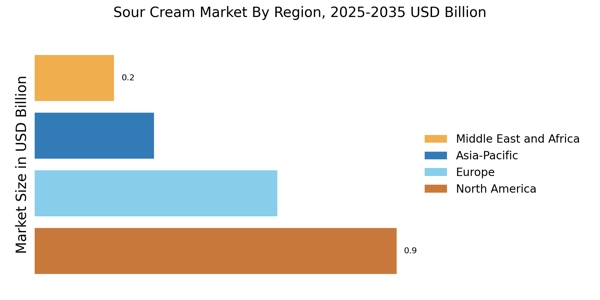
In terms of emphasis on the regions for the global market, the report focused on North America, Europe, Asia Pacific, and the Rest of the World (RoW). The North American region comprises the United States, Canada, and Mexico. The European region comprises the United Kingdom, France, Germany, and Italy. The Asia-Pacific region comprises Australia, China, India, South Korea, and Japan. The RoW region comprises South America and the Middle East & Africa.
The analysis of the sour cream market is conducted based on various inputs such as drivers, restraints, competitive landscape, technological developments, regulatory policies, and pricing trends. The statistical data used in the report is collected by conducting primary surveys and interviews with key stakeholders in the market.
In terms of customer demographics, the customer profiles were identified as grocery stores, retailers, restaurants, food processors, and food service stores. These customers were contacted through telephone interviews and surveys, and their detailed feedback was obtained to gain insights into the performance of the sour cream market.
In order to understand the pricing patterns and customer preferences, it was imperative to understand the buyer-seller dynamics in the sour cream market. In order to do so, interviews were conducted with key personnel from manufacturers and retailers both online, as well as brick-and-mortar stores. This was done in order to gain an understanding of the challenges, and the opportunities available for manufacturers and retailers.
In order to analyze the trends in the sour cream market, certain metrics such as market size, growth rate, and penetration rate were used. The primary research analysis was broadly categorized into qualitative market assessment and quantitative market assessment. The qualitative assessment was conducted through interviews with key opinion leaders, industry analysts, and customers in both the B2B and B2C sectors.
The quantitative assessment is conducted through detailed market and customer surveys and was further supplemented with official statistics available on sour cream and related products. All of the key inputs were utilized to arrive at an accurate forecast of the sour cream market over the forecast period of 2023-2030.