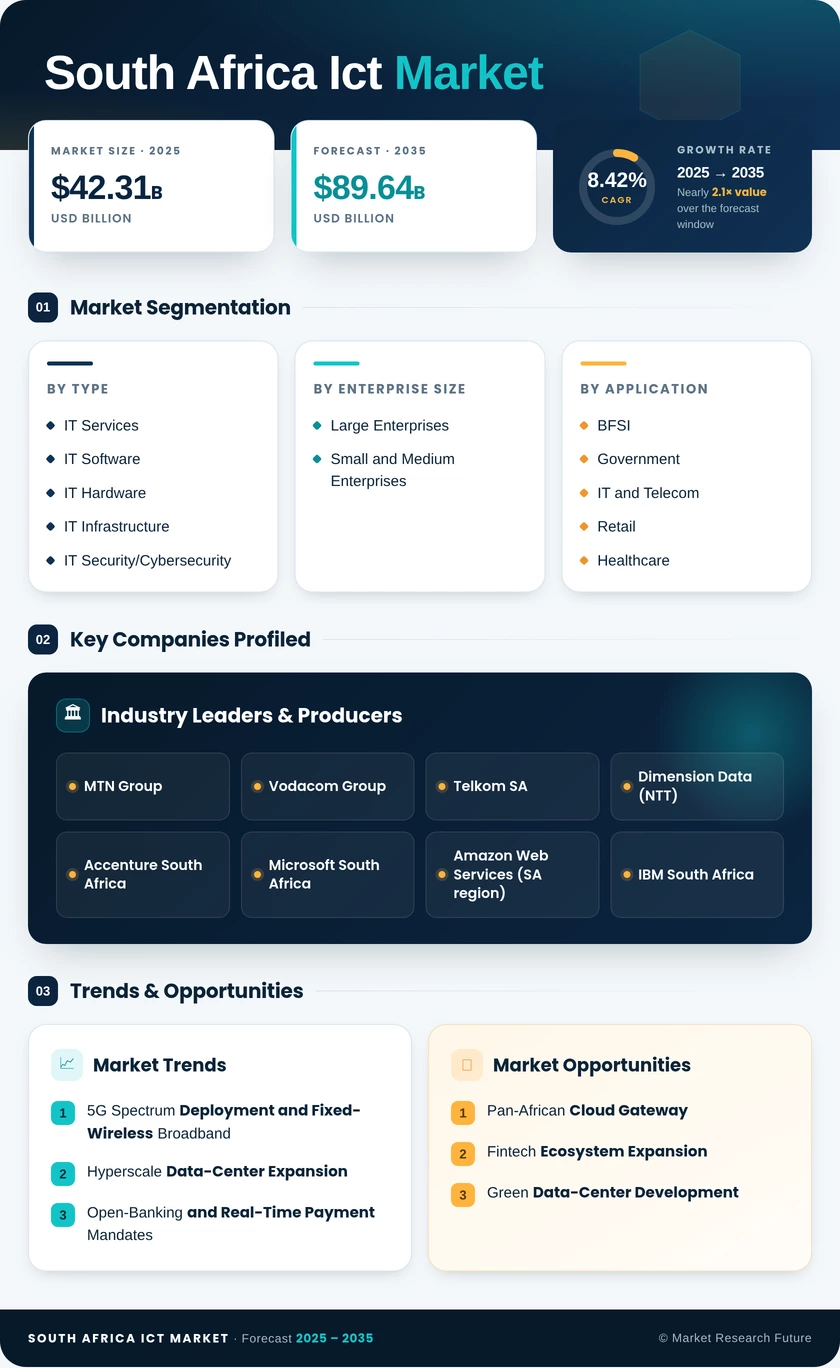
Segmentation Quick Reference
| Dimension | Sub-Segments | Dominant Segment | Fastest Growing Segment |
| Product Type | IT Hardware, IT Software, IT Services, IT Infrastructure, South Africa ICT Market/Cybersecurity, Others | IT Services (34.8% share, 2025) | South Africa ICT Market/Cybersecurity (9.1% CAGR) |
| Enterprise Size | Large Enterprises, SMEs | Large Enterprises (66.4% share, 2025) | SMEs (9.5% CAGR) |
| End-User Industry Vertical | BFSI, Government, Oil and Gas, IT and Telecom, Retail, Manufacturing, Energy, Healthcare, Others | BFSI (USD 10.2B, 2025) | Healthcare (9.2% CAGR) |
| Deployment Model | On-Premise, Cloud, Hybrid | Cloud (50.1% share, 2025) | Hybrid (9.4% CAGR) |
Market Segmentation Overview
By Product Type
| Sub-Segment | Key Trend |
| IT Hardware | Endpoint refresh cycles driven by 5G device upgrades and hybrid-work equipment |
| IT Software | ERP and CRM modernization; migration to SaaS licensing models |
| IT Services | Managed-services contracts bundling cloud orchestration, network ops, and support |
| IT Infrastructure | Hyperscale and edge data-center build-outs across Gauteng and Western Cape |
| South Africa ICT Market/Cybersecurity | Compliance-driven spend under POPIA, Cybercrimes Act, and cyber-insurance mandates |
| Others | Emerging segments including IoT platforms, blockchain-based identity, and drone-based connectivity |
IT services continue to anchor spending across the South Africa ICT Market as enterprises increasingly outsource complex multi-cloud management. Cybersecurity is the segment gaining share most rapidly, driven by tightening regulatory frameworks and insurer-mandated controls.
By Enterprise Size
| Sub-Segment | Key Trend |
| Large Enterprises | Scale-driven procurement with multi-year contracts; hybrid-cloud and AI-first strategies |
| Small and Medium Enterprises (SMEs) | Government-subsidized cloud access; SaaS adoption for accounting, POS, and e-commerce |
Large enterprises command the majority of spending, but the SME segment is the primary growth engine as digital voucher programs and affordable SaaS pricing expand the addressable South Africa ICT Market into underserved business tiers.
By End-User Industry Vertical
| Sub-Segment | Key Trend |
| BFSI | Open banking, real-time payments, and AI-driven fraud analytics |
| Government | E-government platforms, smart-city pilots, and digital identity programs |
| Oil and Gas | Upstream SCADA modernization and remote-monitoring deployments |
| IT and Telecom | 5G rollout, network-function virtualization, and fiber-to-the-premise expansion |
| Retail | Omnichannel commerce, POS digitization, and supply-chain visibility |
| Manufacturing | Industrial IoT, predictive maintenance, and digital-twin adoption |
| Energy | Smart-grid monitoring, renewable-asset management, and distributed-energy platforms |
| Healthcare | Telemedicine, electronic health records, and National Health Insurance digitization |
BFSI remains the largest vertical by revenue, underpinned by the financial sector's systemic role in South Africa's economy. Healthcare is accelerating fastest as public-health digitization mandates create greenfield demand across the South Africa ICT Market.
By Deployment Model
| Sub-Segment | Key Trend |
| On-Premise | Retained for air-gapped environments, legacy mainframes, and classified government systems |
| Cloud | Dominant deployment driven by hyperscaler availability and broadband improvements |
| Hybrid | Fastest-growing model as data-residency rules under POPIA force split-workload architectures |
Cloud holds the largest revenue share, but hybrid architectures are gaining ground as enterprises balance compliance obligations with the elastic-compute advantages of public cloud. Digital infrastructure investment in South Africa is increasingly designed around hybrid-ready facilities.