×
Request Free Sample ×

Kindly complete the form below to receive a free sample of this Report

* Please use a valid business email

Leading companies partner with us for data-driven Insights

clients tt-cursor
Hero Background

South America Biochips Market

ID: MRFR/HC/48216-HCR
200 Pages
Garvit Vyas
October 2025

South America Biochips Market Research Report By Application (Diagnostics, Drug Discovery, Gene Expression Analysis, Genetic Analysis), By Product Type (DNA Chips, Protein Chips, Cell-Based Chips), By Technology (Microarray Technology, Nanolithography, PCR-Based Technology, Mass Spectrometry), By End Use (Research Laboratories, Clinical Laboratories, Pharmaceutical Companies, Biotechnology Companies) andBy Regional (Brazil, Mexico, Argentina, Rest of South America)- Forecast to 2035

Share:
Download PDF ×

We do not share your information with anyone. However, we may send you emails based on your report interest from time to time. You may contact us at any time to opt-out.

South America Biochips Market Infographic
Purchase Options

South America Biochips Market Summary

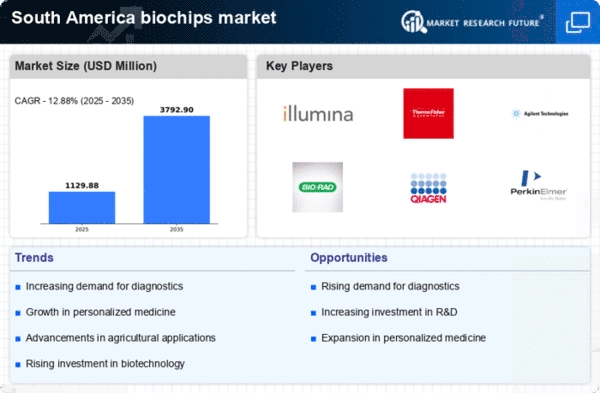
As per MRFR analysis, the South America biochips market Size was estimated at 1000.96 $ Million in 2024. The South America biochips market is projected to grow from 1129.88 $ Million in 2025 to 3792.9 $ Million by 2035, exhibiting a compound annual growth rate (CAGR) of 12.88% during the forecast period 2025 - 2035.

Key Market Trends & Highlights

The South America biochips market is experiencing robust growth driven by technological advancements and increasing demand for personalized medicine.

  • The market is witnessing a rising demand for personalized medicine, particularly in Brazil, which is the largest market in the region.
  • Technological advancements in biochip design are enhancing the capabilities and applications of biochips across various sectors.
  • Collaborative research initiatives are becoming more prevalent, fostering innovation and development in the biochips market.
  • Key drivers such as increasing investment in biotechnology and the growing prevalence of chronic diseases are propelling market growth.

Market Size & Forecast

2024 Market Size 1000.96 (USD Million)
2035 Market Size 3792.9 (USD Million)
CAGR (2025 - 2035) 12.88%

Major Players

Illumina (US), Thermo Fisher Scientific (US), Agilent Technologies (US), Bio-Rad Laboratories (US), Qiagen (DE), PerkinElmer (US), Roche (CH), Abbott Laboratories (US), Merck KGaA (DE)

South America Biochips Market Trends

The biochips market in South America is currently experiencing a notable evolution, driven by advancements in biotechnology and increasing demand for personalized medicine. The region's growing investment in research and development, particularly in countries like Brazil and Argentina, appears to be fostering innovation in biochip technologies. This trend is likely to enhance diagnostic capabilities and improve patient outcomes, as biochips facilitate rapid and accurate analysis of biological samples. Furthermore, collaborations between academic institutions and private enterprises seem to be strengthening the ecosystem, potentially leading to the emergence of new applications in healthcare and agriculture. In addition, regulatory frameworks in South America are gradually adapting to accommodate the unique challenges posed by biochip technologies. This shift may encourage more companies to enter the market, thereby increasing competition and driving down costs. As a result, the accessibility of biochips could improve, making them more widely available for various applications. Overall, the biochips market in South America appears poised for growth, with a focus on innovation, collaboration, and regulatory support shaping its future trajectory.

Rising Demand for Personalized Medicine

The biochips market is witnessing a surge in demand for personalized medicine solutions. This trend is driven by the increasing recognition of the need for tailored healthcare approaches that cater to individual patient profiles. As healthcare providers in South America seek to enhance treatment efficacy, biochips are becoming essential tools for genetic analysis and biomarker discovery.

Technological Advancements in Biochip Design

Innovations in biochip design and manufacturing processes are significantly impacting the biochips market. Enhanced sensitivity and specificity of biochips are being achieved through the integration of nanotechnology and microfluidics. These advancements are likely to improve diagnostic accuracy and expand the range of applications in clinical and research settings.

Collaborative Research Initiatives

Collaborative research initiatives between universities and industry players are emerging as a key trend in the biochips market. Such partnerships are fostering knowledge exchange and accelerating the development of new biochip applications. This collaborative approach is expected to drive innovation and enhance the overall competitiveness of the market in South America.

South America Biochips Market Drivers

Rising Awareness of Genetic Testing

There is a growing awareness of the benefits of genetic testing among the South American population, which is significantly impacting the biochips market. As individuals become more informed about the role of genetics in health, the demand for biochip-based genetic testing solutions is likely to increase. This trend is supported by educational campaigns and initiatives aimed at promoting personalized medicine. The market for genetic testing in South America is projected to reach $1 billion by 2027, indicating a robust growth trajectory. Consequently, biochip manufacturers are expected to capitalize on this trend by developing advanced genetic testing solutions that cater to the evolving needs of consumers.

Growing Prevalence of Chronic Diseases

The rising incidence of chronic diseases in South America is a critical driver for the biochips market. Conditions such as diabetes, cancer, and cardiovascular diseases are becoming increasingly prevalent, necessitating advanced diagnostic tools. Biochips offer rapid and accurate testing capabilities, which are essential for effective disease management. According to recent health statistics, chronic diseases account for over 70% of total deaths in the region. This alarming trend is prompting healthcare providers to adopt biochip technologies to enhance patient care and streamline diagnostic processes. Consequently, the demand for biochips is expected to grow significantly as healthcare systems seek to implement more efficient and effective solutions.

Increasing Investment in Biotechnology

The biochips market in South America is experiencing a surge in investment, particularly from both public and private sectors. Governments are recognizing the potential of biotechnology to drive economic growth and improve healthcare outcomes. For instance, Brazil has allocated approximately $200 million to support biotechnology research and development initiatives. This influx of capital is likely to enhance the capabilities of biochip manufacturers, enabling them to innovate and expand their product offerings. Furthermore, as the region's biotechnology sector matures, it is expected that the biochips market will benefit from increased collaboration between academic institutions and industry players, fostering a more robust ecosystem for biochip development.

Regulatory Support for Innovative Technologies

Regulatory frameworks in South America are evolving to support the adoption of innovative technologies, including biochips. Authorities are increasingly recognizing the importance of biochips in enhancing diagnostic accuracy and patient outcomes. For example, Brazil's National Health Surveillance Agency has introduced streamlined approval processes for biochip-based diagnostics, which could reduce time-to-market for new products. This regulatory support is likely to encourage more companies to invest in biochip development, thereby expanding the market. As a result, the biochips market is poised for growth, driven by a favorable regulatory environment that promotes innovation and ensures safety.

Expansion of Research and Development Facilities

The establishment of new research and development facilities across South America is a pivotal driver for the biochips market. Countries like Argentina and Chile are investing in state-of-the-art laboratories and research centers to foster innovation in biotechnology. This expansion is likely to facilitate the development of novel biochip technologies, enhancing the region's competitive edge in the global market. Moreover, increased R&D activities are expected to lead to breakthroughs in biochip applications, ranging from diagnostics to environmental monitoring. As these facilities become operational, they will contribute to the growth of the biochips market by producing cutting-edge solutions that meet the demands of various industries.


Market Segment Insights

By Application: Diagnostics (Largest) vs. Drug Discovery (Fastest-Growing)

In the application segment of the biochips market, diagnostics holds the largest share, driven by increasing prevalence of chronic diseases and advancements in personalized medicine. It remains the backbone of healthcare applications, providing critical insights into patient conditions. Conversely, drug discovery is witnessing rapid growth as pharmaceutical companies invest heavily in R&D for novel therapeutics, expanding its footprint in the market. Growth trends in this segment are shaped by technological innovations and rising demand for high-throughput screening methods. The surge in genomic and proteomic research also fuels the application of biochips in genetics. As biopharmaceuticals gain traction, both diagnostics and drug discovery are set to grow, but the latter is catching up quickly due to the need for faster drug development processes.

Diagnostics (Dominant) vs. Drug Discovery (Emerging)

Diagnostics plays a dominant role in the biochips market, catering to a broad spectrum of healthcare needs from disease detection to monitoring therapeutic responses. It encompasses various functions such as molecular diagnostics, where its precision and efficiency are key market drivers. In contrast, drug discovery represents an emerging segment characterized by its innovative approaches to identify potential drug candidates using biochips. This segment leverages advancements in bioinformatics and automation to enhance drug development timelines, making it progressively vital for biotech firms and research institutes. As these segments evolve, a collaboration between diagnostics and drug discovery will likely pave the way for advanced healthcare solutions.

By Product Type: DNA Chips (Largest) vs. Protein Chips (Fastest-Growing)

In the South America biochips market, the market share is significantly dominated by DNA Chips, which are widely utilized in genomics and diagnostics. Following closely, Protein Chips hold a substantial share as they are increasingly being adopted for various applications, including drug discovery and development. Cell-Based Chips are an emerging segment but currently do not command a significant share compared to the others. The growth trends in this segment are largely driven by advancements in personalized medicine and increasing investments in biotechnology research. Particularly, the rising prevalence of genetic disorders and the need for early diagnosis are propelling the demand for DNA Chips. Meanwhile, Protein Chips are witnessing rapid growth due to the growing focus on proteomics and biomarker discovery, making them a key area for innovation and development.

DNA Chips (Dominant) vs. Protein Chips (Emerging)

DNA Chips are the dominant product in the biochips segment, known for their precision in genetic analysis and high throughput capabilities, making them essential in molecular diagnostics and research. Their extensive application in understanding genetic predispositions and tailoring treatments enhances their market position. In contrast, Protein Chips are emerging as a critical tool in studying protein interactions and functions, driven by the growing emphasis on proteomics. These chips are pivotal in advancing drug discovery processes and understanding disease mechanisms, positioning them as a promising area for future growth and technological advancements.

By Technology: Microarray Technology (Largest) vs. PCR-Based Technology (Fastest-Growing)

Microarray technology holds the largest market share within the technology segment, reflecting its widespread application in genomics and diagnostics. Following closely, PCR-based technology is emerging with a robust share due to its increasing adoption in various clinical settings, especially for infectious disease detection. Mass spectrometry and nanolithography continue to play vital roles, but they remain overshadowed by these two dominant technologies. Growth trends in the technology segment are driven by advancements in research and development, with microarray technology benefitting from its established presence in laboratories. Conversely, PCR-based technology is gaining momentum as its usability increases in rapid testing solutions powered by automation. As healthcare demands evolve, innovations such as point-of-care testing and personalized medicine enhance the growth prospects of both technologies in South America.

Technology: Microarray (Dominant) vs. PCR (Emerging)

Microarray technology is recognized for its ability to analyze thousands of genes simultaneously, making it an invaluable tool in genomics research and diagnostics, often preferred for its comprehensive data outputs. In contrast, PCR-based technology has emerged as a critical method for amplifying DNA sequences, thus accelerating diagnostic testing and monitoring of diseases. While microarray technology represents a mature segment with well-established applications in clinical laboratories, PCR technology is rapidly evolving, driven by innovations aimed at increasing speed and efficiency. This dynamic allows PCR to capture a growing market share, particularly in infectious disease diagnostics and genetic analysis, making it a key area to watch as demand for rapid and accurate testing continues to rise.

By End-Use: Research Laboratories (Largest) vs. Clinical Laboratories (Fastest-Growing)

In the biochips market, research laboratories hold a significant share, dominating the landscape due to their extensive use of biochips in various research applications. Clinical laboratories also play a crucial role, contributing notably to market dynamics as they adopt advanced technologies for diagnostics and patient care. This dual dominance between research and clinical laboratories creates a competitive balance, with each segment leveraging unique advantages to enhance their market presence. Growth trends indicate that while research laboratories remain the largest segment, clinical laboratories are rapidly gaining traction, driven by the increasing demand for precision diagnostics and personalized medicine. Additionally, the rising investments in biotechnology and the expansion of healthcare facilities fuel the growth of clinical laboratories, leading to their emergence as a pivotal player in the biochips market as they align with evolving healthcare needs.

Research Laboratories (Dominant) vs. Clinical Laboratories (Emerging)

Research laboratories are characterized by their substantial use of biochips for high-throughput screening, genomics, and proteomics, establishing them as a dominant force in the market. They provide essential data critical for scientific advancements and innovations in various fields, reinforcing their market leadership. In contrast, clinical laboratories are positioned as an emerging segment, rapidly adopting biochips for diagnostic purposes, primarily driven by the increasing need for rapid and accurate testing methodologies. Their growth is supported by technological advancements that enhance the capability and efficiency of diagnostic tools, making them essential in modern healthcare frameworks.

Get more detailed insights about South America Biochips Market

Regional Insights

Brazil : Strong Demand and Innovation Drive Success

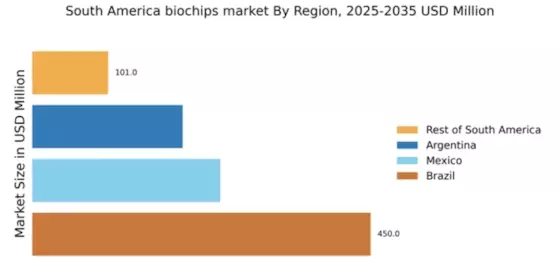
São Paulo and Rio de Janeiro are pivotal markets, hosting major biotech firms and research institutions. The competitive landscape features key players like Illumina and Thermo Fisher Scientific, which have established strong local partnerships. The business environment is favorable, with a growing focus on genomics and diagnostics applications. Local dynamics are shaped by collaborations between universities and industry, fostering innovation in biochip technologies. The sector is poised for growth, driven by advancements in healthcare and agricultural biotechnology.

Mexico : Emerging Hub for Biotechnology Innovation

Key markets include Mexico City and Guadalajara, where numerous biotech startups and established companies thrive. The competitive landscape features major players like Roche and Qiagen, which are expanding their presence. The local business environment is dynamic, with a focus on innovation and collaboration between academia and industry. Applications in agriculture and healthcare are particularly prominent, as Mexico seeks to enhance its capabilities in biotechnology and improve public health outcomes.

Argentina : Focus on Research and Development Initiatives

Buenos Aires and Córdoba are key markets, hosting numerous research institutions and biotech companies. The competitive landscape includes players like Bio-Rad Laboratories and Agilent Technologies, which are establishing local operations. The business environment is characterized by a collaborative approach between universities and industry, fostering innovation. Sector-specific applications in healthcare and agriculture are driving demand, as Argentina aims to position itself as a leader in biotechnology in the region.

Rest of South America : Diverse Opportunities Across Various Countries

Key markets include Santiago and Bogotá, where local biotech firms are emerging. The competitive landscape is less concentrated, with various small to medium enterprises making strides in the biochips sector. Major players are beginning to explore partnerships in these markets. The local business environment is characterized by a growing interest in diagnostics and agricultural applications, as countries seek to enhance their healthcare systems and agricultural productivity.

South America Biochips Market Regional Image

Key Players and Competitive Insights

The biochips market exhibits a dynamic competitive landscape characterized by rapid technological advancements and increasing demand for personalized medicine. Key players such as Illumina (US), Thermo Fisher Scientific (US), and Qiagen (DE) are at the forefront, leveraging innovation and strategic partnerships to enhance their market positions. Illumina (US) focuses on next-generation sequencing technologies, while Thermo Fisher Scientific (US) emphasizes comprehensive solutions for genomic research. Qiagen (DE) is strategically positioned with its molecular diagnostics and sample preparation technologies, collectively shaping a competitive environment that prioritizes innovation and customer-centric solutions.

In terms of business tactics, companies are increasingly localizing manufacturing to reduce costs and enhance supply chain efficiency. The market structure appears moderately fragmented, with several key players exerting significant influence. This fragmentation allows for a diverse range of products and services, fostering competition that drives innovation. The collective strategies of these companies suggest a trend towards collaboration and integration, as they seek to optimize their operations and expand their market reach.

In October 2025, Illumina (US) announced a partnership with a leading South American research institution to develop advanced bioinformatics tools aimed at enhancing genomic data analysis. This collaboration is expected to bolster Illumina's presence in the region, facilitating access to cutting-edge technologies and fostering local expertise in bioinformatics. Such strategic alliances are crucial for driving innovation and expanding market share in a competitive landscape.

In September 2025, Thermo Fisher Scientific (US) launched a new line of biochips designed for high-throughput screening applications, targeting the growing demand for drug discovery and development. This product introduction not only reinforces Thermo Fisher's commitment to innovation but also positions the company to capture a larger share of the burgeoning pharmaceutical market in South America. The strategic importance of this launch lies in its potential to enhance operational efficiencies for researchers and pharmaceutical companies alike.

In August 2025, Qiagen (DE) expanded its product portfolio by acquiring a local bioinformatics firm, thereby enhancing its capabilities in data analysis and interpretation. This acquisition is indicative of Qiagen's strategy to integrate advanced analytics into its offerings, which is increasingly vital in the biochips market. By strengthening its data-driven solutions, Qiagen aims to provide comprehensive services that meet the evolving needs of its customers.

As of November 2025, current trends in the biochips market are heavily influenced by digitalization, sustainability, and the integration of artificial intelligence (AI). Strategic alliances are becoming more prevalent, as companies recognize the value of collaboration in driving innovation and enhancing product offerings. Looking ahead, competitive differentiation is likely to evolve, shifting from price-based competition to a focus on technological advancements, innovation, and supply chain reliability. This transition underscores the importance of agility and responsiveness in a rapidly changing market.

Key Companies in the South America Biochips Market market include

Industry Developments

The South America Biochips Market has experienced significant developments recently. Notable companies such as Qiagen, Merck KGaA, and Roche Diagnostics have been actively innovating their product lines in response to the growing demand for personalized medicine and advanced diagnostics. In July 2023, PerkinElmer announced a strategic collaboration with a local biotechnology firm to enhance biochip applications in disease diagnostics, reflecting the increasing focus on local partnerships.

Additionally, Thermo Fisher Scientific made headlines in August 2023 with the expansion of its manufacturing facility in Brazil, aiming to leverage local resources and reduce operational costs. Within the last couple of years, several companies have seen growth in their market valuation, with BioRad Laboratories reporting a 15% increase in revenue attributed to biochip sales in late 2022. Furthermore, in June 2023, Ginkgo BioWorks made headlines through a joint venture with a prominent South American genomics firm, focusing on biochip technology, though no significant mergers or acquisitions were reported from the companies of interest within this timeframe.

The market's overall trajectory indicates a strong inclination towards innovation and collaborative efforts that reflect the evolving landscape in South America's diagnostics sector.

Future Outlook

South America Biochips Market Future Outlook

The Biochips Market is projected to grow at a 12.88% CAGR from 2024 to 2035, driven by advancements in diagnostics, personalized medicine, and increasing demand for rapid testing solutions.

New opportunities lie in:

  • Development of portable biochip devices for field diagnostics.
  • Investment in AI-driven bioinformatics platforms for data analysis.
  • Partnerships with biotech firms to enhance biochip applications in drug discovery.

By 2035, the biochips market is expected to achieve substantial growth, driven by innovation and strategic collaborations.

Market Segmentation

South America Biochips Market End-Use Outlook

  • Research Laboratories
  • Clinical Laboratories
  • Pharmaceutical Companies
  • Biotechnology Companies

South America Biochips Market Technology Outlook

  • Microarray Technology
  • Nanolithography
  • PCR-Based Technology
  • Mass Spectrometry

South America Biochips Market Application Outlook

  • Diagnostics
  • Drug Discovery
  • Gene Expression Analysis
  • Genetic Analysis

South America Biochips Market Product Type Outlook

  • DNA Chips
  • Protein Chips
  • Cell-Based Chips

Report Scope

MARKET SIZE 20241000.96(USD Million)
MARKET SIZE 20251129.88(USD Million)
MARKET SIZE 20353792.9(USD Million)
COMPOUND ANNUAL GROWTH RATE (CAGR)12.88% (2024 - 2035)
REPORT COVERAGERevenue Forecast, Competitive Landscape, Growth Factors, and Trends
BASE YEAR2024
Market Forecast Period2025 - 2035
Historical Data2019 - 2024
Market Forecast UnitsUSD Million
Key Companies Profiled["Illumina (US)", "Thermo Fisher Scientific (US)", "Agilent Technologies (US)", "Bio-Rad Laboratories (US)", "Qiagen (DE)", "PerkinElmer (US)", "Roche (CH)", "Abbott Laboratories (US)", "Merck KGaA (DE)"]
Segments CoveredApplication, Product Type, Technology, End-Use
Key Market OpportunitiesEmerging demand for personalized medicine drives innovation in biochips market technologies.
Key Market DynamicsRising demand for personalized medicine drives innovation and competition in the biochips market in South America.
Countries CoveredBrazil, Mexico, Argentina, Rest of South America

Leave a Comment

FAQs

What is the projected market size of the South America Biochips Market by 2035?

The South America Biochips Market is expected to be valued at 2000.0 million USD by 2035.

What is the expected compound annual growth rate (CAGR) for the South America Biochips Market from 2025 to 2035?

The market is anticipated to grow at a CAGR of 7.986% from 2025 to 2035.

Which application segment is expected to hold the largest market value in the South America Biochips Market in 2035?

The Diagnostics application segment is projected to reach a market value of 700.0 million USD in 2035.

What are the expected market values for the Drug Discovery application segment by 2035?

The Drug Discovery application segment is expected to be valued at 600.0 million USD in 2035.

Which region is anticipated to be the largest market for biochips in South America by 2035?

Brazil is expected to dominate the market with a valuation of 725.0 million USD by 2035.

What is the projected market size for the Genetic Analysis application in 2035?

The Genetic Analysis application segment is expected to reach a value of 300.0 million USD by 2035.

What were the market values for the Rest of South America region in 2024 and 2035?

The Rest of South America is projected to have market values of 189.0 million USD in 2024 and 475.0 million USD in 2035.

Who are the key players in the South America Biochips Market?

Major players in the market include Qiagen, Merck KGaA, PerkinElmer, and Illumina among others.

What is the expected market size for the Gene Expression Analysis application by 2035?

The Gene Expression Analysis application is projected to be valued at 400.0 million USD by 2035.

What is the anticipated market size for Mexico in 2035?

Mexico is expected to have a market value of 500.0 million USD by 2035.

Download Free Sample

Kindly complete the form below to receive a free sample of this Report

Compare Licence

×
Features License Type
Single User Multiuser License Enterprise User
Price $4,950 $5,950 $7,250
Maximum User Access Limit 1 User Upto 10 Users Unrestricted Access Throughout the Organization
Free Customization
Direct Access to Analyst
Deliverable Format
Platform Access
Discount on Next Purchase 10% 15% 15%
Printable Versions