×
Request Free Sample ×

Kindly complete the form below to receive a free sample of this Report

* Please use a valid business email

Leading companies partner with us for data-driven Insights

clients tt-cursor
Hero Background

South America Chemical Distribution Market

ID: MRFR/CnM/46164-HCR
111 Pages
Chitranshi Jaiswal
October 2025

South America Chemical Distribution Market Research Report: By Product Type (specialty chemicals, commodity chemicals), By End User (automotive, electronics, construction, oil & gas, petroleum, pharmaceuticals, textiles, others) andBy Regional (Brazil, Mexico, Argentina, Rest of South America)- Forecast to 2035

Share:
Download PDF ×

We do not share your information with anyone. However, we may send you emails based on your report interest from time to time. You may contact us at any time to opt-out.

South America Chemical Distribution Market Infographic
Purchase Options

South America Chemical Distribution Market Summary

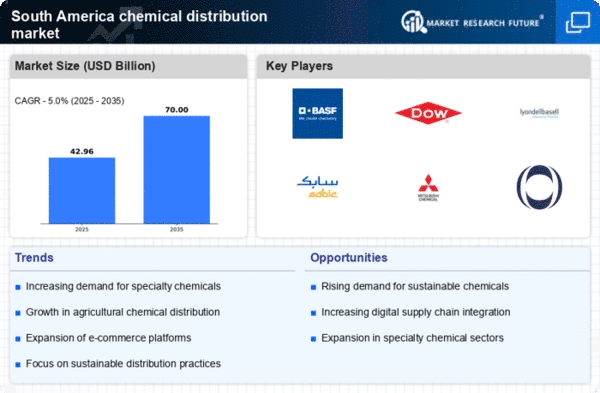
As per analysis, the South America chemical distribution market size was estimated at 40.91 USD Billion in 2024. The South America chemical distribution market is projected to grow from 42.96 USD Billion in 2025 to 70.0 USD Billion by 2035, exhibiting a compound annual growth rate (CAGR) of 5.0% during the forecast period 2025 - 2035.

Key Market Trends & Highlights

The South America chemical distribution market is experiencing a transformative shift towards sustainability and digitalization.

  • Brazil remains the largest market for chemical distribution, driven by its extensive industrial base and demand for diverse chemical products.
  • Mexico is emerging as the fastest-growing region, fueled by increasing investments in manufacturing and infrastructure development.
  • Sustainability initiatives and regulatory compliance are becoming central to market strategies, reflecting a broader global trend.
  • Rising demand for specialty chemicals and technological advancements in logistics are key drivers propelling market growth.

Market Size & Forecast

2024 Market Size 40.91 (USD Billion)
2035 Market Size 70.0 (USD Billion)
CAGR (2025 - 2035) 5.0%

Major Players

BASF (DE), Dow (US), LyondellBasell (US), SABIC (SA), Mitsubishi Chemical (JP), Ineos (GB), Eastman Chemical (US), Huntsman Corporation (US), Solvay (BE)

South America Chemical Distribution Market Trends

The chemical distribution market in South America is currently experiencing a dynamic transformation. This change is driven by various factors, including economic growth, regulatory changes, and evolving consumer demands. Countries within the region are witnessing an increase in industrial activities, which in turn fuels the demand for chemicals across multiple sectors such as agriculture, pharmaceuticals, and manufacturing. The rise of sustainable practices is also influencing distribution strategies. Companies seek to align with environmental regulations and consumer preferences for greener products. This shift is prompting distributors to adapt their supply chains and logistics to ensure compliance while maintaining efficiency. Moreover, the market is characterized by a growing emphasis on digitalization and technological advancements. Companies are increasingly leveraging digital platforms to enhance their distribution processes, improve customer engagement, and optimize inventory management. This trend appears to be reshaping traditional distribution models, allowing for greater flexibility and responsiveness to market changes. As the chemical distribution market continues to evolve, stakeholders must remain vigilant to emerging trends and challenges, ensuring they are well-positioned to capitalize on new opportunities while navigating potential risks.

Sustainability Initiatives

The chemical distribution market is witnessing a notable shift towards sustainability initiatives. Distributors are increasingly adopting eco-friendly practices, such as reducing waste and optimizing transportation routes. This trend is largely driven by regulatory pressures and consumer demand for greener products, prompting companies to rethink their operational strategies.

Digital Transformation

Digital transformation is reshaping the chemical distribution market, with companies embracing technology to streamline operations. The integration of digital tools enhances supply chain visibility and improves customer interactions. This trend indicates a move towards more efficient and responsive distribution networks.

Regulatory Compliance

Regulatory compliance remains a critical focus within the chemical distribution market. As governments implement stricter regulations regarding safety and environmental impact, distributors must adapt their practices accordingly. This trend highlights the importance of staying informed about regulatory changes to maintain competitiveness.

South America Chemical Distribution Market Drivers

Expansion of E-commerce Platforms

The expansion of e-commerce platforms is transforming the chemical distribution market in South America. Businesses increasingly turn to online channels for procurement. As businesses increasingly turn to online channels for procurement, distributors are compelled to enhance their digital presence and streamline their operations. This shift not only broadens the customer base but also allows for more efficient order processing and delivery. Recent statistics indicate that online sales in the chemical sector are expected to grow by 20% annually, reflecting a significant change in purchasing behavior. Distributors who invest in e-commerce capabilities may gain a competitive edge, as they can offer customers greater convenience and access to a wider range of products. This trend is likely to continue shaping the future of the chemical distribution market.

Growing Environmental Regulations

The chemical distribution market in South America is increasingly influenced by growing environmental regulations aimed at reducing pollution and promoting sustainable practices. Governments are implementing stricter guidelines regarding the handling, storage, and transportation of chemicals, which compels distributors to adopt more environmentally friendly practices. Compliance with these regulations often requires investment in new technologies and training for staff, which can be a challenge for smaller distributors. However, those who adapt effectively may find new opportunities in the market, as businesses seek suppliers who can demonstrate compliance and sustainability. This shift towards regulatory adherence is likely to reshape the competitive landscape of the chemical distribution market.

Infrastructure Development Projects

Infrastructure development projects across South America are significantly impacting the chemical distribution market. Governments and private sectors are investing heavily in construction, transportation, and energy sectors, which in turn increases the demand for construction chemicals, coatings, and adhesives. For example, the construction industry is expected to grow by 4.2% annually, leading to a heightened need for chemical products that support these projects. This surge in infrastructure initiatives not only boosts the volume of chemicals distributed but also encourages distributors to establish strategic partnerships with manufacturers to ensure timely delivery and compliance with project specifications. As a result, the chemical distribution market is poised for growth, driven by these infrastructural advancements.

Rising Demand for Specialty Chemicals

The chemical distribution market in South America experiences a notable increase in demand for specialty chemicals. This demand is driven by various industries such as agriculture, pharmaceuticals, and personal care. This trend is likely influenced by the growing need for customized solutions that cater to specific applications. For instance, the agricultural sector is increasingly utilizing specialty fertilizers and pesticides to enhance crop yields. According to recent data, the specialty chemicals segment is projected to grow at a CAGR of approximately 5.5% from 2025 to 2030. This growth indicates a shift in consumer preferences towards high-performance products, thereby creating opportunities for distributors to expand their portfolios and enhance their service offerings in the chemical distribution market.

Technological Advancements in Logistics

Technological advancements in logistics are reshaping the chemical distribution market in South America. The adoption of automation, real-time tracking systems, and data analytics is enhancing supply chain efficiency and reducing operational costs. For instance, the implementation of advanced inventory management systems allows distributors to optimize stock levels and minimize waste. This is particularly crucial in the chemical distribution market, where product shelf life and safety are paramount. Moreover, the integration of digital platforms facilitates better communication between suppliers and customers, ensuring timely deliveries and improved service levels. As logistics technology continues to evolve, it is likely to play a pivotal role in enhancing the competitiveness of chemical distributors in the region.


Market Segment Insights

By Product: Specialty Chemicals (Largest) vs. Commodity Chemicals (Fastest-Growing)

Within the product segment, specialty chemicals hold the largest market share, driven by their diverse applications across various industries such as pharmaceuticals, agriculture, and automotive. Their ability to offer customized solutions caters well to niche markets, significantly bolstering their demand. On the other hand, commodity chemicals are experiencing rapid growth due to their extensive use in everyday products and increasing industrial applications. This segment is particularly benefiting from rising production volumes and the growing trend towards sustainable materials. The growth trends in specialty chemicals are primarily fueled by innovation and the increasing need for specialty products tailored to specific consumer demands. Conversely, commodity chemicals are witnessing a surge as industries seek cost-effective solutions and adapt to mass production techniques. The environmental focus is also reshaping product formulations, leading to new opportunities for both specialty and commodity sectors as businesses aim for sustainable practices.

Specialty Chemicals (Dominant) vs. Commodity Chemicals (Emerging)

Specialty chemicals possess unique properties that differentiate them in the market, making them essential for various advanced applications. They typically command higher margins due to the specialized nature of production and the lower volumes compared to commodity chemicals. In contrast, commodity chemicals are characterized by their high volume and lower prices, driven by mass production and widespread use in several industries including construction and packaging. As emerging markets grow, the demand for both segments is anticipated to increase, with specialty chemicals focusing on innovation and customization, while commodity chemicals benefit from economies of scale.

By End Use: Automotive (Largest) vs. Pharmaceuticals (Fastest-Growing)

The distribution of market share across various end-use segments demonstrates that Automotive leads in demand, primarily driven by the increasing production of vehicles in South America. Following closely are the segments of Oil & Gas and Construction, which capture significant shares due to robust infrastructure projects and energy needs. Meanwhile, sectors such as Pharmaceuticals and Electronics are also gaining traction, driven by technological advancements and rising healthcare requirements. Growth trends are indicative of a shifting landscape, where the Pharmaceuticals segment is emerging as the fastest-growing due to increased investment in healthcare and pharmaceuticals, spurred on by a growing population and greater health awareness. The Electronics sector also shows promise, fueled by the demand for consumer electronics and advancements in technology, which are further enhancing the distribution and usage of chemicals in these industries.

Automotive (Dominant) vs. Pharmaceuticals (Emerging)

The Automotive sector stands as the dominant force in this market segment, primarily attributed to the substantial automotive manufacturing base within South America, which heavily relies on various chemical products for production and operation. This sector encompasses a wide range of supplies, from raw materials to specialized chemicals used in engine manufacturing and maintenance. Conversely, the Pharmaceuticals sector, while emerging, is gaining momentum due to an increase in health concerns and medical needs among the population. This growth is stimulated by the expansion of healthcare infrastructure and the rising demand for pharmaceutical products, leading to an increased requirement for a variety of chemicals, including active ingredients and excipients.

Get more detailed insights about South America Chemical Distribution Market

Regional Insights

Brazil : Leading Market with Robust Growth

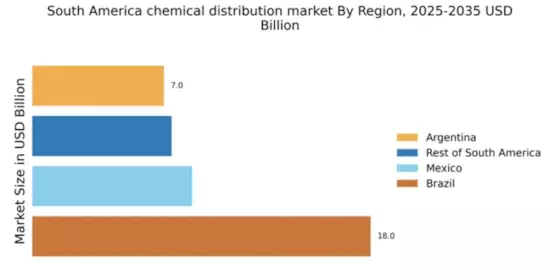
Brazil holds a commanding 18.0% market share in South America's chemical distribution sector, valued at approximately $X billion. Key growth drivers include a burgeoning industrial base, increased demand for agrochemicals, and government initiatives promoting sustainable practices. Regulatory frameworks are evolving to support environmental standards, while infrastructure improvements in logistics and transportation are enhancing distribution efficiency. The growing urbanization and rising consumer demand for chemicals in various sectors are also pivotal trends shaping the market.

Mexico : Growth Fueled by Industrial Expansion

With an 8.5% market share, Mexico's chemical distribution market is gaining traction, driven by industrial expansion and foreign investment. The demand for chemicals in manufacturing, automotive, and construction sectors is on the rise, supported by favorable trade agreements. Government policies aimed at enhancing local production capabilities and reducing import dependencies are also significant. The country's strategic location facilitates trade with North America, further boosting market potential.

Argentina : Navigating Challenges with Innovation

Argentina accounts for a 7.0% share in the chemical distribution market, facing economic challenges yet showing resilience through innovation. Key growth drivers include a focus on bio-based chemicals and sustainable practices. The government is implementing policies to support local production and reduce reliance on imports. Demand trends indicate a shift towards specialty chemicals in agriculture and pharmaceuticals, reflecting changing consumption patterns and regulatory support for environmentally friendly products.

Rest of South America : Emerging Markets with Unique Dynamics

The Rest of South America holds a 7.41% market share in chemical distribution, characterized by diverse opportunities across various countries. Growth is driven by increasing industrialization and urbanization, with countries like Chile and Colombia emerging as key players. The competitive landscape features both local and international firms, with major players like BASF and Dow establishing a presence. Sector-specific applications in mining, agriculture, and construction are shaping local market dynamics, supported by government initiatives to enhance infrastructure.

South America Chemical Distribution Market Regional Image

Key Players and Competitive Insights

The chemical distribution market in South America is characterized by a dynamic competitive landscape, driven by factors such as increasing demand for specialty chemicals, regulatory changes, and a growing emphasis on sustainability. Major players like BASF (Germany), Dow (US), and SABIC (Saudi Arabia) are strategically positioned to leverage these trends. BASF (Germany) focuses on innovation and sustainability, investing heavily in research and development to create eco-friendly products. Dow (US) emphasizes digital transformation, utilizing advanced analytics to optimize supply chains and enhance customer engagement. Meanwhile, SABIC (Saudi Arabia) is expanding its regional footprint through strategic partnerships, aiming to enhance its market presence and operational efficiency. Collectively, these strategies shape a competitive environment that is increasingly focused on sustainability and technological advancement.

Key business tactics in this market include localizing manufacturing and optimizing supply chains to enhance responsiveness to regional demands. The competitive structure appears moderately fragmented, with several key players exerting influence while also facing competition from local distributors. This fragmentation allows for a diverse range of offerings, catering to various customer needs and preferences, while the collective influence of major companies drives innovation and sets industry standards.

In October 2025, BASF (Germany) announced a new initiative aimed at reducing carbon emissions in its production processes by 30% by 2030. This move underscores the company's commitment to sustainability and positions it as a leader in environmentally responsible chemical production. The strategic importance of this initiative lies in its potential to enhance BASF's reputation and attract environmentally conscious customers, thereby strengthening its market position.

In September 2025, Dow (US) launched a digital platform designed to streamline customer interactions and improve supply chain transparency. This platform utilizes AI and machine learning to predict demand and optimize inventory management. The strategic significance of this development is profound, as it not only enhances operational efficiency but also aligns with the growing trend of digitalization in the chemical distribution market, potentially leading to increased customer satisfaction and loyalty.

In August 2025, SABIC (Saudi Arabia) entered into a joint venture with a local distributor in Brazil to expand its reach in the South American market. This partnership is strategically important as it allows SABIC to leverage local expertise and distribution networks, thereby enhancing its operational capabilities and market penetration. Such alliances are indicative of a broader trend towards collaboration in the industry, as companies seek to navigate complex market dynamics and regulatory environments.

As of November 2025, current competitive trends in the chemical distribution market include a strong focus on digitalization, sustainability, and the integration of AI technologies. Strategic alliances are increasingly shaping the landscape, enabling companies to pool resources and expertise to address market challenges. Looking ahead, competitive differentiation is likely to evolve, with a shift from price-based competition towards innovation, technology adoption, and supply chain reliability. This evolution suggests that companies that prioritize these aspects will be better positioned to thrive in an increasingly complex and competitive environment.

Key Companies in the South America Chemical Distribution Market market include

Industry Developments

The South America Chemical Distribution Market has recently witnessed several significant developments. In September 2023, Brenntag announced its expansion strategy in Brazil, focusing on sustainability and innovative distribution methods. Additionally, in October 2023, Nexeo Solutions partnered with local manufacturers to enhance the supply chain efficiency of chemical products. Univar Solutions has been actively expanding its product portfolio in South America, aiming to cater to the growing demand for specialty chemicals in various industries, including agriculture and healthcare.

In terms of mergers and acquisitions, Solvay completed the acquisition of a minority stake in a Brazilian specialty chemical company in August 2023, aligning with its growth strategy in the region. Furthermore, IMCD announced a strategic partnership with a local distributor in Colombia in November 2023 to explore growth opportunities in specialty chemicals. Over the past few years, the market has seen a notable increase in valuations, with key players like Azelis and Allied Universal reporting expanded market presence driven by increased demand and a shift towards sustainable practices.

The South America Chemical Distribution Market is poised for growth, driven by industries such as agriculture, automotive, and construction.

Future Outlook

South America Chemical Distribution Market Future Outlook

The chemical distribution market is projected to grow at a 5.0% CAGR from 2024 to 2035, driven by increasing industrial demand and sustainable practices.

New opportunities lie in:

  • Expansion of e-commerce platforms for chemical distribution
  • Investment in green chemical technologies
  • Development of regional logistics hubs for efficient supply chains

By 2035, the market is expected to achieve robust growth, positioning itself as a leader in sustainable distribution.

Market Segmentation

South America Chemical Distribution Market End Use Outlook

  • Automotive
  • Electronics
  • Construction
  • Oil & Gas
  • Petroleum
  • Pharmaceuticals
  • Textiles
  • Others

South America Chemical Distribution Market Product Outlook

  • Specialty Chemicals
  • Commodity Chemicals

Report Scope

MARKET SIZE 202440.91(USD Billion)
MARKET SIZE 202542.96(USD Billion)
MARKET SIZE 203570.0(USD Billion)
COMPOUND ANNUAL GROWTH RATE (CAGR)5.0% (2024 - 2035)
REPORT COVERAGERevenue Forecast, Competitive Landscape, Growth Factors, and Trends
BASE YEAR2024
Market Forecast Period2025 - 2035
Historical Data2019 - 2024
Market Forecast UnitsUSD Billion
Key Companies Profiled["BASF (DE)", "Dow (US)", "LyondellBasell (US)", "SABIC (SA)", "Mitsubishi Chemical (JP)", "Ineos (GB)", "Eastman Chemical (US)", "Huntsman Corporation (US)", "Solvay (BE)"]
Segments CoveredProduct, End Use
Key Market OpportunitiesAdoption of sustainable practices in chemical distribution market driven by regulatory changes and consumer demand.
Key Market DynamicsRising demand for sustainable chemicals drives innovation and competition in South America's chemical distribution market.
Countries CoveredBrazil, Mexico, Argentina, Rest of South America

Leave a Comment

FAQs

What is the expected market size of the South America Chemical Distribution Market in 2024?

In 2024, the South America Chemical Distribution Market is expected to be valued at approximately 27.28 USD billion.

What will the market size of the South America Chemical Distribution Market reach by 2035?

By 2035, the market size is anticipated to grow to around 53.41 USD billion.

What is the expected CAGR for the South America Chemical Distribution Market from 2025 to 2035?

The market is forecasted to grow at a CAGR of 6.3 percent from 2025 to 2035.

Which region holds the largest market share in the South America Chemical Distribution Market?

Brazil holds the largest market share, valued at 10.5 USD billion in 2024.

How much is the chemical distribution market in Argentina valued at in 2024?

The chemical distribution market in Argentina is valued at 4.0 USD billion in 2024.

Who are the key players in the South America Chemical Distribution Market?

Major players in the market include LyondellBasell, Nexeo Solutions, Solvay, and Brenntag.

What is the market value of specialty chemicals in South America for 2024?

Specialty chemicals are valued at approximately 10.92 USD billion in 2024.

What is the projected market value for commodity chemicals by 2035?

The commodity chemicals market is projected to reach 31.87 USD billion by 2035.

What is the expected market size for Mexico in 2035?

By 2035, the chemical distribution market in Mexico is expected to reach about 14.2 USD billion.

What are the growth opportunities in specialty chemicals within the South America market?

The specialty chemicals sector presents significant growth opportunities, with a forecasted value increase to 21.54 USD billion by 2035.

Download Free Sample

Kindly complete the form below to receive a free sample of this Report

Compare Licence

×
Features License Type
Single User Multiuser License Enterprise User
Price $4,950 $5,950 $7,250
Maximum User Access Limit 1 User Upto 10 Users Unrestricted Access Throughout the Organization
Free Customization
Direct Access to Analyst
Deliverable Format
Platform Access
Discount on Next Purchase 10% 15% 15%
Printable Versions