×
Request Free Sample ×

Kindly complete the form below to receive a free sample of this Report

* Please use a valid business email

Leading companies partner with us for data-driven Insights

clients tt-cursor
Hero Background

South America Cognitive Services Platform Market

ID: MRFR/ICT/59954-HCR
200 Pages
Aarti Dhapte
October 2025

South America Cognitive Services Platform Market Research Report By Application (Natural Language Processing, Computer Vision, Speech Recognition, Emotion Recognition, Predictive Analytics), By Deployment Type (Cloud-Based, On-Premises, Hybrid), By Industry (Healthcare, Retail, Finance, Education, Manufacturing), By User Type (Small and Medium Enterprises, Large Enterprises, Government Organizations) and By Regional (Brazil, Mexico, Argentina, Rest of South America)- Forecast to 2035

Share:
Download PDF ×

We do not share your information with anyone. However, we may send you emails based on your report interest from time to time. You may contact us at any time to opt-out.

South America Cognitive Services Platform Market Infographic
Purchase Options

South America Cognitive Services Platform Market Summary

As per MRFR analysis, the South America cognitive services market size was estimated at 1419.0 USD Million in 2024. The South America cognitive services-platform market is projected to grow from 1489.81 USD Million in 2025 to 2425.0 USD Million by 2035, exhibiting a compound annual growth rate (CAGR) of 4.99% during the forecast period 2025 - 2035.

Key Market Trends & Highlights

The South America cognitive services-platform market is experiencing robust growth driven by technological advancements and increasing demand for AI solutions.

  • Brazil remains the largest market for cognitive services, showcasing a strong inclination towards AI adoption.
  • Mexico is emerging as the fastest-growing region, reflecting a surge in digital transformation initiatives.
  • There is a notable emphasis on data privacy and security as organizations seek to protect sensitive information.
  • Rising demand for automation and government support for innovation are key drivers propelling market expansion.

Market Size & Forecast

2024 Market Size 1419.0 (USD Million)
2035 Market Size 2425.0 (USD Million)
CAGR (2025 - 2035) 4.99%

Major Players

Microsoft (US), Amazon (US), Google (US), IBM (US), Salesforce (US), Oracle (US), SAP (DE), Alibaba (CN), NVIDIA (US)

South America Cognitive Services Platform Market Trends

The cognitive services-platform market is currently experiencing notable growth in South America, driven by increasing demand for advanced technologies that enhance business operations. Organizations across various sectors are increasingly adopting these platforms to leverage artificial intelligence and machine learning capabilities. This trend is particularly evident in industries such as finance, healthcare, and retail, where companies seek to improve customer experiences and operational efficiency. The integration of cognitive services into existing systems appears to be a strategic move for many businesses aiming to remain competitive in a rapidly evolving digital landscape. Moreover, the rise of cloud computing and the proliferation of data are further propelling the cognitive services-platform market. As organizations generate vast amounts of data, the need for sophisticated analytics and processing tools becomes paramount. South American countries are investing in infrastructure to support these technologies, which may lead to enhanced accessibility and affordability of cognitive services. This shift not only fosters innovation but also encourages collaboration among tech companies and startups, potentially resulting in a vibrant ecosystem that supports the growth of cognitive services in the region.

Increased Adoption of AI Solutions

There is a growing trend among businesses in South America to adopt artificial intelligence solutions within the cognitive services-platform market. Companies are recognizing the potential of AI to streamline operations, enhance decision-making, and improve customer interactions. This shift is likely to lead to a more competitive landscape as organizations leverage AI capabilities to differentiate themselves.

Focus on Data Privacy and Security

As the cognitive services-platform market expands, there is an increasing emphasis on data privacy and security in South America. Organizations are becoming more aware of the importance of safeguarding sensitive information, which may drive the development of more robust security measures and compliance frameworks. This focus could enhance consumer trust and encourage wider adoption of cognitive services.

Collaboration with Local Startups

The cognitive services-platform market is witnessing a trend of collaboration between established companies and local startups in South America. This partnership approach appears to foster innovation and accelerate the development of tailored solutions that meet regional needs. By leveraging local expertise, businesses can create more effective cognitive services that resonate with the unique challenges faced in the market.

South America Cognitive Services Platform Market Drivers

Rising Demand for Automation

The cognitive services-platform market in South America experiences a notable surge in demand for automation across various sectors. Industries such as manufacturing, finance, and healthcare are increasingly adopting cognitive solutions to enhance operational efficiency and reduce costs. For instance, automation technologies can lead to a reduction in labor costs by up to 30%, thereby driving the need for cognitive services. This trend is further supported by the growing recognition of the importance of data-driven decision-making, which is facilitated by cognitive platforms. As businesses seek to streamline processes and improve productivity, the cognitive services-platform market is likely to see substantial growth in the coming years.

Government Support for Innovation

The cognitive services-platform market in South America benefits from increasing government support aimed at fostering innovation and technological advancement. Various governments are implementing policies and funding initiatives to encourage the development of AI and cognitive technologies. For example, Brazil's government has launched programs to promote research and development in AI, which could lead to a projected growth rate of 25% in the cognitive services sector by 2027. This supportive environment not only stimulates local startups but also attracts foreign investment, further propelling the cognitive services-platform market.

Investment in Digital Transformation

In South America, organizations are prioritizing digital transformation initiatives, which significantly impacts the cognitive services-platform market. Companies are allocating substantial budgets, with estimates suggesting that investments in digital technologies could reach $100 billion by 2025. This shift towards digitalization is driven by the need to remain competitive in an increasingly globalized economy. Cognitive services play a crucial role in this transformation, enabling businesses to leverage advanced analytics, machine learning, and artificial intelligence. As firms recognize the potential of cognitive solutions to enhance customer experiences and operational efficiencies, the market is poised for robust expansion.

Expansion of Cloud Computing Infrastructure

The cognitive services-platform market in South America is significantly influenced by the expansion of cloud computing infrastructure. As cloud adoption continues to rise, businesses are increasingly able to access cognitive services without the need for substantial upfront investments in hardware. This shift is particularly relevant in regions where traditional IT infrastructure may be lacking. Reports suggest that cloud services in South America could grow by 30% annually, facilitating the integration of cognitive technologies into various sectors. Consequently, the cognitive services-platform market is expected to thrive as more organizations embrace cloud-based solutions.

Growing Need for Enhanced Customer Experience

As competition intensifies across various industries in South America, businesses are increasingly focusing on enhancing customer experience, which drives demand for cognitive services. Companies are leveraging cognitive platforms to analyze customer data and personalize interactions, leading to improved satisfaction and loyalty. Research indicates that organizations utilizing cognitive solutions can achieve a 20% increase in customer retention rates. This emphasis on customer-centric strategies is likely to propel the cognitive services-platform market, as firms seek innovative ways to engage and retain their clientele.

Market Segment Insights

By Application: Natural Language Processing (Largest) vs. Speech Recognition (Fastest-Growing)

In the application segment of the cognitive services-platform market, Natural Language Processing (NLP) holds the largest market share, driven by the increasing demand for efficient communication solutions across various sectors. Following closely is Speech Recognition, which has made significant strides due to advancements in technologies and growing interest from businesses looking to adopt voice-activated systems, thus enhancing user engagement and accessibility. Growth trends within this segment indicate a robust trajectory, particularly for Speech Recognition, which is expected to see the fastest expansion as more industries recognize its potential. Key drivers include an escalating need for personalized customer experiences, the rise of virtual assistants, and the push for automation in various business processes. Additionally, investments in AI technologies are fueling the adoption of these applications, making them vital to organizational strategies for improved efficiency and competitiveness.

NLP (Dominant) vs. Emotion Recognition (Emerging)

Natural Language Processing (NLP) stands out as the dominant application, characterized by its ability to analyze, understand, and derive meaning from human language. This capability has positioned NLP at the forefront, serving diverse industries such as finance, healthcare, and e-commerce. In contrast, Emotion Recognition represents an emerging segment that focuses on interpreting and analyzing human emotions through facial expressions, tone of voice, and body language. Although currently smaller in market share, Emotion Recognition is gaining traction in sectors like marketing and customer service, where understanding consumer sentiments is becoming increasingly crucial. The two segments reflect contrasting stages of maturity, with NLP being well-established and Emotion Recognition rapidly evolving to meet contemporary demands.

By Deployment Type: Cloud-Based (Largest) vs. On-Premises (Fastest-Growing)

The South America cognitive services-platform market exhibits a diverse deployment landscape, with cloud-based solutions holding a substantial majority of the market share. This segment is favored due to its scalability, flexibility, and reduced infrastructure costs, making it attractive for enterprises seeking efficient resource utilization. On-premises deployments, though smaller in market share, are gaining traction among organizations requiring stringent data security and compliance, reflecting a shift towards hybrid solutions that combine both models. Growth trends indicate a strong preference for hybrid deployment models, driven by the need for agility in business operations. The increasing adoption of advanced analytics and machine learning capabilities is propelling the cloud segment forward, while regulatory compliance and data sovereignty concerns fuel the demand for on-premises solutions. As organizations in South America navigate digital transformation, the interplay between these deployment types will shape the market's future dynamics.

Cloud-Based (Dominant) vs. On-Premises (Emerging)

Cloud-based solutions dominate the deployment type landscape due to their ability to offer scalable services and support a wide range of applications. They enable organizations to leverage the latest technologies without the burden of maintaining physical infrastructure. Conversely, on-premises solutions are emerging as crucial for businesses requiring enhanced data control, security, and compliance with local regulations. This deployment type appeals particularly to industries like finance and healthcare, where data sensitivity is paramount. The growing trend towards hybrid models indicates that while cloud remains dominant, there is a significant shift towards integrating on-premises solutions for strategic advantages, providing a balanced approach to deployment in the evolving market.

By Industry: Healthcare (Largest) vs. Retail (Fastest-Growing)

The market share distribution among the cognitive services-platform segments illustrates the dominance of the healthcare industry, which captures the largest portion of the overall market. Following healthcare, the retail segment is rapidly advancing, showcasing significant growth as businesses increasingly adopt cognitive solutions to enhance customer experiences and streamline operations. Other notable segments include finance, education, and manufacturing, each contributing to the evolving landscape of cognitive services. Growth trends in the South American cognitive services-platform market reveal that the healthcare sector continues to innovate, leveraging AI and data analytics to improve patient outcomes and operational efficiency. In contrast, retail is recognized as the fastest-growing segment, driven by the rising demand for personalized shopping experiences and advancements in omni-channel strategies. The finance, education, and manufacturing sectors are also expanding their use of cognitive technologies, albeit at a different pace, reflecting varying adoption rates and market needs.

Healthcare: Dominant vs. Retail: Emerging

The healthcare segment stands out as the dominant force in the cognitive services-platform landscape, characterized by substantial investments in AI-driven solutions for patient management, diagnostics, and operational improvements. This sector has embraced technology to address pressing challenges such as rising costs and the need for enhanced patient care. Meanwhile, retail is emerging as a significant player, focusing on leveraging cognitive services to personalize customer interactions, optimize inventory management, and analyze consumer behavior. As these sectors evolve, the need for advanced cognitive capabilities will continue to shape their strategies, with healthcare leading in application depth and retail catching up with innovative, customer-focused approaches.

By User Type: Large Enterprises (Largest) vs. Government Organizations (Fastest-Growing)

In the User Type segment, Large Enterprises hold the largest market share due to their substantial budgets and the necessity for advanced cognitive services. These organizations increasingly leverage AI solutions to enhance operational efficiency and drive innovation. Government Organizations are witnessing a significant rise in adoption, spurred by the need for digital transformation and improved public services. This segment is emerging as a pivotal driver of market growth in the region. The growth trends within this segment indicate a robust shift towards leveraging cognitive services by Government Organizations, which are focusing on smart city initiatives and e-governance. Large Enterprises continue to invest heavily in cognitive solutions, seeking competitive advantages through data-driven decision making. The convergence of technological advancements and the increasing demand for personalized customer experiences are propelling these segments forward, showcasing a vibrant landscape in the cognitive services domain.

Large Enterprises (Dominant) vs. Government Organizations (Emerging)

Large Enterprises are characterized by their substantial scale and resources, allowing for extensive investments in cognitive services. They prioritize data analytics, machine learning, and AI-driven applications to streamline operations and enhance customer interaction. This segment functions as a leader in market trends, pushing innovation in various industries, including finance, retail, and telecommunications. On the other hand, Government Organizations represent an emerging segment that is rapidly adopting cognitive technologies. The drive for modernization and efficiency in public service delivery, along with initiatives for greater transparency, positions this segment as a key player in the market's evolution. As governments increasingly adopt AI for improved governance and public engagement, they present a promising area for growth and development in cognitive services.

Get more detailed insights about South America Cognitive Services Platform Market

Regional Insights

Brazil : Brazil's Dominance in Technology Growth

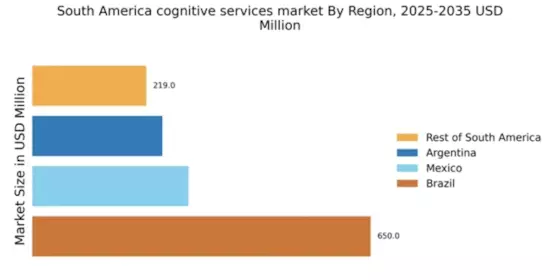
Brazil holds a commanding market share of 41.5% in the cognitive services-platform market, valued at $650.0 million. Key growth drivers include a robust digital transformation agenda, increasing investments in AI, and a growing demand for automation across various sectors. Government initiatives, such as the National AI Strategy, are fostering innovation and regulatory support, while infrastructure improvements in urban centers enhance connectivity and service delivery.

Mexico : Mexico's Rapid Digital Transformation

Mexico accounts for 23.1% of the market share, valued at $300.0 million. The growth is driven by increasing adoption of cloud services and AI technologies across industries like finance and healthcare. Demand for cognitive services is rising as businesses seek to enhance customer experiences and operational efficiency. Government policies promoting digital economy initiatives are also pivotal in shaping the market landscape.

Argentina : Argentina's Evolving Tech Landscape

Argentina holds a market share of 19.2%, valued at $250.0 million. The growth is fueled by a burgeoning startup ecosystem and increasing investments in technology. Demand for cognitive services is particularly strong in sectors like agriculture and finance, where AI applications are enhancing productivity. Regulatory frameworks supporting tech innovation are also emerging, creating a conducive environment for growth.

Rest of South America : Growth Across South American Regions

The Rest of South America represents a market share of 17.2%, valued at $219.0 million. Growth drivers include increasing internet penetration and a rising number of tech startups. Countries like Chile and Colombia are witnessing significant demand for cognitive services, particularly in e-commerce and logistics. The competitive landscape features both local and international players, with a focus on tailored solutions for regional needs.

South America Cognitive Services Platform Market Regional Image

Key Players and Competitive Insights

The cognitive services-platform market in South America is characterized by a dynamic competitive landscape, driven by rapid technological advancements and increasing demand for AI-driven solutions. Major players such as Microsoft (US), Amazon (US), and Google (US) are at the forefront, leveraging their extensive resources and innovative capabilities to capture market share. Microsoft (US) focuses on integrating AI into its cloud services, enhancing user experience and operational efficiency. Amazon (US) emphasizes its robust cloud infrastructure, aiming to provide scalable solutions tailored to local businesses. Google (US) is strategically positioning itself through partnerships and investments in local startups, fostering innovation and expanding its footprint in the region. Collectively, these strategies contribute to a competitive environment that is increasingly centered around technological innovation and customer-centric solutions.

Key business tactics employed by these companies include localizing services and optimizing supply chains to better meet regional demands. The market structure appears moderately fragmented, with a mix of established players and emerging startups. This fragmentation allows for diverse offerings and competitive pricing, although the influence of key players remains substantial, shaping market trends and customer expectations.

In October 2025, Microsoft (US) announced a partnership with a leading South American telecommunications provider to enhance its cloud services, aiming to improve connectivity and accessibility for local businesses. This strategic move is likely to bolster Microsoft's presence in the region, enabling it to offer tailored solutions that address specific market needs. The partnership underscores the importance of local collaborations in driving growth and innovation within the cognitive services sector.

In September 2025, Amazon (US) launched a new AI-driven analytics tool specifically designed for small and medium-sized enterprises (SMEs) in South America. This initiative reflects Amazon's commitment to empowering local businesses with advanced technology, potentially increasing their operational efficiency and competitiveness. By focusing on SMEs, Amazon is likely to tap into a significant market segment that is often underserved by traditional technology providers.

In August 2025, Google (US) expanded its AI research initiatives in Brazil, collaborating with local universities to develop innovative solutions tailored to regional challenges. This strategic action not only enhances Google's research capabilities but also fosters local talent development, positioning the company as a leader in AI innovation within South America. Such investments in local ecosystems are indicative of a broader trend where companies seek to integrate more deeply into regional markets.

As of November 2025, current trends in the cognitive services-platform market include a strong emphasis on digitalization, sustainability, and AI integration. Strategic alliances are increasingly shaping the competitive landscape, as companies recognize the value of collaboration in driving innovation. Looking ahead, competitive differentiation is expected to evolve, with a shift from price-based competition towards a focus on technological innovation, reliability, and supply chain efficiency. This transition suggests that companies that prioritize these aspects will likely gain a competitive edge in the rapidly evolving market.

Key Companies in the South America Cognitive Services Platform Market market include

Industry Developments

Microsoft announced a R$14.7 billion (~US $2.7 billion) investment over three years in September 2024 to expand its cloud and AI infrastructure throughout Brazil. The investment includes the development of new data center capacity in São Paulo and the implementation of initiatives to train 5 million individuals with AI skills through its ConectaAI and Mais Brasil programs. In industries such as finance and healthcare, this expansion directly improves the availability and adoption of Azure Cognitive Services.

Oracle joined forces with Brazilian AI startup WideLabs in May 2024 to train one of the largest local large language models in the country on Oracle Cloud Infrastructure (OCI) in the São Paulo region. The bAIgrapher app, which is developed on GPU-accelerated cloud infrastructure with national data residency, is powered by this initiative. It is intended to generate patient-life stories for dementia support.

A report by ISG in May 2024 emphasized the extent to which Brazilian enterprises' demand for AI is driving the adoption of customized generative AI models on Azure, which in turn enables custom GPTs, predictive analytics, and AI-powered automation solutions across several Latin American sectors.

Future Outlook

South America Cognitive Services Platform Market Future Outlook

The Cognitive Services Platform Market is projected to grow at a 4.99% CAGR from 2024 to 2035, driven by advancements in AI, increased data utilization, and demand for automation.

New opportunities lie in:

  • Development of AI-driven customer support chatbots for businesses
  • Integration of cognitive analytics in supply chain management solutions
  • Creation of tailored machine learning models for local industries

By 2035, the market is expected to achieve substantial growth and innovation.

Market Segmentation

South America Cognitive Services Platform Market Industry Outlook

  • Healthcare
  • Retail
  • Finance
  • Education
  • Manufacturing

South America Cognitive Services Platform Market User Type Outlook

  • Small and Medium Enterprises
  • Large Enterprises
  • Government Organizations

South America Cognitive Services Platform Market Application Outlook

  • Natural Language Processing
  • Computer Vision
  • Speech Recognition
  • Emotion Recognition
  • Predictive Analytics

South America Cognitive Services Platform Market Deployment Type Outlook

  • Cloud-Based
  • On-Premises
  • Hybrid

Report Scope

MARKET SIZE 20241419.0(USD Million)
MARKET SIZE 20251489.81(USD Million)
MARKET SIZE 20352425.0(USD Million)
COMPOUND ANNUAL GROWTH RATE (CAGR)4.99% (2024 - 2035)
REPORT COVERAGERevenue Forecast, Competitive Landscape, Growth Factors, and Trends
BASE YEAR2024
Market Forecast Period2025 - 2035
Historical Data2019 - 2024
Market Forecast UnitsUSD Million
Key Companies Profiled["Microsoft (US)", "Amazon (US)", "Google (US)", "IBM (US)", "Salesforce (US)", "Oracle (US)", "SAP (DE)", "Alibaba (CN)", "NVIDIA (US)"]
Segments CoveredApplication, Deployment Type, Industry, User Type
Key Market OpportunitiesIntegration of artificial intelligence in local business operations enhances efficiency in the cognitive services-platform market.
Key Market DynamicsGrowing demand for AI-driven solutions in South America fuels competition among cognitive services-platform providers.
Countries CoveredBrazil, Mexico, Argentina, Rest of South America

Leave a Comment

FAQs

What is the expected market size of the South America Cognitive Services Platform Market in 2024?

The South America Cognitive Services Platform Market is expected to be valued at 2.37 USD Billion in 2024.

What is the projected growth rate of the South America Cognitive Services Platform Market from 2025 to 2035?

The market is expected to grow at a CAGR of 14.493% from 2025 to 2035.

Which region is expected to hold the largest market share in the South America Cognitive Services Platform Market in 2024?

Brazil is anticipated to hold the largest market share, valued at 0.563 USD Billion in 2024.

What is the projected market value for Natural Language Processing in 2035?

The market value for Natural Language Processing is projected to reach 2.02 USD Billion by 2035.

Who are the key players in the South America Cognitive Services Platform Market?

Key players include Oracle, Microsoft, Wipro, SAP, Amazon, Alibaba, and IBM.

What is the market size for Computer Vision in 2024?

The market size for Computer Vision is valued at 0.55 USD Billion in 2024.

What is the expected market value for Speech Recognition in 2035?

Speech Recognition is expected to reach a market value of 1.8 USD Billion by 2035.

What is the projected market size for Emotion Recognition in 2024?

The market size for Emotion Recognition is anticipated to be 0.37 USD Billion in 2024.

How much is the Rest of South America market expected to grow by 2035?

The Rest of South America market is expected to grow to 3.314 USD Billion by 2035.

What is the expected market value for Predictive Analytics in 2035?

Predictive Analytics is projected to reach a market value of 2.56 USD Billion in 2035.

Download Free Sample

Kindly complete the form below to receive a free sample of this Report

Compare Licence

×
Features License Type
Single User Multiuser License Enterprise User
Price $4,950 $5,950 $7,250
Maximum User Access Limit 1 User Upto 10 Users Unrestricted Access Throughout the Organization
Free Customization
Direct Access to Analyst
Deliverable Format
Platform Access
Discount on Next Purchase 10% 15% 15%
Printable Versions