Download Free Sample
Kindly complete the form below to receive a free sample of this Report
South America Leukemia Therapeutics Market Research Report: Size, Share, Trend Analysis By Drug Type (Chemotherapy, Targeted Therapy, Immunotherapy, Stem Cell Transplant, Radiation Therapy), By Therapy Type (Monotherapy, Combination Therapy, Maintenance Therapy), By Administration Route (Oral, Intravenous, Subcutaneous), By Patient Type (Adult, Pediatric) and By Regional (Brazil, Mexico, Argentina, Rest of South America) - Growth Outlook & Industry Forecast 2025 To 2035
As per Market Research Future analysis, the South America leukemia therapeutics market size was estimated at 1693.65 USD Million in 2024. The South America leukemia therapeutics market is projected to grow from 1734.47 USD Million in 2025 to 2200.0 USD Million by 2035, exhibiting a compound annual growth rate (CAGR) of 2.4% during the forecast period 2025 - 2035
The South America leukemia therapeutics market is experiencing a transformative shift towards innovative treatment modalities.
| 2024 Market Size | 1693.65 (USD Million) |
| 2035 Market Size | 2200.0 (USD Million) |
| CAGR (2025 - 2035) | 2.41% |
The leukemia therapeutics market is currently experiencing notable developments, particularly in South America. The region is witnessing an increase in the prevalence of leukemia, which is prompting healthcare systems to enhance their treatment options. This rise in cases appears to be driving demand for innovative therapies, including targeted treatments and immunotherapies. Furthermore, the collaboration between local pharmaceutical companies and international firms seems to be fostering the development of new drugs tailored to the specific needs of the South American population. Regulatory bodies are also playing a crucial role in expediting the approval processes for these therapies, which may lead to quicker access for patients. In addition, the growing awareness of leukemia and its treatment options among healthcare professionals and patients is likely contributing to the expansion of the leukemia therapeutics market. Educational initiatives and outreach programs are being implemented to inform stakeholders about the latest advancements in treatment. This increased knowledge may enhance patient outcomes and encourage early diagnosis, which is essential for effective management. Overall, the leukemia therapeutics market in South America appears to be on a positive trajectory, with various factors indicating a promising future for both patients and healthcare providers.
The leukemia therapeutics market is witnessing a shift towards targeted therapies, which are designed to attack specific cancer cells while minimizing damage to healthy cells. This trend is particularly relevant in South America, where advancements in genetic research are enabling the development of personalized treatment options. As a result, patients may experience improved efficacy and reduced side effects, leading to better overall outcomes.
Collaboration between local and international pharmaceutical companies is becoming more prevalent in the leukemia therapeutics market. Such partnerships are fostering innovation and accelerating the development of new therapies tailored to the unique needs of South American patients. This collaborative approach may enhance the availability of cutting-edge treatments and improve access to care.
Regulatory bodies in South America are increasingly supportive of new therapies for leukemia. Streamlined approval processes and initiatives aimed at encouraging research and development are likely to facilitate quicker access to innovative treatments. This regulatory environment may significantly impact the leukemia therapeutics market by ensuring that patients receive timely and effective care.
The rising incidence of leukemia in South America is a critical driver for the leukemia therapeutics market. Recent data indicates that leukemia cases have increased by approximately 15% over the past decade in several South American countries. This surge necessitates the development and availability of effective treatment options. As healthcare systems adapt to this growing burden, there is an increasing demand for innovative therapies, including chemotherapy, targeted therapies, and immunotherapies. The leukemia therapeutics market is thus positioned to expand significantly, as pharmaceutical companies invest in research and development to address this pressing health issue. Furthermore, the increasing awareness of leukemia symptoms and the importance of early diagnosis contribute to the growing patient population seeking treatment, further propelling market growth.
The growing awareness and education regarding leukemia in South America are pivotal in shaping the leukemia therapeutics market. Public health campaigns and educational initiatives have significantly increased knowledge about leukemia symptoms, risk factors, and the importance of early detection. This heightened awareness is leading to more individuals seeking medical attention, resulting in earlier diagnoses and treatment interventions. As a consequence, the demand for effective leukemia therapies is on the rise. Moreover, healthcare professionals are becoming more adept at recognizing and managing leukemia cases, which further supports the market's growth. The emphasis on education and awareness is likely to continue driving patient engagement and treatment adherence, ultimately benefiting the leukemia therapeutics market.
The rise in healthcare expenditure across South America is a significant driver for the leukemia therapeutics market. Governments and private sectors are allocating more resources to healthcare, with a focus on improving cancer treatment facilities and access to medications. For example, healthcare spending in Brazil has increased by over 10% annually, reflecting a commitment to enhancing cancer care. This financial support enables the procurement of advanced therapies and the establishment of comprehensive treatment programs for leukemia patients. As healthcare systems evolve, the availability of innovative treatments is expected to improve, thereby increasing patient access to necessary therapies. Consequently, the leukemia therapeutics market is likely to benefit from this upward trend in healthcare investment, leading to enhanced treatment options and improved patient outcomes.
Regulatory changes in South America are fostering an environment conducive to innovation within the leukemia therapeutics market. Recent reforms aimed at streamlining the approval process for new therapies have encouraged pharmaceutical companies to invest in research and development. These changes are designed to expedite the availability of novel treatments, including biologics and personalized medicine, which are crucial for addressing the diverse needs of leukemia patients. As a result, the market is witnessing an influx of new therapies that may offer improved efficacy and safety profiles. The supportive regulatory landscape is likely to enhance competition among manufacturers, driving down costs and increasing accessibility for patients. This trend is expected to significantly impact the leukemia therapeutics market in the region, promoting advancements in treatment options.
Innovations in research and development are propelling the leukemia therapeutics market forward in South America. The region has witnessed a surge in clinical trials and studies focusing on novel treatment modalities, including CAR T-cell therapy and monoclonal antibodies. These advancements are not only enhancing treatment efficacy but also improving patient outcomes. For instance, recent reports suggest that new therapies have shown a 30% increase in survival rates among patients with specific leukemia subtypes. As research institutions and pharmaceutical companies collaborate to bring these innovations to market, the therapeutic landscape for leukemia is evolving rapidly. This dynamic environment fosters competition and encourages the introduction of cutting-edge therapies, which is likely to attract investment and drive market growth in the coming years.
In the South America leukemia therapeutics market, chemotherapy remains the largest segment, consistently commanding a significant share due to its established efficacy and widespread use in treating various leukemia types. Notably, targeted therapy and radiation therapy also contribute to the market, but their shares are comparatively smaller. As more patients are diagnosed and treated, the overall uptake of these drug types is evolving, influencing market dynamics significantly.
On the other hand, immunotherapy is rapidly emerging as the fastest-growing segment, driven by increasing research and development activities that focus on innovative treatment options for leukemia. Enhanced understanding of the immune system and its response to cancer drives this growth, as does the rising demand for personalized therapies. The increasing incidence of leukemia in South America further propels this trend, with healthcare systems adapting to incorporate these advanced therapeutic modalities.
Chemotherapy (Dominant) vs. Immunotherapy (Emerging)
Chemotherapy leads the South America leukemia therapeutics market, celebrated for its historical success in eradicating cancer cells and its broad acceptance among healthcare providers. It employs various drug combinations to maximize efficacy, showcasing versatility against diverse leukemia forms. Conversely, immunotherapy is rising as an emerging contender, characterized by its approach of using the body’s immune system to identify and attack cancer cells. This segment is gaining traction due to innovative treatments like CAR T-cell therapy that promise significant improvements in patient outcomes, reflecting a shift towards more personalized and effective treatment strategies. This dynamic illustrates a pivotal transformation in leukemia management, balancing established practices with innovative approaches.
In the South America leukemia therapeutics market, the market share is predominantly held by Combination Therapy, which is widely preferred due to its effectiveness in treating various leukemia types. This therapy type is noted for its ability to target multiple pathways simultaneously, hence providing a comprehensive treatment approach. In contrast, Monotherapy, while currently smaller in share, is emerging rapidly as advancements in targeted therapies are enhancing its appeal and adoption among clinicians.
The growth trends in this segment are primarily driven by increased research efforts, collaboration between pharmaceutical companies, and rising investments in developing innovative therapies. Moreover, the prevalence of leukemia cases in South America is propelling the demand for more effective treatment regimens. As healthcare systems evolve, there is a significant shift toward personalized medicine, further boosting the growth potential of both Monotherapy and Combination Therapy across the region.
Combination Therapy (Dominant) vs. Monotherapy (Emerging)
Combination Therapy is recognized as the dominant force in the South America leukemia therapeutics market, characterized by its multifaceted approach to treatment that enhances efficacy and patient outcomes. This therapy utilizes a strategic blend of agents to mitigate resistance and maximize therapeutic impact against various leukemia forms. On the other hand, Monotherapy is emerging as a compelling alternative, particularly with the rise of targeted therapies designed to focus on specific leukemia subtypes. This approach is gaining traction due to its convenience and potential for lower toxicity. As both therapies evolve, their interplay will likely shape the future landscape of leukemia treatment options in the market.
The market share distribution for the administration route segment in the leukemia therapeutics market showcases Oral as the most prominent option, capturing a significant share due to its convenience and patient compliance. Intravenous therapies continue to hold a vital position, especially in acute cases, whereas Subcutaneous routes are gaining minor traction but remain limited in comparison.
Growth trends indicate a robust increase in preference for Intravenous therapies, primarily driven by advancements in drug formulations and delivery technologies. Additionally, the rising prevalence of leukemia and increasing awareness regarding treatment efficacy are projected to further boost market dynamics. The Oral segment will likely maintain dominance, supported by patient-centric approaches and ongoing innovations in formulations.
Oral (Dominant) vs. Intravenous (Emerging)
Oral administration has established itself as the dominant choice in the leukemia therapeutics landscape, largely attributed to its ease of use and ability to enhance patient adherence to treatment protocols. This route allows patients to manage their therapies conveniently at home, reducing the need for complex hospital visits. In contrast, Intravenous administration is emerging as a valuable alternative, particularly for patients requiring immediate therapeutic interventions. Continued innovations in intravenous therapies are expected to elevate their status, driven by enhanced drug efficacy and targeted delivery systems, making them increasingly relevant in the treatment of more aggressive leukemia forms.
In the South America leukemia therapeutics market, the adult patient segment commands the largest share, benefiting from a higher incidence rate of leukemia among adults compared to pediatric cases. Adults typically face a variety of leukemia types, including acute and chronic forms, which contribute to a consistent demand for therapeutic solutions. Meanwhile, the pediatric segment, although smaller in market share, is witnessing rapid growth driven by increased awareness, advancements in treatment protocols, and improved diagnostic methods. This change indicates a shift towards more targeted therapies for children, thereby expanding the therapeutic landscape.
Growth trends in the adult segment are influenced by an aging population and the rising prevalence of risk factors associated with adult leukemia, while the pediatric segment is emerging rapidly due to the increasing focus on childhood diseases and improved healthcare access. Enhanced clinical trials and research focusing specifically on pediatric leukemia therapies are driving this growth. Additionally, collaborative efforts among healthcare providers and organizations are fostering better treatment options and outcomes for pediatric patients, contributing to the segment's fastest-growing nature in the market.
Adult: Dominant vs. Pediatric: Emerging
The adult patient segment in the South America leukemia therapeutics market remains dominant, accounting for a significant portion of the overall market due to the higher incidence rates of adult leukemia. This segment benefits from a diverse range of treatment options, including chemotherapy, targeted therapies, and emerging immunotherapies. On the other hand, the pediatric segment is viewed as emerging, supported by a dedicated focus on innovative therapies designed specifically for children. This demographic often requires modified treatment approaches that take into account the unique physiological differences in children. As awareness and treatment capabilities increase, the pediatric segment is expected to grow significantly, reflecting a positive shift in the therapeutic focus for younger patients.
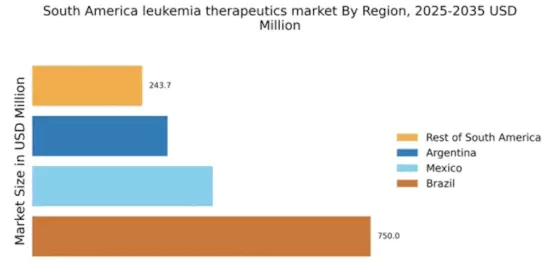
Brazil holds a dominant position in the South American leukemia therapeutics market, accounting for approximately 61.5% of the total market share with a value of $750.0 million. Key growth drivers include increasing incidence rates of leukemia, advancements in treatment options, and supportive government policies aimed at improving healthcare access. The Brazilian government has implemented initiatives to enhance drug availability and affordability, fostering a favorable environment for market expansion. Additionally, robust healthcare infrastructure and a growing pharmaceutical industry contribute to rising demand for innovative therapies.
Mexico represents a significant portion of the South American leukemia therapeutics market, valued at $400.0 million, which is about 32.5% of the total market. The growth in this sub-region is driven by rising healthcare investments, increasing awareness of leukemia, and the introduction of new therapies. Regulatory bodies are actively working to streamline drug approval processes, enhancing market accessibility. The demand for targeted therapies is also on the rise, reflecting changing consumption patterns among healthcare providers and patients.
Argentina's leukemia therapeutics market is valued at $300.0 million, representing approximately 24.5% of the South American market. The growth is fueled by a combination of increasing leukemia cases and a shift towards innovative treatment options. Government initiatives aimed at improving healthcare infrastructure and access to medications are also pivotal. The regulatory environment is becoming more favorable, encouraging local and international players to invest in the market, thus enhancing competition and availability of therapies.
The Rest of South America, encompassing several countries, has a combined market value of $243.65 million, accounting for about 19.8% of the overall market. This sub-region presents diverse opportunities driven by varying healthcare needs and regulatory environments. Countries like Chile and Colombia are witnessing increased investments in healthcare, which is expected to boost demand for leukemia therapies. Local players are emerging alongside established multinational companies, creating a competitive landscape that fosters innovation and accessibility.
The leukemia therapeutics market in South America is characterized by a dynamic competitive landscape, driven by increasing incidences of leukemia and a growing demand for innovative treatment options. Key players such as Roche (CH), Novartis (CH), and Bristol-Myers Squibb (US) are actively engaged in enhancing their market presence through strategic initiatives. Roche (CH) focuses on innovation, particularly in targeted therapies, while Novartis (CH) emphasizes regional expansion and partnerships to bolster its portfolio. Bristol-Myers Squibb (US) is leveraging its strong research capabilities to develop novel therapies, thereby shaping a competitive environment that prioritizes innovation and patient-centric solutions.The market structure appears moderately fragmented, with several players vying for market share. Companies are increasingly localizing manufacturing and optimizing supply chains to enhance efficiency and reduce costs. This collective influence of key players fosters a competitive atmosphere where agility and responsiveness to market needs are paramount. The strategies employed by these companies not only reflect their operational focus but also indicate a broader trend towards collaboration and integration within the industry.
In October Roche (CH) announced a partnership with a local biotechnology firm to enhance the development of personalized therapies for leukemia patients in South America. This strategic move is significant as it underscores Roche's commitment to tailoring treatments to meet regional needs, potentially improving patient outcomes and expanding its market reach. Such collaborations may also facilitate faster access to innovative therapies, aligning with the growing demand for personalized medicine.
In September Novartis (CH) launched a new digital platform aimed at improving patient engagement and adherence to leukemia treatments. This initiative reflects Novartis's focus on digital transformation, which is increasingly vital in enhancing patient experiences and outcomes. By integrating technology into its therapeutic offerings, Novartis positions itself as a leader in patient-centric care, which could lead to improved treatment adherence and overall market competitiveness.
In August Bristol-Myers Squibb (US) expanded its clinical trial programs in South America, focusing on novel immunotherapies for leukemia. This expansion is crucial as it not only demonstrates the company's commitment to advancing research but also highlights the potential for bringing cutting-edge therapies to the region. By investing in local clinical trials, Bristol-Myers Squibb may enhance its understanding of regional patient populations, thereby tailoring its strategies to better meet local needs.
As of November current trends in the leukemia therapeutics market indicate a shift towards digitalization, sustainability, and the integration of artificial intelligence in drug development. Strategic alliances are increasingly shaping the competitive landscape, fostering innovation and collaboration among key players. The evolution of competitive differentiation appears to be moving away from price-based competition towards a focus on innovation, technology, and supply chain reliability. This shift suggests that companies that prioritize these aspects may gain a competitive edge in the rapidly evolving market.

In South America, the Leukemia Therapeutics Market has witnessed significant developments recently, particularly in Brazil and Argentina. In June 2023, Gilead Sciences announced advancements in its cell therapy program, aiming to enhance treatment options for patients with acute lymphoblastic leukemia in the region.
Concurrently, in July 2023, Merck launched a new clinical trial for a novel leukemia treatment, further demonstrating the growing emphasis on Research and Development among major players. The market is also seeing financial growth, with companies like Roche reporting increased revenue from leukemia therapies, reflecting a surge in demand and improved patient access to innovative treatments.
Furthermore, recent mergers and acquisitions have reshaped the landscape; for instance, in August 2022, Pfizer acquired a smaller biotech firm specializing in leukemia treatments, strengthening its portfolio in South America, where more tailored therapies are required. Regulatory frameworks in countries like Brazil are evolving, facilitating faster approvals for new therapies, which is vital for improving patient outcomes. The growing patient population and rising healthcare investments underscore the region's potential for further advancements in leukemia treatment options.
The Leukemia Therapeutics Market is projected to grow at 2.41% CAGR from 2025 to 2035, driven by advancements in targeted therapies and increasing patient awareness.
New opportunities lie in:
By 2035, the market is expected to achieve substantial growth, driven by innovative therapies and enhanced patient access.
| MARKET SIZE 2024 | 1693.65(USD Million) |
| MARKET SIZE 2025 | 1734.47(USD Million) |
| MARKET SIZE 2035 | 2200.0(USD Million) |
| COMPOUND ANNUAL GROWTH RATE (CAGR) | 2.41% (2025 - 2035) |
| REPORT COVERAGE | Revenue Forecast, Competitive Landscape, Growth Factors, and Trends |
| BASE YEAR | 2024 |
| Market Forecast Period | 2025 - 2035 |
| Historical Data | 2019 - 2024 |
| Market Forecast Units | USD Million |
| Key Companies Profiled | Roche (CH), Novartis (CH), Bristol-Myers Squibb (US), Amgen (US), Gilead Sciences (US), Celgene (US), Takeda (JP), AstraZeneca (GB), Merck & Co. (US) |
| Segments Covered | Drug Type, Therapy Type, Administration Route, Patient Type |
| Key Market Opportunities | Emerging gene therapies and personalized medicine are reshaping the leukemia therapeutics market landscape. |
| Key Market Dynamics | Rising demand for targeted therapies drives innovation and competition in the leukemia therapeutics market. |
| Countries Covered | Brazil, Mexico, Argentina, Rest of South America |
The overall market valuation for leukemia therapeutics in South America was $1693.65 Million in 2024.
The projected market valuation for leukemia therapeutics in South America is $2200.0 Million by 2035.
The expected CAGR for the South America leukemia therapeutics market during the forecast period 2025 - 2035 is 2.41%.
Key players in the South America leukemia therapeutics market include Roche, Novartis, Bristol-Myers Squibb, Amgen, Gilead Sciences, Celgene, Takeda, AstraZeneca, and Merck & Co.
In 2024, the revenue figures for chemotherapy in the South America leukemia therapeutics market ranged from $500.0 Million to $650.0 Million.
The revenue from combination therapy in 2024 ranged from $800.0 Million to $1000.0 Million, whereas monotherapy ranged from $500.0 Million to $650.0 Million.
The revenue range for intravenous administration of leukemia therapeutics in 2024 was between $800.0 Million and $1000.0 Million.
The projected revenue figures for pediatric patients in the South America leukemia therapeutics market by 2035 are expected to be between $676.82 Million and $860.0 Million.
In 2024, the revenue for immunotherapy in the South America leukemia therapeutics market ranged from $300.0 Million to $400.0 Million.
The expected revenue range for stem cell transplant therapies in the South America leukemia therapeutics market by 2035 is projected to be between $300.0 Million and $350.0 Million.


Kindly complete the form below to receive a free sample of this Report

“This is really good guys. Excellent work on a tight deadline. I will continue to use you going forward and recommend you to others. Nice job”


“Thanks. It’s been a pleasure working with you, please use me as reference with any other Intel employees.”


“Thanks for sending the report it gives us a good global view of the Betaïne market.”


“Thank you, this will be very helpful for OQS.”


“We found the report very insightful! we found your research firm very helpful. I'm sending this email to secure our future business.”


“I am very pleased with how market segments have been defined in a relevant way for my purposes (such as "Portable Freezers & refrigerators" and "last-mile"). In general the report is well structured. Thanks very much for your efforts.”


“I have been reading the first document or the study, ,the Global HVAC and FP market report 2021 till 2026. Must say, good info! I have not gone in depth at all parts, but got a good indication of the data inside!”


“We got the report in time, we really thank you for your support in this process. I also thank to all of your team as they did a great job.”


“The Automotive 48V ECU Components Procurement Intelligence Study” was a complex project, but the Market Research Future (MRFR) team handled it with quality, agility, and customer-centricity. They delivered all requested data on time and within the agreed scope. The team, including Shubhendra Anand and Rahul Gotadki, was always readily available to clarify questions and swiftly implement necessary adjustments, driving the project to a successful conclusion within a very demanding timeframe.
I would also like to specifically commend Akshay Agarwal for his responsiveness and support at every stage—from our initial inquiry on May 6th through to final delivery on June 18th. His dedication made the entire process seamless.”



