Download Free Sample
Kindly complete the form below to receive a free sample of this Report
South America Montelukast Intermediate Market Research Report By Application (Asthma, Allergic Rhinitis, Bronchospasm, Urticaria) andBy Regional (Brazil, Mexico, Argentina, Rest of South America) - Growth & Industry Forecast 2025 To 2035
As per Market Research Future analysis, the Montelukast Intermediate market size was estimated at 40.0 USD Million in 2024. The montelukast intermediate market is projected to grow from 42.09 USD Million in 2025 to 70.0 USD Million by 2035, exhibiting a compound annual growth rate (CAGR) of 5.2% during the forecast period 2025 - 2035
The South America montelukast intermediate market is experiencing robust growth driven by increasing demand for respiratory medications.
| 2024 Market Size | 40.0 (USD Million) |
| 2035 Market Size | 70.0 (USD Million) |
| CAGR (2025 - 2035) | 5.22% |
Merck & Co (US), Mylan N.V. (US), Teva Pharmaceutical Industries Ltd. (IL), Aurobindo Pharma (IN), Sun Pharmaceutical Industries Ltd. (IN), Cipla Ltd. (IN), Hikma Pharmaceuticals PLC (GB), Zydus Cadila (IN)
Our Impact
Enabled $4.3B Revenue Impact for Fortune 500 and Leading Multinationals
Partnering with 2000+ Global Organizations Each Year
30K+ Citations by Top-Tier Firms in the Industry
The montelukast intermediate market is currently experiencing notable developments, particularly in South America. This region has seen a gradual increase in demand for montelukast, a medication primarily used for asthma and allergic rhinitis. The growing awareness of respiratory diseases and the rising prevalence of allergies among the population are contributing factors. Furthermore, the pharmaceutical industry in South America is evolving, with local manufacturers focusing on enhancing production capabilities and ensuring compliance with international quality standards. This shift may lead to a more competitive landscape, potentially benefiting consumers through improved access to medications. In addition, regulatory frameworks in South America are adapting to support the growth of the montelukast intermediate market. Governments are implementing policies aimed at fostering innovation and encouraging local production. This could result in a more robust supply chain, reducing dependency on imports. As the market continues to mature, stakeholders are likely to explore partnerships and collaborations to enhance research and development efforts. Overall, the montelukast intermediate market appears poised for growth, driven by both demand and supportive regulatory environments.
The montelukast intermediate market is witnessing an increase in demand for respiratory medications. This trend is largely driven by a growing awareness of respiratory conditions among the population. As more individuals seek treatment for asthma and allergies, the need for montelukast intermediates is likely to rise, prompting manufacturers to scale up production.
Regulatory bodies in South America are actively promoting local production of pharmaceuticals, including montelukast intermediates. This support may lead to enhanced manufacturing capabilities and compliance with international standards. As a result, local companies could gain a competitive edge, potentially improving market dynamics.
There is an increasing emphasis on quality and compliance within the montelukast intermediate market. Manufacturers are prioritizing adherence to stringent quality control measures to meet both local and international regulations. This focus on quality may enhance consumer trust and drive market growth.
The montelukast intermediate market is currently benefiting from enhancements in the regulatory framework governing pharmaceutical production in South America. Recent reforms have streamlined the approval processes for new medications and intermediates, thereby facilitating quicker market entry for manufacturers. This regulatory support is crucial for companies looking to introduce montelukast intermediates, as it reduces the time and costs associated with compliance. Furthermore, the establishment of clear guidelines for quality assurance and safety standards is likely to bolster consumer confidence in locally produced medications. As a result, the montelukast intermediate market may experience accelerated growth, as manufacturers are better equipped to meet both domestic and international demand for high-quality products.
Technological advancements in production processes are poised to have a transformative impact on the montelukast intermediate market in South America. Innovations such as continuous manufacturing and process optimization are enabling companies to enhance efficiency and reduce production costs. These advancements may lead to a more sustainable production model, which is increasingly important in today's environmentally conscious market. As manufacturers adopt these technologies, the quality and consistency of montelukast intermediates are expected to improve, thereby meeting the stringent requirements of regulatory bodies. This shift towards modernized production techniques could potentially position the montelukast intermediate market for significant growth, as companies strive to remain competitive in an evolving landscape.
There appears to be a growing awareness of preventive healthcare measures among the South American population, which is positively influencing the montelukast intermediate market. As individuals become more informed about the benefits of managing respiratory conditions proactively, the demand for montelukast as a preventive treatment option is likely to increase. Educational campaigns and community health initiatives are playing a crucial role in disseminating information about asthma management and the importance of medication adherence. Consequently, this heightened awareness may lead to an uptick in prescriptions for montelukast, thereby driving growth in the intermediate market. The potential for increased patient engagement in their health management could further solidify the position of montelukast as a preferred choice for asthma control.
The montelukast intermediate market in South America is witnessing a surge in investment aimed at enhancing local pharmaceutical manufacturing capabilities. Governments and private investors are increasingly recognizing the potential for economic growth through the production of essential medications. For instance, recent initiatives have allocated over $100 million towards the establishment of state-of-the-art manufacturing facilities. This investment not only aims to reduce dependency on imports but also to ensure a steady supply of montelukast intermediates. As local production ramps up, it is anticipated that the montelukast intermediate market will benefit from reduced costs and improved accessibility for healthcare providers and patients alike. This trend may also foster innovation within the industry, as companies strive to enhance their production processes and product offerings.
The montelukast intermediate market in South America is likely experiencing growth due to the rising prevalence of allergic conditions such as asthma and allergic rhinitis. Reports indicate that approximately 20% of the population in urban areas suffers from asthma, which necessitates effective treatment options. This increasing incidence of respiratory disorders is driving demand for montelukast, a key medication in managing these conditions. As healthcare providers seek to offer effective solutions, the montelukast intermediate market is positioned to benefit from this trend, as manufacturers ramp up production to meet the growing needs of patients. Furthermore, the emphasis on early diagnosis and treatment in South America is expected to further bolster the market, as more individuals seek medical intervention for their allergic conditions.
The South America montelukast intermediate market sees a significant distribution of applications, with Pharmaceuticals leading as the dominant segment. This sector utilizes montelukast intermediates prominently in the formulation of medications aimed at treating respiratory conditions like asthma and allergic rhinitis. Other noteworthy applications include Research and Development, which plays a crucial role in innovation and therapeutic advancements, showcasing an increasing trend in interest and investment. Growth in the South America montelukast intermediate market is propelled by robust demand from the Pharmaceuticals sector, driven by rising healthcare awareness and prevalence of respiratory diseases. The Research and Development segment is witnessing rapid expansion as companies seek to innovate and improve existing therapies. These trends are supported by increased funding in healthcare and a focus on advanced drug delivery systems that cater to diverse patient needs.
Pharmaceuticals: Dominant vs. Research and Development: Emerging
In the South America montelukast intermediate market, the Pharmaceuticals sector stands out as the dominant application, characterized by its established use in the production of vital respiratory medications. This segment benefits from a comprehensive distribution network and strong relationships with healthcare providers, ensuring sustained demand. On the other hand, the Research and Development segment is emerging, focusing on innovative drug formulations and therapeutic solutions. This evolving segment is gaining traction as pharmaceutical companies invest in R&D to enhance drug efficacy and develop new delivery mechanisms, responding to unmet healthcare needs and the dynamic nature of patient care.
In the South America montelukast intermediate market, the end-use segments exhibit varied market share distributions, with Asthma Management leading due to the high prevalence of asthma in the region. Allergy Treatment follows, showing significant interest, especially among healthcare providers looking to enhance patient care. Other segments such as Chronic Obstructive Pulmonary Disease and Respiratory Disorders hold smaller shares but play crucial roles in specialized healthcare settings. Pediatric Care remains an essential focus, particularly as parents and caregivers prioritize health management for children with respiratory issues. Growth trends in the South America montelukast intermediate market are notable, with Asthma Management projected to continue dominating due to increasing asthma diagnoses and a broader focus on respiratory health. The Allergy Treatment segment is recognized as the fastest-growing, driven by rising awareness of allergic conditions and the development of new therapeutic solutions. Additionally, the segment's expansion is supported by initiatives aimed at improving patient access to treatment and enhancing awareness among healthcare professionals about effective management options.
Asthma Management (Dominant) vs. Allergy Treatment (Emerging)
Asthma Management holds a dominant position in the South America montelukast intermediate market, primarily driven by the high prevalence of asthma and its associated healthcare management needs. Healthcare providers focus significantly on effective therapeutic options, leading to a strong demand for montelukast as a preferred treatment. Conversely, the Allergy Treatment segment is emerging rapidly, fueled by a growing understanding and diagnosis of allergic conditions among the population. Increased healthcare investments and patient education regarding the importance of managing allergy symptoms contribute to its fast growth. Both segments reflect diverse healthcare priorities, with Asthma Management emphasizing established chronic care paths, while Allergy Treatment shows promising potential as awareness and demand escalate.
In the South America montelukast intermediate market, distribution channels are key players with varied market shares. Pharmacy chains command a substantial portion of the market, benefiting from established networks and customer trust. In contrast, online retail, while smaller in share, is rapidly gaining traction due to increasing internet penetration and consumer preference for convenience. The advent of e-commerce has altered traditional buying habits, making online platforms an essential part of the distribution landscape. Growth trends in this segment indicate a strong uptrend for online retail, which is anticipated to outpace other channels in the coming years. Factors driving this growth include a shift towards digital platforms for purchasing medications and the increasing focus on providing customers with easy access to medications. Furthermore, innovations in supply chain logistics enhance the effectiveness of online retail channels, allowing for faster and more reliable delivery services.
Pharmacy Chains (Dominant) vs. Online Retail (Emerging)
Pharmacy chains remain the dominant distribution channel in the South America montelukast intermediate market due to their extensive reach and established relationships with healthcare providers. They benefit from high foot traffic and consumer trust, which helps in driving consistent sales. On the other hand, online retail is emerging rapidly, appealing primarily to the tech-savvy demographic that values convenience and accessibility. As more consumers turn to online purchases for their healthcare needs, the online segment is becoming increasingly competitive. The adaptability of online retailers to offer promotions and real-time inventory updates provides a substantial advantage. This growing acceptance of e-commerce, coupled with technological advancements, positions online retail as a crucial player for future growth in this market.
In the South America montelukast intermediate market, the 'Formulation Type' segment showcases a diverse range of options. Tablets remain the largest segment, leveraging their convenience and patient compliance, which contributes significantly to their market share. Oral suspensions, although smaller in volume, are gaining popularity due to their ease of administration, particularly among pediatric patients, carving a niche within this competitive market.
Tablets (Dominant) vs. Oral Suspension (Emerging)
Tablets dominate the South America montelukast intermediate market due to their established efficacy and strong preference among healthcare providers. This format is favored for its convenience and dosing accuracy. Conversely, oral suspensions are emerging as a preferred choice, particularly for younger patients or those with swallowing difficulties. The trend towards more personalized medicine is driving innovation in this segment, leading to higher acceptance as formulations improve and new delivery mechanisms become available.
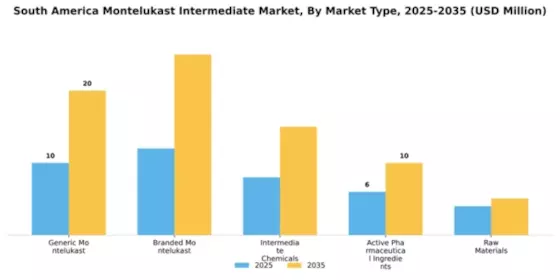
In the South America montelukast intermediate market, generic montelukast dominates the market share due to its cost-effectiveness and wide acceptance among healthcare providers and patients. Generic products offer affordability, which drives their higher consumption in various therapeutic applications. On the other hand, branded montelukast, while having a smaller share, shows significant growth potential, bolstered by brand loyalty and perceived quality among consumers and prescribers alike. Growth trends in the South America montelukast intermediate market are influenced by increasing healthcare awareness and rising incidences of asthma and allergic conditions requiring effective management. As generic montelukast remains the preferred option for budget-sensitive healthcare systems, branded montelukast is capturing the interest of higher-income patients through marketing initiatives and trust in established pharmaceutical brands. The overall market dynamics indicate a balanced competition between affordability and brand equity, shaping future growth trajectories in this segment.
Generic Montelukast (Dominant) vs. Branded Montelukast (Emerging)
Generic montelukast is recognized as the dominant player in the South America market for its affordability and accessibility. It appeals to a broad demographic, particularly patients without insurance or those seeking lower-cost alternatives to branded medications. The availability of multiple generic options ensures competitive pricing and fosters wider usage across hospitals and pharmacies. Conversely, branded montelukast is considered an emerging segment, capturing market share through innovative marketing strategies and maintaining quality standards. Patients who prioritize brand reputation may prefer these products, thus driving the acceptance of branded montelukast among specific consumer segments. The contrasting characteristics of these segments highlight a diverse market landscape focused on varying patient needs and economic factors.
Get more detailed insights about South America Montelukast Intermediate Market Request Free Sample
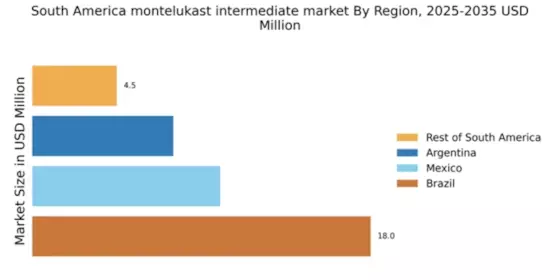
Brazil holds the largest market share in South America at 18.0%, driven by increasing respiratory diseases and a growing population. Key growth drivers include government initiatives to improve healthcare access and the rising prevalence of asthma and allergies. Regulatory policies favoring generic drug production have also boosted market dynamics. Infrastructure improvements in healthcare facilities further support demand trends, making Brazil a pivotal player in the montelukast intermediate market.
Mexico accounts for a 10.0% market share in the montelukast intermediate sector, fueled by a robust healthcare system and increasing awareness of respiratory conditions. The demand for affordable medications is rising, supported by government policies promoting generic drugs. The competitive landscape is characterized by both local and international players, with cities like Mexico City and Guadalajara being key markets. The presence of major companies like Mylan and Teva enhances market dynamics, fostering innovation and accessibility.
With a market share of 7.5%, Argentina's montelukast intermediate market is experiencing growth due to recent healthcare reforms aimed at improving access to essential medications. The demand for montelukast is rising, particularly in urban areas like Buenos Aires and Córdoba, where respiratory issues are prevalent. The competitive landscape includes significant players such as Aurobindo Pharma and Sun Pharmaceutical, which are adapting to local market needs. Regulatory support for generics is also enhancing market conditions, making it a promising region for investment.
The Rest of South America holds a 4.5% market share in the montelukast intermediate market, with potential for significant growth. Countries like Chile and Colombia are witnessing increasing demand for respiratory medications, driven by rising pollution levels and urbanization. Government initiatives to improve healthcare infrastructure are crucial for market expansion. The competitive landscape is less saturated, providing opportunities for new entrants and local manufacturers to establish a foothold in the market.
The montelukast intermediate market in South America is characterized by a competitive landscape that is increasingly shaped by innovation, strategic partnerships, and regional expansion. Key players such as Merck & Co (US), Mylan N.V. (US), and Teva Pharmaceutical Industries Ltd. (IL) are actively pursuing strategies that enhance their market positioning. Merck & Co (US) focuses on innovation in drug formulation, which appears to be a critical driver for maintaining competitive advantage. Meanwhile, Mylan N.V. (US) emphasizes regional expansion, particularly in emerging markets, to capture a larger share of the montelukast intermediate market. Teva Pharmaceutical Industries Ltd. (IL) is leveraging digital transformation to optimize its supply chain, thereby enhancing operational efficiency. Collectively, these strategies indicate a market that is not only moderately fragmented but also increasingly competitive, as companies strive to differentiate themselves through various operational tactics.In terms of business tactics, localizing manufacturing and optimizing supply chains are pivotal for companies operating in this market. The competitive structure is moderately fragmented, with several players vying for market share. This fragmentation allows for a diverse range of products and pricing strategies, which can benefit consumers but also intensifies competition among manufacturers. The influence of key players is significant, as their operational decisions can set trends that others may follow, thereby shaping the overall market dynamics.
In October Merck & Co (US) announced a strategic partnership with a local South American pharmaceutical firm to enhance its distribution network. This move is likely to improve Merck's market penetration and accessibility of its montelukast intermediate products, thereby strengthening its competitive position in the region. The partnership underscores the importance of local knowledge and infrastructure in navigating the complexities of the South American market.
In September Mylan N.V. (US) launched a new montelukast intermediate product tailored specifically for the South American market. This product launch is significant as it reflects Mylan's commitment to addressing regional healthcare needs and expanding its product portfolio. By focusing on localized solutions, Mylan may enhance its brand loyalty and capture a larger customer base in the region.
In August Teva Pharmaceutical Industries Ltd. (IL) implemented advanced AI-driven analytics to streamline its supply chain operations. This strategic move is indicative of a broader trend towards digitalization within the industry. By utilizing AI, Teva aims to reduce operational costs and improve delivery times, which could provide a competitive edge in a market where efficiency is increasingly valued.
As of November current trends in the montelukast intermediate market are heavily influenced by digitalization, sustainability, and the integration of AI technologies. Strategic alliances are becoming more prevalent, as companies recognize the need for collaboration to enhance their competitive positioning. Looking ahead, it appears that competitive differentiation will increasingly pivot from traditional price-based competition to a focus on innovation, technological advancements, and supply chain reliability. This shift suggests that companies that can effectively leverage these trends will likely emerge as leaders in the evolving market landscape.




In recent months, the South America Montelukast Intermediate Market has experienced significant developments, especially concerning the manufacturers involved. Companies such as Teva Pharmaceutical Industries and Lupin Pharmaceuticals have observed a growth in market valuation.
This is attributed to an increase in demand for treatments addressing asthma and allergic rhinitis, which Montelukast addresses. In July 2023, Torrent Pharmaceuticals announced the launch of a new generic version of Montelukast, aiming to leverage the growing market in South America.
The pharmaceutical landscape has seen strategic partnerships aimed at improving production capabilities. For instance, in March 2023, Strides Pharma Science initiated a collaboration with a regional player to enhance supply chain efficiency for Montelukast production.
Moreover, the government of Brazil has been actively promoting regulations that favor generic drug manufacturing, impacting market dynamics positively for companies like Cipla and Aurobindo Pharma. In terms of mergers and acquisitions, there have been no significant publicly announced deals in 2023 among the listed companies.
However, companies remain vigilant in exploring opportunities due to rising competition in this space. Overall, the Montelukast Intermediate Market continues to evolve, supported by favorable regulatory frameworks and strategic market engagements, ensuring its continued growth.
The Montelukast Intermediate Market is projected to grow at a 5.22% CAGR from 2025 to 2035, driven by increasing demand for asthma treatments and regulatory support.
New opportunities lie in:
By 2035, the montelukast intermediate market is expected to achieve robust growth and increased market share.
| MARKET SIZE 2024 | 40.0(USD Million) |
| MARKET SIZE 2025 | 42.09(USD Million) |
| MARKET SIZE 2035 | 70.0(USD Million) |
| COMPOUND ANNUAL GROWTH RATE (CAGR) | 5.22% (2025 - 2035) |
| REPORT COVERAGE | Revenue Forecast, Competitive Landscape, Growth Factors, and Trends |
| BASE YEAR | 2024 |
| Market Forecast Period | 2025 - 2035 |
| Historical Data | 2019 - 2024 |
| Market Forecast Units | USD Million |
| Key Companies Profiled | Merck & Co (US), Mylan N.V. (US), Teva Pharmaceutical Industries Ltd. (IL), Aurobindo Pharma (IN), Sun Pharmaceutical Industries Ltd. (IN), Cipla Ltd. (IN), Hikma Pharmaceuticals PLC (GB), Zydus Cadila (IN) |
| Segments Covered | Application, Formulation Type, Route of Administration, Distribution Channel |
| Key Market Opportunities | Growing demand for montelukast intermediates driven by regulatory support for asthma and allergy treatments. |
| Key Market Dynamics | Rising demand for montelukast intermediates driven by regulatory shifts and increasing respiratory health awareness in South America. |
| Countries Covered | Brazil, Mexico, Argentina, Rest of South America |
The overall market valuation was 40.0 USD Million in 2024.
The projected valuation for 2035 is 75.07 USD Million.
The expected CAGR for the market from 2025 to 2035 is 5.89%.
Key players include Teva Pharmaceutical Industries Ltd, Mylan N.V., Sandoz International GmbH, and others.
Primary applications include Allergy Treatment, Asthma Management, and Chronic Obstructive Pulmonary Disease.
Market segments by distribution channel include Direct Sales, Wholesale Distribution, and Pharmacy Chains.
Formulation types include Tablets, Oral Suspension, and Inhalation Solutions.
End use segmentation includes Allergy Treatment, Pediatric Care, and Respiratory Disorders.
The valuation range for the Chemical Manufacturing segment is between 8.0 and 15.0 USD Million.
Market type segmentation includes Generic Montelukast, Branded Montelukast, and Intermediate Chemicals.


Kindly complete the form below to receive a free sample of this Report

“This is really good guys. Excellent work on a tight deadline. I will continue to use you going forward and recommend you to others. Nice job”


“Thanks. It’s been a pleasure working with you, please use me as reference with any other Intel employees.”


“Thanks for sending the report it gives us a good global view of the Betaïne market.”


“Thank you, this will be very helpful for OQS.”


“We found the report very insightful! we found your research firm very helpful. I'm sending this email to secure our future business.”


“I am very pleased with how market segments have been defined in a relevant way for my purposes (such as "Portable Freezers & refrigerators" and "last-mile"). In general the report is well structured. Thanks very much for your efforts.”


“I have been reading the first document or the study, ,the Global HVAC and FP market report 2021 till 2026. Must say, good info! I have not gone in depth at all parts, but got a good indication of the data inside!”


“We got the report in time, we really thank you for your support in this process. I also thank to all of your team as they did a great job.”


“The Automotive 48V ECU Components Procurement Intelligence Study” was a complex project, but the Market Research Future (MRFR) team handled it with quality, agility, and customer-centricity. They delivered all requested data on time and within the agreed scope. The team, including Shubhendra Anand and Rahul Gotadki, was always readily available to clarify questions and swiftly implement necessary adjustments, driving the project to a successful conclusion within a very demanding timeframe.
I would also like to specifically commend Akshay Agarwal for his responsiveness and support at every stage—from our initial inquiry on May 6th through to final delivery on June 18th. His dedication made the entire process seamless.”



