Download Free Sample
Kindly complete the form below to receive a free sample of this Report
South America Neurorehabilitation Devices Market Research Report: Size, Share, Trend Analysis By Types (Neuro-Robotic Devices, Wearable Devices, Non-Invasive Stimulators, Brain-Computer Interfaces), By Applications (Brain Stroke, Parkinson's Disease, Multiple Sclerosis, Spinal Cord Injury, Cerebral Palsy, Schizophrenia), By End Users (Rehabilitation Centers, Hospitals & Clinics, Home Care) and By Regional (Brazil, Mexico, Argentina, Rest of South America) - Growth Outlook & Industry Forecast 2025 To 2035
As per Market Research Future analysis, the South America neurorehabilitation devices market size was estimated at 87.32 $ Million in 2024. The South America neurorehabilitation devices market is projected to grow from 91.45 $ Million in 2025 to 145.23 $ Million by 2035, exhibiting a compound annual growth rate (CAGR) of 4.7% during the forecast period 2025 - 2035
The South America neurorehabilitation devices market is experiencing robust growth driven by technological advancements and increasing healthcare needs.
| 2024 Market Size | 87.32 (USD Million) |
| 2035 Market Size | 145.23 (USD Million) |
| CAGR (2025 - 2035) | 4.73% |
ReWalk Robotics (IL), Ekso Bionics (US), Medtronic (US), Bionik Laboratories (CA), AlterG (US), NeuroPace (US), Hocoma (CH), Kessler Foundation (US), Tyromotion (AT)
Our Impact
Enabled $4.3B Revenue Impact for Fortune 500 and Leading Multinationals
Partnering with 2000+ Global Organizations Each Year
30K+ Citations by Top-Tier Firms in the Industry
The neurorehabilitation devices market is currently experiencing notable growth, driven by an increasing prevalence of neurological disorders and a rising demand for effective rehabilitation solutions. In South America, the aging population and the incidence of conditions such as stroke and traumatic brain injuries are contributing to the expansion of this market. Furthermore, advancements in technology, including the integration of artificial intelligence and robotics, are enhancing the efficacy of rehabilitation devices. This evolution is likely to improve patient outcomes and foster greater acceptance among healthcare providers. Moreover, government initiatives aimed at improving healthcare infrastructure and increasing access to rehabilitation services are expected to further stimulate market growth. Investment in research and development is also on the rise, as stakeholders seek innovative solutions to address the unique challenges faced by patients in South America. The combination of these factors suggests a promising outlook for the neurorehabilitation devices market, as it adapts to meet the needs of a diverse patient population and leverages technological advancements to enhance rehabilitation processes.
The neurorehabilitation devices market is witnessing a surge in technological innovations, particularly in the areas of robotics and virtual reality. These advancements are enhancing the effectiveness of rehabilitation therapies, allowing for more personalized and engaging patient experiences. As technology continues to evolve, it is likely that new devices will emerge, offering improved functionalities and better integration with existing healthcare systems.
In South America, government initiatives are increasingly focused on enhancing healthcare services, including neurorehabilitation. Funding programs and policies aimed at improving access to rehabilitation technologies are becoming more prevalent. This support is expected to drive the adoption of advanced neurorehabilitation devices, ultimately benefiting patients and healthcare providers alike.
There is a rising awareness regarding the importance of neurorehabilitation among healthcare professionals and patients in South America. Educational programs and workshops are being implemented to inform stakeholders about the benefits of rehabilitation devices. This growing knowledge base is likely to lead to increased demand for neurorehabilitation solutions, as more individuals recognize their potential to improve recovery outcomes.
In South America, increasing healthcare expenditure is fostering growth in the neurorehabilitation devices market. Governments and private sectors are allocating more funds towards healthcare infrastructure, which includes rehabilitation services. For instance, healthcare spending in Brazil has seen an increase of over 10% in recent years, reflecting a commitment to enhancing patient care. This financial support is crucial for the development and adoption of advanced neurorehabilitation technologies. As healthcare budgets expand, the neurorehabilitation devices market is likely to benefit from improved access to innovative devices, ultimately leading to better patient outcomes and a more robust rehabilitation ecosystem.
The integration of advanced technologies such as robotics, artificial intelligence, and virtual reality into rehabilitation practices is transforming the neurorehabilitation devices market. In South America, there is a growing trend towards adopting these technologies to enhance therapeutic effectiveness. For example, robotic-assisted therapy has shown to improve motor recovery in stroke patients, which is gaining traction among rehabilitation centers. The neurorehabilitation devices market is thus experiencing a shift towards more sophisticated, technology-driven solutions that promise to deliver personalized and efficient rehabilitation experiences. This trend indicates a potential for significant growth as healthcare providers increasingly recognize the benefits of these innovations.
The demographic shift towards an aging population in South America is a significant driver for the neurorehabilitation devices market. As the elderly population grows, the incidence of age-related neurological conditions is likely to increase, creating a higher demand for rehabilitation services. Reports indicate that by 2030, the number of individuals aged 65 and older in South America will surpass 100 million, necessitating effective rehabilitation solutions. This demographic trend compels healthcare systems to invest in neurorehabilitation devices, ensuring that they can cater to the needs of this vulnerable population. The neurorehabilitation devices market is thus poised for growth, as it aligns with the increasing demand for specialized care for older adults.
The rising prevalence of neurological disorders in South America is a critical driver for the neurorehabilitation devices market. Conditions such as stroke, traumatic brain injuries, and neurodegenerative diseases are becoming more common, leading to a heightened demand for effective rehabilitation solutions. According to recent health statistics, approximately 1.5 million people in South America suffer from stroke annually, which necessitates advanced rehabilitation technologies. This growing patient population is likely to propel investments in neurorehabilitation devices, as healthcare providers seek to improve recovery outcomes. The neurorehabilitation devices market is thus positioned to expand significantly, as it addresses the urgent need for innovative therapies and devices tailored to the unique challenges posed by these disorders.
Collaboration between public and private sectors is emerging as a vital driver for the neurorehabilitation devices market in South America. Partnerships between government agencies, healthcare providers, and private companies are fostering innovation and improving access to rehabilitation technologies. These collaborations often lead to joint ventures that focus on research and development, resulting in the creation of cutting-edge neurorehabilitation devices. For instance, initiatives in Argentina have successfully combined resources to enhance rehabilitation services, demonstrating the potential for improved patient outcomes. The neurorehabilitation devices market is likely to benefit from these synergies, as they promote the sharing of knowledge and resources, ultimately leading to a more effective rehabilitation landscape.
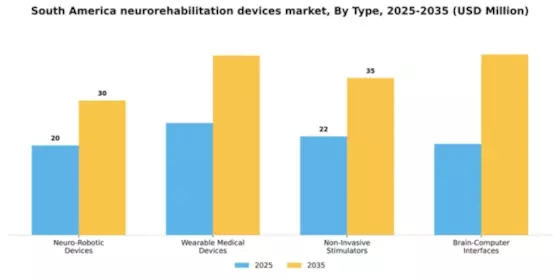
In the South America neurorehabilitation devices market, Neuro-Robotic Devices occupy the largest share, showcasing their prominence in assisting rehabilitation processes. Wearable Medical Devices are swiftly gaining traction, driven by technological enhancements and an increasing focus on personalized healthcare. Non-Invasive Stimulators and Brain-Computer Interfaces play complementary roles in the overall landscape, contributing to a diversified offering for neurorehabilitation solutions.
The growth trends in this segment are significantly influenced by advancements in technology, such as improved sensor integration and artificial intelligence. The rising geriatric population, coupled with the growing incidence of neurological disorders, further supports the demand for innovative solutions. Increased investment in healthcare infrastructure across various South American countries also paves the way for wider adoption of these devices, making the market dynamic and competitive.
Neuro-Robotic Devices (Dominant) vs. Wearable Medical Devices (Emerging)
Neuro-Robotic Devices represent a dominant force in the market, recognized for their precision and effectiveness in rehabilitation therapy. These devices provide users with tailored experiences, often utilizing advanced robotics to enhance physical mobility and recovery rates. In contrast, Wearable Medical Devices are emerging as a formidable competitor, appealing to a broad demographic through accessible technology that encourages user engagement and continuous monitoring. Though currently smaller in market share, their rapid adoption reflects a shift towards more preventative care approaches that blend seamlessly with daily life, such as fitness tracking and health monitoring. Both segments highlight the importance of innovation and user-centric design in the evolving landscape of neurorehabilitation.
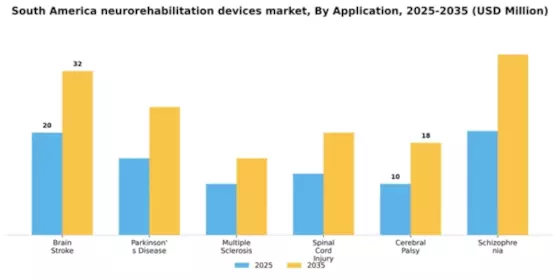
In the Application segment of neurorehabilitation devices, Brain Stroke holds the largest market share, driven by the high incidence rate and the increasing demand for effective rehabilitation solutions. Following closely, Parkinson's Disease has emerged as the fastest-growing segment, reflecting a rising awareness of therapeutic options among patients and caregivers, along with advancements in technology that enhance treatment efficacy.
Growth trends indicate a robust future for the Application segment as the population continues to age, leading to an increase in neurodegenerative conditions like Parkinson's Disease. Additionally, the push for better healthcare infrastructure and improved access to rehabilitation services is expected to further propel these segments. Innovations in device technology and increased patient engagement are facilitating a more effective recovery process, thereby expanding market opportunities.
Brain Stroke (Dominant) vs. Parkinson's Disease (Emerging)
Brain Stroke, recognized as the dominant segment due to its prevalent impact on public health, necessitates comprehensive rehabilitation strategies to aid recovery. Meanwhile, Parkinson's Disease, though currently smaller in market share, represents an emerging area with significant potential. Its growth is fueled by technological advancements in treatment devices and a deeper understanding of patient needs. The shift towards personalized therapy approaches in Parkinson's rehabilitation further enhances its appeal. As healthcare providers focus on improving patient outcomes, both segments are likely to experience transformative changes, ensuring long-term engagement and support for affected individuals.
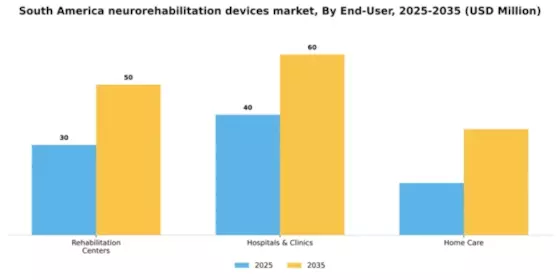
In the End-User segment, Rehabilitation Centers hold the largest share, dominating the market with their extensive facilities and specialized services tailored for neurorehabilitation. Hospitals & Clinics contribute significantly to the segment, providing crucial therapies and support. However, Home Care is rapidly gaining ground, driven by increasing demand for personalized, in-home treatment options that cater to individual patient needs.
The growth trends in the End-User segment are influenced by factors such as rising aging populations and higher incidences of neurological disorders. The shift towards Home Care reflects a broader trend in healthcare where patients prefer receiving treatment in the comfort of their homes. Furthermore, advancements in teletherapy technologies and remote monitoring are reshaping how care is delivered, making it more accessible and efficient.
Rehabilitation Centers (Dominant) vs. Home Care (Emerging)
Rehabilitation Centers are pivotal in providing specialized services and facilities that cater to neurorehabilitation patients, thereby establishing themselves as a dominant force in the market. Their structured programs and comprehensive rehabilitation therapies attract a larger patient base, making them essential in the recovery journey. In contrast, Home Care has emerged as a crucial segment in response to patient preferences for personalized care. The flexibility and convenience offered by Home Care services appeal to a growing demographic that seeks comfort and individualized attention. Innovations in technology also support this trend, allowing caregivers to administer effective therapies at home. The ability to combine professional care with personal comfort is attracting more patients toward the Home Care segment.
Get more detailed insights about South America Neurorehabilitation Devices Market Request Free Sample
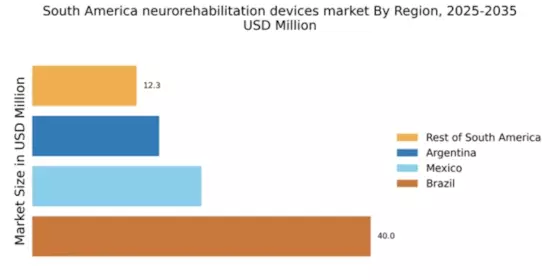
Brazil holds a commanding 40.0% market share in the neurorehabilitation devices sector, driven by increasing incidences of neurological disorders and a growing elderly population. Government initiatives, such as the National Health System's focus on rehabilitation, and investments in healthcare infrastructure are pivotal. The demand for advanced rehabilitation technologies is rising, supported by favorable regulatory policies that encourage innovation and accessibility.
Mexico accounts for 20.0% of the South American neurorehabilitation devices market, with significant growth driven by rising healthcare expenditure and increasing awareness of rehabilitation therapies. The government is actively promoting health initiatives, which include funding for rehabilitation programs. Urbanization and improved healthcare infrastructure are also contributing to the demand for neurorehabilitation devices.
Argentina represents 15.0% of the market share in neurorehabilitation devices, with growth fueled by a rising prevalence of stroke and other neurological conditions. The government has implemented policies to enhance healthcare access, including subsidies for rehabilitation technologies. The demand for personalized rehabilitation solutions is increasing, reflecting a shift towards patient-centered care in the healthcare system.
The Rest of South America holds a 12.32% market share in neurorehabilitation devices, characterized by diverse healthcare needs and varying levels of infrastructure development. Countries like Chile and Colombia are witnessing growth due to increased investment in healthcare and rehabilitation services. Local players are emerging, while international companies are expanding their presence to tap into these markets, driven by unique regional demands.
The neurorehabilitation devices market in South America is characterized by a dynamic competitive landscape, driven by technological advancements and an increasing demand for effective rehabilitation solutions. Key players such as ReWalk Robotics (IL), Ekso Bionics (US), and Medtronic (US) are at the forefront, each adopting distinct strategies to enhance their market presence. ReWalk Robotics (IL) focuses on innovation in exoskeleton technology, aiming to improve mobility for individuals with spinal cord injuries. Meanwhile, Ekso Bionics (US) emphasizes partnerships with rehabilitation centers to expand its reach and integrate its devices into clinical practices. Medtronic (US) leverages its extensive portfolio to offer comprehensive solutions, including neurostimulation devices, thereby positioning itself as a leader in the market. Collectively, these strategies contribute to a competitive environment that is increasingly centered on technological innovation and strategic collaborations.In terms of business tactics, companies are localizing manufacturing to reduce costs and enhance supply chain efficiency. This approach is particularly relevant in South America, where logistical challenges can impact product availability. The market structure appears moderately fragmented, with several players vying for market share. However, the influence of major companies is significant, as they set industry standards and drive technological advancements that smaller firms often follow.
In October ReWalk Robotics (IL) announced a partnership with a leading rehabilitation hospital in Brazil to conduct clinical trials for its latest exoskeleton model. This strategic move is likely to enhance the company's visibility in the region and facilitate the adoption of its technology in clinical settings, potentially leading to improved patient outcomes and increased sales. The collaboration underscores the importance of clinical validation in the neurorehabilitation sector, where evidence-based practices are paramount.
In September Ekso Bionics (US) launched a new version of its EksoGT exoskeleton, featuring advanced AI capabilities for personalized rehabilitation. This innovation is expected to significantly improve user experience and outcomes, positioning the company as a pioneer in integrating AI into rehabilitation devices. The introduction of such technology may attract more healthcare providers to adopt Ekso's solutions, thereby expanding its market share in South America.
In August Medtronic (US) expanded its product line by introducing a new neurostimulation device specifically designed for stroke rehabilitation. This strategic expansion not only diversifies Medtronic's offerings but also addresses a critical need in the market, as stroke recovery remains a significant challenge in rehabilitation. By enhancing its product portfolio, Medtronic is likely to strengthen its competitive position and appeal to a broader range of healthcare providers.
As of November current trends in the neurorehabilitation devices market include a strong emphasis on digitalization, sustainability, and the integration of AI technologies. These trends are reshaping the competitive landscape, as companies increasingly seek strategic alliances to enhance their technological capabilities and market reach. The shift from price-based competition to a focus on innovation and technology is evident, with firms prioritizing the development of advanced solutions that improve patient outcomes and operational efficiency. Looking ahead, competitive differentiation will likely hinge on the ability to innovate and adapt to evolving market demands, underscoring the importance of reliable supply chains and cutting-edge technology.
In recent months, the South America Neurorehabilitation Devices Market has witnessed significant developments, particularly in Brazil and Argentina, where increasing government initiatives aim to improve technological integration in healthcare. Companies like KinaTrax and Medtronic have shown notable advancements in their product offerings, enhancing rehabilitation outcomes for neurological patients.
Current affairs reflect a growing collaboration between private and public sectors to address the rising demand for neurorehabilitation solutions.In terms of mergers and acquisitions, AlterG completed a partnership with Hanger Orthopedic Group in February 2023 to expand its reach in Brazil, aiming to combine its strengths in rehabilitation technology.
Additionally, MindMaze announced an acquisition of a local startup focused on virtual reality applications for neurorehabilitation in March 2023. The market is experiencing substantial growth, with an estimated valuation increase, projected to reach USD 800 million by 2025, driven by advancements in technology and rising stroke rates across South America. A notable occurrence in the past few years includes Neurotech's introduction of brain-computer interface technology in August 2022, which has positively influenced rehabilitation approaches across the region.
The Neurorehabilitation Devices Market is projected to grow at a 4.73% CAGR from 2025 to 2035, driven by technological advancements, increasing patient populations, and rising healthcare investments.
New opportunities lie in:
By 2035, the market is expected to achieve substantial growth, reflecting evolving healthcare needs.
| MARKET SIZE 2024 | 87.32(USD Million) |
| MARKET SIZE 2025 | 91.45(USD Million) |
| MARKET SIZE 2035 | 145.23(USD Million) |
| COMPOUND ANNUAL GROWTH RATE (CAGR) | 4.73% (2025 - 2035) |
| REPORT COVERAGE | Revenue Forecast, Competitive Landscape, Growth Factors, and Trends |
| BASE YEAR | 2024 |
| Market Forecast Period | 2025 - 2035 |
| Historical Data | 2019 - 2024 |
| Market Forecast Units | USD Million |
| Key Companies Profiled | ReWalk Robotics (IL), Ekso Bionics (US), Medtronic (US), Bionik Laboratories (CA), AlterG (US), NeuroPace (US), Hocoma (CH), Kessler Foundation (US), Tyromotion (AT) |
| Segments Covered | Type, Application, End-User |
| Key Market Opportunities | Integration of advanced robotics and artificial intelligence in neurorehabilitation devices market enhances patient outcomes and engagement. |
| Key Market Dynamics | Rising demand for innovative neurorehabilitation devices driven by technological advancements and evolving patient care standards. |
| Countries Covered | Brazil, Mexico, Argentina, Rest of South America |
The market valuation was $87.32 Million in 2024.
The projected valuation for 2035 is $145.23 Million.
The expected CAGR during the forecast period 2025 - 2035 is 4.73%.
Key players include ReWalk Robotics, Ekso Bionics, Medtronic, Bionik Laboratories, and others.
Main types include Neuro-Robotic Devices, Wearable Medical Devices, Non-Invasive Stimulators, and Brain-Computer Interfaces.
Neuro-Robotic Devices generated revenue between $20.0 Million and $30.0 Million in 2024.
Key applications include Brain Stroke, Parkinson's Disease, Multiple Sclerosis, and Spinal Cord Injury.
Wearable Medical Devices generated revenue between $25.0 Million and $40.0 Million in 2024.
End-users include Rehabilitation Centers, Hospitals & Clinics, and Home Care.
Hospitals & Clinics generated revenue between $40.0 Million and $60.0 Million in 2024.



Kindly complete the form below to receive a free sample of this Report

“This is really good guys. Excellent work on a tight deadline. I will continue to use you going forward and recommend you to others. Nice job”


“Thanks. It’s been a pleasure working with you, please use me as reference with any other Intel employees.”


“Thanks for sending the report it gives us a good global view of the Betaïne market.”


“Thank you, this will be very helpful for OQS.”


“We found the report very insightful! we found your research firm very helpful. I'm sending this email to secure our future business.”


“I am very pleased with how market segments have been defined in a relevant way for my purposes (such as "Portable Freezers & refrigerators" and "last-mile"). In general the report is well structured. Thanks very much for your efforts.”


“I have been reading the first document or the study, ,the Global HVAC and FP market report 2021 till 2026. Must say, good info! I have not gone in depth at all parts, but got a good indication of the data inside!”


“We got the report in time, we really thank you for your support in this process. I also thank to all of your team as they did a great job.”


“The Automotive 48V ECU Components Procurement Intelligence Study” was a complex project, but the Market Research Future (MRFR) team handled it with quality, agility, and customer-centricity. They delivered all requested data on time and within the agreed scope. The team, including Shubhendra Anand and Rahul Gotadki, was always readily available to clarify questions and swiftly implement necessary adjustments, driving the project to a successful conclusion within a very demanding timeframe.
I would also like to specifically commend Akshay Agarwal for his responsiveness and support at every stage—from our initial inquiry on May 6th through to final delivery on June 18th. His dedication made the entire process seamless.”



