Download Free Sample
Kindly complete the form below to receive a free sample of this Report
South America Physician Groups Market Research Report: Size, Share, Trend Analysis By Types of Physician Groups (Independent Physician Groups, Hospital-Affiliated Physician Groups, Multispecialty Physician Groups, Single Specialty Physician Groups), By Service Offered (Primary Care Services, Specialty Care Services, Emergency Care Services, Preventive Care Services), By Practice Size (Small Practices, Medium Practices, Large Practices), By Payer Mix (Public Payers, Private Insurers, Self-Pay) and By Regional (Brazil, Mexico, Argentina, Rest of South America) - Growth Outlook & Industry Forecast 2025 To 2035
As per Market Research Future analysis, the South America physician groups market size was estimated at 8.21 USD Billion in 2024. The South America physician groups market is projected to grow from 8.5 USD Billion in 2025 to 12.01 USD Billion by 2035, exhibiting a compound annual growth rate (CAGR) of 3.5% during the forecast period 2025 - 2035
The South America physician groups market is experiencing robust growth driven by evolving healthcare demands and technological advancements.
| 2024 Market Size | 8.21 (USD Billion) |
| 2035 Market Size | 12.01 (USD Billion) |
| CAGR (2025 - 2035) | 3.52% |
HCA Healthcare (US), Tenet Healthcare (US), Community Health Systems (US), Universal Health Services (US), Cleveland Clinic (US), Mayo Clinic (US), Ascension Health (US), Kaiser Permanente (US)
Our Impact
Enabled $4.3B Revenue Impact for Fortune 500 and Leading Multinationals
Partnering with 2000+ Global Organizations Each Year
30K+ Citations by Top-Tier Firms in the Industry
the physician groups market in South America is experiencing a dynamic evolution, driven by various factors including demographic shifts, technological advancements, and changing healthcare policies. The region's population is aging, leading to an increased demand for healthcare services, which in turn influences the structure and operation of physician groups. Additionally, the rise of telemedicine and digital health solutions is reshaping how these groups deliver care, making it more accessible and efficient. As healthcare systems adapt to these changes, physician groups are likely to play a pivotal role in ensuring quality care delivery across diverse populations. Moreover, the regulatory environment in South America is also undergoing transformation, with governments focusing on improving healthcare access and quality. This shift may encourage the formation of larger physician groups, enabling better resource allocation and collaborative care models. The integration of technology into practice management and patient engagement is becoming increasingly important, suggesting that physician groups must embrace innovation to remain competitive. Overall, the physician groups market in South America appears poised for growth, with opportunities for enhanced service delivery and improved patient outcomes.
the physician groups market witnesses a notable shift towards specialized care, driven by the growing complexity of health conditions. As patients seek more tailored treatment options, physician groups are adapting by expanding their specialties. This trend reflects a broader understanding of the need for focused expertise in managing chronic diseases and complex health issues.
The integration of telehealth services within the physician groups market is becoming increasingly prevalent. This trend is characterized by the use of digital platforms to facilitate remote consultations and follow-ups. By leveraging technology, physician groups can enhance patient access to care, reduce wait times, and improve overall satisfaction.
There is a rising trend of collaboration among physician groups, as they seek to form networks that enhance service delivery. This approach allows for shared resources, knowledge exchange, and improved patient care coordination. Such collaborations may lead to more comprehensive healthcare solutions, addressing the diverse needs of the population.
The increasing prevalence of chronic diseases in South America is a pivotal driver for the physician groups market. Conditions such as diabetes, hypertension, and cardiovascular diseases are on the rise, necessitating specialized care. According to health statistics, chronic diseases account for approximately 70% of all deaths in the region. This trend compels physician groups to adapt their services to meet the growing demand for management and treatment of these conditions. As a result, physician groups are likely to expand their offerings, focusing on preventive care and chronic disease management. This shift not only enhances patient outcomes but also positions physician groups as essential players in the healthcare landscape, potentially increasing their market share and revenue streams.
There is a notable shift towards preventive healthcare in South America, which serves as a vital driver for the physician groups market. As awareness of health issues increases, patients are seeking proactive measures to maintain their health and prevent diseases. This trend is reflected in the rising demand for routine check-ups, screenings, and wellness programs. Physician groups are responding by developing comprehensive preventive care strategies, which may include lifestyle counseling and early intervention programs. The emphasis on prevention is expected to grow, with estimates suggesting a 20% increase in preventive care services over the next few years. This focus not only improves patient health outcomes but also positions physician groups as key players in the healthcare continuum.
Technological innovations are transforming the healthcare landscape in South America, significantly impacting the physician groups market. The integration of electronic health records (EHR), artificial intelligence (AI), and data analytics is streamlining operations and improving patient care. For instance, EHR systems enhance communication among healthcare providers, leading to better-coordinated care. Moreover, AI applications in diagnostics and treatment planning are becoming increasingly prevalent, allowing physician groups to offer more precise and efficient services. The investment in technology is expected to grow, with projections indicating a potential increase of 15% in healthcare IT spending over the next few years. This technological evolution not only enhances operational efficiency but also attracts patients seeking modern healthcare solutions.
The evolving regulatory landscape in South America is a significant driver for the physician groups market. Governments are increasingly implementing policies aimed at improving healthcare access and quality. For example, recent reforms have focused on expanding insurance coverage and incentivizing preventive care. These changes create opportunities for physician groups to align their services with new regulations, potentially increasing patient volumes. Additionally, compliance with these regulations may require physician groups to invest in training and infrastructure, which could lead to enhanced service delivery. The impact of these regulatory changes is profound, as they shape the operational framework within which physician groups function, influencing their growth and sustainability.
The demographic shift towards an aging population in South America is a crucial driver for the physician groups market. As the population ages, there is a corresponding increase in healthcare needs, particularly for chronic and complex conditions. By 2030, it is projected that individuals aged 65 and older will represent a significant portion of the population, leading to heightened demand for medical services. Physician groups are likely to adapt by expanding their geriatric care services and enhancing their capabilities to manage age-related health issues. This demographic trend not only presents challenges but also opportunities for physician groups to innovate and cater to the specific needs of older patients, thereby potentially increasing their market presence.
In the South America physician groups market, Independent Physician Groups hold the largest share, reflecting a strong preference among patients for personalized, patient-centered care. Meanwhile, Hospital-Affiliated Physician Groups are gaining traction, representing a significant portion of the market as they integrate with hospitals to offer a wider array of services and improve patient outcomes.
Growth trends indicate that Hospital-Affiliated Physician Groups are the fastest-growing segment, driven by increasing hospital consolidation and the need for coordinated care. Additionally, the demand for specialized care and the shift towards value-based care models are propelling the growth of these groups, while Independent Physician Groups continue to thrive due to their agility and ability to adapt to patient needs.
Independent Physician Groups (Dominant) vs. Hospital-Affiliated Physician Groups (Emerging)
Independent Physician Groups are characterized by their operational autonomy and focus on individualized patient care, making them the dominant segment in the market. They often provide a range of services, allowing for a closer patient-physician relationship. In contrast, Hospital-Affiliated Physician Groups are emerging as a competitive force by leveraging hospital resources, offering more comprehensive care options, and enhancing patient access to specialized services. These groups are increasingly important as healthcare systems look for ways to improve efficiency and patient satisfaction, particularly in urban areas with higher demands for healthcare services.

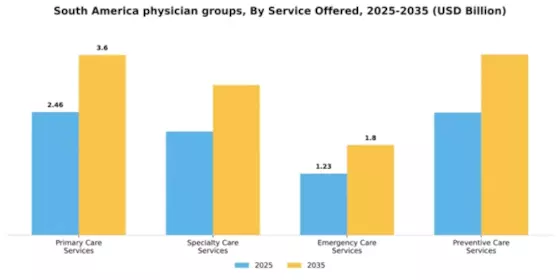
In the South America physician groups market, Primary Care Services hold the largest market share, due to the high demand for basic healthcare services in the region. The widespread need for accessible healthcare options among various demographics has positioned primary care as an essential element of the healthcare landscape. Conversely, Specialty Care Services, while having a smaller share, are experiencing rapid growth, driven by increasing awareness and need for specialized treatments across various medical fields.
The growth of the Specialty Care Services segment is fueled by factors such as an aging population, rising incidences of chronic diseases, and advancements in medical technologies. As healthcare consumers become more informed, the emphasis on receiving care from specialists is growing. This trend indicates a significant shift in patient preferences, paving the way for further investment and development within specialty services to meet emergent healthcare needs.
Primary Care Services (Dominant) vs. Emergency Care Services (Emerging)
Within the South America physician groups market, Primary Care Services are dominant due to their foundational role in delivering accessible healthcare to a broad population. These services encompass routine check-ups, preventive care, and management of common ailments, ensuring a stable patient flow. Meanwhile, Emergency Care Services are classified as emerging, driven by the urgent nature of healthcare demands and the necessity for immediate medical interventions. This segment is witnessing rapid innovation in service delivery, with enhancements in triage systems and the integration of telemedicine, making emergency services more accessible. As urbanization continues and lifestyle-related health issues rise, the demand for both service types is expected to evolve, creating a more dynamic healthcare framework.
In the South America physician groups market, practice size is a significant factor in determining market dynamics. Small practices command a substantial share, appealing to localized patient bases with personalized care. In contrast, large practices are on the rise, leveraging economies of scale to offer a broad range of services, which has attracted more patients seeking comprehensive care options.
The growth trajectory for large practices can be attributed to the increasing demand for integrated healthcare solutions and technological advancements. Additionally, the trend towards consolidation in the healthcare market has enabled larger groups to expand their reach and resources. As small practices adapt, many are exploring partnerships to remain competitive, further influencing market growth and the overall distribution of practice sizes in South America.
Small Practices (Dominant) vs. Medium Practices (Emerging)
Small practices dominate the physician groups segment by maintaining close relationships with their patients and community, facilitating a high level of patient trust and satisfaction. They are characterized by personalized services and flexibility in patient care, making them a preferred choice for many individuals. On the other hand, medium practices are emerging as vital players, bridging the gap between small personalized care and the extensive capabilities of larger groups. They often combine some attributes of both, providing specialized services while also beginning to implement advanced technologies to enhance patient management. As these practices evolve, they are integrating digital health solutions and expanding service offerings, which positions them favorably amid changing market demands.

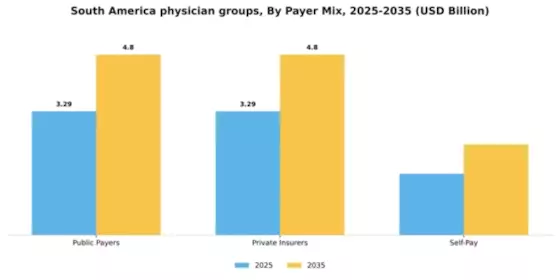
In the South America physician groups market, Public Payers hold a substantial market share, driven by government funding and regulatory support. This segment has been traditionally favored due to its accessibility, catering to a large population seeking affordable healthcare options. Private Insurers, while currently holding a smaller slice of the market, are rapidly expanding their footprint, responding to increasing demand for personalized and prompt healthcare services, which are often perceived as lacking in the public sector.
The growth of the Private Insurers segment can be attributed to several key factors. First, an increasing middle-class population is seeking better healthcare options, resulting in more individuals opting for private insurance. Additionally, the rising awareness of the limitations of public healthcare services is motivating a shift towards private plans. This trend indicates a robust potential for the private insurance market, positioning it as the fastest-growing segment within the overall payer mix.
Public Payers (Dominant) vs. Private Insurers (Emerging)
Public Payers are characterized by their government-backed funding and extensive reach, making up the dominant segment in the region. This model offers low-cost healthcare to a vast majority of the population, ensuring basic health services are accessible. However, the challenges of funding and resource allocation often hinder the quality of service provided. In contrast, Private Insurers are emerging as a crucial player, catering to an evolving patient demographic that values quality and speed. They offer tailored healthcare plans, leading to an increase in patient satisfaction. This segment is focusing on innovative healthcare delivery models, such as telemedicine and value-based care, to differentiate their offerings from public options and capture a more lucrative market share.
Get more detailed insights about South America Physician Groups Market Request Free Sample
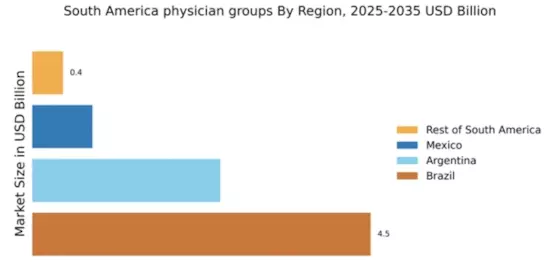
Brazil holds a commanding market share of 4.5% in the physician groups market, driven by a growing population and increasing healthcare demands. Key growth drivers include government initiatives aimed at expanding healthcare access, alongside rising investments in medical infrastructure. The country is witnessing a shift towards preventive care, influenced by changing consumption patterns and regulatory policies that promote public-private partnerships. Infrastructure development, particularly in urban areas, is enhancing service delivery and accessibility.
Mexico's physician groups market, with a share of 0.8%, is characterized by emerging opportunities driven by regulatory reforms aimed at improving healthcare quality. The demand for specialized medical services is on the rise, influenced by an aging population and increasing chronic diseases. Government initiatives are focusing on expanding insurance coverage, which is expected to boost market growth. Additionally, the private sector is becoming more involved, enhancing competition and service delivery.
Argentina holds a market share of 2.5% in the physician groups sector, demonstrating resilience despite economic fluctuations. Key growth drivers include a strong emphasis on public health initiatives and a growing demand for specialized care. The government is implementing policies to enhance healthcare access, particularly in rural areas. Consumption patterns are shifting towards preventive care, reflecting a broader trend in health awareness among the population.
The Rest of South America accounts for a market share of 0.41%, representing untapped potential in the physician groups market. Key growth drivers include increasing urbanization and a rising middle class, which are driving demand for quality healthcare services. Regulatory frameworks are evolving to support private sector involvement, enhancing competition. Countries like Chile and Colombia are emerging as key markets, with significant investments in healthcare infrastructure and services.
The physician groups market in South America is characterized by a competitive landscape that is increasingly shaped by strategic partnerships, technological advancements, and a focus on patient-centered care. Key players such as HCA Healthcare (US), Tenet Healthcare (US), and Universal Health Services (US) are actively pursuing growth through various means, including mergers and acquisitions, regional expansions, and the integration of digital health solutions. These strategies not only enhance their operational capabilities but also contribute to a more dynamic competitive environment, where innovation and adaptability are paramount.In terms of business tactics, companies are increasingly localizing their operations to better meet regional healthcare demands. This approach, coupled with supply chain optimization, allows for more efficient service delivery and cost management. The market appears moderately fragmented, with a mix of large healthcare systems and smaller, specialized groups. The collective influence of these key players is significant, as they drive trends in quality of care and operational efficiency, thereby shaping the overall market structure.
In October HCA Healthcare (US) announced a strategic partnership with a leading telehealth provider to enhance its digital service offerings. This move is indicative of the growing importance of telemedicine in the healthcare landscape, particularly in underserved areas. By integrating telehealth solutions, HCA aims to improve patient access and streamline care delivery, which could potentially lead to better health outcomes and increased patient satisfaction.
In September Tenet Healthcare (US) completed the acquisition of a regional hospital network, expanding its footprint in South America. This acquisition is strategically significant as it allows Tenet to leverage existing infrastructure and patient bases, thereby enhancing its market share. The integration of these facilities is expected to improve operational efficiencies and provide a broader range of services to patients, aligning with the company's goal of delivering comprehensive care.
In August Universal Health Services (US) launched a new initiative focused on mental health services, responding to the rising demand for mental health care in the region. This initiative not only addresses a critical need but also positions Universal Health Services as a leader in a niche market. By expanding its service offerings, the company is likely to attract a diverse patient demographic, further solidifying its competitive stance.
As of November the physician groups market is witnessing trends that emphasize digitalization, sustainability, and the integration of artificial intelligence (AI) in healthcare delivery. Strategic alliances are becoming increasingly vital, as they enable companies to pool resources and expertise to tackle complex healthcare challenges. Looking ahead, competitive differentiation is expected to evolve, with a shift from traditional price-based competition to a focus on innovation, technology adoption, and supply chain reliability. This transition may redefine how healthcare providers engage with patients and deliver care, ultimately enhancing the overall quality of healthcare services in the region.






In recent developments within the South America Physician Groups Market, notable activities have unfolded among key players. Clinicas del Country has reinforced its presence with strategic collaborations, while Dasa continues expanding its diagnostic services across the region, enhancing accessibility for patients. Hospital Puerto Montt is progressing in improving healthcare delivery through technological innovations, reflecting larger trends in the market.
Grupo Fleury has reported a significant rise in its valuation, primarily attributed to increased demand for diagnostic services and preventive healthcare, impacting market dynamics positively. Meanwhile, Amil is focusing on expanding its insurance offerings to cater to the growing need for comprehensive health coverage.
In terms of mergers and acquisitions, Grupo Sabin recently acquired Medicos Asociados in July 2023, further consolidating its position in the Brazilian healthcare market. Hospital de Cáncer de Curitiba has also been involved in partnerships to enhance oncology care services.
Over the past few years, the South American healthcare sector has seen a robust growth trajectory, marked by innovations and strategic alliances aimed at improving patient care outcomes across the region, reflecting a shift towards integrated healthcare models.
The Physician Groups Market is projected to grow at a 3.52% CAGR from 2025 to 2035, driven by technological advancements, increasing healthcare demand, and strategic partnerships.
New opportunities lie in:
By 2035, the physician groups market is expected to achieve robust growth and enhanced service delivery.
| MARKET SIZE 2024 | 8.21(USD Billion) |
| MARKET SIZE 2025 | 8.5(USD Billion) |
| MARKET SIZE 2035 | 12.01(USD Billion) |
| COMPOUND ANNUAL GROWTH RATE (CAGR) | 3.52% (2025 - 2035) |
| REPORT COVERAGE | Revenue Forecast, Competitive Landscape, Growth Factors, and Trends |
| BASE YEAR | 2024 |
| Market Forecast Period | 2025 - 2035 |
| Historical Data | 2019 - 2024 |
| Market Forecast Units | USD Billion |
| Key Companies Profiled | HCA Healthcare (US), Tenet Healthcare (US), Community Health Systems (US), Universal Health Services (US), Cleveland Clinic (US), Mayo Clinic (US), Ascension Health (US), Kaiser Permanente (US) |
| Segments Covered | Type, Service Offered, Practice Size, Payer Mix |
| Key Market Opportunities | Integration of telehealth services enhances patient access and operational efficiency in the physician groups market. |
| Key Market Dynamics | Growing consolidation among physician groups enhances competitive positioning and influences healthcare delivery in South America. |
| Countries Covered | Brazil, Mexico, Argentina, Rest of South America |
The overall market valuation was $8.21 Billion in 2024.
The projected market valuation for 2035 is $12.01 Billion.
The expected CAGR for the market during the forecast period 2025 - 2035 is 3.52%.
In 2024, Hospital-Affiliated Physician Groups had a valuation of $2.64 Billion, the highest among types.
The projected valuation for Independent Physician Groups by 2035 is $3.56 Billion.
In 2024, Primary Care Services had a valuation of $2.46 Billion, while Specialty Care Services had $2.07 Billion.
The valuation of Large Practices is projected to reach $4.89 Billion by 2035.
The valuation of Public Payers in 2024 was $3.29 Billion.
Key players in the market include HCA Healthcare, Tenet Healthcare, and Universal Health Services.
The projected valuation for Emergency Care Services by 2035 is $1.8 Billion.


Kindly complete the form below to receive a free sample of this Report

“This is really good guys. Excellent work on a tight deadline. I will continue to use you going forward and recommend you to others. Nice job”


“Thanks. It’s been a pleasure working with you, please use me as reference with any other Intel employees.”


“Thanks for sending the report it gives us a good global view of the Betaïne market.”


“Thank you, this will be very helpful for OQS.”


“We found the report very insightful! we found your research firm very helpful. I'm sending this email to secure our future business.”


“I am very pleased with how market segments have been defined in a relevant way for my purposes (such as "Portable Freezers & refrigerators" and "last-mile"). In general the report is well structured. Thanks very much for your efforts.”


“I have been reading the first document or the study, ,the Global HVAC and FP market report 2021 till 2026. Must say, good info! I have not gone in depth at all parts, but got a good indication of the data inside!”


“We got the report in time, we really thank you for your support in this process. I also thank to all of your team as they did a great job.”


“The Automotive 48V ECU Components Procurement Intelligence Study” was a complex project, but the Market Research Future (MRFR) team handled it with quality, agility, and customer-centricity. They delivered all requested data on time and within the agreed scope. The team, including Shubhendra Anand and Rahul Gotadki, was always readily available to clarify questions and swiftly implement necessary adjustments, driving the project to a successful conclusion within a very demanding timeframe.
I would also like to specifically commend Akshay Agarwal for his responsiveness and support at every stage—from our initial inquiry on May 6th through to final delivery on June 18th. His dedication made the entire process seamless.”



