×
Request Free Sample ×

Kindly complete the form below to receive a free sample of this Report

* Please use a valid business email

Leading companies partner with us for data-driven Insights

clients tt-cursor
Hero Background

South America Smokeless Tobacco Treatment Market

ID: MRFR/HC/52275-HCR
200 Pages
Rahul Gotadki
October 2025

South America Smokeless Tobacco Treatment Market Research Report By Type (chewing tobacco, snuff/dipping tobacco, dissolvable tobacco, Varenicline), By Treatment (nicotine replacement therapy, medication), By End-user (hospitals & clinics), and By Regional (Brazil, Mexico, Argentina, Rest of South America)- Forecast to 2035

Share:
Download PDF ×

We do not share your information with anyone. However, we may send you emails based on your report interest from time to time. You may contact us at any time to opt-out.

South America Smokeless Tobacco Treatment Market Infographic
Purchase Options

South America Smokeless Tobacco Treatment Market Summary

As per MRFR analysis, the South America smokeless tobacco-treatment market Size was estimated at 2191.8 USD Million in 2024. The South America smokeless tobacco-treatment market is projected to grow from 2271.8 USD Million in 2025 to 3250.0 USD Million by 2035, exhibiting a compound annual growth rate (CAGR) of 3.65% during the forecast period 2025 - 2035.

Key Market Trends & Highlights

The South America smokeless tobacco-treatment market is experiencing a transformative shift driven by regulatory support and technological advancements.

  • Brazil remains the largest market for smokeless tobacco treatment, reflecting a complex interplay of cultural attitudes and health initiatives.
  • Mexico is emerging as the fastest-growing region, indicating a rising demand for effective treatment solutions among its population.
  • There is a notable increase in public awareness and education regarding the health risks associated with smokeless tobacco use, fostering a more informed consumer base.
  • Rising health concerns and government initiatives are key drivers propelling the market forward, as they encourage the adoption of innovative treatment options.

Market Size & Forecast

2024 Market Size 2191.8 (USD Million)
2035 Market Size 3250.0 (USD Million)
CAGR (2025 - 2035) 3.65%

Major Players

Altria Group (US), British American Tobacco (GB), Reynolds American (US), Swedish Match (SE), Philip Morris International (US), Japan Tobacco (JP), Imperial Brands (GB), Djarum (ID), ITC Limited (IN)

South America Smokeless Tobacco Treatment Market Trends

The smokeless tobacco-treatment market in South America is currently experiencing notable shifts, driven by increasing awareness of health risks associated with smokeless tobacco products. Public health campaigns and government regulations are playing a crucial role in educating consumers about the dangers of these products. As a result, there is a growing demand for effective treatment options, including counseling and pharmacotherapy. This trend is further supported by the rising prevalence of tobacco-related diseases, which has prompted both individuals and healthcare providers to seek out solutions for cessation. Moreover, the landscape of the smokeless tobacco-treatment market is evolving with the introduction of innovative therapies and support systems. Digital health solutions, such as mobile applications and online support groups, are gaining traction, providing users with accessible resources for quitting. This shift towards technology-driven solutions appears to resonate particularly well with younger demographics, who are more inclined to utilize digital platforms for health management. Overall, the smokeless tobacco-treatment market is poised for growth as it adapts to changing consumer preferences and the ongoing emphasis on public health initiatives.

Increased Regulation and Policy Support

Governments in South America are implementing stricter regulations on smokeless tobacco products, which is likely to enhance the smokeless tobacco-treatment market. These policies may include higher taxes, advertising restrictions, and public smoking bans, all aimed at reducing tobacco consumption. Such measures could lead to a greater focus on cessation programs and treatment options.

Rise of Digital Health Solutions

The integration of technology into healthcare is becoming increasingly relevant in the smokeless tobacco-treatment market. Digital platforms, including mobile apps and telehealth services, are emerging as effective tools for supporting individuals in their cessation journeys. This trend suggests a shift towards more personalized and accessible treatment options.

Growing Public Awareness and Education

There is a noticeable increase in public awareness regarding the health risks associated with smokeless tobacco use. Educational campaigns led by health organizations are fostering a better understanding of the dangers, which may drive more individuals to seek treatment. This heightened awareness is likely to contribute positively to the smokeless tobacco-treatment market.

South America Smokeless Tobacco Treatment Market Drivers

Rising Health Concerns

The increasing awareness of health risks associated with smokeless tobacco use is a primary driver in the smokeless tobacco-treatment market. In South America, studies indicate that nearly 30% of users are concerned about the long-term health effects, which include oral cancers and cardiovascular diseases. This growing apprehension is prompting individuals to seek treatment options, thereby expanding the market. Furthermore, public health campaigns aimed at educating the population about the dangers of smokeless tobacco are gaining traction, leading to a shift in consumer behavior. As a result, the smokeless tobacco-treatment market is likely to experience a surge in demand for cessation products and services.

Government Initiatives and Support

Government initiatives aimed at reducing tobacco consumption are significantly influencing the smokeless tobacco-treatment market. In South America, various countries have implemented policies that promote cessation programs and provide funding for public health campaigns. For instance, Brazil has allocated approximately $50 million annually to support anti-tobacco initiatives. These efforts not only raise awareness but also facilitate access to treatment options for users. The smokeless tobacco-treatment market is thus benefiting from these supportive measures, as they encourage individuals to seek help and reduce their dependency on smokeless tobacco.

Technological Advancements in Treatment

Technological advancements are reshaping the smokeless tobacco-treatment market, particularly in South America. Innovations such as mobile health applications and telemedicine services are making it easier for users to access treatment and support. For example, a recent survey revealed that 40% of users prefer digital platforms for receiving guidance on cessation methods. This trend indicates a shift towards more personalized and accessible treatment options. Consequently, the smokeless tobacco-treatment market is likely to expand as these technologies become more integrated into cessation strategies, appealing to a broader audience.

Cultural Shifts and Changing Social Norms

Cultural shifts in attitudes towards smokeless tobacco are driving changes in the smokeless tobacco-treatment market. In South America, there is a noticeable decline in the social acceptance of tobacco use, particularly among younger generations. This change is fostering a more health-conscious environment, where individuals are increasingly motivated to quit. Surveys indicate that approximately 25% of users are actively seeking treatment options due to changing social norms. As these cultural dynamics evolve, the smokeless tobacco-treatment market is expected to grow, reflecting the changing landscape of tobacco consumption.

Increased Availability of Treatment Options

The growing availability of diverse treatment options is a crucial driver in the smokeless tobacco-treatment market. In South America, there has been a notable increase in the number of clinics and programs dedicated to tobacco cessation. Reports suggest that the number of treatment facilities has risen by 15% over the past three years. This expansion provides users with more choices, including counseling, pharmacotherapy, and support groups. As a result, the smokeless tobacco-treatment market is likely to see an uptick in participation rates, as individuals find it easier to access the help they need.

Market Segment Insights

By Type: Dissolvable Tobacco (Largest) vs. Dipping Tobacco (Fastest-Growing)

In the smokeless tobacco-treatment landscape, the distribution of market share among segment values reveals that Dissolvable Tobacco holds the largest segment, catering to a significant portion of user preferences. Meanwhile, Dipping Tobacco, with its growing appeal among new consumers, is steadily increasing its share, driven by younger demographics seeking convenient options. Chewing tobacco continues to maintain a loyal user base, but its growth is not as pronounced as the emerging interest in dips. The growth trends within this segment are largely influenced by shifting consumer preferences, with a noticeable decline in traditional chewing tobacco usage. The convenience of Dissolvable Tobacco products appeals to busy lifestyles, while the innovative flavors and packaging of Dipping Tobacco attract a younger audience. Meanwhile, health awareness campaigns also act as a double-edged sword, promoting alternative methods of tobacco consumption but simultaneously reminding users of health risks associated with all tobacco products.

Dissolvable Tobacco (Dominant) vs. Dipping Tobacco (Emerging)

Dissolvable Tobacco stands out as a dominant segment in the market, characterized by its user-friendly and discreet nature, appealing to those who prefer a tobacco experience without the need for traditional chewing or spitting. This segment benefits from innovative product offerings, including flavored tablets and strips that dissolve quickly, making it an attractive choice for consumers seeking convenience. On the other hand, Dipping Tobacco is emerging as a significant player, capturing attention with a variety of formats like moist and dry snuffs that cater to diverse preferences. Its rapid growth is driven by younger users looking for alternative smokeless options. Both segments display unique characteristics, with Dissolvable Tobacco leading in overall market share while Dipping Tobacco rapidly gains traction among new consumer demographics.

By Form: Moist (Largest) vs. Dry (Fastest-Growing)

In the smokeless tobacco-treatment market, the distribution between dry and moist forms shows that the moist category holds a significant share, appealing to a broad segment of users due to its palatable nature and enhanced satisfaction. This appealing character provides it with a strong foothold, making it currently the largest form in the market, while the dry form is increasingly gaining traction among specific user demographics seeking convenience and portability. Growth trends indicate that the dry form is emerging as the fastest segment, driven by lifestyle changes and preferences among younger consumers. Factors motivating this shift include the growing awareness of health impacts associated with traditional tobacco products and a desire for discreet consumption methods. As such, brands are innovating to accommodate these preferences, influencing overall market dynamics favorably toward dry options.

Moist (Dominant) vs. Dry (Emerging)

The moist segment currently dominates the smokeless tobacco-treatment landscape, characterized by its increased user acceptance and stronger market presence. Moist products often provide enhanced flavors and a more enjoyable user experience, appealing to a wide range of users. In contrast, the dry segment, while emerging, is catching up quickly, driven by trends toward convenience and portability. Users are increasingly drawn to the dry form for its ease of use and reduced likelihood of leaking, making it particularly appealing to younger, active consumers. Both segments are evolving as manufacturers tailor products to meet shifting consumer demands, with moist products enjoying established popularity and dry products rapidly gaining market share.

By Route: Nasal (Largest) vs. Oral (Fastest-Growing)

In the South America smokeless tobacco-treatment market, the Nasal segment currently exhibits the largest market share, reflecting strong consumer preference driven by ease of use and accessibility. The distribution among segment values reveals that while Nasal remains dominant, the Oral segment is rapidly escalating in popularity, capturing the interest of new users through innovative product offerings and marketing efforts. The growth trends within this segment are influenced by changing consumer attitudes towards smokeless tobacco use, with an increasing number of individuals seeking alternatives to traditional smoking methods. The Oral segment, in particular, demonstrates potential as both health awareness and product diversification fuel its ascendancy in the market, making it the fastest-growing segment with opportunities for significant expansion.

Nasal (Dominant) vs. Oral (Emerging)

The Nasal segment holds a significant position in the smokeless tobacco-treatment market, characterized by strong user loyalty and established distribution channels that facilitate widespread availability. Its dominant status is attributed to the effective delivery mechanism and user familiarity with nasal products. In contrast, the Oral segment is emerging as a formidable challenger, appealing to a younger demographic with innovative flavors and packaging. This shift towards Oral products is further driven by social trends favoring versatility and convenience. As health-conscious consumers increasingly seek alternatives, the Oral segment stands poised for substantial growth, reflecting changing preferences and a dynamic market landscape.

Get more detailed insights about South America Smokeless Tobacco Treatment Market

Regional Insights

Brazil : Brazil's Robust Consumption Patterns

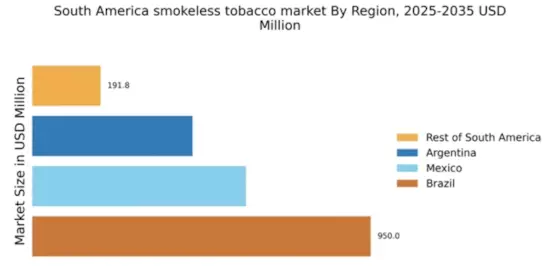
Brazil holds a commanding market share of 49.5% in the South American smokeless tobacco-treatment market, valued at $950.0 million. Key growth drivers include a rising awareness of health risks associated with traditional tobacco, coupled with government initiatives promoting smokeless alternatives. Demand trends indicate a shift towards less harmful products, supported by regulatory policies that encourage the use of smokeless tobacco. Infrastructure improvements in distribution channels further bolster market growth.

Mexico : Mexico's Evolving Tobacco Landscape

Mexico accounts for 31.6% of the South American market, valued at $600.0 million. The growth is driven by increasing urbanization and changing consumer preferences towards smokeless options. Regulatory frameworks are evolving, with the government focusing on public health campaigns that discourage smoking. The demand for smokeless tobacco is rising, particularly among younger demographics, as awareness of health risks grows.

Argentina : Argentina's Unique Market Dynamics

Argentina holds a 22.4% market share, valued at $450.0 million. The market is driven by a combination of cultural acceptance and increasing health awareness. Recent regulatory changes have aimed to restrict traditional tobacco use, inadvertently boosting smokeless alternatives. Demand is particularly strong in urban areas like Buenos Aires, where health campaigns are prevalent, influencing consumer behavior towards smokeless products.

Rest of South America : Regional Insights Across South America

The Rest of South America represents a smaller segment, with a market share of 9.2%, valued at $191.8 million. Growth is uneven, influenced by local regulations and cultural attitudes towards tobacco. Countries like Chile and Colombia show potential for smokeless tobacco, driven by increasing health awareness. The competitive landscape is fragmented, with local players gaining traction alongside international brands, adapting to regional preferences.

South America Smokeless Tobacco Treatment Market Regional Image

Key Players and Competitive Insights

The smokeless tobacco-treatment market in South America exhibits a dynamic competitive landscape, characterized by a blend of innovation and strategic maneuvering among key players. Major companies such as Altria Group (US), British American Tobacco (GB), and Philip Morris International (US) are actively shaping the market through various strategies. Altria Group (US) appears to focus on product diversification and the development of reduced-risk products, which aligns with the growing consumer demand for healthier alternatives. British American Tobacco (GB) emphasizes regional expansion and digital transformation, leveraging technology to enhance consumer engagement and streamline operations. Meanwhile, Philip Morris International (US) is heavily investing in sustainability initiatives, aiming to transition towards a smoke-free future, which resonates with the increasing regulatory pressures and consumer preferences for environmentally friendly products.

The business tactics employed by these companies reflect a concerted effort to optimize supply chains and localize manufacturing processes. The market structure is moderately fragmented, with several players vying for market share, yet the collective influence of these key companies is substantial. Their strategies not only enhance operational efficiencies but also foster competitive advantages that are crucial in a rapidly evolving market landscape.

In October 2025, Altria Group (US) announced a partnership with a local South American firm to enhance its distribution network, which is expected to significantly improve its market penetration and consumer reach. This strategic move underscores Altria's commitment to localizing its operations and adapting to regional market dynamics, potentially increasing its competitive edge in the smokeless tobacco-treatment sector.

In September 2025, British American Tobacco (GB) launched a new digital platform aimed at educating consumers about smokeless tobacco alternatives. This initiative not only positions the company as a thought leader in the market but also reflects a broader trend towards digital engagement, which is becoming increasingly vital in attracting and retaining consumers. The platform is likely to enhance brand loyalty and facilitate a deeper connection with the target audience.

In August 2025, Philip Morris International (US) unveiled a new sustainability initiative focused on reducing carbon emissions across its supply chain. This initiative is particularly significant as it aligns with global sustainability goals and addresses the growing consumer demand for responsible corporate practices. By prioritizing sustainability, Philip Morris is not only enhancing its brand image but also positioning itself favorably in a market that is increasingly influenced by environmental considerations.

As of November 2025, the competitive trends in the smokeless tobacco-treatment market are increasingly defined by digitalization, sustainability, and technological integration. Strategic alliances are becoming more prevalent, as companies recognize the value of collaboration in navigating complex market challenges. Looking ahead, competitive differentiation is likely to evolve from traditional price-based competition towards innovation, technology adoption, and supply chain reliability. This shift suggests that companies that prioritize these areas will be better positioned to thrive in an increasingly competitive environment.

Key Companies in the South America Smokeless Tobacco Treatment Market market include

Industry Developments

The South America Smokeless Tobacco Treatment Market has experienced several notable developments recently. As of October 2023, Bristol-Myers Squibb has been focusing on expanding its health product lines aimed at tobacco cessation, contributing to the market's growth in Brazil and Argentina.

Swedish Match and British American Tobacco are also increasing their investments in smokeless tobacco alternatives as consumers seek less harmful options, reflecting a shift driven by health awareness campaigns in the region.

In September 2023, Altria Group announced a collaboration with MediSprout to develop digital health tools aimed at supporting users in quitting smokeless tobacco, showing a trend towards integrating technology into treatment methods.

Furthermore, in August 2023, Philip Morris International revealed plans to enhance its portfolio with new smokeless products tailored for South American consumers, indicating a strong market potential. Growth was also noted in the valuation of Mylan after its launch of a new smokeless tobacco treatment product, highlighting positive responses from local markets.

Over the past two years, there has been a growing emphasis on smokeless tobacco reduction strategies, especially in key markets like Brazil and Argentina, which are working toward comprehensive tobacco control policies.

Future Outlook

South America Smokeless Tobacco Treatment Market Future Outlook

The Smokeless Tobacco Treatment Market is projected to grow at 3.65% CAGR from 2024 to 2035, driven by increasing health awareness and regulatory support.

New opportunities lie in:

  • Development of mobile health applications for user engagement
  • Expansion of telehealth services for remote consultations
  • Partnerships with local retailers for product distribution

By 2035, the market is expected to achieve substantial growth and enhanced accessibility.

Market Segmentation

South America Smokeless Tobacco Treatment Market Form Outlook

  • Dry
  • Moist

South America Smokeless Tobacco Treatment Market Type Outlook

  • Dissolvable Tobacco
  • Chewing tobacco (twist, chew bags, loose-leaf, plug, and others)
  • Dipping Tobacco (dry snuff and moist snuff)

South America Smokeless Tobacco Treatment Market Route Outlook

  • Nasal
  • Oral

Report Scope

MARKET SIZE 20242191.8(USD Million)
MARKET SIZE 20252271.8(USD Million)
MARKET SIZE 20353250.0(USD Million)
COMPOUND ANNUAL GROWTH RATE (CAGR)3.65% (2024 - 2035)
REPORT COVERAGERevenue Forecast, Competitive Landscape, Growth Factors, and Trends
BASE YEAR2024
Market Forecast Period2025 - 2035
Historical Data2019 - 2024
Market Forecast UnitsUSD Million
Key Companies Profiled["Altria Group (US)", "British American Tobacco (GB)", "Reynolds American (US)", "Swedish Match (SE)", "Philip Morris International (US)", "Japan Tobacco (JP)", "Imperial Brands (GB)", "Djarum (ID)", "ITC Limited (IN)"]
Segments CoveredType, Form, Route
Key Market OpportunitiesEmerging digital health solutions enhance accessibility and engagement in the smokeless tobacco-treatment market.
Key Market DynamicsRising consumer awareness drives demand for innovative smokeless tobacco-treatment solutions in South America.
Countries CoveredBrazil, Mexico, Argentina, Rest of South America

Leave a Comment

FAQs

What is the projected market size of the South America Smokeless Tobacco Treatment Market in 2024?

The South America Smokeless Tobacco Treatment Market is expected to be valued at 1.48 USD Billion in 2024.

What will the market value be in 2035?

By 2035, the South America Smokeless Tobacco Treatment Market is projected to reach 2.22 USD Billion.

What is the expected CAGR for the South America Smokeless Tobacco Treatment Market from 2025 to 2035?

The market is anticipated to grow at a CAGR of 3.719% from 2025 to 2035.

Which region holds the largest market share in the South America Smokeless Tobacco Treatment Market?

Brazil is the dominant region in the market, valued at 0.65 USD Billion in 2024.

What will be the market size for Mexico in 2035?

The market size for Mexico is expected to reach 0.58 USD Billion by 2035.

Who are the key players in the South America Smokeless Tobacco Treatment Market?

Major players in the market include BristolMyers Squibb, Swedish Match, and British American Tobacco.

What is the market size for chewing tobacco in 2024?

The market for chewing tobacco is valued at 0.52 USD Billion in 2024.

What is the growth outlook for snuff/dipping tobacco by 2035?

Snuff/dipping tobacco is expected to grow to 0.63 USD Billion by 2035.

What are the expected values for dissolvable tobacco and Varenicline in 2024?

Dissolvable tobacco is valued at 0.24 USD Billion and Varenicline at 0.30 USD Billion in 2024.

What challenges and opportunities exist in the South America Smokeless Tobacco Treatment Market?

The market faces challenges related to regulation while presenting opportunities for innovation and differentiated products.

Download Free Sample

Kindly complete the form below to receive a free sample of this Report

Compare Licence

×
Features License Type
Single User Multiuser License Enterprise User
Price $4,950 $5,950 $7,250
Maximum User Access Limit 1 User Upto 10 Users Unrestricted Access Throughout the Organization
Free Customization
Direct Access to Analyst
Deliverable Format
Platform Access
Discount on Next Purchase 10% 15% 15%
Printable Versions