×
Request Free Sample ×

Kindly complete the form below to receive a free sample of this Report

Leading companies partner with us for data-driven Insights

clients tt-cursor
Hero Background

South America Surgical Navigation Systems Market

ID: MRFR/MED/47878-HCR
200 Pages
Rahul Gotadki
October 2025

South America Surgical Navigation Systems Market Research Report By Technology (Electromagnetic Navigation Systems, Optical Navigation Systems, Intraoperative Imaging Navigation Systems, Hybrid Navigation Systems), By Application (Orthopedic Surgeries, Neurosurgeries, ENT Surgeries, Dental Surgeries), By End Use (Hospitals, Ambulatory Surgical Centers, Academic and Research Institutes), By Product Type (Hardware, Software, Services) and By Regional (Brazil, Mexico, Argentina, Rest of South America)-Forecast to 2035

Share:
Download PDF ×

We do not share your information with anyone. However, we may send you emails based on your report interest from time to time. You may contact us at any time to opt-out.

South America Surgical Navigation Systems Market Infographic
Purchase Options

South America Surgical Navigation Systems Market Summary

As per MRFR analysis, the South America surgical navigation systems market size was estimated at 173.09 USD Million in 2024. The South America surgical navigation-systems market is projected to grow from 176.9 USD Million in 2025 to 220.0 USD Million by 2035, exhibiting a compound annual growth rate (CAGR) of 2.2% during the forecast period 2025 - 2035.

Key Market Trends & Highlights

The South America The surgical navigation systems market is poised for substantial growth. This growth is driven by technological advancements and increasing healthcare investments.

  • Brazil remains the largest market for surgical navigation systems, reflecting a robust healthcare infrastructure.
  • Mexico is emerging as the fastest-growing region, indicating a rising demand for advanced surgical technologies.
  • The market is witnessing a growing preference for minimally invasive procedures. These procedures enhance patient recovery and reduce hospital stays.
  • Key drivers include the rising prevalence of chronic diseases and government initiatives aimed at improving healthcare access.

Market Size & Forecast

2024 Market Size 173.09 (USD Million)
2035 Market Size 220.0 (USD Million)

Major Players

Medtronic (US), Stryker (US), Brainlab (DE), Zimmer Biomet (US), Siemens Healthineers (DE), Philips (NL), B. Braun (DE), Intuitive Surgical (US)

South America Surgical Navigation Systems Market Trends

The surgical navigation systems market is currently experiencing notable growth in South America. This growth is driven by advancements in technology and increasing demand for precision in surgical procedures. The integration of augmented reality and robotics into surgical navigation systems enhances the accuracy of operations. This, in turn, improves patient outcomes. Furthermore, the rising prevalence of chronic diseases necessitates more complex surgical interventions, which in turn fuels the adoption of sophisticated navigation systems. As healthcare facilities invest in modernizing their surgical capabilities, the market is poised for further expansion. In addition, the regulatory environment in South America is evolving, with governments emphasizing the importance of innovative medical technologies. This shift is likely to encourage manufacturers to introduce cutting-edge solutions tailored to the specific needs of the region. Moreover, collaborations between local healthcare providers and international technology firms may enhance the availability of advanced surgical navigation systems. Overall, The surgical navigation systems market appears to be on a promising trajectory. This reflects a commitment to improving surgical precision and patient care in South America.

Technological Advancements

The surgical navigation-systems market is witnessing rapid technological advancements, particularly in imaging and tracking technologies. Innovations such as real-time imaging and enhanced visualization tools are becoming increasingly prevalent, allowing surgeons to perform procedures with greater accuracy and efficiency. This trend is likely to continue as manufacturers strive to develop more sophisticated systems that integrate seamlessly with existing surgical workflows.

Increased Investment in Healthcare

Investment in healthcare infrastructure across South America is on the rise, which is positively impacting the surgical navigation-systems market. Governments and private entities are allocating more resources to upgrade medical facilities and acquire advanced surgical technologies. This influx of capital is expected to facilitate the adoption of navigation systems, ultimately enhancing surgical capabilities and patient outcomes.

Growing Demand for Minimally Invasive Procedures

There is a growing demand for minimally invasive surgical procedures in South America, which is driving the need for advanced navigation systems. These procedures often require precise navigation to ensure optimal results while minimizing patient recovery time. As more surgeons adopt minimally invasive techniques, the surgical navigation-systems market is likely to expand to meet this evolving demand.

South America Surgical Navigation Systems Market Drivers

Surge in Elderly Population

The demographic shift towards an aging population in South America is contributing to the growth of the surgical navigation systems market. As the elderly population increases, there is a corresponding rise in age-related health issues that often require surgical intervention. Reports suggest that by 2030, the proportion of individuals aged 65 and older in South America will reach approximately 15%. This demographic trend necessitates the use of advanced surgical techniques to address complex health conditions prevalent among older adults. Surgical navigation systems play a pivotal role in enhancing the accuracy and safety of surgeries performed on this vulnerable population. Consequently, the demand for these systems is expected to rise, as healthcare providers aim to improve surgical outcomes for elderly patients, thereby driving the surgical navigation-systems market forward.

Government Initiatives and Funding

Government initiatives aimed at improving healthcare infrastructure in South America are significantly impacting the surgical navigation-systems market. Various countries in the region are allocating funds to modernize healthcare facilities and enhance surgical capabilities. For instance, recent budgets indicate an increase in healthcare spending by approximately 10% in several South American nations. This financial support is directed towards acquiring advanced medical technologies, including surgical navigation systems. Such investments are crucial for improving surgical precision and patient outcomes. Furthermore, government programs that promote the adoption of innovative technologies in hospitals are likely to stimulate market growth. As a result, the surgical navigation-systems market is poised to benefit from these initiatives, leading to increased accessibility and utilization of advanced surgical technologies across the region.

Growing Awareness of Surgical Safety

There is a notable increase in awareness regarding surgical safety among healthcare professionals and patients in South America, which is positively influencing the surgical navigation-systems market. As surgical errors can lead to severe complications, the emphasis on safety protocols has intensified. Recent surveys indicate that approximately 75% of healthcare providers prioritize the implementation of technologies that enhance surgical safety. Surgical navigation systems are recognized for their ability to improve precision and reduce the likelihood of errors during procedures. This growing focus on safety is prompting hospitals and surgical centers to invest in navigation systems, thereby driving market growth. The surgical navigation systems market is expected to benefit from this heightened awareness. Stakeholders seek to adopt technologies that ensure better surgical outcomes.

Rising Prevalence of Chronic Diseases

The surgical navigation systems market in South America is experiencing growth. This growth is due to the increasing prevalence of chronic diseases such as cardiovascular disorders and diabetes. These conditions often necessitate complex surgical interventions, thereby driving the demand for advanced surgical navigation systems. According to health statistics, chronic diseases account for approximately 60% of all deaths in the region, highlighting the urgent need for effective surgical solutions. As healthcare providers seek to improve surgical outcomes and reduce complications, the adoption of navigation systems becomes essential. This trend indicates a shift towards more precise surgical techniques, which are facilitated by these advanced technologies. Consequently, the surgical navigation-systems market is likely to expand as hospitals and surgical centers invest in these systems to enhance their capabilities in managing chronic disease-related surgeries.

Technological Integration in Surgical Procedures

The integration of advanced technologies such as augmented reality (AR) and artificial intelligence (AI) into surgical procedures is reshaping the surgical navigation systems market in South America. These technologies enhance the capabilities of navigation systems, allowing for more precise and efficient surgical interventions. The adoption of AR and AI in surgical settings is projected to increase by approximately 20% over the next five years, as healthcare providers recognize the benefits of these innovations. This technological evolution not only improves surgical accuracy but also reduces the risk of complications during procedures. As a result, the surgical navigation-systems market is likely to expand as hospitals invest in these cutting-edge technologies to stay competitive and provide superior patient care.

Market Segment Insights

By Technology: Optical Navigation Systems (Largest) vs. Electromagnetic Navigation Systems (Fastest-Growing)

In the South America surgical navigation-systems market, Optical Navigation Systems hold the largest market share, attributed to their high precision and user-friendly features. Meanwhile, Electromagnetic Navigation Systems are rapidly gaining traction, driven by advancements in technology and increased demand for minimally invasive surgical procedures. Hybrid and Robotic-Assisted Navigation Systems also contribute to the market, but their share remains smaller compared to these leading technologies. The growth trends in this segment indicate a shift towards integrated and robotic-assisted solutions. Increasing investments in healthcare infrastructure, along with the rising incidence of surgical procedures, serve as significant growth drivers. As medical professionals increasingly adopt innovative technologies, the adoption rates for Electromagnetic Navigation Systems are expected to surge, positioning them as a key player in the market.

Technology: Optical Navigation Systems (Dominant) vs. Electromagnetic Navigation Systems (Emerging)

Optical Navigation Systems are characterized by their high accuracy and dependability, making them the dominant choice among surgeons for various procedures, including orthopedic and neurosurgery. Their robust functionality in tracking instruments with minimal interference showcases their advantages in complex surgeries. In contrast, Electromagnetic Navigation Systems, although emerging, are becoming increasingly popular due to their versatility and ability to operate in real-time without the need for line-of-sight. This adaptability makes them ideal for diverse surgical applications and appeals to a broader range of healthcare facilities, particularly as the demand for minimally invasive techniques rises.

By Application: Orthopedics (Largest) vs. Neurosurgery (Fastest-Growing)

In the South America surgical navigation-systems market, Orthopedics holds the largest market share due to its widespread adoption and essential applications in joint surgeries and complex orthopedic procedures. It is followed by Neurosurgery, which has been gaining traction rapidly and is expected to expand significantly as advancements in technology and increasing demand for minimally invasive procedures propel its adoption. ENT Surgery, Spinal Surgery, and Cardiac Surgery are emerging but haven’t captured as substantial market shares as the leading segments. The growth trends in this segment are driven by the increasing prevalence of orthopedic disorders and neurological conditions in the region. Additionally, the rising awareness and investment in healthcare facilities emphasize the integration of advanced surgical navigation systems. As technology evolves, surgeons are leveraging these tools to enhance precision and outcomes during surgeries, subsequently leading to improved patient recovery experiences and ultimately boosting segment growth.

Orthopedics (Dominant) vs. Neurosurgery (Emerging)

Orthopedics is primarily characterized by well-established practices and equipment that improve surgical accuracy, making it a fundamental aspect of surgical navigation systems in the region. With advanced imaging and real-time data, orthopedic surgeries utilize navigation systems to enhance procedural effectiveness. In contrast, Neurosurgery, while emerging, showcases rapid growth potential driven by technological advancements and a rising number of neurological surgeries. The integration of navigation systems in Neurosurgery enhances the precision of operations on critical brain structures, facilitating safer and more effective treatments. Both segments reflect significant adaptability and responsiveness to the evolving healthcare landscape, laying a strong foundation for future market expansion.

By End Use: Hospitals (Largest) vs. Ambulatory Surgical Centers (Fastest-Growing)

In the surgical navigation systems market, hospitals account for the largest share, significantly influencing market dynamics. Ambulatory surgical centers, on the other hand, are rapidly gaining ground due to an increase in outpatient surgeries and the rising demand for minimally invasive procedures. Research institutions are also contributing but remain a smaller segment in comparison to the other two. Growth in this segment is driven by technological advancements and an increase in the adoption of digital health solutions. Hospitals are enhancing their surgical capabilities with advanced navigation systems to improve surgical outcomes. In contrast, ambulatory surgical centers are emerging as pivotal players, as more patients opt for less invasive surgical options that allow for quicker recovery, thereby boosting the demand for sophisticated navigation solutions.

Hospitals (Dominant) vs. Ambulatory Surgical Centers (Emerging)

Hospitals serve as the dominant force in the surgical navigation systems market, characterized by their extensive infrastructure and access to advanced technologies, thereby ensuring high-quality patient care and surgical precision. They invest significantly in innovative solutions to enhance operational efficiency and surgical outcomes. On the other hand, ambulatory surgical centers represent an emerging market segment, prioritizing convenience and cost-effectiveness. With a focus on outpatient procedures, these centers are increasingly adopting surgical navigation systems to improve accuracy and reduce recovery times, reflecting a shift in patient preferences toward less invasive interventions.

By Component: Hardware (Largest) vs. Software (Fastest-Growing)

In the South America surgical navigation-systems market, the component segment reveals distinct characteristics among its primary values: hardware, software, and services. Hardware stands out as the largest segment, driven by the high demand for advanced surgical instruments and systems that enhance precision and effectiveness in procedures. The software segment, while smaller, exhibits rapid growth as medical facilities increasingly adopt integrated solutions to improve workflow efficiency and patient outcomes. Growth trends in the South America surgical navigation-systems market are significantly influenced by technological advancements and increasing investment in healthcare infrastructure. The software segment is particularly boosted by the need for innovative applications that support enhanced surgical planning and real-time imaging. Additionally, the ongoing rise in minimally invasive surgeries propels both hardware and software demand, positioning them favorably for future expansion in a competitive healthcare landscape.

Hardware (Dominant) vs. Software (Emerging)

The hardware component in the surgical navigation-systems market is regarded as dominant due to its critical role in ensuring successful surgical interventions. This segment includes advanced imaging systems and navigation tools that facilitate precision in complex surgeries. Conversely, the software segment is emerging as a vital player, fueled by the incorporation of AI and machine learning technologies that provide surgeons with enhanced decision-making capabilities and streamlined processes. With healthcare systems increasingly prioritizing digital transformation, software solutions are being developed to offer scalable applications that cater to diverse surgical needs. Both segments are essential in driving innovation and improving patient outcomes, yet hardware remains integral to the operational foundation of surgical procedures.

Get more detailed insights about South America Surgical Navigation Systems Market

Regional Insights

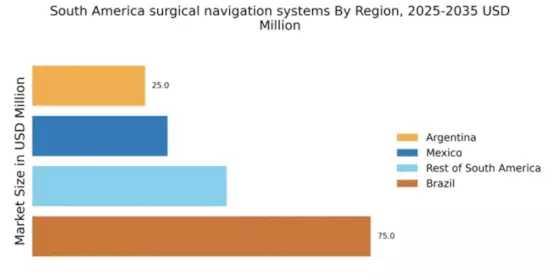
Brazil : Brazil's Surgical Navigation Growth Surge

Brazil holds a commanding 75.0% market share in the surgical navigation systems sector, valued at approximately $300 million. Key growth drivers include increasing healthcare investments, a rising number of surgical procedures, and advancements in technology. Government initiatives aimed at improving healthcare infrastructure and regulatory support for innovative medical devices further bolster demand. The trend towards minimally invasive surgeries is also shaping consumption patterns, leading to higher adoption rates of navigation systems.

Mexico : Mexico's Surgical Navigation Expansion

Mexico accounts for a 30.0% share of the South American surgical navigation market, valued at around $120 million. The growth is driven by increasing healthcare expenditure, a growing elderly population, and a rise in chronic diseases necessitating surgical interventions. Regulatory frameworks are becoming more favorable, with initiatives to streamline the approval process for medical devices. The demand for advanced surgical technologies is also on the rise, reflecting changing consumption patterns.

Argentina : Argentina's Navigational Systems Market

Argentina holds a 25.0% market share in surgical navigation systems, valued at approximately $80 million. Key growth drivers include a focus on improving surgical outcomes and the adoption of advanced technologies in healthcare. However, economic challenges and regulatory hurdles can impact market dynamics. The government is working on policies to enhance healthcare access, which may positively influence demand for surgical navigation systems in the future.

Rest of South America : Navigational Systems Across South America

The Rest of South America represents a 43.09% market share in surgical navigation systems, valued at about $150 million. This diverse region shows varying demand trends influenced by local healthcare policies and economic conditions. Countries like Chile and Colombia are emerging markets with increasing investments in healthcare infrastructure. The competitive landscape includes major players like Siemens Healthineers and Philips, who are adapting to local market dynamics and sector-specific applications.

South America Surgical Navigation Systems Market Regional Image

Key Players and Competitive Insights

The surgical navigation-systems market in South America is characterized by a dynamic competitive landscape, driven by technological advancements and increasing demand for precision in surgical procedures. Key players such as Medtronic (US), Stryker (US), and Brainlab (DE) are at the forefront, each adopting distinct strategies to enhance their market presence. Medtronic (US) focuses on innovation through the development of advanced navigation technologies, while Stryker (US) emphasizes strategic partnerships to expand its product offerings. Brainlab (DE) is leveraging digital transformation to enhance its software solutions, thereby positioning itself as a leader in integrated surgical navigation systems. Collectively, these strategies contribute to a competitive environment that is increasingly focused on technological differentiation and customer-centric solutions.

In terms of business tactics, companies are localizing manufacturing and optimizing supply chains to better serve the South American market. The competitive structure appears moderately fragmented, with several players vying for market share. However, the influence of major companies is significant, as they set industry standards and drive innovation. This competitive dynamic encourages smaller firms to innovate or seek partnerships to remain relevant in the market.

In October 2025, Medtronic (US) announced the launch of its latest surgical navigation system, which integrates augmented reality (AR) technology to enhance surgical precision. This strategic move is likely to position Medtronic as a leader in the market, as AR technology is increasingly recognized for its potential to improve surgical outcomes. The introduction of this system may also stimulate further innovation among competitors, as they seek to match or exceed Medtronic's advancements.

In September 2025, Stryker (US) entered into a partnership with a local South American healthcare provider to enhance the distribution of its navigation systems. This collaboration is strategically important as it allows Stryker to leverage local expertise and improve its market penetration. By aligning with established healthcare networks, Stryker can better address regional needs and preferences, potentially increasing its market share in the competitive landscape.

In August 2025, Brainlab (DE) expanded its software capabilities by acquiring a local tech startup specializing in AI-driven surgical solutions. This acquisition is indicative of Brainlab's commitment to integrating artificial intelligence into its navigation systems, which could significantly enhance the functionality and efficiency of surgical procedures. The move not only strengthens Brainlab's product portfolio but also positions it to capitalize on the growing trend of AI integration in healthcare.

As of November 2025, the competitive trends in the surgical navigation-systems market are increasingly defined by digitalization, sustainability, and the integration of AI technologies. Strategic alliances are becoming more prevalent, as companies recognize the value of collaboration in driving innovation and expanding their reach. Looking ahead, competitive differentiation is likely to evolve from traditional price-based competition to a focus on technological innovation, reliability in supply chains, and the ability to deliver tailored solutions that meet the specific needs of healthcare providers.

Key Companies in the South America Surgical Navigation Systems Market market include

Industry Developments

In recent months, the South America Surgical Navigation Systems Market has experienced notable advancements, particularly in Brazil and Argentina, as healthcare institutions increasingly adopt advanced surgical technologies to enhance precision and patient outcomes. Companies like Medtronic, Stryker, and Zimmer Biomet have introduced innovative navigation solutions aimed at improving surgical efficacy in orthopedics and neurosurgery. In September 2023, Siemens Healthineers announced a partnership with local distributors to enhance its presence and customer service in the Brazilian market. Meanwhile, in July 2023, NeuroLogica launched a new portable imaging solution in Chile, further diversifying its product offerings in the region.

The market is seeing significant growth due to a rising geriatric population, increased healthcare spending, and an emphasis on minimally invasive procedures. Furthermore, the consistent investment in Research and Development has led companies like Philips Healthcare and Olympus Corporation to introduce cutting-edge technologies tailored to South American hospital requirements. The market is expected to continue expanding as healthcare policies evolve and technology adoption accelerates, reflecting a shift towards improved surgical training and navigation support for medical professionals.

Future Outlook

South America Surgical Navigation Systems Market Future Outlook

The Surgical Navigation Systems Market is projected to grow at a 2.2% CAGR from 2024 to 2035, driven by technological advancements and increasing surgical procedures.

New opportunities lie in:

  • Development of AI-driven navigation software for enhanced precision
  • Expansion of telemedicine solutions for remote surgical guidance
  • Partnerships with local hospitals for integrated navigation systems

By 2035, the market is expected to achieve substantial growth and innovation.

Market Segmentation

South America Surgical Navigation Systems Market End Use Outlook

  • Hospitals
  • Ambulatory Surgical Centers
  • Research Institutions

South America Surgical Navigation Systems Market Component Outlook

  • Hardware
  • Software
  • Services

South America Surgical Navigation Systems Market Technology Outlook

  • Optical Navigation Systems
  • Electromagnetic Navigation Systems
  • Hybrid Navigation Systems
  • Robotic-Assisted Navigation Systems

South America Surgical Navigation Systems Market Application Outlook

  • Orthopedics
  • Neurosurgery
  • ENT Surgery
  • Spinal Surgery
  • Cardiac Surgery

Report Scope

MARKET SIZE 2024173.09(USD Million)
MARKET SIZE 2025176.9(USD Million)
MARKET SIZE 2035220.0(USD Million)
COMPOUND ANNUAL GROWTH RATE (CAGR)2.2% (2024 - 2035)
REPORT COVERAGERevenue Forecast, Competitive Landscape, Growth Factors, and Trends
BASE YEAR2024
Market Forecast Period2025 - 2035
Historical Data2019 - 2024
Market Forecast UnitsUSD Million
Key Companies Profiled["Medtronic (US)", "Stryker (US)", "Brainlab (DE)", "Zimmer Biomet (US)", "Siemens Healthineers (DE)", "Philips (NL)", "B. Braun (DE)", "Intuitive Surgical (US)"]
Segments CoveredTechnology, Application, End Use, Component
Key Market OpportunitiesIntegration of advanced imaging technologies enhances precision in the surgical navigation-systems market.
Key Market DynamicsRising demand for advanced surgical navigation systems driven by technological innovations and regulatory support in South America.
Countries CoveredBrazil, Mexico, Argentina, Rest of South America

Leave a Comment

FAQs

What is the expected market size of the South America Surgical Navigation Systems Market in 2024?

The South America Surgical Navigation Systems Market is expected to be valued at 206.0 million USD in 2024.

What will be the market value of the South America Surgical Navigation Systems Market by 2035?

By 2035, the market is anticipated to reach a valuation of 550.0 million USD.

What is the expected CAGR for the South America Surgical Navigation Systems Market from 2025 to 2035?

The market is projected to grow at a CAGR of 9.338% from 2025 to 2035.

Which region holds the largest market share in the South America Surgical Navigation Systems Market?

Brazil holds the largest market share with a projected value of 70.0 million USD in 2024.

What are the market values for the key technologies by 2035?

In 2035, Electromagnetic Navigation Systems will be valued at 135.0 million USD, Optical Navigation Systems at 155.0 million USD, Intraoperative Imaging Navigation Systems at 110.0 million USD, and Hybrid Navigation Systems at 150.0 million USD.

Which key players dominate the South America Surgical Navigation Systems Market?

Major players in the market include Brainlab, Medtronic, Stryker, and Siemens Healthineers among others.

What are the projected market values for Mexico and Argentina in 2035?

By 2035, Mexico will have a market value of 130.0 million USD, while Argentina will reach 75.0 million USD.

How much is the Rest of South America expected to contribute to the market by 2035?

The Rest of South America is expected to contribute a market value of 165.0 million USD by 2035.

What challenges is the South America Surgical Navigation Systems Market facing?

Challenges include high costs of surgical navigation systems and limited awareness among healthcare providers.

What are the key growth drivers of the South America Surgical Navigation Systems Market?

Key growth drivers include advancements in technology, increasing surgical procedures, and a rising demand for minimally invasive surgeries.

Download Free Sample

Kindly complete the form below to receive a free sample of this Report

Compare Licence

×
Features License Type
Single User Multiuser License Enterprise User
Price $4,950 $5,950 $7,250
Maximum User Access Limit 1 User Upto 10 Users Unrestricted Access Throughout the Organization
Free Customization
Direct Access to Analyst
Deliverable Format
Platform Access
Discount on Next Purchase 10% 15% 15%
Printable Versions