×
Request Free Sample ×

Kindly complete the form below to receive a free sample of this Report

* Please use a valid business email

Leading companies partner with us for data-driven Insights

clients tt-cursor
Hero Background

South America Theranostics Market

ID: MRFR/HC/43897-HCR
200 Pages
Garvit Vyas
October 2025

South America Theranostics Market Research Report By Application (Oncology, Neurology, Cardiology, Infectious Diseases), By Technology (Genomics, Proteomics, Metabolomics, Biomarkers), By End User (Hospitals, Diagnostic Laboratories, Research Institutes) and By Product Type (Instruments, Reagents, Software)- Forecast to 2035

Share:
Download PDF ×

We do not share your information with anyone. However, we may send you emails based on your report interest from time to time. You may contact us at any time to opt-out.

South America Theranostics Market Infographic
Purchase Options

South America Theranostics Market Summary

As per MRFR analysis, the South America theranostics market Size was estimated at 917.6 USD Million in 2024. The South America theranostics market is projected to grow from 1025.6 USD Million in 2025 to 3120.7 USD Million by 2035, exhibiting a compound annual growth rate (CAGR) of 11.77% during the forecast period 2025 - 2035.

Key Market Trends & Highlights

The South America theranostics market is poised for substantial growth driven by technological advancements and increasing demand for personalized medicine.

  • The integration of diagnostics and therapeutics is becoming a prominent trend in the South America theranostics market.
  • Brazil remains the largest market, while Mexico is recognized as the fastest-growing region in this sector.
  • There is a notable increase in awareness and education regarding theranostics among healthcare professionals and patients alike.
  • Rising incidence of chronic diseases and government initiatives are key drivers propelling market expansion.

Market Size & Forecast

2024 Market Size 917.6 (USD Million)
2035 Market Size 3120.7 (USD Million)
CAGR (2025 - 2035) 11.77%

Major Players

Roche (CH), Thermo Fisher Scientific (US), Abbott Laboratories (US), Siemens Healthineers (DE), Bristol-Myers Squibb (US), Merck KGaA (DE), Illumina (US), Qiagen (DE)

South America Theranostics Market Trends

The theranostics market in South America is currently experiencing a notable evolution, driven by advancements in personalized medicine and the increasing demand for targeted therapies. This region is witnessing a growing integration of diagnostic and therapeutic approaches, which enhances treatment efficacy and patient outcomes. The rise in chronic diseases, coupled with an aging population, is propelling the need for innovative solutions that can tailor treatments to individual patient profiles. Furthermore, collaborations between healthcare providers and research institutions are fostering the development of novel theranostic products, thereby expanding the market landscape. In addition, regulatory frameworks in South America are gradually adapting to accommodate the unique requirements of theranostics. This shift is likely to facilitate faster approvals for new therapies and diagnostics, encouraging investment in research and development. The increasing awareness among healthcare professionals and patients about the benefits of theranostics is also contributing to market growth. As the region continues to embrace these advancements, the theranostics market is poised for significant expansion, potentially transforming the healthcare landscape in South America.

Integration of Diagnostics and Therapeutics

The trend towards combining diagnostic and therapeutic modalities is becoming increasingly prominent in the theranostics market. This integration allows for more precise treatment plans tailored to individual patient needs, enhancing overall treatment effectiveness. As healthcare providers in South America adopt these innovative approaches, the demand for products that facilitate this integration is likely to rise.

Regulatory Adaptations

Regulatory bodies in South America are evolving to better support the unique challenges posed by theranostics. This adaptation may lead to streamlined approval processes for new diagnostic and therapeutic products, thereby encouraging innovation. As regulations become more favorable, companies are expected to invest more in the development of theranostic solutions.

Growing Awareness and Education

There is a noticeable increase in awareness regarding the benefits of theranostics among healthcare professionals and patients in South America. Educational initiatives aimed at informing stakeholders about the advantages of personalized medicine are gaining traction. This heightened awareness is likely to drive demand for theranostic products, further propelling market growth.

South America Theranostics Market Drivers

Government Initiatives and Funding

Government initiatives aimed at enhancing healthcare infrastructure and funding for research are crucial drivers of the theranostics market in South America. Various countries in the region are investing in healthcare reforms that prioritize personalized medicine and innovative treatment modalities. For example, Brazil has allocated approximately $500 million for research and development in biotechnology, which includes theranostics. Such investments not only foster innovation but also encourage collaboration between public and private sectors, facilitating the development of new theranostic products. As these initiatives gain momentum, they are expected to create a conducive environment for the growth of the theranostics market.

Rising Incidence of Chronic Diseases

The increasing prevalence of chronic diseases in South America is a pivotal driver for the theranostics market. Conditions such as cancer, diabetes, and cardiovascular diseases are on the rise, necessitating advanced diagnostic and therapeutic solutions. According to recent health statistics, cancer rates in South America have escalated, with projections indicating a potential increase of 20% in the next decade. This surge creates a demand for personalized medicine approaches, where theranostics plays a crucial role in tailoring treatments to individual patient profiles. The integration of diagnostic tools with therapeutic strategies not only enhances treatment efficacy but also improves patient outcomes, thereby propelling the growth of the theranostics market in the region.

Technological Advancements in Diagnostics

Technological innovations in diagnostic tools are significantly influencing the theranostics market in South America. The advent of next-generation sequencing (NGS), liquid biopsies, and advanced imaging techniques has revolutionized the way diseases are diagnosed and treated. These technologies enable earlier detection and more accurate characterization of diseases, which is essential for effective theranostic applications. For instance, the market for NGS is expected to grow at a CAGR of 15% over the next five years, reflecting the increasing adoption of these technologies in clinical settings. As healthcare providers in South America embrace these advancements, the demand for integrated diagnostic and therapeutic solutions is likely to expand, further driving the theranostics market.

Collaboration Between Academia and Industry

The collaboration between academic institutions and the biotechnology industry is emerging as a significant driver for the theranostics market in South America. Such partnerships facilitate the translation of research findings into practical applications, accelerating the development of innovative theranostic solutions. Universities and research centers are increasingly engaging with biotech firms to co-develop diagnostic tests and targeted therapies. This synergy not only enhances the research capabilities but also ensures that new products meet clinical needs effectively. As these collaborations expand, they are likely to contribute to the growth of the theranostics market, fostering an ecosystem that supports innovation and commercialization.

Increasing Demand for Personalized Medicine

The shift towards personalized medicine is reshaping the landscape of the theranostics market in South America. Patients and healthcare providers are increasingly recognizing the benefits of tailored treatment approaches that consider individual genetic and phenotypic characteristics. This trend is supported by a growing body of evidence suggesting that personalized therapies can lead to improved treatment outcomes and reduced adverse effects. As a result, the demand for theranostic solutions that integrate diagnostic and therapeutic components is on the rise. Market analysts project that the personalized medicine segment will account for over 30% of the total theranostics market by 2030, indicating a robust growth trajectory driven by this paradigm shift.

Market Segment Insights

By Application: Oncology (Largest) vs. Neurology (Fastest-Growing)

In the South America theranostics market, the application segment is primarily dominated by oncology, which commands a substantial portion of the market share. Oncology's significance stems from rising cancer prevalence and an increasing focus on personalized medicine, leading to innovative diagnostics and treatment options. Neurology follows as a notable player, reflecting growing awareness and investment in neurodegenerative disorders, thereby capturing a significant yet smaller share of the market. Growth trends in this segment are primarily driven by technological advancements in diagnostic tools and therapeutic approaches. The surge in oncology applications is fueled by a greater emphasis on precision medicine, improved imaging techniques, and biomarker discovery. In contrast, the neurology sector is witnessing a rapid escalation in research initiatives aimed at combating diseases such as Alzheimer's and Parkinson's, making it one of the fastest-growing areas in the thernostics landscape.

Oncology: Dominant vs. Neurology: Emerging

Oncology holds a dominant position in the application segment of theranostics, characterized by significant investment in research and development aimed at enhancing targeted therapies and diagnostics. This dominance is supported by an increased incidence of various cancers and a shift towards personalized treatment strategies that demand accurate diagnostic tools. Conversely, neurology is emerging as a crucial area of growth due to an acceleration in the understanding of neurological diseases and advancements in neuroimaging. The potential for growth in this sector is underscored by the increasing incidence of neurological disorders and a proactive push for innovation in treatment modalities, positioning neurology as a field ripe for development in the theranostics market.

By Technology: Genomics (Largest) vs. Proteomics (Fastest-Growing)

In the South America theranostics market, the technology segment is prominently led by Genomics, which captures the largest share among the values analyzed. This segment has solidified its position due to heightened investments in genetic research and personalized medicine. Meanwhile, Proteomics is emerging rapidly, showcasing significant potential driven by advancements in analytical techniques and biomarker discovery, making it a focal point for future growth. Growth trends within this segment indicate a robust increase in the adoption of Genomics technologies as healthcare systems prioritize precision medicine approaches. Proteomics is also witnessing an accelerating adoption rate, fueled by increasing research activities and a better understanding of proteins' roles in disease mechanisms. The combined advancements in these technologies underscore the dynamic nature of the theranostics landscape in South America, bolstered by collaborative efforts between academic institutions and biotech firms.

Technology: Genomics (Dominant) vs. Proteomics (Emerging)

Genomics clearly stands out as the dominant force in the technology segment, largely due to its established frameworks that support gene sequencing and analysis. This dominance is complemented by a growing base of clinical applications, which solidifies its relevance in diagnostics and treatment personalization. On the other hand, Proteomics, categorized as an emerging technology, is gaining traction through innovative approaches in understanding protein functions and interactions. Its growth is driven by the rising demand for more detailed molecular insights in diagnostics, providing an alternative or complementary pathway to genomic data. Both segment values are crucial as they offer diverse insights into theranostics, with Genomics leading in application breadth while Proteomics edges forward in specialization.

By End User: Hospitals (Largest) vs. Diagnostic Laboratories (Fastest-Growing)

In the South America theranostics market, hospitals hold the largest share of the end user segment, employing advanced theranostic solutions for patient care. Diagnostic laboratories, on the other hand, are rapidly expanding, leveraging cutting-edge technologies and methodologies that cater to an increasing demand for accurate diagnostics. Their growth trajectory is significantly influenced by a rise in chronic diseases and the need for personalized medicine. The growth trends showcase strategic investments in diagnostic laboratories, aiming to enhance capabilities for complex testing scenarios. Healthcare reforms and increased healthcare spending are also driving hospitals to adopt more sophisticated theranostic approaches. This momentum indicates an evolving landscape where hospitals remain dominant but diagnostic laboratories will play an essential role in shaping future market dynamics.

Hospitals (Dominant) vs. Diagnostic Laboratories (Emerging)

Hospitals represent the dominant end user segment, equipped with extensive facilities and access to comprehensive resources for implementing theranostics in patient care. Their reliance on advanced imaging and diagnostics technologies ensures that they remain at the forefront of personalized medicine initiatives. In contrast, diagnostic laboratories emerge as a crucial segment characterized by their adaptability and focus on innovation. They tend to collaborate with hospitals to provide specialized tests and services, making them an integral part of the healthcare ecosystem. As patient-centric approaches gain traction, the role of diagnostic laboratories is expected to expand, providing essential contributions to disease detection and management.

By Product Type: Instruments (Largest) vs. Reagents (Fastest-Growing)

The South America theranostics market is characterized by significant contributions from various product types. Instruments currently hold the largest share, driven by their essential role in diagnostics and therapy monitoring. Reagents follow closely behind, showing notable growth due to increasing demand for personalized medicine and targeted therapies. The market is witnessing an emphasis on advanced technologies and innovative solutions, with a diverse range of options available to healthcare providers. The growth trends within this segment are influenced by several factors including rising investments in research and development, the need for early detection of diseases, and the expanding application of theranostics in oncology. Additionally, government initiatives and collaborations are promoting the integration of advanced diagnostic tools in clinical practices. The rise in chronic diseases and the demand for tailored healthcare solutions are also propelling the demand for reagents, making it an emerging yet rapidly evolving segment of the market.

Instruments (Dominant) vs. Reagents (Emerging)

Instruments dominate the South America theranostics market due to their critical role in enabling precise and efficient diagnostic and therapeutic processes. These tools are foundational in the clinical workflow, supporting healthcare professionals in making informed decisions. On the other hand, reagents represent an emerging segment that is experiencing substantial growth driven by innovative applications in precision medicine. Reagents are integral for various assays and are witnessing increased adoption as healthcare systems shift towards personalized approaches. Both segments are essential, but while instruments provide stability, reagents are rapidly evolving with advancements in technology, thus shaping the future landscape of the market.

Get more detailed insights about South America Theranostics Market

Regional Insights

Brazil : Robust Growth and Innovation Hub

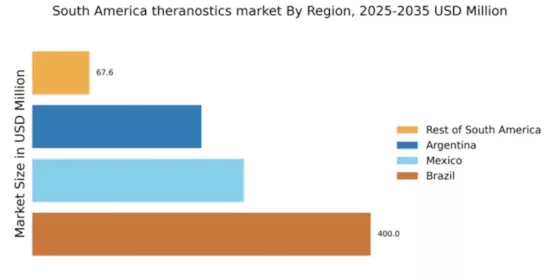
Brazil holds a dominant position in the South American theranostics market, accounting for 400.0 million, representing a significant market share. Key growth drivers include increasing investments in healthcare infrastructure, rising prevalence of chronic diseases, and government initiatives promoting personalized medicine. The demand for advanced diagnostic solutions is on the rise, supported by regulatory policies that encourage innovation and streamline approval processes for new therapies and diagnostics.

Mexico : Growing Demand and Investment Opportunities

Mexico's theranostics market is valued at 250.0 million, showcasing a growing share in the region. The market is driven by increasing healthcare expenditure, a rising aging population, and a focus on precision medicine. Regulatory frameworks are evolving to support the introduction of innovative therapies, while local initiatives aim to enhance healthcare delivery. The demand for personalized treatment options is also gaining traction among healthcare providers and patients alike.

Argentina : Focus on Personalized Medicine Solutions

Argentina's theranostics market is valued at 200.0 million, reflecting steady growth in the sector. Key growth drivers include an increasing focus on personalized medicine, rising healthcare investments, and a growing awareness of advanced diagnostic technologies. Regulatory bodies are working to streamline processes for new product approvals, fostering a conducive environment for innovation. The demand for targeted therapies is expected to rise, driven by the prevalence of chronic diseases.

Rest of South America : Diverse Opportunities Across Borders

The Rest of South America represents a smaller theranostics market, valued at 67.6 million. However, it offers unique growth opportunities driven by increasing healthcare investments and a rising demand for advanced diagnostics. Regulatory frameworks are gradually improving, encouraging local and international players to enter the market. Countries like Chile and Colombia are emerging as key markets, with a focus on enhancing healthcare infrastructure and access to innovative therapies.

South America Theranostics Market Regional Image

Key Players and Competitive Insights

The theranostics market in South America is characterized by a dynamic competitive landscape, driven by increasing demand for personalized medicine and advancements in diagnostic technologies. Key players such as Roche (CH), Thermo Fisher Scientific (US), and Abbott Laboratories (US) are strategically positioned to leverage their extensive portfolios and innovative capabilities. Roche (CH) focuses on integrating diagnostics with therapeutics, enhancing patient outcomes through tailored treatment plans. Meanwhile, Thermo Fisher Scientific (US) emphasizes its commitment to innovation, particularly in genomic and proteomic technologies, which are crucial for the development of theranostic applications. Abbott Laboratories (US) is also making strides in this area, concentrating on expanding its diagnostic offerings to support personalized healthcare solutions, thereby shaping a competitive environment that prioritizes innovation and patient-centric approaches.

The business tactics employed by these companies reflect a concerted effort to optimize operations and enhance market presence. Localizing manufacturing and optimizing supply chains are prevalent strategies, allowing for more efficient distribution and reduced costs. The market structure appears moderately fragmented, with several key players exerting influence while also facing competition from emerging firms. This fragmentation fosters a competitive atmosphere where innovation and strategic partnerships are essential for maintaining market share.

In October 2025, Roche (CH) announced a collaboration with a leading South American biotechnology firm to develop novel biomarkers for cancer therapies. This partnership is expected to enhance Roche's capabilities in personalized medicine, allowing for more precise treatment options tailored to individual patient profiles. Such strategic alliances are indicative of a broader trend towards collaboration in the industry, aimed at accelerating the development of innovative solutions.

In September 2025, Thermo Fisher Scientific (US) launched a new platform designed to streamline the integration of genomic data into clinical workflows. This initiative is significant as it addresses the growing need for efficient data management in theranostics, potentially improving patient outcomes through faster and more accurate diagnostics. The launch underscores Thermo Fisher's commitment to enhancing its technological offerings in a rapidly evolving market.

In August 2025, Abbott Laboratories (US) expanded its diagnostic portfolio by acquiring a South American company specializing in molecular diagnostics. This acquisition is likely to bolster Abbott's position in the theranostics market, enabling it to offer a more comprehensive range of diagnostic solutions. The move reflects a strategic focus on enhancing capabilities and expanding market reach, which is crucial in a competitive landscape.

As of November 2025, current trends in the theranostics market include a strong emphasis on digitalization, sustainability, and the integration of artificial intelligence (AI) into diagnostic processes. Strategic alliances are increasingly shaping the competitive landscape, facilitating the sharing of resources and expertise among key players. Looking ahead, it appears that competitive differentiation will evolve, with a shift from price-based competition to a focus on innovation, technological advancements, and supply chain reliability. This transition may redefine how companies position themselves in the market, emphasizing the importance of delivering value through cutting-edge solutions.

Key Companies in the South America Theranostics Market market include

Industry Developments

In recent months, the South America Theranostics Market has seen significant developments, particularly in the wake of the COVID-19 pandemic, which has accelerated interest in precision medicine and personalized treatment. Companies such as AbbVie, AstraZeneca, and Roche Holding have focused on expanding their theranostic offerings to address the rising demand for targeted therapies.

Notably, in June 2023, Pfizer announced a collaboration with local firms to enhance the adoption of novel theranostic solutions across Brazil and Argentina. Additionally, Novartis has been increasing its investments in South American markets to boost research and development activities, thereby enhancing therapeutic options in oncology and rare diseases.

Mergers and acquisitions have also made headlines; for example, Merck & Co. initiated discussions in April 2023 to merge its South American operations with a leading biotech firm to gain market access and enhance its product portfolio.

The overall growth in market valuation, driven by emerging partnerships and continuing advancements in diagnostics, is creating substantial opportunities for companies like Siemens Healthineers and Abbott Laboratories, forming a robust ecosystem for theranostics in the region. This environment is expected to stimulate further innovations and improve patient outcomes across South America.

Future Outlook

South America Theranostics Market Future Outlook

The Theranostics Market is projected to grow at 11.77% CAGR from 2024 to 2035, driven by advancements in personalized medicine, increasing demand for targeted therapies, and enhanced diagnostic technologies.

New opportunities lie in:

  • Development of integrated diagnostic-therapeutic platforms for personalized treatment plans.
  • Expansion of telemedicine services for remote patient monitoring and management.
  • Investment in AI-driven analytics for improved patient stratification and outcomes.

By 2035, the theranostics market is expected to achieve substantial growth, reflecting its critical role in healthcare.

Market Segmentation

South America Theranostics Market End User Outlook

  • Hospitals
  • Diagnostic Laboratories
  • Research Institutes

South America Theranostics Market Technology Outlook

  • Genomics
  • Proteomics
  • Metabolomics
  • Biomarkers

South America Theranostics Market Application Outlook

  • Oncology
  • Neurology
  • Cardiology
  • Infectious Diseases

South America Theranostics Market Product Type Outlook

  • Instruments
  • Reagents
  • Software

Report Scope

MARKET SIZE 2024917.6(USD Million)
MARKET SIZE 20251025.6(USD Million)
MARKET SIZE 20353120.7(USD Million)
COMPOUND ANNUAL GROWTH RATE (CAGR)11.77% (2024 - 2035)
REPORT COVERAGERevenue Forecast, Competitive Landscape, Growth Factors, and Trends
BASE YEAR2024
Market Forecast Period2025 - 2035
Historical Data2019 - 2024
Market Forecast UnitsUSD Million
Key Companies Profiled["Roche (CH)", "Thermo Fisher Scientific (US)", "Abbott Laboratories (US)", "Siemens Healthineers (DE)", "Bristol-Myers Squibb (US)", "Merck KGaA (DE)", "Illumina (US)", "Qiagen (DE)"]
Segments CoveredApplication, Technology, End User, Product Type
Key Market OpportunitiesEmerging personalized medicine trends drive growth in the theranostics market across South America.
Key Market DynamicsGrowing demand for personalized medicine drives innovation and investment in the theranostics market across South America.
Countries CoveredBrazil, Mexico, Argentina, Rest of South America

Leave a Comment

FAQs

What is the expected market size of the South America Theranostics Market by 2024?

The South America Theranostics Market is expected to be valued at 916.0 USD Million by the year 2024.

How much is the South America Theranostics Market expected to grow by 2035?

By 2035, the South America Theranostics Market is projected to reach a value of 3119.0 USD Million.

What is the expected CAGR for the South America Theranostics Market from 2025 to 2035?

The anticipated CAGR for the South America Theranostics Market from 2025 to 2035 is 11.783%.

Which application segment dominates the South America Theranostics Market?

Oncology is the dominant application segment, expected to be valued at 400.0 USD Million in 2024 and 1400.0 USD Million by 2035.

What market share does the Neurology segment hold in the South America Theranostics Market?

The Neurology segment is projected to reach 250.0 USD Million in 2024 and 850.0 USD Million in 2035.

How does the Cardiology segment contribute to the South America Theranostics Market?

The Cardiology segment is expected to be valued at 180.0 USD Million in 2024 and 630.0 USD Million by 2035.

What are the key players in the South America Theranostics Market?

Major players in the market include AbbVie, AstraZeneca, Bristol-Myers Squibb, and Merck & Co.

What is the expected market value for the Infectious Diseases segment by 2035?

The Infectious Diseases segment is forecasted to reach a valuation of 239.0 USD Million by 2035.

What are the growth drivers for the South America Theranostics Market?

The growth of the South America Theranostics Market is driven by advancements in personalized medicine and increasing prevalence of chronic diseases.

How might regional developments affect the South America Theranostics Market?

Regional developments and healthcare policy changes may significantly influence the growth trajectory of the South America Theranostics Market.

Download Free Sample

Kindly complete the form below to receive a free sample of this Report

Compare Licence

×
Features License Type
Single User Multiuser License Enterprise User
Price $4,950 $5,950 $7,250
Maximum User Access Limit 1 User Upto 10 Users Unrestricted Access Throughout the Organization
Free Customization
Direct Access to Analyst
Deliverable Format
Platform Access
Discount on Next Purchase 10% 15% 15%
Printable Versions