×
Request Free Sample ×

Kindly complete the form below to receive a free sample of this Report

* Please use a valid business email

Leading companies partner with us for data-driven Insights

clients tt-cursor
Hero Background

South Korea Ai In Iot Market

ID: MRFR/ICT/63681-HCR
200 Pages
Aarti Dhapte
October 2025

South Korea AI in IoT Market Research Report By Component (Platforms, Software Solutions, Services), By Technologies (ML and Deep Learning, NLP), and By Vertical (Manufacturing, Energy and Utilities, Transportation and Mobility, BFSI, Government and Defense, Retail, Healthcare and Life Sciences, Telecom, Others)- Forecast to 2035

Share:
Download PDF ×

We do not share your information with anyone. However, we may send you emails based on your report interest from time to time. You may contact us at any time to opt-out.

South Korea Ai In Iot Market Infographic
Purchase Options

South Korea Ai In Iot Market Summary

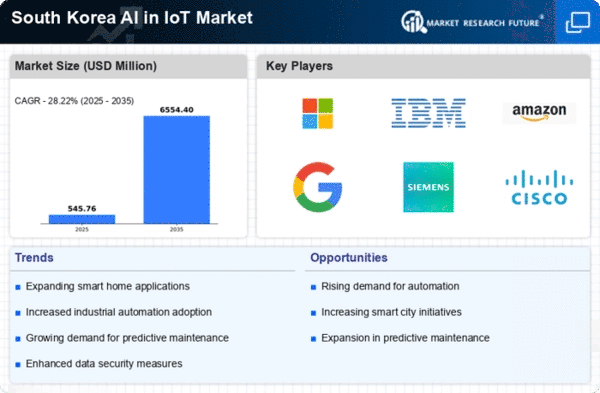
As per MRFR analysis, the South Korea AI in IoT Market Size was estimated at 425.64 USD Million in 2024. The South Korea ai in-iot market is projected to grow from 545.76 USD Million in 2025 to 6554.4 USD Million by 2035, exhibiting a compound annual growth rate (CAGR) of 28.22% during the forecast period 2025 - 2035.

Key Market Trends & Highlights

The South Korea AI in-IoT market is experiencing robust growth driven by technological advancements and increasing consumer demand.

  • The largest segment in the South Korea AI in-IoT market is the smart home devices sector, which is witnessing accelerated adoption.
  • The fastest-growing segment is anticipated to be industrial IoT solutions, reflecting a shift towards automation in manufacturing.
  • Government initiatives and support are fostering innovation and investment in AI and IoT technologies across various sectors.
  • Rising demand for automation and enhanced connectivity infrastructure are key drivers propelling market expansion.

Market Size & Forecast

2024 Market Size 425.64 (USD Million)
2035 Market Size 6554.4 (USD Million)
CAGR (2025 - 2035) 28.22%

Major Players

Microsoft (US), IBM (US), Amazon (US), Google (US), Siemens (DE), Cisco (US), Intel (US), Qualcomm (US), SAP (DE)

South Korea Ai In Iot Market Trends

The AI in IoT Market is currently experiencing a transformative phase, driven by advancements in artificial intelligence and the proliferation of Internet of Things devices. In South Korea, the integration of these technologies is reshaping various sectors, including manufacturing, healthcare, and smart cities. The government has been actively promoting initiatives to enhance digital infrastructure, which appears to facilitate the growth of this market. As a result, businesses are increasingly adopting ai solutions to optimize operations and improve efficiency. This trend suggests a strong alignment between technological innovation and economic development in the region. Moreover, the demand for smart devices and connected systems is on the rise, as consumers seek enhanced convenience and automation in their daily lives. The ai in-iot market is likely to benefit from this consumer shift, with companies investing in research and development to create more sophisticated applications. The emphasis on data security and privacy is also becoming more pronounced, as stakeholders recognize the importance of safeguarding sensitive information in an interconnected environment. Overall, the ai in-iot market is poised for substantial growth, reflecting the dynamic interplay between technology and user needs.

Increased Adoption of Smart Devices

The trend towards smart devices is gaining momentum, as consumers and businesses alike seek to leverage the benefits of connectivity. This shift is evident in various sectors, including home automation and industrial applications, where the integration of ai technologies enhances functionality and user experience.

Focus on Data Security

As the ai in-iot market expands, concerns regarding data security are becoming more prominent. Stakeholders are increasingly prioritizing the implementation of robust security measures to protect sensitive information, which is crucial for maintaining consumer trust and ensuring compliance with regulations.

Government Initiatives and Support

The South Korean government is actively supporting the development of the ai in-iot market through various initiatives. These efforts include funding for research projects and the establishment of regulatory frameworks that encourage innovation, thereby fostering a conducive environment for market growth.

South Korea Ai In Iot Market Drivers

Increased Investment in R&D

Investment in research and development (R&D) is a pivotal driver for the AI in IoT Market in South Korea. Companies are allocating significant resources to innovate and develop new AI algorithms and IoT devices that can operate more efficiently and effectively. The South Korean government has also announced plans to invest approximately $1 billion in AI and IoT research by 2027, fostering collaboration between academia and industry. This focus on R&D is likely to accelerate advancements in the ai in-iot market, leading to the creation of cutting-edge technologies that can address complex challenges across various sectors.

Rising Demand for Automation

The AI in IoT Market in South Korea experiences a notable surge in demand for automation across various sectors. Industries such as manufacturing, logistics, and healthcare are increasingly integrating AI-driven IoT solutions to enhance operational efficiency. This trend is driven by the need to reduce labor costs and improve productivity. According to recent data, the automation market in South Korea is projected to grow at a CAGR of 10.5% from 2023 to 2028. As businesses seek to streamline processes, the ai in-iot market is positioned to benefit significantly from this shift towards automation, enabling real-time data analysis and decision-making.

Growing Focus on Smart Cities

The push towards smart city initiatives in South Korea significantly influences the AI in IoT Market. Government investments in urban infrastructure aim to enhance sustainability, efficiency, and quality of life for residents. The integration of AI and IoT technologies in areas such as traffic management, waste management, and energy consumption is becoming increasingly prevalent. Reports indicate that the smart city market in South Korea is expected to reach $30 billion by 2026, creating substantial opportunities for the ai in-iot market to thrive as cities adopt intelligent solutions to address urban challenges.

Enhanced Connectivity Infrastructure

The development of advanced connectivity infrastructure is a critical driver for the AI in IoT Market in South Korea. The rollout of 5G technology facilitates faster data transmission and lower latency, which are essential for the effective functioning of IoT devices. This enhanced connectivity allows for seamless integration of AI algorithms with IoT systems, leading to improved data analytics and operational insights. As of 2025, it is estimated that over 80% of South Korean households will have access to 5G networks, thereby expanding the potential user base for ai in-iot applications and services.

Rising Consumer Awareness and Adoption

Consumer awareness regarding the benefits of AI and IoT technologies is on the rise in South Korea, driving growth in the AI in IoT Market. As individuals become more informed about smart home devices, wearable technology, and connected appliances, the demand for these products is increasing. Market Research Future indicates that the smart home market in South Korea is projected to grow by 15% annually, reflecting a growing acceptance of AI-driven solutions. This trend suggests that as consumers embrace these technologies, the ai in-iot market will likely expand, offering innovative products that enhance daily life.

Market Segment Insights

By Component: Software Solutions (Largest) vs. Platforms (Fastest-Growing)

In the South Korea ai in-iot market, the distribution of market share shows that Software Solutions hold the largest share, driven by their integration capabilities and functionality. Platforms are also significant but are characterized by rapid growth, appealing to enterprises looking for robust solutions that enhance connectivity and data management. The increasing demand for automation and real-time analytics is propelling software offerings to the forefront, while platforms are gaining traction as businesses adopt more comprehensive IoT strategies. Growth trends in this segment are influenced by technological advancements and changing customer requirements. The need for scalability and interoperability among devices promotes the use of Software Solutions. On the other hand, Platforms are experiencing faster adoption rates due to the increasing number of IoT devices and applications. As organizations aim to leverage AI within IoT ecosystems, both segments are expected to evolve rapidly, highlighting the importance of innovation and adaptability in the marketplace.

Software Solutions: Dominant vs. Platforms: Emerging

Software Solutions dominate the market due to their extensive capabilities, addressing various needs such as analytics, security, and device management. Their integration with existing infrastructure allows enterprises to enhance efficiency and streamline operations. The software landscape is marked by continuous innovation, with features evolving to meet current technological demands. In contrast, Platforms are emerging strongly, with an emphasis on facilitating communication among diverse devices. They are designed to support large-scale implementations, catering to organizations looking for comprehensive management tools. As the South Korea ai in-iot market grows, the interaction between Software Solutions and Platforms will be pivotal in shaping the industry, driving further advancements and integration.

By Technologies: ML and Deep Learning (Largest) vs. NLP (Fastest-Growing)

In the South Korea ai in-iot market, ML and Deep Learning hold a significant share of the overall market, indicating its established position among technologies. This segment benefits from widespread applications across various industries, particularly in data processing and predictive analytics. Comparatively, NLP, though smaller in market share, is rapidly gaining traction, driven by the increasing demand for automation and enhanced user interaction through intelligent systems. The growth trends in the South Korea ai in-iot market are underscored by the ongoing advancements in machine learning frameworks and natural language processing techniques. With businesses striving for efficiency and sophistication in their operations, investments in these technologies are surging. Key drivers include the rise in IoT adoption, the need for real-time data insights, and the evolution of customer engagement strategies, which all significantly favor the expansion of both ML and Deep Learning, as well as NLP applications.

Technology: ML and Deep Learning (Dominant) vs. NLP (Emerging)

ML and Deep Learning are deemed the dominant technologies within the South Korea ai in-iot market, largely due to their versatility and ability to process large datasets for various applications such as automation and predictive modeling. ML techniques, fueled by deep learning advancements, are increasingly utilized across sectors like healthcare, finance, and manufacturing for enhanced operational efficiency. On the other hand, NLP is emerging as a crucial technology as organizations prioritize user-friendly interfaces and voice-activated systems. Its growth is driven by demand for better customer service solutions and applications in chatbots and virtual assistants, making it a key area to watch as enterprises transition towards more intuitive and responsive systems.

By Vertical: Manufacturing (Largest) vs. Healthcare and Life Sciences (Fastest-Growing)

The South Korea ai in-iot market exhibits a dynamic distribution of market share across various verticals. Manufacturing remains the largest segment, capitalizing on advancements in automation and smart factory solutions. Healthcare and Life Sciences, while currently smaller in share, represent a rapidly growing area, driven by increasing investments in telemedicine and health monitoring solutions enabled by AI and IoT technologies. Growth trends indicate that sectors such as Healthcare and Life Sciences are experiencing a surge due to heightened demand for remote patient monitoring and personalized medicine. Conversely, Manufacturing continues to innovate with IoT integration, enhancing production efficiency and predictive maintenance. Other sectors such as Transportation and Mobility and BFSI are also poised for growth, reflecting a broader digital transformation throughout the economy.

Manufacturing (Dominant) vs. Healthcare and Life Sciences (Emerging)

Manufacturing stands out as the dominant player in the South Korea ai in-iot market, leveraging its robust infrastructure and a strong push towards Industry 4.0. The sector incorporates AI-driven analytics to optimize supply chains and enhance production processes. In contrast, Healthcare and Life Sciences, while emerging, are gaining significant traction through AI-based diagnostic tools and IoT-enabled health devices. The rise in chronic diseases and the aging population are contributing to this growth, prompting healthcare providers to adopt advanced technologies for better patient outcomes. Both segments highlight the diverse opportunities within the market, showcasing how technological advancements are reshaping industry landscapes.

Get more detailed insights about South Korea Ai In Iot Market

Key Players and Competitive Insights

The ai in-iot market in South Korea is characterized by a dynamic competitive landscape, driven by rapid technological advancements and increasing demand for smart solutions across various sectors. Major players such as Microsoft (US), IBM (US), and Siemens (DE) are strategically positioning themselves through innovation and partnerships. Microsoft (US) focuses on enhancing its Azure IoT platform, integrating AI capabilities to provide comprehensive solutions for industries ranging from manufacturing to healthcare. IBM (US) emphasizes its Watson IoT platform, leveraging AI to optimize operations and improve decision-making processes. Siemens (DE) is heavily investing in digital transformation initiatives, particularly in smart manufacturing, which aligns with the growing trend of Industry 4.0. Collectively, these strategies foster a competitive environment that encourages continuous improvement and technological evolution.

Key business tactics within the ai in-iot market include localizing manufacturing and optimizing supply chains to enhance operational efficiency. The market structure appears moderately fragmented, with a mix of established players and emerging startups. This fragmentation allows for diverse offerings and innovation, as companies strive to differentiate themselves in a crowded marketplace. The influence of key players is substantial, as their investments in R&D and strategic partnerships shape market trends and consumer expectations.

In October 2025, Microsoft (US) announced a collaboration with a leading South Korean telecommunications provider to enhance IoT connectivity solutions. This partnership aims to leverage 5G technology to improve data transmission speeds and reliability for IoT applications. The strategic importance of this move lies in Microsoft's commitment to expanding its footprint in the South Korean market, positioning itself as a leader in next-generation IoT solutions.

In September 2025, IBM (US) launched a new AI-driven analytics tool specifically designed for the manufacturing sector. This tool aims to provide real-time insights into production processes, enabling manufacturers to optimize operations and reduce downtime. The introduction of this tool underscores IBM's focus on integrating AI into IoT applications, enhancing its competitive edge in the market.

In August 2025, Siemens (DE) unveiled a new smart factory initiative in South Korea, aimed at demonstrating the capabilities of its digital twin technology. This initiative showcases Siemens' commitment to advancing smart manufacturing solutions and highlights the potential for increased efficiency and sustainability in production processes. The strategic significance of this initiative is its ability to attract local partnerships and foster innovation within the region.

As of November 2025, current competitive trends in the ai in-iot market are heavily influenced by digitalization, sustainability, and the integration of AI technologies. Strategic alliances are increasingly shaping the landscape, as companies recognize the value of collaboration in driving innovation. Looking ahead, competitive differentiation is likely to evolve, with a shift from price-based competition to a focus on technological innovation, reliability in supply chains, and the ability to deliver tailored solutions. This transition may redefine market dynamics, emphasizing the importance of agility and responsiveness in meeting the evolving needs of consumers.

Key Companies in the South Korea Ai In Iot Market market include

Industry Developments

Naver's generative AI services were introduced in August 2023 with the ClovaX platform, which incorporates cutting-edge AI capabilities into a range of applications. Furthermore, in May 2025, Naver announced the creation of Naver Ventures, a company dedicated to finding AI talent and funding innovative AI firms in the United States.

SK Telecom announced notable progress in artificial intelligence in 2024 and restructured its business into seven major AI-focused units.In order to expedite the expansion of AI infrastructure in both local and foreign markets, SK Telecom established 'SKT GPUaaS' and opened the Gasan AI data center in December 2024 in collaboration with Lambda.For the first time by a Korean construction business, Daewoo E&C unveiled "AI Media Pagora," a cutting-edge rest area that blends art and artificial intelligence technology, in June 2025 as part of its flagship residential brand, Prugio Complex.

The software division of Hyundai Motor Group, 42dot, revealed plans in July 2025 to fund $500 billion ($360 million) through a rights sale in order to improve its software development and artificial intelligence capabilities. Hyundai Motor also unveiled 'Shucle,' a demand-responsive transportation platform that uses artificial intelligence (AI) to optimize vehicle operations in response to passenger demand in real time.With the support of its logistics and retail data, Coupang launched its new AI-focused intelligent cloud computing service in July 2025 with the goal of moving beyond logistics and retail into content and cloud services.

South Korea AI in IoT

Future Outlook

South Korea Ai In Iot Market Future Outlook

The AI in IoT Market is projected to grow at 28.22% CAGR from 2024 to 2035, driven by advancements in connectivity, data analytics, and automation technologies.

New opportunities lie in:

  • Development of AI-driven predictive maintenance solutions for industrial IoT devices.
  • Integration of smart sensors in agriculture for real-time data analytics.
  • Creation of AI-enhanced security systems for IoT networks to mitigate cyber threats.

By 2035, the market is expected to achieve substantial growth, driven by innovative applications and strategic investments.

Market Segmentation

South Korea Ai In Iot Market Vertical Outlook

  • Manufacturing
  • Energy and Utilities
  • Transportation and Mobility
  • BFSI
  • Government and Defense
  • Retail
  • Healthcare and Life Sciences
  • Telecom
  • Others (agriculture, education, telecom, and tourism and hospitality)

South Korea Ai In Iot Market Component Outlook

  • Platforms
  • Software Solutions
  • Services

South Korea Ai In Iot Market Technologies Outlook

  • ML and Deep Learning
  • NLP

Report Scope

MARKET SIZE 2024 425.64(USD Million)
MARKET SIZE 2025 545.76(USD Million)
MARKET SIZE 2035 6554.4(USD Million)
COMPOUND ANNUAL GROWTH RATE (CAGR) 28.22% (2024 - 2035)
REPORT COVERAGE Revenue Forecast, Competitive Landscape, Growth Factors, and Trends
BASE YEAR 2024
Market Forecast Period 2025 - 2035
Historical Data 2019 - 2024
Market Forecast Units USD Million
Key Companies Profiled Microsoft (US), IBM (US), Amazon (US), Google (US), Siemens (DE), Cisco (US), Intel (US), Qualcomm (US), SAP (DE)
Segments Covered Component, Technologies, Vertical
Key Market Opportunities Integration of advanced AI algorithms enhances predictive maintenance in the ai in-iot market.
Key Market Dynamics Rapid technological advancements drive competitive dynamics in the ai in-iot market, influencing consumer adoption and regulatory frameworks.
Countries Covered South Korea

Leave a Comment

FAQs

What is the expected market size of the South Korea AI in IoT Market in 2024?

The South Korea AI in IoT Market is expected to be valued at 372.4 USD Million in 2024.

What will the market size of the South Korea AI in IoT Market be in 2035?

In 2035, the market is anticipated to reach a value of 1186.4 USD Million.

What is the expected CAGR for the South Korea AI in IoT Market between 2025 and 2035?

The market is projected to grow at a CAGR of 11.109% from 2025 to 2035.

What are the major components of the South Korea AI in IoT Market?

The market is divided into Platforms, Software Solutions, and Services.

What is the projected value of Platforms in the South Korea AI in IoT Market for 2035?

Platforms are expected to be valued at 482.0 USD Million by 2035.

What will be the value of Software Solutions in the South Korea AI in IoT Market by 2035?

Software Solutions are projected to reach a value of 380.0 USD Million in 2035.

What is the expected market value of Services in the South Korea AI in IoT Market by 2035?

By 2035, Services are expected to grow to 324.4 USD Million.

Who are some of the key players in the South Korea AI in IoT Market?

Major players include Naver Corporation, SK Telecom, and Hyundai Motor Company, among others.

What is the largest segment within the South Korea AI in IoT Market as of 2024?

As of 2024, Platforms hold the largest segment with a value of 150.0 USD Million.

What trends are impacting the growth of the South Korea AI in IoT Market?

Key trends include increasing automation, enhanced connectivity, and smart technology adoption driving growth.

Download Free Sample

Kindly complete the form below to receive a free sample of this Report

Compare Licence

×
Features License Type
Single User Multiuser License Enterprise User
Price $4,950 $5,950 $7,250
Maximum User Access Limit 1 User Upto 10 Users Unrestricted Access Throughout the Organization
Free Customization
Direct Access to Analyst
Deliverable Format
Platform Access
Discount on Next Purchase 10% 15% 15%
Printable Versions