South Korea EU Simulation Software Market Segment Insights
EU Simulation Software Market Deployment Mode Insights
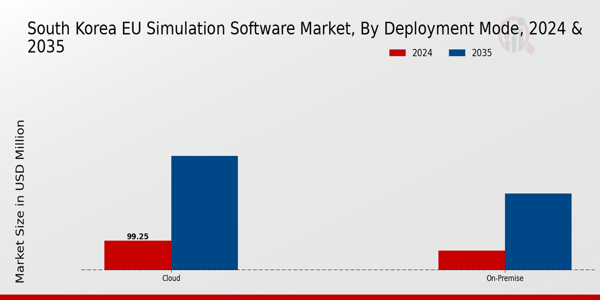
The South Korea EU Simulation Software Market is experiencing substantial growth, with Deployment Mode emerging as a critical segment driving this expansion. This segment consists of two primary approaches: On-Premise and Cloud deployment. Each method offers unique advantages that cater to varying needs of organizations. On-Premise deployment allows businesses to have complete control over their data and software environment, making it an attractive option for industries with stringent regulatory compliance requirements. This control often leads to enhanced security features, which are vital for sectors like finance and healthcare, where data sensitivity is paramount. In comparison, Cloud deployment is gaining significant traction among businesses due to its flexibility and cost-effectiveness.
By leveraging cloud infrastructure, companies can scale their resources up or down as needed, which is particularly beneficial for small and medium-sized enterprises. Furthermore, this approach supports remote access and collaboration across various teams, thereby enhancing productivity and efficiency. The integration of advanced technologies such as Artificial Intelligence and Machine Learning within cloud platforms is also propelling the adoption of this deployment mode, as these technologies offer enhanced analytics capabilities.The continuous digital transformation across South Korea is acting as a catalyst for the growth of both On-Premise and Cloud segments within the South Korea EU Simulation Software Market.
Businesses are increasingly investing in these deployment modes to streamline their operations and enhance their decision-making processes. The South Korean government has been actively promoting technological advancements and supporting the digital economy, which is likely to further stimulate the adoption of these deployment solutions.While both deployment modes play a vital role in the market, current trends show a shift towards Cloud solutions, largely driven by the need for agility and quick deployment times.
The competitive landscape is evolving as more vendors offer hybrid options, combining the strengths of both On-Premise and Cloud systems. Organizations are looking for deployment strategies that not only meet their immediate needs but also position them favorably for future changes in the digital landscape. Overall, the Deployment Mode segment is set to influence the South Korea EU Simulation Software Market significantly, aligning with broader trends in digital adoption and innovation across various industries.
Source: Primary Research, Secondary Research, MRFR Database and Analyst Review
EU Simulation Software Market Vertical Insights
The South Korea EU Simulation Software Market is a rapidly evolving landscape characterized by its diverse vertical segments. Within these segments, Automotive is a critical player, driven by advancements in electric and autonomous vehicle technology, enhancing design and testing processes. Aerospace and Defense also represent a significant portion of the market, focusing on simulation software to improve efficiency and safety in aircraft manufacturing and military operations. The Electrical and Electronics sector leverages simulation tools for product development and to optimize supply chains.In Healthcare and Pharmaceuticals, simulation software aids in drug discovery and patient management systems, facilitating faster and more accurate research outcomes.
The Oil and Gas Mining segment emphasizes the need for simulation tools to improve extraction methods and operational efficiency. Construction has increasingly adopted these technologies to simulate structural integrity and project timelines, while the Ship Building and Marine segment utilizes simulation for hydrodynamic testing and vessel performance optimization. Chemical industries benefit from simulation software to streamline processes and ensure safety compliance.Each of these segments, while unique in its applications, collectively underscores the growing importance of simulation tools in enhancing operational capabilities and maintaining competitiveness in the South Korean market.
EU Simulation Software Market Application Insights
The South Korea EU Simulation Software Market, particularly within the Application segment, has become a critical area of investment and innovation. This market includes essential domains like Product Engineering, Research and Development, and Gamification, each contributing significantly to the technological landscape in South Korea. Product Engineering is vital as it enhances product design and testing processes, enabling companies to achieve higher efficiency and quality. Research and Development takes center stage by fostering innovation and improving the accuracy of simulations, which is crucial for industries such as automotive and aerospace.
Meanwhile, Gamification is rapidly gaining traction as businesses recognize the potential to engage users and improve learning outcomes through interactive simulations. These applications are not only pivotal for tech-driven advancements but also align with South Korea's focus on becoming a global leader in technology and innovation. The increasingly competitive market environment and the emphasis on advanced simulation methodologies open doors for growth opportunities while also presenting challenges like the need for skilled professionals and the integration of new technologies in existing systems.Overall, the segmentation in the South Korea EU Simulation Software Market underscores the essential role these applications play in driving economic development and technological progress in the region.