South Korea Managed Network Services Market Segment Insights
Managed Network Services Market Service Type Insights
The South Korea Managed Network Services Market is characterized by a diversified range of service types that cater to various business needs and operational demands. Key segments include Managed LAN/WAN Networks, Managed Wi-Fi, Managed IP/VPN, Managed Network Monitoring, Managed Network Security, and Other Services. Each segment plays a pivotal role in the overall market, enhancing network efficiency, security, and accessibility for organizations. Managed LAN/WAN networks facilitate seamless communication and data transfer, significantly impacting productivity levels for businesses as connectivity remains a cornerstone of operational success in South Korea, where digital transformation is accelerating.Similarly, Managed Wi-Fi services are critical as organizations increasingly require reliable wireless connectivity, particularly given the growing trend of remote work and the rise in mobile device usage.
Managed IP/VPN solutions support secure data transmission and protect sensitive information, especially for businesses operating in sectors such as finance and healthcare, which are heavily regulated. Furthermore, Managed Network Monitoring services ensure that networks operate smoothly and efficiently, allowing organizations to proactively address potential issues before they disrupt operations.Meanwhile, the demand for Managed Network Security has grown rapidly in response to escalating cybersecurity threats, making it an essential service for protecting organizational assets and data integrity. Other Services offered within this segment provide tailored solutions to address specific organizational needs, enhancing the flexibility and customization available to businesses in South Korea.
In essence, these service types not only reflect the current trends within the South Korean digital landscape but also illustrate a broader commitment to improving business operations through managed services that prioritize security, efficiency, and connectivity amid a continuously evolving technological environment.The landscape of the South Korea Managed Network Services Market is fueled by the increasing reliance on digital solutions, necessitating advanced networking capabilities that these service types can effectively provide.
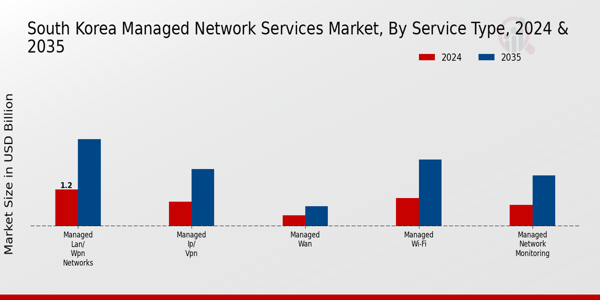
Source: Primary Research, Secondary Research, MRFR Database and Analyst Review
Managed Network Services Market Organization Size Insights
The Organization Size segment of the South Korea Managed Network Services Market presents distinct dynamics, primarily segmented into Small and Medium Enterprises (SMEs) and Large Enterprises. Small and Medium Enterprises often represent a significant portion of the market, as they increasingly look for cost-effective solutions to enhance their operational efficiency and competitiveness. These businesses, which are a backbone of the South Korean economy, benefit from managed network services that enable them to access advanced technologies without substantial upfront investments.On the other hand, Large Enterprises, with their complex infrastructures and higher data traffic, tend to dominate in terms of managed services utilization.
They require robust, scalable solutions that can accommodate their extensive operations and security needs. The trend towards digital transformation in South Korea is driving demand across both segments, with factors such as increased remote work and the need for enhanced cybersecurity creating ample opportunities for growth. However, SMEs may face challenges such as budget constraints and a lack of technical expertise, which makes the role of managed network services even more critical in leveling the playing field against larger competitors.Overall, the differentiation in needs between the two organization sizes presents a multifaceted landscape in the South Korea Managed Network Services Market, reflecting a blend of challenges and opportunities across varying scales of operation.
Managed Network Services Market Deployment Mode Insights
The Deployment Mode segment of the South Korea Managed Network Services Market is pivotal, observing a shift towards diverse technological preferences. The increasing adoption of On-Cloud solutions is significantly reshaping the landscape, driven by the demand for agility, cost-effectiveness, and seamless scalability. Many organizations in South Korea are leveraging cloud-based managed network services as they provide enhanced flexibility, allowing businesses to adapt quickly to changing market demands. On-Premises solutions, while also relevant, are favored for their control and security benefits, particularly among IT-sensitive industries.
This segmentation reflects a careful balance, with companies assessing their unique requirements regarding data sovereignty and operational capacity. The South Korean government has actively promoted digital infrastructure, which further fuels investments in both deployment modes. As enterprises work towards improving operational efficiency and performance, understanding the nuances of these deployment strategies becomes crucial in navigating the evolving South Korea Managed Network Services Market landscape. With the robust growth in the digital economy, these deployment options are not only gaining traction but also play a critical role in shaping the future of managed network services in South Korea.
Managed Network Services Market Vertical Insights
The South Korea Managed Network Services Market is characterized by its diverse vertical segment, which encompasses critical industries such as Banking, Financial Services, and Insurance (BFSI), IT and Telecommunications, Retail and E-Commerce, Manufacturing, Government, and Healthcare. Each of these sectors relies heavily on managed network services to enhance operational efficiency, security, and customer experience. For instance, the BFSI sector increasingly utilizes these services to ensure regulatory compliance and secure transactions, while the IT and Telecommunications industry leverages managed networks to support the rapid growth of digital communications and data consumption.
The Retail and E-Commerce segment benefits from robust network solutions that facilitate seamless online transactions and inventory management, thus improving customer satisfaction. Additionally, the Manufacturing sector is witnessing a shift towards smart factories that require reliable and scalable network services for automation and data analytics. The Government sector focuses on secure and resilient networks for public safety and citizen services, while Healthcare increasingly depends on managed services to safeguard sensitive patient data and enhance telehealth solutions.Overall, these sectors illustrate the critical role of managed network services in enabling growth, sustainability, and innovation within the South Korean economy.






















