×
Request Free Sample ×

Kindly complete the form below to receive a free sample of this Report

* Please use a valid business email

Leading companies partner with us for data-driven Insights

clients tt-cursor
Hero Background

South Korea mHealth Applications Market

ID: MRFR/HC/55247-HCR
200 Pages
Rahul Gotadki
October 2025

South Korea mHealth Applications Market Size, Growth Research Report By Type (Fitness and Wellness, Chronic Disease Management, Women's Health, Mental Health, Medication Management), By End-user (Consumers, Healthcare Providers, Pharmaceutical Companies, Insurance Companies), By Platform (iOS, Android, Web-based), and By Functionality (Monitoring, Diagnosis, Consultation, Treatment)– Competitor Industry Analysis and Trends Forecast Till 2035

Share:
Download PDF ×

We do not share your information with anyone. However, we may send you emails based on your report interest from time to time. You may contact us at any time to opt-out.

South Korea mHealth Applications Market Infographic
Purchase Options

South Korea mHealth Applications Market Summary

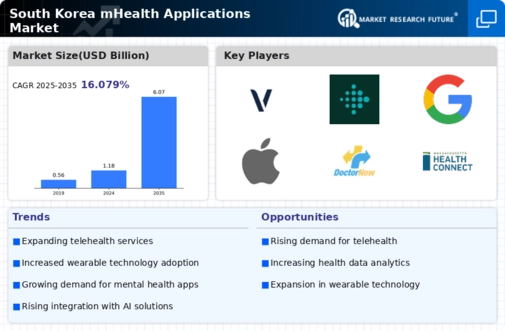
As per MRFR analysis, the mhealth applications market size was estimated at 1180.0 USD Million in 2024.. The mhealth applications market is projected to grow from 1371.04 USD Million in 2025 to 6150.0 USD Million by 2035, exhibiting a compound annual growth rate (CAGR) of 16.19% during the forecast period 2025 - 2035.

Key Market Trends & Highlights

The South Korea mhealth applications market is experiencing robust growth driven by technological advancements and increasing health awareness.

  • The market is witnessing an increased focus on preventive health, particularly in the chronic disease management segment.
  • Integration of AI and machine learning technologies is enhancing user engagement and personalization in mhealth applications.
  • Collaboration with healthcare providers is becoming more prevalent, facilitating better health outcomes and service delivery.
  • Rising smartphone penetration and government initiatives are key drivers propelling market expansion.

Market Size & Forecast

2024 Market Size 1180.0 (USD Million)
2035 Market Size 6150.0 (USD Million)
CAGR (2025 - 2035) 16.19%

Major Players

Apple Inc (US), Samsung Electronics (KR), Google LLC (US), Fitbit Inc (US), Philips Healthcare (NL), Cerner Corporation (US), McKesson Corporation (US), IBM Corporation (US), Allscripts Healthcare Solutions (US)

South Korea mHealth Applications Market Trends

The mhealth applications market in South Korea is experiencing notable growth, driven by the increasing adoption of smartphones and wearable devices among the population. This trend appears to be supported by a robust digital infrastructure and a tech-savvy consumer base that values health management through technology. The government has also shown interest in promoting digital health solutions, which may further enhance the market landscape. As individuals become more health-conscious, the demand for applications that facilitate remote monitoring, fitness tracking, and personalized health insights is likely to rise. Moreover, the integration of artificial intelligence and data analytics into mhealth applications suggests a shift towards more sophisticated health management tools. These innovations could potentially improve user engagement and health outcomes, as they provide tailored recommendations based on individual health data. The collaboration between healthcare providers and technology firms may also foster the development of comprehensive solutions that address various health needs. Overall, the mhealth applications market is poised for continued expansion, reflecting broader trends in digital health and consumer behavior in South Korea.

Increased Focus on Preventive Health

There is a growing emphasis on preventive health measures within the mhealth applications market. Users are increasingly seeking tools that help them monitor their health proactively, rather than reactively. This trend indicates a shift towards applications that provide insights into lifestyle choices, nutrition, and exercise, potentially leading to healthier living.

Integration of AI and Machine Learning

The incorporation of artificial intelligence and machine learning technologies into mhealth applications is becoming more prevalent. These advancements may enhance user experience by offering personalized health recommendations and predictive analytics, thereby improving overall health management.

Collaboration with Healthcare Providers

Partnerships between mhealth application developers and healthcare providers are on the rise. Such collaborations could facilitate the creation of integrated health solutions that allow for seamless communication between patients and providers, ultimately improving care delivery and patient outcomes.

South Korea mHealth Applications Market Drivers

Growing Health Awareness

The rising health awareness among the South Korean population is a significant driver for the mhealth applications market. With an increasing focus on personal health and wellness, individuals are more inclined to utilize mobile health applications to track their fitness, nutrition, and overall well-being. Surveys indicate that approximately 70% of South Koreans are now actively seeking ways to improve their health, which correlates with the growing adoption of mhealth solutions. This trend is further supported by the increasing prevalence of lifestyle-related diseases, prompting individuals to take charge of their health through technology. Consequently, the mhealth applications market will likely expand as more users turn to mobile platforms for health management., suggesting a potential market size increase to $1 billion by 2027.

Rising Smartphone Penetration

The increasing penetration of smartphones in South Korea is a pivotal driver for the mhealth applications market. As of 2025, smartphone ownership in the country is estimated to exceed 95%, facilitating easy access to mobile health solutions. This widespread adoption enables users to engage with various health applications, ranging from fitness tracking to chronic disease management. The convenience of mobile technology allows individuals to monitor their health metrics in real-time, thereby promoting proactive health management. Furthermore, the integration of advanced features in smartphones, such as biometric sensors, enhances the functionality of mhealth applications. This trend suggests that as smartphone usage continues to rise, the mhealth applications market will likely experience substantial growth, driven by an increasingly health-conscious population eager to leverage technology for better health outcomes.

Government Initiatives and Support

Government initiatives in South Korea play a crucial role in propelling the mhealth applications market. The South Korean government has been actively promoting digital health solutions through various policies and funding programs. For instance, the Ministry of Health and Welfare has allocated significant resources to support the development and implementation of mhealth technologies. This includes grants for startups and incentives for healthcare providers to adopt mobile health solutions. As a result, the mhealth applications market is witnessing increased innovation and a surge in new applications tailored to meet the needs of the population. The government's commitment to enhancing healthcare accessibility through technology indicates a favorable environment for mhealth applications, potentially leading to a market growth rate of over 20% annually in the coming years.

Increased Collaboration with Tech Companies

The mhealth applications market is experiencing a surge in collaboration between healthcare providers and technology companies. This trend is characterized by partnerships aimed at developing innovative mobile health solutions that enhance patient care. In South Korea, numerous tech firms are investing in healthcare technology, leading to the creation of applications that integrate artificial intelligence and data analytics. These collaborations enable the development of tailored health solutions that address specific patient needs, thereby improving health outcomes. As these partnerships continue to grow, the mhealth applications market is likely to benefit from enhanced product offerings and increased consumer trust in mobile health solutions. This collaborative approach may lead to a market expansion, with projections suggesting a potential increase in market value to $2 billion by 2028.

Technological Advancements in Health Monitoring

Technological advancements in health monitoring devices are significantly influencing the mhealth applications market. Innovations such as wearable devices, including smartwatches and fitness trackers, are becoming increasingly popular in South Korea. These devices often integrate seamlessly with mhealth applications, allowing users to monitor vital signs, physical activity, and sleep patterns. The data collected from these devices can be analyzed through mobile applications, providing users with personalized health insights. As the technology continues to evolve, the capabilities of mhealth applications are expected to expand, offering more sophisticated features such as remote patient monitoring and telehealth services. This evolution indicates a promising future for the mhealth applications market, as consumers increasingly seek comprehensive health management solutions.


Market Segment Insights

By Application Type: Fitness and Wellness (Largest) vs. Chronic Disease Management (Fastest-Growing)

In the South Korea mhealth applications market, the distribution of application types reveals Fitness and Wellness as the largest segment, capturing a significant portion of user engagement. Following closely, Chronic Disease Management is gaining traction, indicating a shift in consumer focus towards managing health conditions more actively through technology. Women's Health and Mental Health also hold notable shares, reflecting the diverse needs of users across varying demographics. The growth trends in the South Korea mhealth applications market are driven by increased smartphone penetration and a rising awareness of personal health management. Consumers are increasingly investing in their health-related applications, motivated by the convenience and accessibility these tools offer. As chronic diseases continue to rise in prevalence, application developers are prioritizing features that cater to this demographic, particularly in Chronic Disease Management, which is emerging rapidly as a pivotal aspect of healthcare delivery.

Fitness and Wellness (Dominant) vs. Chronic Disease Management (Emerging)

Fitness and Wellness services dominate the South Korea mhealth applications market, appealing largely to health-conscious consumers who prioritize maintaining an active lifestyle. These applications typically offer features such as workout tracking, diet planning, and social sharing, meeting the high demand for personalized health insights. In contrast, Chronic Disease Management apps are emerging as essential tools for patients with long-term health conditions, providing features like symptom tracking, medication reminders, and telehealth functionalities. This dual focus allows developers to cater to both preventive health enthusiasts and patients seeking support, thereby broadening their market reach and enhancing user engagement.

By End User: Consumers (Largest) vs. Healthcare Providers (Fastest-Growing)

In the South Korea mhealth applications market, Consumers comprise the largest share, driven by the rapid adoption of health-focused applications among individuals seeking self-monitoring and wellness solutions. Healthcare Providers are positioned as the fastest-growing segment, propelled by their increasing reliance on mhealth technologies to enhance patient care and streamline healthcare services. The growth trends indicate a shift towards digital health solutions, with Consumers favoring apps for fitness tracking and telehealth, while Healthcare Providers embrace mhealth solutions for improving treatment outcomes and operational efficiency. Innovations in app features and usability, along with rising smartphone penetration, significantly contribute to the expansion of these segments, indicating a vibrant market trajectory.

Consumers (Dominant) vs. Healthcare Providers (Emerging)

Consumers in the South Korea mhealth applications market represent a dominant force, characterized by a strong inclination towards personalized health management tools. This segment is primarily driven by the desire for convenience, accessibility, and real-time health tracking. On the other hand, Healthcare Providers emerge as a vital segment, leveraging mhealth applications to optimize clinical workflows and patient engagement. They are increasingly adopting these technologies to address healthcare challenges efficiently, ensuring better patient outcomes. The interplay between these two segments highlights a transformative approach in healthcare delivery, merging consumer needs with professional healthcare services.

By Platform: Android (Largest) vs. iOS (Fastest-Growing)

In the South Korea mhealth applications market, Android holds the largest share, dominating the platform segment significantly with a user base that appreciates its accessibility and affordability. iOS follows, appealing to a premium segment of users who prefer high-quality applications and a seamless ecosystem. Web-based applications, while present, have a smaller market share, as mobile solutions continue to overshadow them in terms of usage and engagement. The growth trends in this segment indicate a surge in iOS adoption, driven by an increasing number of high-income individuals and a focus on personal healthcare. Android's dominance, however, is maintained through its widespread device compatibility and continuous innovation. The emerging trend shows that developers are prioritizing iOS apps to capture the growing affluent demographic, leading to enhanced functionalities and user experiences.

Android (Dominant) vs. iOS (Emerging)

Android applications are dominant in the South Korea mhealth applications market due to their widespread availability and adaptability across numerous devices, which enables a broad user base. Its open-source nature encourages innovation and competition among developers, fostering a diverse range of applications designed to meet various health needs. In contrast, iOS applications, while emerging, are rapidly gaining traction among users who prioritize quality and integration with other Apple products. The growing emphasis on data privacy and security in health tracking has led to a rise in iOS app development, enhancing user experience. Both platforms are likely to continue influencing the market with distinct strategies targeting different consumer segments.

By Functionality: Monitoring (Largest) vs. Consultation (Fastest-Growing)

In the South Korea mhealth applications market, the functionality segment is primarily dominated by monitoring applications, which account for a significant share of the overall market. This category encompasses a variety of tools designed to track health statistics and provide users with valuable insights into their wellbeing. Following closely are diagnosis and treatment applications, with consultation functionalities emerging as a vital component in addressing modern healthcare challenges. Growth trends in this segment indicate a shifting focus toward more integrated healthcare solutions, particularly in consultation services, which leverage telemedicine technologies to deliver healthcare remotely. The demand for efficient and accessible healthcare services is driving the expansion of diagnosis and treatment applications as well. Moreover, the increasing adoption of wearable devices and health trackers is expected to bolster the monitoring segment further, showcasing a holistic approach to health management in the digital age.

Monitoring (Dominant) vs. Consultation (Emerging)

Monitoring applications are at the forefront of the South Korea mhealth applications market, providing users with crucial tools to oversee their health metrics, such as heart rate, activity levels, and sleep patterns. These applications not only empower individuals to take charge of their health but also encourage preventive care by enabling users to recognize early signs of health issues. Meanwhile, consultation applications are rapidly emerging, offering convenient access to healthcare professionals through virtual platforms. This trend is largely driven by a growing need for remote healthcare solutions, especially in light of increasing health concerns. Combining these segments creates a comprehensive ecosystem that supports a more proactive and responsive healthcare experience for users.

Get more detailed insights about South Korea mHealth Applications Market

Key Players and Competitive Insights

The mhealth applications market in South Korea is characterized by a dynamic competitive landscape, driven by rapid technological advancements and increasing consumer demand for health management solutions. Key players such as Apple Inc (US), Samsung Electronics (KR), and Google LLC (US) are at the forefront, each adopting distinct strategies to enhance their market presence. Apple Inc (US) continues to innovate with its health-focused features integrated into its devices, emphasizing user experience and data security. Samsung Electronics (KR) leverages its extensive ecosystem of devices to offer comprehensive health monitoring solutions, while Google LLC (US) focuses on integrating AI capabilities into its health applications, thereby enhancing predictive analytics and user engagement. Collectively, these strategies contribute to a competitive environment that is increasingly focused on innovation and user-centric solutions.

In terms of business tactics, companies are increasingly localizing their operations to better cater to the South Korean market. This includes optimizing supply chains and enhancing customer service capabilities. The market structure appears moderately fragmented, with several players vying for dominance. However, the influence of major companies is substantial, as they set trends and standards that smaller firms often follow. The collective actions of these key players shape the competitive dynamics, pushing the market towards more integrated and sophisticated health solutions.

In October 2025, Samsung Electronics (KR) announced a partnership with a leading local healthcare provider to develop a new mhealth application aimed at chronic disease management. This strategic move is significant as it not only enhances Samsung's product offerings but also positions the company as a key player in the healthcare ecosystem, potentially increasing user engagement and loyalty. The collaboration is expected to leverage Samsung's technological expertise alongside the healthcare provider's clinical insights, creating a robust platform for patient management.

In September 2025, Apple Inc (US) launched an updated version of its Health app, which now includes advanced features for mental health tracking. This initiative reflects a growing recognition of mental health as a critical component of overall well-being. By integrating these features, Apple aims to differentiate itself in a crowded market, appealing to a broader audience that prioritizes holistic health management. This strategic enhancement could potentially lead to increased user retention and attract new customers seeking comprehensive health solutions.

In November 2025, Google LLC (US) unveiled a new AI-driven health analytics tool designed to provide personalized health insights based on user data. This tool represents a significant advancement in the application of AI within mhealth, allowing users to receive tailored recommendations and alerts. The introduction of such technology not only enhances user experience but also positions Google as a leader in the integration of AI in health applications, potentially reshaping user expectations and industry standards.

As of November 2025, current trends in the mhealth applications market are heavily influenced by digitalization, sustainability, and the integration of AI technologies. Strategic alliances among key players are increasingly shaping the competitive landscape, fostering innovation and collaboration. Looking ahead, it appears that competitive differentiation will evolve from traditional price-based strategies to a focus on technological innovation, user experience, and supply chain reliability. This shift suggests that companies that prioritize these aspects may gain a competitive edge in an increasingly sophisticated market.

Key Companies in the South Korea mHealth Applications Market market include

Industry Developments

The South Korea mHealth Applications Market has seen significant advancements, particularly with companies like Samsung Electronics and LG Electronics enhancing their health-related technologies, integrating them with wearable devices. Myongji Hospital and DoctorNow have been expanding their telemedicine services to cater to the growing demand for remote healthcare solutions.

Vuno is making strides in AI-powered diagnostics, while Kakao Corp is enhancing its platform to offer better health management applications. Recent developments include a collaboration between MediBloc and healthcare providers to streamline patient data access, impacting efficiency positively.

In terms of mergers and acquisitions, no substantial activity has been reported recently among the key players like Google, Apple, and Fitbit in the South Korea market. However, Biomechanics remains focused on partnerships that aim to innovate user experience in health applications.

Over the past few years, the mHealth applications market has experienced notable growth, driven by an increase in the adoption of smart devices, with market value expectations forecasted to strengthen further as more individuals seek digital health solutions and as government initiatives encourage technological advancements in the healthcare sector.

Future Outlook

South Korea mHealth Applications Market Future Outlook

the mHealth Applications Market will grow at a 16.19% CAGR from 2024 to 2035., driven by technological advancements, increasing smartphone penetration, and rising health awareness.

New opportunities lie in:

  • Development of AI-driven personalized health coaching apps
  • Integration of telehealth services with wearable devices
  • Expansion of subscription-based health monitoring platforms

By 2035, the mhealth applications market is expected to achieve substantial growth and innovation.

Market Segmentation

South Korea mHealth Applications Market End User Outlook

  • Consumers
  • Healthcare Providers
  • Pharmaceutical Companies
  • Insurance Companies

South Korea mHealth Applications Market Platform Outlook

  • iOS
  • Android
  • Web-based

South Korea mHealth Applications Market Functionality Outlook

  • Monitoring
  • Diagnosis
  • Consultation
  • Treatment

South Korea mHealth Applications Market Application Type Outlook

  • Fitness and Wellness
  • Chronic Disease Management
  • Women's Health
  • Mental Health
  • Medication Management

Report Scope

MARKET SIZE 2024 1180.0(USD Million)
MARKET SIZE 2025 1371.04(USD Million)
MARKET SIZE 2035 6150.0(USD Million)
COMPOUND ANNUAL GROWTH RATE (CAGR) 16.19% (2024 - 2035)
REPORT COVERAGE Revenue Forecast, Competitive Landscape, Growth Factors, and Trends
BASE YEAR 2024
Market Forecast Period 2025 - 2035
Historical Data 2019 - 2024
Market Forecast Units USD Million
Key Companies Profiled Apple Inc (US), Samsung Electronics (KR), Google LLC (US), Fitbit Inc (US), Philips Healthcare (NL), Cerner Corporation (US), McKesson Corporation (US), IBM Corporation (US), Allscripts Healthcare Solutions (US)
Segments Covered Application Type, End User, Platform, Functionality
Key Market Opportunities Integration of artificial intelligence in mhealth applications enhances personalized healthcare delivery and user engagement.
Key Market Dynamics Rising consumer demand for personalized health solutions drives innovation in mhealth applications within South Korea.
Countries Covered South Korea

Leave a Comment

FAQs

What is the expected market size of the South Korea mHealth Applications Market in 2024?

The South Korea mHealth Applications Market is expected to be valued at 1.18 billion USD in 2024.

What is the projected market size of the South Korea mHealth Applications Market by 2035?

By 2035, the South Korea mHealth Applications Market is anticipated to reach a value of 6.07 billion USD.

What is the expected CAGR for the South Korea mHealth Applications Market from 2025 to 2035?

The expected CAGR for the South Korea mHealth Applications Market from 2025 to 2035 is 16.079%.

Which application type is expected to dominate the South Korea mHealth Applications Market?

The Fitness and Wellness application type is projected to dominate, with a market size of 1.79 billion USD by 2035.

What is the market size for Chronic Disease Management in 2024?

The market size for Chronic Disease Management in the South Korea mHealth Applications Market is valued at 0.29 billion USD in 2024.

Who are the key players in the South Korea mHealth Applications Market?

Key players include Samsung Electronics, Myongji Hospital, Vuno, Kakao Corp, and Fitbit among others.

What is the expected market size for Women's Health by 2035?

By 2035, the market size for Women's Health within the South Korea mHealth Applications Market is expected to reach 1.24 billion USD.

How much is the Mental Health segment valued at in 2024?

The Mental Health segment is valued at 0.2 billion USD in 2024.

What market growth is anticipated for Medication Management from 2024 to 2035?

The Medication Management segment is expected to grow from 0.19 billion USD in 2024 to 0.92 billion USD by 2035.

What challenges might the South Korea mHealth Applications Market face in the coming years?

The market may face challenges related to regulatory hurdles and competition among numerous emerging players.

Download Free Sample

Kindly complete the form below to receive a free sample of this Report

Compare Licence

×
Features License Type
Single User Multiuser License Enterprise User
Price $4,950 $5,950 $7,250
Maximum User Access Limit 1 User Upto 10 Users Unrestricted Access Throughout the Organization
Free Customization
Direct Access to Analyst
Deliverable Format
Platform Access
Discount on Next Purchase 10% 15% 15%
Printable Versions