×
Request Free Sample ×

Kindly complete the form below to receive a free sample of this Report

* Please use a valid business email

Leading companies partner with us for data-driven Insights

clients tt-cursor
Hero Background

UK mHealth Applications Market

ID: MRFR/HC/55246-HCR
200 Pages
Rahul Gotadki
October 2025

UK MHealth Applications Market Research Report By Application Type (Fitness and Wellness, Chronic Disease Management, Women's Health, Mental Health, Medication Management), By End-user (Consumers, Healthcare Providers, Pharmaceutical Companies, Insurance Companies), By Platform (iOS, Android, Web-based), and By Functionality (Monitoring, Diagnosis, Consultation, Treatment)-Forecast to 2035

Share:
Download PDF ×

We do not share your information with anyone. However, we may send you emails based on your report interest from time to time. You may contact us at any time to opt-out.

UK mHealth Applications Market Infographic
Purchase Options

UK mHealth Applications Market Summary

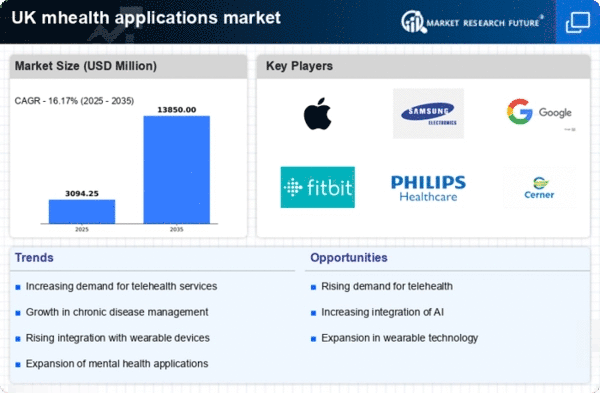
As per MRFR analysis, the mhealth applications market size was estimated at 2663.55 USD Million in 2024. The mhealth applications market is projected to grow from 3094.25 USD Million in 2025 to 13850.0 USD Million by 2035, exhibiting a compound annual growth rate (CAGR) of 16.17% during the forecast period 2025 - 2035.

Key Market Trends & Highlights

The UK mhealth applications market is experiencing robust growth driven by technological advancements and increasing consumer demand.

  • The rise of telehealth services is reshaping patient-provider interactions, enhancing accessibility and convenience.
  • Integration of wearable technology is becoming prevalent, allowing for real-time health monitoring and data collection.
  • The focus on mental health solutions is intensifying, reflecting a growing awareness of mental well-being among consumers.
  • Key market drivers include increasing demand for remote patient monitoring and government initiatives and funding supporting mhealth innovations.

Market Size & Forecast

2024 Market Size 2663.55 (USD Million)
2035 Market Size 13850.0 (USD Million)
CAGR (2025 - 2035) 16.17%

Major Players

Apple Inc (US), Samsung Electronics (KR), Google LLC (US), Fitbit Inc (US), Philips Healthcare (NL), Cerner Corporation (US), McKesson Corporation (US), IBM Corporation (US), Omada Health (US)

UK mHealth Applications Market Trends

The mhealth applications market is evolving rapidly, driven by advancements in technology and increasing consumer demand for health-related solutions. The proliferation of smartphones and wearable devices has facilitated the integration of health management tools into daily life. Users are increasingly seeking applications that offer personalized health insights, remote monitoring, and telehealth services. This trend appears to be supported by a growing awareness of health and wellness, prompting individuals to take proactive steps in managing their health. Furthermore, the regulatory environment is adapting to accommodate the rapid growth of digital health solutions, which may enhance user trust and adoption rates. In addition, Collaborations between technology firms and healthcare providers are expected to benefit the mhealth applications market. Such partnerships could lead to the development of innovative solutions that address specific health challenges faced by the population. The emphasis on data security and privacy is also becoming more pronounced, as users demand assurance that their personal health information is protected. Overall, the mhealth applications market seems poised for continued growth, with a focus on enhancing user experience and improving health outcomes through technology-driven solutions.

Rise of Telehealth Services

Telehealth services are becoming increasingly prevalent within the mhealth applications market. Users are seeking convenient access to healthcare professionals through virtual consultations, which may reduce barriers to care. This trend suggests a shift towards more accessible healthcare delivery models, allowing individuals to receive timely medical advice without the need for in-person visits.

Integration of Wearable Technology

The integration of wearable technology into the mhealth applications market is gaining traction. Devices such as smartwatches and fitness trackers are providing users with real-time health data, which can be monitored and analyzed through dedicated applications. This trend indicates a growing interest in self-monitoring and preventive health measures.

Focus on Mental Health Solutions

There is an increasing emphasis on mental health solutions within the mhealth applications market. Applications designed to support mental well-being, such as meditation and therapy platforms, are becoming more popular. This trend reflects a broader societal recognition of the importance of mental health and the need for accessible resources.

UK mHealth Applications Market Drivers

Government Initiatives and Funding

Government initiatives play a crucial role in shaping the mhealth applications market. In the UK, the National Health Service (NHS) has been actively promoting digital health solutions to improve healthcare delivery. Recent funding allocations aimed at enhancing digital infrastructure and supporting innovative mhealth applications are indicative of this commitment. For instance, the NHS Long Term Plan outlines a vision for increasing the use of technology in healthcare, which includes mhealth applications. This strategic focus is expected to drive market growth, as public and private sectors collaborate to develop and implement effective solutions. The mhealth applications market is likely to benefit from these initiatives, with an anticipated increase in investment reaching £1 billion by 2026.

Rising Health Awareness Among Consumers

Consumer health awareness is on the rise, significantly impacting the mhealth applications market. With an increasing emphasis on preventive healthcare, individuals are more inclined to seek out mobile health solutions that facilitate self-management of health. The proliferation of health-related information through various channels, including social media and online platforms, has empowered consumers to take charge of their well-being. In the UK, surveys indicate that over 60% of adults are now using health apps to monitor fitness, nutrition, and overall health. This growing trend suggests a shift towards proactive health management, which is likely to drive demand for innovative mhealth applications. Consequently, the market is expected to witness a robust growth trajectory, potentially reaching £2 billion by 2025.

Technological Advancements in Mobile Devices

Technological advancements in mobile devices are significantly influencing the mhealth applications market. The continuous evolution of smartphones and tablets, equipped with advanced sensors and capabilities, has created a fertile ground for the development of sophisticated health applications. Features such as GPS tracking, heart rate monitoring, and integration with wearable devices enhance the functionality of mhealth applications, making them more appealing to users. In the UK, the smartphone penetration rate is approximately 85%, providing a vast user base for mhealth solutions. As mobile technology continues to advance, the mhealth applications market is likely to expand, with projections indicating a potential market size of £3 billion by 2027.

Increasing Demand for Remote Patient Monitoring

There is a notable surge in demand for remote patient monitoring solutions in the mhealth applications market. This trend is driven by the growing need for continuous health tracking, particularly among chronic disease patients. In the UK, it is estimated that around 15 million individuals live with chronic conditions, necessitating effective management strategies. Remote monitoring applications enable healthcare providers to collect real-time data, enhancing patient engagement and adherence to treatment plans. Furthermore, the integration of artificial intelligence in these applications is likely to improve predictive analytics, thereby facilitating timely interventions. As a result, the mhealth applications market is projected to expand significantly, with a compound annual growth rate (CAGR) of approximately 25% over the next five years.

Growing Focus on Personalised Healthcare Solutions

The mhealth applications market is increasingly shifting towards personalised healthcare solutions. This trend is driven by the recognition that individual health needs vary significantly, necessitating tailored approaches to treatment and management. In the UK, there is a growing demand for applications that offer customised health plans based on user data, preferences, and lifestyle choices. The integration of machine learning algorithms in mhealth applications allows for the analysis of vast amounts of data, enabling the delivery of personalised recommendations. This focus on individualised care is likely to enhance user satisfaction and engagement, thereby propelling market growth. The mhealth applications market could potentially reach £4 billion by 2028, reflecting this shift towards personalised healthcare.


Market Segment Insights

By Application Type: Chronic Disease Management (Largest) vs. Mental Health (Fastest-Growing)

In the UK mhealth applications market, the distribution of application types shows that Fitness and Wellness holds a significant share, but Chronic Disease Management leads as the largest segment. This is due to the increasing prevalence of chronic illnesses and the growing awareness of using technology for active disease management. Women's Health and Medication Management also contribute to the market, but they are comparatively smaller segments, focusing on specialized health needs and adherence to treatments. Growth trends indicate a robust rise in Mental Health applications, which is presently the fastest-growing segment. The increasing emphasis on mental well-being, especially post-pandemic, contributes to the demand for innovative mental health solutions. Additionally, advancements in AI and personalized health apps are facilitating the growth of various segments while enhancing user engagement and adherence to health regimes.

Chronic Disease Management (Dominant) vs. Mental Health (Emerging)

Chronic Disease Management applications dominate the UK mhealth applications market by addressing critical health needs through comprehensive monitoring and management solutions. These applications facilitate patient engagement and empower individuals to manage conditions such as diabetes and hypertension effectively. In contrast, Mental Health applications are emerging rapidly due to rising societal awareness and acceptance of mental health issues. They often include features like therapy sessions, mood tracking, and mindfulness exercises, catering to a growing user base seeking mental well-being solutions. Both segments underline the importance of digital health solutions; however, the former focuses more on long-term disease management, while the latter is increasingly adopting innovative approaches to enhance user experience.

By End User: Consumers (Largest) vs. Healthcare Providers (Fastest-Growing)

The UK mhealth applications market reveals a diverse distribution of market share among its key end users. Consumers are currently the largest segment, engaging with various applications aimed at health management, fitness tracking, and dietary mindfulness. This significant share highlights their role in driving the overall market growth, encouraged by the surge in smartphone adoption and increased health awareness within the population. In contrast, the healthcare providers segment is emerging as the fastest-growing category. This growth is propelled by technological advancements, increased investments in digital health solutions, and the ongoing transition toward value-based care. Healthcare providers are increasingly leveraging mhealth applications for patient monitoring and enhancing healthcare delivery, indicating a shift in operational strategies within the healthcare sector.

Consumers (Dominant) vs. Pharmaceutical Companies (Emerging)

The consumers segment is the dominant force in the UK mhealth applications market, characterized by a significant user base keen on health and wellness solutions tailored to personal needs. These applications provide a wide range of functionalities that help users manage health, track fitness goals, and access personalized dietary advice. In comparison, the pharmaceutical companies segment is emerging, pivoting towards integrating digital solutions with traditional pharmaceuticals to enhance patient engagement and medication adherence. This shift presents new opportunities for pharmaceutical companies to collaborate with tech firms, thereby expanding their reach and enabling innovative approaches to healthcare solutions. As both segments evolve, their interplay will shape the future landscape of the market.

By Platform: iOS (Largest) vs. Android (Fastest-Growing)

In the UK mhealth applications market, the distribution of platform usage is heavily dominated by iOS, which has established itself as the largest segment. Its user-friendly interface and consistent updates have made it a preferred choice among health-conscious consumers. On the other hand, Android, while currently trailing in market share, is rapidly gaining traction due to its extensive reach and affordability, appealing to a broader demographic. The growth trends for mobile health applications are being driven by the increasing adoption of smartphones, with Android witnessing the fastest growth thanks to its diverse ecosystem of devices. Users are increasingly seeking health solutions that offer integrated features, making both platforms indispensable. The competition is intensified as developers focus on creating cross-platform applications that cater to the unique needs of users across iOS and Android, ensuring a robust growth trajectory.

iOS: Dominant vs. Android: Emerging

iOS remains the dominant platform in the market, known for its seamless user experience and higher revenue generation capabilities. The platform excels in providing high-quality health applications that often lead to better user retention rates. Users appreciate the strong security protocols and privacy features that iOS offers, making it a go-to for health management applications. Conversely, Android is emerging with aggressive growth metrics as it captures an increasing share of the market, especially in lower-income segments. The platform's flexibility in app development and affordability of devices encourages more users to adopt health-related applications. As the competition heats up, both platforms are expected to innovate, catering to specific health needs and expanding their user bases.

By Functionality: Monitoring (Largest) vs. Diagnosis (Fastest-Growing)

In the UK mhealth applications market, the functionality segment showcases diverse applications, with monitoring leading in market share. This segment benefits from the rising demand for health tracking technologies and patient engagement tools that foster proactive healthcare management. Monitoring applications are widely adopted due to their ability to provide real-time data and personalized insights, enhancing user experience and overall health outcomes. Conversely, the diagnosis segment is emerging as the fastest-growing area within the market. This growth can be attributed to advancements in AI and machine learning technologies that improve diagnostic accuracy. Additionally, increased awareness of healthcare accessibility and the demand for remote diagnostic tools drive the widespread adoption of diagnosis-focused applications among consumers and healthcare professionals alike.

Monitoring (Dominant) vs. Diagnosis (Emerging)

Monitoring applications are integral to the UK mhealth applications market, characterized by their capability to track health metrics such as heart rate, physical activity, and chronic condition management. They provide users with personalized feedback and encourage healthier lifestyle choices. These applications not only cater to individual users but also serve healthcare providers looking to enhance patient outcomes. In contrast, the diagnosis segment is rapidly emerging, fueled by innovation in telemedicine and the need for swift, accurate health assessments. Diagnosis applications leverage advanced technologies to assist in clinical decision-making, making them increasingly relevant in patient care protocols. This dual dynamic of dominance and emergence reflects a robust landscape of functionality within the market.

Get more detailed insights about UK mHealth Applications Market

Key Players and Competitive Insights

The mhealth applications market in the UK is characterized by a dynamic competitive landscape, driven by rapid technological advancements and an increasing focus on personalized healthcare solutions. Key players such as Apple Inc (US), Samsung Electronics (KR), and Google LLC (US) are at the forefront, leveraging their technological prowess to enhance user engagement and health outcomes. Apple Inc (US) has positioned itself as a leader in health monitoring through its Apple Watch, which integrates seamlessly with its ecosystem, emphasizing innovation in health data analytics. Meanwhile, Samsung Electronics (KR) continues to expand its health-related offerings, focusing on wearables that promote fitness and wellness, thereby appealing to a broad consumer base. Google LLC (US) is enhancing its presence through strategic partnerships and acquisitions, particularly in artificial intelligence, which is likely to redefine user experiences in mhealth applications.

The business tactics employed by these companies reflect a concerted effort to optimize supply chains and localize manufacturing, which may enhance responsiveness to market demands. The competitive structure of the mhealth applications market appears moderately fragmented, with a mix of established players and emerging startups. This fragmentation allows for diverse innovations, although the influence of major corporations remains substantial, shaping market trends and consumer expectations.

In October 2025, Apple Inc (US) announced a significant update to its Health app, integrating advanced AI features that provide personalized health insights based on user data. This strategic move not only enhances user engagement but also positions Apple as a frontrunner in the integration of AI within health applications, potentially setting new standards for user experience in the industry. Similarly, in September 2025, Samsung Electronics (KR) launched a new health initiative aimed at integrating its wearables with telehealth services, which could significantly improve access to healthcare for users, particularly in remote areas. This initiative underscores Samsung's commitment to expanding its health ecosystem and enhancing the utility of its devices.

In August 2025, Google LLC (US) acquired a health analytics startup, which is expected to bolster its capabilities in data-driven health solutions. This acquisition reflects a broader trend of tech companies seeking to enhance their data analytics capabilities, thereby improving the personalization of health services. The strategic importance of these actions lies in their potential to create a more interconnected health ecosystem, where data flows seamlessly between devices and applications, ultimately benefiting users.

As of November 2025, the competitive trends in the mhealth applications market are increasingly defined by digitalization, sustainability, and the integration of AI technologies. Strategic alliances among key players are shaping the landscape, fostering innovation and collaboration. The shift from price-based competition to a focus on technological innovation and supply chain reliability is evident, suggesting that future competitive differentiation will hinge on the ability to deliver unique, high-quality health solutions that resonate with consumers' evolving needs.

Key Companies in the UK mHealth Applications Market market include

Industry Developments

The UK MHealth Applications Market has seen significant developments recently, notably with advancements made by HealthUnlocked and Babylon Health, focusing on improving patient engagement tools and access to healthcare.

Doctorlink has made strides in streamlining patient appointments and triaging, while Fitbit continues to expand its fitness and health tracking technology, integrating more features. In terms of market growth, MyFitnessPal and Samsung have reported increased user engagement, signaling positive consumer response amidst the growing adoption of digital health solutions.

The NHS Digital initiative has been pivotal in promoting such applications to enhance healthcare delivery, which reflects an increasing government push towards technology integration in health services. In July 2023, it was reported that HealthifyMe expanded its services to the UK, further intensifying competition in the market.

Furthermore, significant mergers and acquisitions are shaping the landscape, including Lantum’s acquisition of a tech startup intending to improve healthcare workforce management in August 2023. The overall market is experiencing a surge in valuation due to increasing mobile health applications uptake, highlighting a shift in healthcare delivery aligned with modern technology preferences in the UK.

Future Outlook

UK mHealth Applications Market Future Outlook

The mHealth Applications Market is projected to grow at a 16.17% CAGR from 2024 to 2035, driven by technological advancements, increasing health awareness, and demand for remote healthcare solutions.

New opportunities lie in:

  • Development of AI-driven personalized health coaching apps
  • Integration of telehealth services with wearable devices
  • Expansion of subscription-based health monitoring platforms

By 2035, the mhealth applications market is expected to achieve substantial growth and innovation.

Market Segmentation

UK mHealth Applications Market End User Outlook

  • Consumers
  • Healthcare Providers
  • Pharmaceutical Companies
  • Insurance Companies

UK mHealth Applications Market Platform Outlook

  • iOS
  • Android
  • Web-based

UK mHealth Applications Market Functionality Outlook

  • Monitoring
  • Diagnosis
  • Consultation
  • Treatment

UK mHealth Applications Market Application Type Outlook

  • Fitness and Wellness
  • Chronic Disease Management
  • Women's Health
  • Mental Health
  • Medication Management

Report Scope

MARKET SIZE 2024 2663.55(USD Million)
MARKET SIZE 2025 3094.25(USD Million)
MARKET SIZE 2035 13850.0(USD Million)
COMPOUND ANNUAL GROWTH RATE (CAGR) 16.17% (2024 - 2035)
REPORT COVERAGE Revenue Forecast, Competitive Landscape, Growth Factors, and Trends
BASE YEAR 2024
Market Forecast Period 2025 - 2035
Historical Data 2019 - 2024
Market Forecast Units USD Million
Key Companies Profiled Apple Inc (US), Samsung Electronics (KR), Google LLC (US), Fitbit Inc (US), Philips Healthcare (NL), Cerner Corporation (US), McKesson Corporation (US), IBM Corporation (US), Omada Health (US)
Segments Covered Application Type, End User, Platform, Functionality
Key Market Opportunities Integration of artificial intelligence in mhealth applications enhances personalized healthcare delivery and user engagement.
Key Market Dynamics Rising consumer demand for personalized health solutions drives innovation in mhealth applications market.
Countries Covered UK

Leave a Comment

FAQs

What is the expected market value of the UK MHealth Applications Market in 2024?

The expected market value of the UK MHealth Applications Market in 2024 is 2.65 USD Billion.

What is the projected market value of the UK MHealth Applications Market by 2035?

By 2035, the projected market value of the UK MHealth Applications Market is 12.07 USD Billion.

What is the anticipated compound annual growth rate (CAGR) for the UK MHealth Applications Market from 2025 to 2035?

The anticipated CAGR for the UK MHealth Applications Market from 2025 to 2035 is 14.781%.

Which application type is expected to dominate the UK MHealth Applications Market by 2035?

By 2035, the Fitness and Wellness application type is expected to dominate the UK MHealth Applications Market, projected to be valued at 3.45 USD Billion.

What are the projected values for Chronic Disease Management in the UK MHealth Applications Market by 2035?

The projected value for Chronic Disease Management in the UK MHealth Applications Market by 2035 is 3.1 USD Billion.

How much revenue is expected from the Women's Health segment of the UK MHealth Applications Market by 2035?

The Women's Health segment is expected to generate 2.3 USD Billion in revenue by 2035.

What is the market size for Mental Health applications in 2024 and its projection for 2035?

The Mental Health applications market size is valued at 0.55 USD Billion in 2024 and is projected to reach 2.8 USD Billion by 2035.

What will be the market value of Medication Management applications in 2035?

The market value of Medication Management applications in 2035 is expected to be 0.9 USD Billion.

Who are some of the key players in the UK MHealth Applications Market?

Key players in the UK MHealth Applications Market include HealthUnlocked, Babylon Health, Doctorlink, Fitbit, and NHS Digital.

What are the primary growth opportunities and challenges in the UK MHealth Applications Market?

The primary growth opportunities in the UK MHealth Applications Market include rising health awareness and technological advancements, while challenges may include regulatory hurdles and market competition.

Download Free Sample

Kindly complete the form below to receive a free sample of this Report

Compare Licence

×
Features License Type
Single User Multiuser License Enterprise User
Price $4,950 $5,950 $7,250
Maximum User Access Limit 1 User Upto 10 Users Unrestricted Access Throughout the Organization
Free Customization
Direct Access to Analyst
Deliverable Format
Platform Access
Discount on Next Purchase 10% 15% 15%
Printable Versions