Download Free Sample
Kindly complete the form below to receive a free sample of this Report
South Korea Pharmacy Market Research Report: Size, Share, Trend Analysis By Product Type (Prescription Drugs, Over-The-Counter Drugs, Vaccines, Homeopathic Medicine), By Distribution Channel (Retail Pharmacy, Hospital Pharmacy, Online Pharmacy, Specialty Pharmacy), By Therapeutic Area (Cardiovascular, Oncology, Diabetes, Neurology, Infectious Diseases) and By Formulation (Tablets, Injectables, Topicals, Liquids) - Growth Outlook & Industry Forecast 2025 To 2035
As per Market Research Future analysis, the South Korea pharmacy market Size was estimated at 22.5 USD Billion in 2024. The South Korea pharmacy market is projected to grow from 23.42 USD Billion in 2025 to 35.0 USD Billion by 2035, exhibiting a compound annual growth rate (CAGR) of 4% during the forecast period 2025 - 2035
The South Korea pharmacy market is experiencing a transformative shift driven by digital innovation and a focus on preventive healthcare.
| 2024 Market Size | 22.5 (USD Billion) |
| 2035 Market Size | 35.0 (USD Billion) |
| CAGR (2025 - 2035) | 4.1% |
CVS Health (US), Walgreens Boots Alliance (US), Roche (CH), McKesson (US), Cigna (US), Cardinal Health (US), AstraZeneca (GB), Sanofi (FR), GSK (GB), Novartis (CH)
Our Impact
Enabled $4.3B Revenue Impact for Fortune 500 and Leading Multinationals
Partnering with 2000+ Global Organizations Each Year
30K+ Citations by Top-Tier Firms in the Industry
The pharmacy market in South Korea is currently experiencing a dynamic transformation, driven by various factors including technological advancements and changing consumer behaviors. The integration of digital health solutions is becoming increasingly prevalent, as pharmacies adopt e-commerce platforms and telepharmacy services to enhance accessibility and convenience for patients. This shift not only improves the customer experience but also allows pharmacies to expand their reach beyond traditional brick-and-mortar locations. Furthermore, the growing emphasis on preventive healthcare is influencing the types of products and services offered, with pharmacies increasingly providing health screenings and wellness consultations. In addition to technological integration, regulatory changes are shaping the landscape of the pharmacy market. The South Korean government is actively promoting policies that encourage innovation and competition within the sector. This includes initiatives aimed at improving the supply chain and ensuring the availability of essential medications. As a result, pharmacies are likely to adapt their business models to align with these regulations, potentially leading to enhanced service offerings and improved patient outcomes. Overall, the pharmacy market in South Korea appears poised for continued growth, driven by a combination of technological advancements and supportive government policies.
The pharmacy market is witnessing a significant shift towards digital solutions. Pharmacies are increasingly adopting e-commerce platforms and telehealth services, allowing for greater accessibility and convenience for consumers. This trend is likely to enhance customer engagement and expand market reach.
There is a growing emphasis on preventive healthcare within the pharmacy market. Pharmacies are expanding their services to include health screenings and wellness consultations, reflecting a shift in consumer preferences towards proactive health management.
The South Korean government is implementing policies that foster innovation in the pharmacy market. These regulatory changes aim to improve supply chain efficiency and ensure the availability of essential medications, encouraging pharmacies to adapt and enhance their service offerings.
The aging population in South Korea is a crucial driver for the pharmacy market. As the demographic shifts towards an older age group, the demand for pharmaceuticals and healthcare services is expected to rise significantly. By 2025, it is projected that over 20% of the population will be aged 65 and above, leading to increased prevalence of chronic diseases. This demographic trend necessitates a robust pharmacy market to cater to the growing needs for medications, consultations, and health management services. Furthermore, the pharmacy market is likely to see a surge in demand for specialized medications tailored for geriatric patients, thereby influencing market dynamics and growth strategies for pharmacy operators.
Rising health awareness among the South Korean population is significantly influencing the pharmacy market. With an increasing focus on preventive healthcare and wellness, consumers are more inclined to seek out pharmacies for health consultations and over-the-counter products. Surveys indicate that nearly 70% of South Koreans are actively seeking information about health and wellness, which is driving demand for health-related products and services. This trend is likely to propel the pharmacy market towards offering a wider range of health supplements, preventive medications, and wellness programs. Consequently, pharmacies are adapting their business models to include health education and preventive care services, thereby enhancing their role in the healthcare ecosystem.
The growth of e-commerce is emerging as a significant driver for the pharmacy market in South Korea. With the increasing penetration of the internet and mobile devices, consumers are increasingly turning to online platforms for purchasing medications and health products. As of 2025, it is estimated that online sales in the pharmacy market could account for over 25% of total sales, reflecting a shift in consumer behavior. This trend is prompting traditional pharmacies to enhance their online presence and develop e-commerce strategies to remain competitive. Furthermore, the convenience of home delivery services and online consultations is likely to attract a broader customer base, thereby transforming the landscape of the pharmacy market.
Government initiatives and policies play a pivotal role in shaping the pharmacy market in South Korea. The government has been actively promoting policies aimed at improving access to medications and enhancing the quality of healthcare services. Recent reforms have focused on reducing drug prices and increasing the availability of essential medicines, which is expected to stimulate growth in the pharmacy market. Additionally, the government is investing in healthcare infrastructure, which includes expanding pharmacy services in rural areas. These initiatives are likely to create a more favorable environment for pharmacy operations, encouraging innovation and competition within the market.
Technological advancements are reshaping the pharmacy market in South Korea. Innovations such as automated dispensing systems, telepharmacy, and electronic health records are enhancing operational efficiency and patient care. The integration of artificial intelligence in drug management and patient monitoring systems is expected to improve accuracy and reduce errors. As of 2025, the pharmacy market is anticipated to witness a growth rate of approximately 10% annually, driven by these technological innovations. Moreover, the adoption of mobile health applications is empowering patients to manage their medications more effectively, thus increasing engagement and adherence to treatment regimens. This technological evolution is likely to redefine the competitive landscape of the pharmacy market.
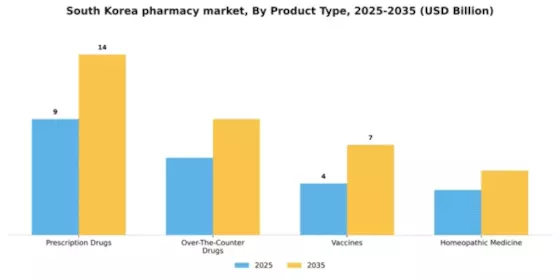
In the South Korea pharmacy market, Prescription Drugs hold the largest share among product types, reflecting strong healthcare reliance and a robust system of healthcare providers. Over-The-Counter (OTC) Drugs, while smaller in market share, have been gaining traction due to increasing self-medication trends among consumers, giving rise to easier accessibility and convenience in purchasing such products. Growth trends in this segment are significantly influenced by the rise in chronic diseases and an aging population that necessitates ongoing health management, driving demand for Prescription Drugs. Concurrently, the OTC Drugs segment is fueled by innovative marketing strategies, expanding distribution channels, and growing health awareness among consumers, contributing to its status as the fastest-growing segment within the market.
Prescription Drugs: Dominant vs. Vaccines: Emerging
Prescription Drugs are characterized by their essential role in treating various chronic conditions and diseases, reflecting a well-established market position and comprehensive infrastructure supporting their distribution. This segment benefits from a variety of therapeutic categories, catering to an extensive range of health needs. Conversely, Vaccines represent an emerging segment showcasing substantial growth potential driven by public health initiatives and increasing vaccine awareness. The ongoing efforts to combat infectious diseases and promote preventative healthcare contribute to the rising demand for Vaccines, making it a notable contender in the South Korea pharmacy market.
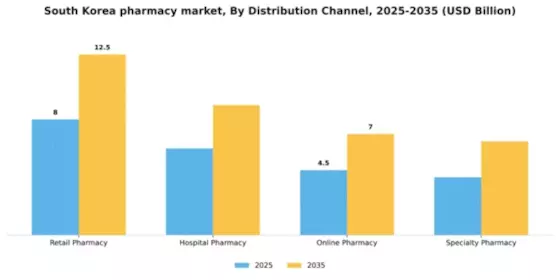
In the South Korea pharmacy market, retail pharmacies dominate the distribution channel with the largest market share, primarily due to their established presence and accessibility to consumers. Meanwhile, online pharmacies have been gaining traction, now representing a significant emerging segment thanks to the increasing consumer preference for convenience and digital transactions. This shift is particularly observable in urban areas where consumers value quick access to medications and health products. Growth trends within this segment indicate a strong upward trajectory for online pharmacies, driven by the proliferation of e-commerce and mobile health technologies. Consumers are increasingly drawn to the ease of ordering medications from home, coupled with the availability of detailed product information online. In contrast, retail pharmacies will continue to thrive, but they face the challenge of adapting to the changing landscape by integrating online services to retain their market position.
Retail Pharmacy: Dominant vs. Online Pharmacy: Emerging
Retail pharmacies play a critical role in the South Korea pharmacy market, characterized by their extensive network of physical locations and established trust among consumers. They serve as primary points for medication dispensing, counseling, and health services, leveraging personalized customer interactions. On the other hand, online pharmacies are emerging as a disruptive force, offering unparalleled convenience for patients seeking to purchase medications and health products without leaving their homes. This segment appeals particularly to tech-savvy consumers and younger demographics, who prioritize quick service and home delivery. Both segments must navigate the evolving regulatory environment and shifting consumer preferences to secure their positions in this dynamic marketplace.
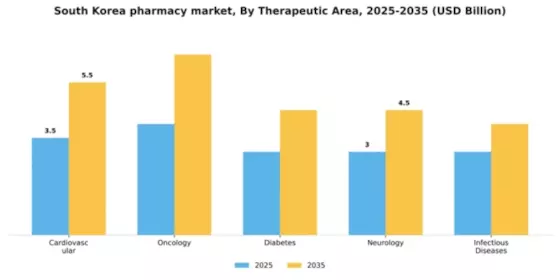
In the South Korea pharmacy market, the therapeutic area segment showcases diverse distribution among its key segments. Cardiovascular drugs hold the largest market share, underscoring the critical need for effective management of heart diseases in the region. Conversely, oncology is rapidly gaining traction, reflecting the increasing prevalence of cancer and the growing emphasis on innovative treatments. Growth trends in this segment are driven by several factors, including an aging population, rising lifestyle-related diseases, and enhanced healthcare access. Oncology, in particular, is experiencing a surge as research and technology lead to breakthroughs in treatment options, capturing significant investor interest. As a result, this segment is predicted to expand swiftly, presenting new opportunities for pharmaceutical companies in the market.
Cardiovascular: Dominant vs. Oncology: Emerging
The cardiovascular segment remains dominant in the South Korea pharmacy market, characterized by a wide range of medications including antihypertensives, anticoagulants, and cholesterol-lowering drugs. This segment benefits from strong clinical demand due to the high incidence of cardiovascular diseases. In contrast, oncology is viewed as an emerging segment, fueled by advances in targeted therapies and immunotherapies. Pharmaceutical companies are increasingly investing in oncology research, driven by the urgent need for effective treatments. The focus on personalized medicine and collaborative research partnerships further elevates the oncology segment, positioning it as a vital area for growth and innovation in the pharmacy market.
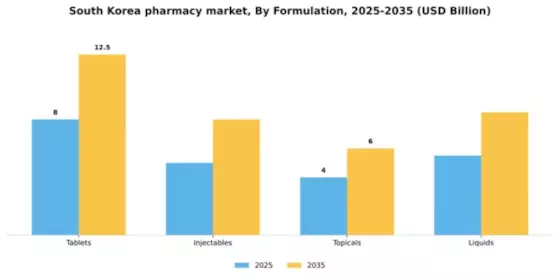
In the South Korea pharmacy market, the formulation segment is led primarily by tablets, which hold the largest market share. They are favored for their easy administration and established efficacy, dominating consumer preference. Injectables, while smaller in market share, are gaining traction rapidly, particularly in specialized treatments, showing a significant rise in adoption rates among healthcare providers and patients alike. Growth trends indicate a robust expansion within the formulation segment as healthcare innovations, including personalized medicine and biopharmaceutical advancements, drive demand. Injectables, in particular, are on the upsurge due to their effectiveness in treating chronic diseases and increased reliance on health professionals for administration. Additionally, changing patient preferences towards efficacious treatment options contribute to this dynamic growth trajectory.
Tablets: Dominant vs. Injectables: Emerging
Tablets are characterized by their versatility and ease of use, making them the dominant choice among patients in the South Korea pharmacy market. They offer a broad range of formulations and dosages, catering to diverse therapeutic needs. Conversely, injectables, while currently emerging, are becoming increasingly popular, particularly for patients requiring long-term medication management or those with gastrointestinal absorption issues. They provide rapid onset of action and tailored therapeutic outcomes, positioning them as a key focus for pharmaceutical innovation. As healthcare systems evolve, both segments are expected to adapt to changing regulatory landscapes and patient preferences, carving out distinctive niches within the formulation market.
Get more detailed insights about South Korea Pharmacy Market Request Free Sample
The pharmacy market in South Korea is characterized by a dynamic competitive landscape, driven by factors such as increasing healthcare demands, an aging population, and a growing emphasis on digital health solutions. Major players like CVS Health (US), Walgreens Boots Alliance (US), and Roche (CH) are actively shaping the market through strategic initiatives. CVS Health (US) focuses on expanding its digital health services, enhancing customer engagement through telehealth solutions, while Walgreens Boots Alliance (US) emphasizes partnerships with local healthcare providers to improve service delivery. Roche (CH) is investing in innovative diagnostics and personalized medicine, which positions it favorably in a market that increasingly values tailored healthcare solutions. Collectively, these strategies contribute to a competitive environment that prioritizes innovation and customer-centric services.Key business tactics within the pharmacy market include localizing manufacturing and optimizing supply chains to enhance efficiency and responsiveness. The market structure appears moderately fragmented, with several key players exerting influence while also allowing for smaller, niche companies to thrive. This fragmentation fosters a competitive atmosphere where companies must continuously innovate and adapt to maintain market share, thereby driving overall growth in the sector.
In October CVS Health (US) announced a strategic partnership with a leading telehealth provider to enhance its digital health offerings. This move is significant as it aligns with the growing consumer preference for remote healthcare services, potentially increasing CVS's market penetration and customer loyalty. By integrating telehealth into its service portfolio, CVS Health (US) is likely to attract a broader customer base, particularly among tech-savvy younger demographics.
In September Walgreens Boots Alliance (US) launched a new initiative aimed at expanding its pharmacy services in rural areas of South Korea. This initiative is crucial as it addresses the healthcare accessibility challenges faced by underserved populations. By enhancing its footprint in these regions, Walgreens Boots Alliance (US) not only strengthens its market position but also contributes to improving health outcomes, which may enhance its brand reputation and customer trust.
In August Roche (CH) unveiled a new line of personalized medicine products tailored for chronic disease management. This strategic move underscores Roche's commitment to innovation and positions the company as a leader in the evolving landscape of precision healthcare. By focusing on personalized solutions, Roche (CH) is likely to differentiate itself from competitors, appealing to healthcare providers and patients seeking targeted therapies.
As of November current competitive trends in the pharmacy market include a pronounced shift towards digitalization, sustainability, and the integration of artificial intelligence (AI) in operations. Strategic alliances are increasingly shaping the landscape, enabling companies to leverage complementary strengths and enhance service offerings. Looking ahead, competitive differentiation is expected to evolve, with a notable shift from price-based competition to a focus on innovation, technology, and supply chain reliability. This transition may redefine market dynamics, compelling companies to invest in advanced technologies and sustainable practices to meet the changing demands of consumers.


Recent developments in the South Korea Pharmacy Market include a notable increase in collaboration and innovation among major companies such as Celltrion, Hanmi Pharmaceutical, and Samsung Biologics, particularly in the biopharmaceutical sector. In October 2023, LG Chem announced a significant investment in expanding its Research and Development operations to enhance its portfolio of biologics and therapeutics, reflecting the growing demand for advanced medical solutions. Furthermore, in August 2023, Daewoong Pharmaceutical made headlines with its strategic partnership involving Yungjin Pharmaceutical to co-develop next-generation biopharmaceuticals, highlighting a trend towards collaborative ventures for accelerated market entry.
Additionally, in June 2023, Genexine and Merck Korea entered a collaborative agreement focused on immunotherapy, underscoring the ongoing shift towards innovative treatment options. The overall market valuation shows promising growth, driven by the increasing prevalence of chronic diseases and the focus on personalized medicine. Over the past two years, significant advancements in the regulatory environment have favored the introduction of new drugs, and companies are adapting to changing market dynamics through mergers and acquisitions. However, no major mergers have been reported recently among the companies of interest.
The Pharmacy Market in South Korea is projected to grow at a 4.1% CAGR from 2025 to 2035, driven by technological advancements, an aging population, and increased healthcare spending.
New opportunities lie in:
By 2035, the pharmacy market is expected to achieve robust growth, driven by innovation and evolving consumer needs.
| MARKET SIZE 2024 | 22.5(USD Billion) |
| MARKET SIZE 2025 | 23.42(USD Billion) |
| MARKET SIZE 2035 | 35.0(USD Billion) |
| COMPOUND ANNUAL GROWTH RATE (CAGR) | 4.1% (2025 - 2035) |
| REPORT COVERAGE | Revenue Forecast, Competitive Landscape, Growth Factors, and Trends |
| BASE YEAR | 2024 |
| Market Forecast Period | 2025 - 2035 |
| Historical Data | 2019 - 2024 |
| Market Forecast Units | USD Billion |
| Key Companies Profiled | CVS Health (US), Walgreens Boots Alliance (US), Roche (CH), McKesson (US), Cigna (US), Cardinal Health (US), AstraZeneca (GB), Sanofi (FR), GSK (GB), Novartis (CH) |
| Segments Covered | Product Type, Distribution Channel, Therapeutic Area, Formulation |
| Key Market Opportunities | Integration of digital health solutions enhances patient engagement and streamlines pharmacy operations. |
| Key Market Dynamics | Rising demand for personalized medicine drives innovation and competition in South Korea's pharmacy market. |
| Countries Covered | South Korea |
The overall market valuation was $22.5 Billion in 2024.
The projected valuation for 2035 is $35.0 Billion.
The expected CAGR during the forecast period 2025 - 2035 is 4.1%.
In 2024, Prescription Drugs had the highest valuation at $9.0 Billion.
By 2035, the projected value for Over-The-Counter Drugs is $9.0 Billion.
Retail Pharmacy is expected to grow the most, with a projected value of $12.5 Billion by 2035.
The market size for Online Pharmacy was $4.5 Billion in 2024.
Oncology is projected to have the highest growth, reaching $6.5 Billion by 2035.
The expected market value for injectables by 2035 is $8.0 Billion.
Key players include CVS Health, Walgreens Boots Alliance, Roche, and McKesson.



Kindly complete the form below to receive a free sample of this Report

“This is really good guys. Excellent work on a tight deadline. I will continue to use you going forward and recommend you to others. Nice job”


“Thanks. It’s been a pleasure working with you, please use me as reference with any other Intel employees.”


“Thanks for sending the report it gives us a good global view of the Betaïne market.”


“Thank you, this will be very helpful for OQS.”


“We found the report very insightful! we found your research firm very helpful. I'm sending this email to secure our future business.”


“I am very pleased with how market segments have been defined in a relevant way for my purposes (such as "Portable Freezers & refrigerators" and "last-mile"). In general the report is well structured. Thanks very much for your efforts.”


“I have been reading the first document or the study, ,the Global HVAC and FP market report 2021 till 2026. Must say, good info! I have not gone in depth at all parts, but got a good indication of the data inside!”


“We got the report in time, we really thank you for your support in this process. I also thank to all of your team as they did a great job.”


“The Automotive 48V ECU Components Procurement Intelligence Study” was a complex project, but the Market Research Future (MRFR) team handled it with quality, agility, and customer-centricity. They delivered all requested data on time and within the agreed scope. The team, including Shubhendra Anand and Rahul Gotadki, was always readily available to clarify questions and swiftly implement necessary adjustments, driving the project to a successful conclusion within a very demanding timeframe.
I would also like to specifically commend Akshay Agarwal for his responsiveness and support at every stage—from our initial inquiry on May 6th through to final delivery on June 18th. His dedication made the entire process seamless.”



