×
Request Free Sample ×

Kindly complete the form below to receive a free sample of this Report

* Please use a valid business email

Leading companies partner with us for data-driven Insights

clients tt-cursor
Hero Background

Spain Geographic Atrophy (GA) Market

ID: MRFR/HC/49916-HCR
200 Pages
Garvit Vyas
October 2025

Spain Geographic Atrophy GA Market Research Report By Age Group (Above 60 Years, Above 75 Years), By Diagnosis (Fundus Autofluorescence, Optical Coherence Tomography Angiography, Multifocal Electroretinography) and By Therapeutic Agents Clinical Phase (Late-Stage, Phase II, Phase I, Pre-Clinical Stage, Discovery Candidates)- Forecast to 2035

Share:
Download PDF ×

We do not share your information with anyone. However, we may send you emails based on your report interest from time to time. You may contact us at any time to opt-out.

Spain Geographic Atrophy (GA) Market Infographic
Purchase Options

Spain Geographic Atrophy (GA) Market Summary

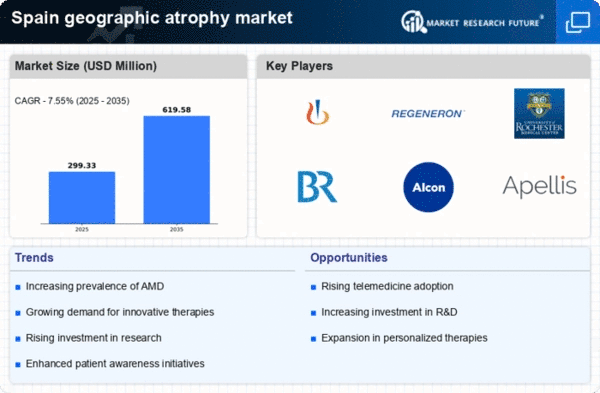
As per MRFR analysis, the geographic atrophy market size was estimated at 278.32 USD Million in 2024. The geographic atrophy-ga market is projected to grow from 299.33 USD Million in 2025 to 619.58 USD Million by 2035, exhibiting a compound annual growth rate (CAGR) of 7.55% during the forecast period 2025 - 2035.

Key Market Trends & Highlights

The Spain geographic atrophy market is poised for growth driven by demographic shifts and technological advancements.

  • The rising prevalence of age-related macular degeneration (AMD) is significantly influencing the geographic atrophy market in Spain.
  • Regulatory advancements are facilitating the introduction of innovative therapies, enhancing treatment options for patients.
  • The largest segment in the market is the pharmaceutical sector, while the fastest-growing segment appears to be the digital health solutions.
  • Key market drivers include the aging population dynamics and improvements in healthcare infrastructure, which are likely to bolster market growth.

Market Size & Forecast

2024 Market Size 278.32 (USD Million)
2035 Market Size 619.58 (USD Million)
CAGR (2025 - 2035) 7.55%

Major Players

Novartis (CH), Regeneron Pharmaceuticals (US), Roche (CH), Bayer (DE), Alcon (CH), Apellis Pharmaceuticals (US), Santen Pharmaceutical (JP), Horizon Therapeutics (IE)

Spain Geographic Atrophy (GA) Market Trends

The geographic atrophy-ga market is currently experiencing notable developments, driven by an increasing prevalence of age-related macular degeneration (AMD) among the aging population. In Spain, the demographic shift towards an older population is likely to contribute to a rise in cases of geographic atrophy, which may, in turn, stimulate demand for innovative treatment options. The Spanish healthcare system is adapting to these changes, focusing on enhancing patient access to therapies and improving overall care for individuals affected by this condition. Furthermore, advancements in research and technology are paving the way for new therapeutic approaches, which could potentially reshape the landscape of the geographic atrophy-ga market in the near future. In addition to demographic factors, the regulatory environment in Spain appears to be evolving, with authorities increasingly prioritizing the approval of novel therapies for retinal diseases. This shift may facilitate faster access to treatments for patients suffering from geographic atrophy. Moreover, collaboration between pharmaceutical companies and research institutions is likely to foster innovation, leading to the development of more effective therapies. As the market continues to grow, stakeholders must remain vigilant in addressing the challenges posed by this condition, ensuring that patients receive timely and effective care.

Rising Prevalence of AMD

The increasing incidence of age-related macular degeneration (AMD) in Spain is a critical factor influencing the geographic atrophy-ga market. As the population ages, the number of individuals affected by AMD is expected to rise, leading to a greater demand for treatments targeting geographic atrophy.

Regulatory Advancements

Recent changes in the regulatory landscape in Spain suggest a more favorable environment for the approval of new therapies for geographic atrophy. This trend may enhance patient access to innovative treatments, thereby potentially improving outcomes for those affected by the condition.

Technological Innovations

Ongoing advancements in medical technology are likely to play a pivotal role in the geographic atrophy-ga market. Innovations in diagnostic tools and treatment modalities may lead to more effective management of the condition, ultimately benefiting patients and healthcare providers alike.

Spain Geographic Atrophy (GA) Market Drivers

Aging Population Dynamics

The demographic shift towards an older population in Spain appears to be a primary driver for the geographic atrophy-ga market. As individuals age, the risk of developing age-related macular degeneration (AMD) increases, leading to a higher incidence of geographic atrophy. Current statistics indicate that approximately 20% of individuals over 75 years old are affected by AMD, which suggests a growing patient population. This trend is likely to escalate the demand for effective treatments and management strategies within the geographic atrophy-ga market. Furthermore, the increasing life expectancy in Spain, projected to reach 86 years by 2030, may further amplify the prevalence of geographic atrophy, thereby creating a robust market environment for therapeutic interventions.

Rising Awareness and Education

There appears to be a growing awareness regarding eye health and the implications of geographic atrophy in Spain. Public health campaigns and educational initiatives are increasingly focusing on the importance of early detection and treatment of AMD and its associated conditions. This heightened awareness may lead to more individuals seeking medical advice and screening, thereby increasing the patient base for the geographic atrophy-ga market. Recent surveys indicate that nearly 60% of the population is now aware of AMD, a significant increase from previous years. As awareness continues to rise, it is likely that more patients will be diagnosed and treated, driving demand for innovative therapies and management solutions in the geographic atrophy-ga market.

Regulatory Support for New Therapies

Regulatory bodies in Spain appear to be increasingly supportive of the development and approval of new therapies for geographic atrophy. The streamlined approval processes and incentives for innovative treatments may encourage pharmaceutical companies to invest in this area. Recent regulatory changes have reduced the time required for clinical trials and expedited the review of new drugs, which could lead to faster access to therapies for patients. This supportive regulatory environment is likely to stimulate growth in the geographic atrophy-ga market, as it fosters innovation and encourages the introduction of new treatment options. As a result, patients may benefit from a wider array of therapies designed to address geographic atrophy.

Healthcare Infrastructure Improvements

Spain's ongoing enhancements in healthcare infrastructure are likely to bolster the geographic atrophy-ga market. The government has been investing significantly in healthcare facilities and services, aiming to improve access to eye care for the aging population. Recent reports indicate that healthcare spending in Spain has increased by approximately 5% annually, which may facilitate better diagnosis and treatment options for geographic atrophy. Enhanced training for healthcare professionals and the establishment of specialized eye care centers could lead to earlier detection and intervention, ultimately benefiting patients. This improved infrastructure is expected to create a more favorable environment for the geographic atrophy-ga market, as it aligns with the growing need for effective management of age-related eye diseases.

Investment in Research and Development

The geographic atrophy-ga market in Spain is likely to benefit from increased investment in research and development (R&D) focused on innovative treatment options. Pharmaceutical companies and research institutions are actively pursuing new therapies aimed at slowing the progression of geographic atrophy. Recent data suggests that R&D spending in the ophthalmology sector has risen by approximately 10% annually, reflecting a commitment to addressing unmet medical needs. This investment may lead to breakthroughs in drug development and novel therapeutic approaches, which could significantly enhance the treatment landscape for geographic atrophy. As new therapies emerge, the geographic atrophy-ga market is expected to expand, offering patients more effective options for managing their condition.


Market Segment Insights

By Age Group: Above 60 Years (Largest) vs. Above 75 Years (Fastest-Growing)

In the Spain geographic atrophy-ga market, the age group above 60 years holds the largest market share, highlighting a significant segment of individuals affected by geographic atrophy. This demographic is characterized by increased susceptibility to age-related vision conditions, leading to a substantial demand for treatment options tailored to their needs. In contrast, the above 75 years age group is emerging rapidly, indicating a growing understanding of the condition and a higher propensity for seeking medical intervention. The growth trends in these age segments are driven primarily by the aging population and advancements in medical technology that enhance the management of geographic atrophy. Increased awareness of eye health and preventive care among older adults further propels growth. Financial support from healthcare systems and improved healthcare access are likely to stimulate demand in these segments, particularly for the above 75 years group, which is increasingly recognized as a priority in treatment strategies.

Above 60 Years (Dominant) vs. Above 75 Years (Emerging)

The age group above 60 years is regarded as the dominant segment in the Spain geographic atrophy-ga market, primarily due to its larger population base. This group tends to encompass individuals with chronic health concerns, making them more susceptible to geographic atrophy and, consequently, necessitating comprehensive treatment options. Meanwhile, the above 75 years segment is rapidly emerging, driven by growing healthcare awareness and an increasing number of elderly individuals seeking advanced healthcare solutions. This segment is particularly noteworthy due to its rising demand for innovative therapies and support services, which align with better health outcomes and improved quality of life for patients. As healthcare providers adapt to these trends, the market is anticipated to evolve significantly to meet the needs of both segments.

By Diagnosis: Fundus Autofluorescence (Largest) vs. Optical Coherence Tomography Angiography (Fastest-Growing)

In the current market landscape, Fundus Autofluorescence (FAF) emerges as the leading diagnostic technique, capturing a significant market share. It plays a pivotal role in early diagnosis and disease monitoring, which enhances its attractiveness to healthcare providers. On the other hand, Optical Coherence Tomography Angiography (OCT-A) is rapidly gaining traction, positioning itself as the fastest-growing segment. Its advanced imaging capabilities allow for non-invasive analysis, which further propels its adoption across various healthcare settings. Growth trends within the diagnosis segment reveal a surging demand for precision in diagnosing geographic atrophy. The increasing prevalence of retinal disorders drives investments in innovative diagnostic technologies. As healthcare professionals increasingly rely on non-invasive procedures, OCT-A is becoming integral to clinical workflows, reflecting a shift toward advanced imaging solutions. Additionally, ongoing technological advancements and favorable reimbursement policies are expected to further stimulate growth in both FAF and OCT-A diagnostics.

FAF (Dominant) vs. OCT-A (Emerging)

Fundus Autofluorescence (FAF) stands out in the diagnosis segment due to its established effectiveness in detecting retinal diseases. This technique harnesses the natural autofluorescence properties of retinal pigment epithelium, allowing for detailed visualization of pathological changes. Its dominance is attributed to its ability to provide comprehensive information on retinal health, making it indispensable for clinicians. Conversely, Optical Coherence Tomography Angiography (OCT-A) is attractive for its non-invasive nature and ability to provide real-time images of blood flow without the need for dye injection. As it gains recognition for its accuracy and efficiency in diagnosing geographic atrophy, OCT-A is swiftly transitioning from an emerging technology to a crucial diagnostic tool in modern ophthalmology.

By Therapeutic Agents Clinical Phase: Late-Stage (Largest) vs. Phase II (Fastest-Growing)

In the therapeutic agents clinical phase segment, the late-stage therapies are currently the largest contributors, dominating the market share due to their advanced development status and regulatory approvals. This segment benefits from ongoing clinical trials that further enhance their visibility and uptake among healthcare providers. Conversely, Phase II agents are emerging rapidly, capturing increased attention as they show promising efficacy and safety profiles in preliminary studies, creating anticipation for their potential market entry. The growth trends in this segment are primarily driven by robust R&D investments and the rising prevalence of geographic atrophy, propelling advancements through various clinical phases. Innovative mechanisms of action combined with novel delivery systems are enhancing the attractiveness of therapies in Phase II and Pre-Clinical stages. As research continues to evolve, both Phase II and late-stage treatments will likely see substantial interest from stakeholders focused on addressing unmet medical needs in this area.

Late-Stage (Dominant) vs. Phase II (Emerging)

The late-stage therapeutic agents represent the dominant force in the clinical phase segment, typically showcasing a higher success rate due to their proximity to market launch. These agents benefit from extensive clinical trials that provide a wealth of data affirming their effectiveness and safety, which builds confidence among medical professionals and patients alike. In contrast, Phase II therapies, deemed as emerging agents, are characterized by their current transition through critical testing stages, showing significant potential in treating geographic atrophy. These therapies often leverage innovative research findings and address critical gaps observed in earlier treatments, making them attractive options for future market entrants. As clinical evidence mounts, Phase II agents are expected to gain traction and possibly reshape treatment paradigms.

Get more detailed insights about Spain Geographic Atrophy (GA) Market

Key Players and Competitive Insights

The geographic atrophy-ga market in Spain is characterized by a competitive landscape that is increasingly shaped by innovation and strategic partnerships. Key players such as Novartis (CH), Regeneron Pharmaceuticals (US), and Roche (CH) are actively pursuing strategies that emphasize research and development, aiming to enhance their product offerings and market presence. Novartis, for instance, has focused on expanding its portfolio through collaborations with biotech firms, which appears to bolster its capabilities in addressing unmet medical needs in geographic atrophy. Meanwhile, Regeneron Pharmaceuticals has been investing heavily in clinical trials, suggesting a commitment to advancing its therapeutic pipeline, while Roche is leveraging its extensive experience in ophthalmology to enhance its competitive positioning in this niche market.

The business tactics employed by these companies reflect a concerted effort to optimize supply chains and localize manufacturing processes. The market structure is moderately fragmented, with several players vying for market share, yet the influence of major companies remains pronounced. This competitive dynamic fosters an environment where innovation is paramount, as companies seek to differentiate themselves through advanced therapies and improved patient outcomes.

In October 2025, Novartis (CH) announced a strategic partnership with a leading AI firm to enhance its drug discovery processes. This collaboration is expected to streamline the identification of potential therapeutic candidates for geographic atrophy, thereby accelerating the development timeline and potentially reducing costs. Such a move underscores the growing importance of technology in pharmaceutical development and reflects a broader trend towards integrating AI into healthcare solutions.

In September 2025, Regeneron Pharmaceuticals (US) reported positive results from a pivotal clinical trial for its novel treatment targeting geographic atrophy. The trial's success not only strengthens Regeneron's position in the market but also highlights the company's focus on evidence-based approaches to therapy development. This strategic emphasis on robust clinical data may enhance investor confidence and facilitate future market penetration.

In August 2025, Roche (CH) launched a new initiative aimed at increasing awareness and education regarding geographic atrophy among healthcare professionals in Spain. This initiative is indicative of Roche's commitment to not only advancing treatment options but also ensuring that healthcare providers are well-informed about the latest developments in the field. By fostering a knowledgeable healthcare community, Roche may enhance its market presence and drive demand for its therapies.

As of November 2025, the competitive trends in the geographic atrophy-ga market are increasingly defined by digitalization, sustainability, and the integration of advanced technologies. Strategic alliances are becoming more prevalent, as companies recognize the value of collaboration in navigating complex market dynamics. Looking ahead, it is likely that competitive differentiation will evolve, with a shift from traditional price-based competition towards a focus on innovation, technological advancements, and supply chain reliability. This transition may ultimately reshape the landscape, fostering a more dynamic and responsive market environment.

Key Companies in the Spain Geographic Atrophy (GA) Market market include

Industry Developments

In recent months, the Spain Geographic Atrophy GA Market has seen significant developments, particularly regarding innovative treatments from major companies. HoffmannLa Roche has been advancing its portfolio targeted at retinal diseases, while Apellis Pharmaceuticals continues to make strides with their complement-inhibition therapy, which shows promise for GA treatment. Bayer AG has been focusing on partnerships and enhancing its research capacity in eye care, aiming to launch new therapies by 2024.

Market valuation for key players like Novartis and Regeneron Pharmaceuticals has risen as they expand their Research and Development efforts in Spain, signaling growing investor confidence and interest in GA therapies. In terms of mergers and acquisitions, no recent information has surfaced related specifically to the mentioned companies within Spain's GA market. Over the last 2-3 years, significant advances in clinical trials have occurred, highlighting a shift towards personalized medicine in the treatment of GA.

This innovative approach fosters hopes of improved patient outcomes and engages multiple stakeholders in the healthcare sector, including regulatory bodies and clinical research organizations, indicating a positive future trajectory for the GA market in Spain.

Future Outlook

Spain Geographic Atrophy (GA) Market Future Outlook

The Geographic Atrophy GA Market in Spain is projected to grow at a 7.55% CAGR from 2024 to 2035, driven by increasing prevalence and advancements in treatment options.

New opportunities lie in:

  • Development of telemedicine platforms for remote patient monitoring.
  • Investment in AI-driven diagnostic tools for early detection.
  • Expansion of personalized treatment plans based on genetic profiling.

By 2035, the market is expected to achieve substantial growth, positioning itself as a leader in innovative treatment solutions.

Market Segmentation

Spain Geographic Atrophy (GA) Market Age Group Outlook

  • Above 60 Years
  • Above 75 Years

Spain Geographic Atrophy (GA) Market Diagnosis Outlook

  • Fundus Autofluorescence (FAF)
  • Optical Coherence Tomography Angiography (OCT-A)
  • Multifocal Electroretinography (MfERG)

Spain Geographic Atrophy (GA) Market Therapeutic Agents Clinical Phase Outlook

  • Late-Stage (Phase III)
  • Phase II
  • Phase I
  • Pre-Clinical Stage & Discovery Candidates

Report Scope

MARKET SIZE 2024 278.32(USD Million)
MARKET SIZE 2025 299.33(USD Million)
MARKET SIZE 2035 619.58(USD Million)
COMPOUND ANNUAL GROWTH RATE (CAGR) 7.55% (2024 - 2035)
REPORT COVERAGE Revenue Forecast, Competitive Landscape, Growth Factors, and Trends
BASE YEAR 2024
Market Forecast Period 2025 - 2035
Historical Data 2019 - 2024
Market Forecast Units USD Million
Key Companies Profiled Novartis (CH), Regeneron Pharmaceuticals (US), Roche (CH), Bayer (DE), Alcon (CH), Apellis Pharmaceuticals (US), Santen Pharmaceutical (JP), Horizon Therapeutics (IE)
Segments Covered Age Group, Diagnosis, Therapeutic Agents Clinical Phase
Key Market Opportunities Advancements in gene therapy and novel treatment modalities enhance prospects in the geographic atrophy-ga market.
Key Market Dynamics Rising demand for innovative therapies drives competition and regulatory scrutiny in the geographic atrophy market.
Countries Covered Spain

Leave a Comment

FAQs

What is the projected market size of the Spain Geographic Atrophy GA Market in 2024?

The projected market size of the Spain Geographic Atrophy GA Market in 2024 is 333.75 million USD.

What is the expected market size of the Spain Geographic Atrophy GA Market by 2035?

The market is expected to grow to 665.0 million USD by 2035.

What is the Compound Annual Growth Rate (CAGR) for the Spain Geographic Atrophy GA Market from 2025 to 2035?

The CAGR for the Spain Geographic Atrophy GA Market from 2025 to 2035 is anticipated to be 6.468%.

Which age group represents the largest portion of the Spain Geographic Atrophy GA Market?

The age group above 60 years represents the largest portion, valued at 200.0 million USD in 2024.

What is the market value for the age group above 75 years in 2024?

The market value for the age group above 75 years in 2024 is 133.75 million USD.

What will be the market value for the age group above 60 years by 2035?

The market value for the age group above 60 years is expected to reach 400.0 million USD by 2035.

Who are the key players in the Spain Geographic Atrophy GA Market?

Key players in the market include HoffmannLa Roche, Bayer AG, and Regeneron Pharmaceuticals among others.

What is the anticipated market value for the age group above 75 years by 2035?

The anticipated market value for the age group above 75 years by 2035 is 265.0 million USD.

What are some emerging trends in the Spain Geographic Atrophy GA Market?

Emerging trends include increased investments in research and development and innovative treatment options.

How have the dynamics of the Spain Geographic Atrophy GA Market changed recently?

The dynamics of the market have changed with an increasing population aging and rising awareness regarding eye health.

Download Free Sample

Kindly complete the form below to receive a free sample of this Report

Compare Licence

×
Features License Type
Single User Multiuser License Enterprise User
Price $4,950 $5,950 $7,250
Maximum User Access Limit 1 User Upto 10 Users Unrestricted Access Throughout the Organization
Free Customization
Direct Access to Analyst
Deliverable Format
Platform Access
Discount on Next Purchase 10% 15% 15%
Printable Versions