×
Request Free Sample ×

Kindly complete the form below to receive a free sample of this Report

* Please use a valid business email

Leading companies partner with us for data-driven Insights

clients tt-cursor
Hero Background

Specialty Elastomers Market

ID: MRFR/CnM/3166-HCR
140 Pages
Priya Nagrale
October 2025

Specialty Elastomer Market Research Report Information by Type {Thermoplastic Elastomers (TPE) [Thermoplastic Olefin (TPO), Thermoplastic Polyurethane (TPU), Thermoplastic Vulcanizates (TPV), Styrene Block Copolymer (SBC), and Others] and Thermosetting Elastomer (TSE) [Styrene Butadiene Rubber (SBR), Butyl Rubber, Polybutadiene Rubber (PBR), Nitrile Rubber, Ethylene Propylene Rubber (EPM)}, Application (Automotive, Medical, Consumer Goods, Building & Construction, Electrical & Electronics, Industrial) and Region - Forecast till 2035

Share:
Download PDF ×

We do not share your information with anyone. However, we may send you emails based on your report interest from time to time. You may contact us at any time to opt-out.

Specialty Elastomers Market Infographic
Purchase Options

Specialty Elastomers Market Summary

As per MRFR analysis, the Specialty Elastomers Market Size was estimated at 1229.22 USD Million in 2024. The Specialty Elastomers industry is projected to grow from 1373.16 in 2025 to 4155.76 by 2035, exhibiting a compound annual growth rate (CAGR) of 11.71 during the forecast period 2025 - 2035.

Key Market Trends & Highlights

The Specialty Elastomers Market is poised for robust growth driven by sustainability and technological advancements.

  • North America remains the largest market for specialty elastomers, driven by its established automotive sector.
  • The Asia-Pacific region is emerging as the fastest-growing market, fueled by increasing industrialization and consumer demand.
  • The automotive segment continues to dominate, while the medical devices segment is experiencing rapid growth due to technological innovations.
  • Key market drivers include rising demand in the automotive sector and a growing focus on sustainability initiatives.

Market Size & Forecast

2024 Market Size 1229.22 (USD Million)
2035 Market Size 4155.76 (USD Million)
CAGR (2025 - 2035) 11.71%

Major Players

Kraton Corporation (US), BASF SE (DE), Dow Inc. (US), Mitsubishi Chemical Corporation (JP), Wacker Chemie AG (DE), Evonik Industries AG (DE), Solvay S.A. (BE), Hexpol AB (SE), SABIC (SA)

Specialty Elastomers Market Trends

The Specialty Elastomers Market is currently experiencing a dynamic evolution, driven by a confluence of technological advancements and shifting consumer preferences. This sector encompasses a diverse range of materials that exhibit unique properties, making them suitable for various applications across industries such as automotive, construction, and consumer goods. The increasing demand for lightweight and durable materials is propelling innovation, as manufacturers strive to develop elastomers that not only meet performance standards but also adhere to environmental regulations. Furthermore, the growing emphasis on sustainability is prompting companies to explore bio-based alternatives, which could reshape the competitive landscape of the market. In addition to sustainability, the Specialty Elastomers Market is witnessing a surge in demand for high-performance materials that can withstand extreme conditions. Industries are increasingly seeking elastomers that offer superior resistance to heat, chemicals, and abrasion. This trend is particularly evident in the automotive sector, where the need for enhanced fuel efficiency and reduced emissions drives the adoption of advanced materials. As the market continues to evolve, collaboration between manufacturers and research institutions appears crucial for fostering innovation and addressing the challenges posed by changing regulatory frameworks. Overall, the Specialty Elastomers Market is poised for growth, with opportunities emerging from both technological advancements and evolving consumer expectations.

Sustainability Initiatives

The Specialty Elastomers Market is increasingly influenced by sustainability initiatives, as manufacturers seek to reduce their environmental footprint. This trend encompasses the development of bio-based elastomers and recycling processes that minimize waste. Companies are investing in research to create materials that not only perform well but also align with eco-friendly practices, appealing to environmentally conscious consumers.

High-Performance Materials

There is a notable shift towards high-performance materials within the Specialty Elastomers Market. Industries are demanding elastomers that can endure extreme conditions, such as high temperatures and chemical exposure. This trend is particularly pronounced in sectors like automotive and aerospace, where the need for durability and efficiency drives innovation in material development.

Technological Advancements

Technological advancements are playing a pivotal role in shaping the Specialty Elastomers Market. Innovations in processing techniques and material formulations are enabling the creation of elastomers with enhanced properties. These advancements not only improve performance but also facilitate the customization of materials for specific applications, thereby expanding the market's potential.

Specialty Elastomers Market Drivers

Market Growth Projections

The Global Specialty Elastomer Market Industry is projected to experience substantial growth in the coming years. By 2024, the market is expected to reach 235.94 USD Billion, with further growth anticipated to 541.32 USD Billion by 2035. This represents a compound annual growth rate (CAGR) of 7.84% from 2025 to 2035. Such growth is indicative of the increasing adoption of specialty elastomers across various sectors, driven by technological advancements and rising demand for sustainable solutions. The market's expansion reflects the versatility of specialty elastomers and their critical role in meeting the evolving needs of diverse industries.

Expansion of End-Use Industries

The Global Specialty Elastomer Market Industry is experiencing growth due to the expansion of end-use industries such as construction, healthcare, and electronics. In construction, specialty elastomers are utilized in sealants and adhesives, providing enhanced durability and weather resistance. In healthcare, they are employed in medical devices and equipment, where biocompatibility is crucial. The electronics sector also benefits from specialty elastomers in applications such as insulation and protective coatings. As these industries continue to grow and innovate, the demand for specialty elastomers is likely to increase, contributing to the overall market expansion. This diversification across sectors underscores the versatility and adaptability of specialty elastomers.

Rising Demand in Automotive Sector

The automotive industry is witnessing a notable shift towards the adoption of specialty elastomers, driven by the need for lightweight materials that enhance fuel efficiency and reduce emissions. In 2024, the Global Specialty Elastomer Market Industry is projected to reach 235.94 USD Billion, reflecting the increasing integration of these materials in vehicle manufacturing. Specialty elastomers offer superior performance characteristics, such as improved elasticity and resistance to extreme temperatures, making them ideal for applications in tires, seals, and gaskets. As automotive manufacturers strive to meet stringent environmental regulations, the demand for specialty elastomers is expected to surge, contributing significantly to market growth.

Growing Demand for Sustainable Solutions

There is an increasing emphasis on sustainability within the Global Specialty Elastomer Market Industry, as consumers and manufacturers alike seek eco-friendly alternatives. Specialty elastomers, particularly those derived from renewable resources, are gaining traction due to their lower environmental impact compared to traditional materials. This shift is evident in various sectors, including packaging, where companies are adopting biodegradable elastomers to meet consumer preferences for sustainable products. As regulatory frameworks become more stringent regarding environmental sustainability, the demand for specialty elastomers is expected to rise, further propelling market growth. The industry's commitment to sustainability may also enhance its appeal to investors and stakeholders.

Technological Advancements in Material Science

Innovations in material science are propelling the development of advanced specialty elastomers, which are increasingly utilized across various industries. The Global Specialty Elastomer Market Industry benefits from ongoing research and development efforts that enhance the properties of these materials, such as durability, flexibility, and chemical resistance. For instance, the introduction of thermoplastic elastomers has revolutionized applications in consumer goods and industrial products. These advancements not only improve product performance but also expand the range of applications, thereby driving market growth. As manufacturers continue to invest in R&D, the market is likely to experience a robust expansion, with projections indicating a CAGR of 7.84% from 2025 to 2035.

Increasing Investment in Infrastructure Development

Investment in infrastructure development is a key driver for the Global Specialty Elastomer Market Industry, particularly in emerging economies. Governments are allocating substantial budgets for infrastructure projects, including roads, bridges, and public transportation systems. Specialty elastomers are increasingly being used in construction materials due to their superior performance characteristics, such as resistance to weathering and chemical exposure. This trend is expected to accelerate market growth, as the demand for durable and high-performance materials rises. As infrastructure projects expand globally, the specialty elastomer market is poised to benefit significantly, with projections indicating a market size of 541.32 USD Billion by 2035.
Market Segment Insights

By Application: Automotive (Largest) vs. Medical (Fastest-Growing)

In the Specialty Elastomers Market, the application segments showcase significant differentiation in market share. The automotive application remains the largest, driven by the demand for durable and lightweight materials in vehicle manufacturing. This segment utilizes specialty elastomers for components like seals, gaskets, and vibration dampening, which are critical for optimizing performance and extending vehicle lifespan. The construction and consumer goods segments also exhibit notable shares, but they trail behind automotive in terms of overall dominance. Conversely, the medical application is emerging as the fastest-growing segment within the Specialty Elastomers Market. The demand for medical devices and equipment, coupled with technological advancements, propels this growth. Specialty elastomers are increasingly used for their biocompatibility and flexibility, essential in applications such as drug delivery systems and surgical instruments, driving expanded utilization across the healthcare sector.

Automotive: Durable (Dominant) vs. Consumer Goods: Flexible (Emerging)

The automotive segment within the Specialty Elastomers Market is characterized by its emphasis on durability and performance. Automotive applications rely heavily on specialty elastomers to enhance vehicle efficiency, safety, and longevity, utilizing these materials for a wide array of components that withstand harsh conditions. In contrast, the consumer goods segment is emerging as a flexible and innovative application space for specialty elastomers. Here, the focus is on creating products that combine functionality with aesthetic appeal, catering to consumer preferences for lightweight, durable, and vibrant materials. This segment is rapidly evolving, with manufacturers leveraging elastomer capabilities to produce versatile goods that resonate with modern market demands and consumer lifestyles.

By End Use: Automotive Components (Largest) vs. Medical Devices (Fastest-Growing)

The Specialty Elastomers Market is significantly influenced by its end-use segments, with Automotive Components holding the largest market share. This segment benefits from the growing demand for lightweight and fuel-efficient vehicles, which require advanced elastomer solutions for better performance. In contrast, the Medical Devices segment is rapidly gaining traction due to the increasing emphasis on healthcare and innovation in medical technology. Both segments play crucial roles but exhibit different characteristics influencing their market positions.

Automotive Components (Dominant) vs. Medical Devices (Emerging)

Automotive Components, as the dominant segment, encompasses various applications including tires, interior parts, and under-the-hood components, leveraging specialty elastomers' properties like durability and temperature resistance. These attributes cater to the automotive industry’s need for performance and longevity. Meanwhile, the Medical Devices segment is emerging rapidly, driven by advancements in healthcare technology and a rise in chronic diseases that require innovative medical solutions. Specialty elastomers used in this segment ensure biocompatibility and flexibility, crucial for applications like catheters and surgical instruments, marking its potential for significant growth.

By Type: Thermoplastic Elastomers (Largest) vs. Silicone Elastomers (Fastest-Growing)

The Specialty Elastomers Market is primarily segmented into Thermoplastic Elastomers (TPEs), Thermoset Elastomers, Silicone Elastomers, Polyurethane Elastomers, and Fluoroelastomers. Among these, TPEs hold the largest market share due to their versatile applications in industries such as automotive, consumer goods, and healthcare. Silicone Elastomers are emerging rapidly, driven by their superior thermal stability and chemical resistance, making them favorable for high-performance applications. These two segments showcase distinctive characteristics that cater to different industrial needs while contributing significantly to the market dynamics.

Thermoplastic Elastomers (Dominant) vs. Silicone Elastomers (Emerging)

Thermoplastic Elastomers (TPEs) are widely regarded as the dominant segment in the Specialty Elastomers Market, owing to their unique combination of elastomeric properties and processing advantages similar to thermoplastics. They are highly adaptable, used in a variety of applications from automotive parts to consumer products, making them a preferred choice for manufacturers. In contrast, Silicone Elastomers are recognized as emerging players in the market due to their exceptional resistance to extreme temperatures and chemicals, which positions them favorably for specialized applications such as medical devices and aerospace components. While TPEs continue to capture significant market share, the growth potential for Silicone Elastomers highlights a shifting focus toward high-performance solutions.

Get more detailed insights about Specialty Elastomers Market

Regional Insights

North America : Market Leader in Specialty Elastomers

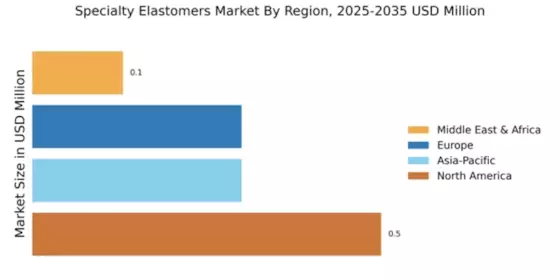
North America is poised to maintain its leadership in the Specialty Elastomers Market, holding a significant market share of $600.0 million as of 2024. The region's growth is driven by increasing demand in automotive, healthcare, and consumer goods sectors, alongside stringent regulations promoting sustainable materials. The push for innovation in elastomer formulations is further catalyzed by government incentives for research and development. The United States stands as the primary contributor, with key players like Kraton Corporation and Dow Inc. leading the charge. The competitive landscape is characterized by a mix of established firms and emerging startups, all vying for market share. The presence of advanced manufacturing facilities and a robust supply chain enhances the region's attractiveness for investment, ensuring continued growth in the specialty elastomers sector.

Europe : Emerging Market with Growth Potential

Europe is witnessing a notable rise in the Specialty Elastomers Market, with a market size of $350.0 million. The growth is fueled by increasing applications in automotive and construction industries, alongside a strong regulatory framework promoting eco-friendly materials. The European Union's Green Deal and various sustainability initiatives are pivotal in driving demand for innovative elastomer solutions that meet stringent environmental standards. Germany, France, and the UK are leading countries in this market, with major players like BASF SE and Wacker Chemie AG at the forefront. The competitive landscape is marked by strategic collaborations and investments in R&D, aimed at enhancing product offerings. The region's focus on sustainability and innovation positions it well for future growth, making it an attractive market for both local and international players.

Asia-Pacific : Rapid Growth in Emerging Economies

The Asia-Pacific region is experiencing rapid growth in the Specialty Elastomers Market, with a market size of $250.0 million. This growth is driven by increasing industrialization, urbanization, and rising consumer demand for high-performance materials. Countries like China and India are at the forefront, supported by government initiatives aimed at boosting manufacturing and infrastructure development, which are crucial for elastomer applications. China is the leading country in this market, with significant contributions from companies like Mitsubishi Chemical Corporation and Hexpol AB. The competitive landscape is evolving, with both domestic and international players striving to capture market share. The region's focus on innovation and cost-effective production methods is expected to drive further growth, making it a key player in The Specialty Elastomers.

Middle East and Africa : Niche Market with Growth Opportunities

The Middle East and Africa region is a niche market for Specialty Elastomers, with a market size of $29.22 million. The growth is primarily driven by increasing demand in the oil and gas sector, as well as construction and automotive industries. Regulatory frameworks are gradually evolving to support the use of advanced materials, which is expected to enhance market dynamics in the coming years. Countries like South Africa and the UAE are leading the way, with local and international players exploring opportunities in this emerging market. The competitive landscape is characterized by a mix of established firms and new entrants, all aiming to leverage the region's unique market conditions. As infrastructure projects expand, the demand for specialty elastomers is anticipated to grow, presenting significant opportunities for investment and development.

Key Players and Competitive Insights

The Specialty Elastomers Market is characterized by a dynamic competitive landscape, driven by innovation, sustainability, and strategic partnerships. Key players such as Kraton Corporation (US), BASF SE (DE), and Dow Inc. (US) are actively shaping the market through their distinct operational focuses. Kraton Corporation (US) emphasizes sustainable product development, leveraging its expertise in bio-based materials to cater to the growing demand for eco-friendly solutions. Meanwhile, BASF SE (DE) is heavily investing in digital transformation initiatives, aiming to enhance operational efficiency and customer engagement through advanced analytics and automation. Dow Inc. (US) appears to be concentrating on expanding its product portfolio, particularly in high-performance elastomers, to meet the diverse needs of various industries, including automotive and consumer goods. Collectively, these strategies indicate a shift towards a more integrated and innovation-driven competitive environment.

In terms of business tactics, companies are increasingly localizing manufacturing and optimizing supply chains to enhance responsiveness to market demands. The Specialty Elastomers Market is moderately fragmented, with a mix of established players and emerging companies. The collective influence of key players is significant, as they not only drive technological advancements but also set industry standards that smaller firms often follow.

In November 2025, Kraton Corporation (US) announced the launch of a new line of bio-based elastomers designed for use in automotive applications. This strategic move underscores the company's commitment to sustainability and positions it favorably in a market that increasingly values eco-friendly materials. The introduction of these products is likely to enhance Kraton's competitive edge, particularly as automotive manufacturers seek to reduce their carbon footprints.

In October 2025, BASF SE (DE) unveiled a new digital platform aimed at streamlining customer interactions and improving supply chain transparency. This initiative reflects the company's focus on digitalization, which is becoming a critical factor in maintaining competitiveness. By enhancing customer engagement and operational efficiency, BASF is likely to strengthen its market position and respond more effectively to evolving customer needs.

In September 2025, Dow Inc. (US) entered into a strategic partnership with a leading automotive manufacturer to develop advanced elastomer solutions for electric vehicles. This collaboration not only expands Dow's reach into the burgeoning electric vehicle market but also highlights the importance of strategic alliances in fostering innovation. Such partnerships are essential for companies looking to leverage complementary strengths and accelerate product development.

As of December 2025, current trends in the Specialty Elastomers Market are increasingly defined by digitalization, sustainability, and the integration of AI technologies. Strategic alliances are playing a pivotal role in shaping the competitive landscape, enabling companies to pool resources and expertise. Looking ahead, competitive differentiation is likely to evolve from traditional price-based competition to a focus on innovation, technological advancements, and supply chain reliability. This shift suggests that companies that prioritize R&D and sustainable practices will be better positioned to thrive in an increasingly competitive environment.

Key Companies in the Specialty Elastomers Market market include

Future Outlook

Specialty Elastomers Market Future Outlook

The Specialty Elastomers Market is projected to grow at 11.71% CAGR from 2024 to 2035, driven by increasing demand in automotive, healthcare, and consumer goods sectors.

New opportunities lie in:

  • Development of bio-based specialty elastomers for sustainable applications.
  • Expansion into emerging markets with tailored product offerings.
  • Investment in advanced manufacturing technologies to enhance production efficiency.

By 2035, the Specialty Elastomers Market is expected to achieve robust growth, solidifying its position as a key industry segment.

Market Segmentation

Specialty Elastomers Market Type Outlook

  • Thermoplastic Elastomers
  • Thermoset Elastomers
  • Silicone Elastomers
  • Polyurethane Elastomers
  • Fluoroelastomers

Specialty Elastomers Market End Use Outlook

  • Automotive Components
  • Seals and Gaskets
  • Adhesives and Coatings
  • Medical Devices
  • Electrical Insulation

Specialty Elastomers Market Application Outlook

  • Automotive
  • Construction
  • Consumer Goods
  • Medical
  • Industrial

Report Scope

MARKET SIZE 20241229.22(USD Million)
MARKET SIZE 20251373.16(USD Million)
MARKET SIZE 20354155.76(USD Million)
COMPOUND ANNUAL GROWTH RATE (CAGR)11.71% (2024 - 2035)
REPORT COVERAGERevenue Forecast, Competitive Landscape, Growth Factors, and Trends
BASE YEAR2024
Market Forecast Period2025 - 2035
Historical Data2019 - 2024
Market Forecast UnitsUSD Million
Key Companies ProfiledKraton Corporation (US), BASF SE (DE), Dow Inc. (US), Mitsubishi Chemical Corporation (JP), Wacker Chemie AG (DE), Evonik Industries AG (DE), Solvay S.A. (BE), Hexpol AB (SE), SABIC (SA)
Segments CoveredApplication, End Use, Type
Key Market OpportunitiesGrowing demand for sustainable materials drives innovation in the Specialty Elastomers Market.
Key Market DynamicsRising demand for lightweight materials drives innovation and competition in the Specialty Elastomers Market.
Countries CoveredNorth America, Europe, APAC, South America, MEA

Market Highlights

Author
Priya Nagrale
Senior Research Analyst

With an experience of over five years in market research industry (Chemicals & Materials domain), I gather and analyze market data from diverse sources to produce results, which are then presented back to a client. Also, provide recommendations based on the findings. As a Senior Research Analyst, I perform quality checks (QC) for market estimations, QC for reports, and handle queries and work extensively on client customizations. Also, handle the responsibilities of client proposals, report planning, report finalization, and execution

Leave a Comment

FAQs

What is the size of the specialty elastomers market?

The global specialty elastomers market had a total volume of 38,000 kilotons in 2018.

What are the growth prospects of the market?

The global specialty elastomers market is expected to exhibit a strong 6.50% CAGR over the forecast period from 2025-2035. By value, the market is expected to exhibit a solid 6.50% CAGR over the forecast period.

What is the leading end user of specialty elastomers?

The automotive industry is the leading end user of specialty elastomers, and accounted for a 35% share in the global market in 2018.

What is the leading regional market for specialty elastomers?

Asia Pacific is the leading regional market for specialty elastomers due to the growing consumption of the product in the automotive, consumer goods, construction, and medical industries.

What are the leading players in the specialty elastomers market?

Leading players in the specialty elastomers market include BASF, Dow, JSR Corporation, Lanxess, LG Chem, Zeon Corporation, and Kuraray, among others.

Download Free Sample

Kindly complete the form below to receive a free sample of this Report

Compare Licence

×
Features License Type
Single User Multiuser License Enterprise User
Price $4,950 $5,950 $7,250
Maximum User Access Limit 1 User Upto 10 Users Unrestricted Access Throughout the Organization
Free Customization
Direct Access to Analyst
Deliverable Format
Platform Access
Discount on Next Purchase 10% 15% 15%
Printable Versions