×
Hero Background
English
Chinese
French
Japanese
Korean
German
Spanish

Specialty Fertilizers Market Trends

ID: MRFR/Agri/3838-HCR
110 Pages
Tejas Chaudhary
October 2025

Specialty Fertilizers Market information by type (nitrogen fertilizers, phosphate fertilizers, potash fertilizers, and others) crop type (cereals oilseeds, fruits vegetables, turf ornamentals, and others), and region Forecast till 2035

Share:
Download PDF ×

We do not share your information with anyone. However, we may send you emails based on your report interest from time to time. You may contact us at any time to opt-out.

Specialty Fertilizers Market Infographic
Purchase Options

Market Trends

Key Emerging Trends in the Specialty Fertilizers Market

The need for fertilizers is growing, and most of them are made from phosphorus-containing minerals found in nature. Phosphorus (P) is like food for living things, especially in farming. The kind of phosphate found in rocks, called apatite, isn't easy for plants to use. So, they have to treat the phosphate rock to make it useful for plants. There are also other sources of phosphate, like manure, bone meal, and waste from cities, but these are not used much because they cost more and there's not enough to make all the fertilizers the world needs. The most common fertilizers are diammonium phosphate (DAP), monoammonium phosphate (MAP), and triple superphosphate (TSP). These make up half of all phosphate-based fertilizers used. According to IFA, fertilizers with high amounts of phosphate, like DAP, and compounds with nitrogen (N), phosphorus (P), and potassium (K), known as NPK, will be the main ones in demand in the next five years. DAP is the most used phosphate fertilizer globally because it has a lot of nutrients and works well for plants like wheat, barley, fruits, and vegetables. In 2020, the world wanted about 30 million tons of DAP. NPKs are compound fertilizers that have different amounts of nitrogen, phosphorus, and potassium. In 2020, the demand for NPK was about 20 million tons worldwide. In 2020, the world needed a lot of fertilizer, around 201.66 million tons. This happened because the weather was good after a strong El Niño event, and farming was looking profitable in some countries. The supply of fertilizer was good, and prices were low for most crops. Economic prospects were going up in developed countries like Russia, Brazil, and Sub-Saharan Africa, but there was some uncertainty in big markets that use a lot of fertilizer. The situation in 2020 supports a modest increase in demand for fertilizer in the next five years, unless there are big changes in the weather or the economy. The Food and Agriculture Organization (FAO) of the United Nations thinks the global farming industry will be worth more than USD 4.1 trillion by the end of 2020, growing at a rate of around 4%. They also estimate that the world wanted over 200 million tons of fertilizer in 2020. The global fertilizer market is expected to grow by around 2%. Asia-Pacific, especially India, is a big market for fertilizers. The United Nations predicts that the world's population will be more than 8.6 billion by 2030, and there will be less land for each person to grow crops. This means we need to grow more from the same land. In places like India, Brazil, China, and Turkey, using phosphate-based fertilizers has increased crop yields. So, with the growing farming industry and the need for more crops, the demand for phosphate in making fertilizers is likely to go up in the coming years.

Author
Tejas Chaudhary
Research Analyst Level II

I have a degree in Engineering (Civil), with masters in Business Administration (Marketing). With more than 4 years of experience in market research and consulting, I am involved in end-to-end process of market research, proposals, project kickoffs and delivery. I have research knowledge and expertise in consumer goods/packaging domain. Also I have worked for various other domains like construction & equipment. Effectively managed and delivered more than 60 report studies for regional as well as global clientele.

Leave a Comment

FAQs

At what CAGR is the global specialty fertilizers market projected to grow in the forecast period (2025-2035)?

Specialty fertilizers market is projected to grow at approximately 7.13% CAGR during the assessment period (2025-2035).

Which are the largest segments in the global specialty fertilizers market?

On the basis of type, the potash fertilizers segment and on the basis of crop type, the turf & ornamentals segment, accounts for the major shares in the global specialty fertilizers market.

Who are the top players in the global specialty fertilizers market?

Mosaic Company (U.S.), Yara International (Norway), Agrium Inc. (Canada), Haifa Chemicals (Israel), Art Wilson Co. (U.S.), Atlantic Gold Corp (Canada), and Eurochem (Switzerland), are some of the top players operating in the global specialty fertilizers market.

Which region holds the largest share in the global specialty fertilizers market?

Asia Pacific holds the largest share in the global specialty fertilizers market, followed by North America and Europe, respectively.

What are the major tailwinds pushing the growth of the global specialty fertilizers market?

Growing demand for food and to increase agricultural productivity, ever-increasing population, and limited availability of cultivable land, are major tailwinds pushing the growth of the global specialty fertilizers market.

Market Summary

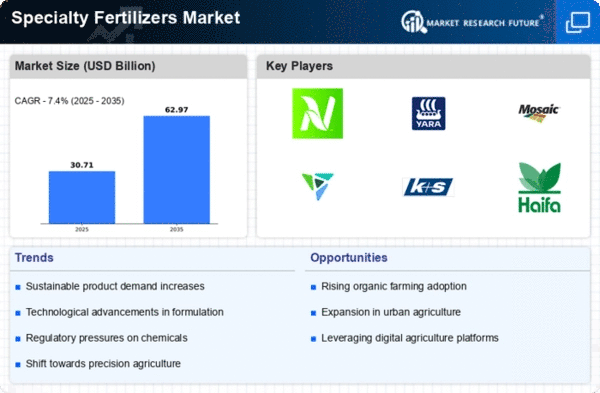
As per MRFR analysis, the Specialty Fertilizers Market Size was estimated at 28.59 USD Billion in 2024. The Specialty Fertilizers industry is projected to grow from 31.03 USD Billion in 2025 to 62.97 USD Billion by 2035, exhibiting a compound annual growth rate (CAGR) of 7.4 during the forecast period 2025 - 2035.

Key Market Trends & Highlights

The Specialty Fertilizers Market is experiencing robust growth driven by sustainability and technological advancements.

  • The market is increasingly oriented towards sustainability, reflecting a broader environmental consciousness among consumers and producers.
  • Technological advancements in fertilizer production are enhancing efficiency and effectiveness, particularly in the North American market.
  • Soil health awareness is rising, prompting farmers to adopt specialty fertilizers that improve soil quality and crop yield.
  • The increasing demand for organic produce and government initiatives supporting sustainable agriculture are key drivers propelling market growth in both North America and Asia-Pacific.

Market Size & Forecast

2024 Market Size 28.59 (USD Billion)
2035 Market Size 62.97 (USD Billion)
CAGR (2025 - 2035) 7.4%
Largest Regional Market Share in 2024 North America

Major Players

<p>Nutrien (CA), Yara International (NO), The Mosaic Company (US), CF Industries (US), K+S AG (DE), Haifa Group (IL), ICL Group (IL), Sociedad Quimica y Minera de Chile (CL), OCP Group (MA)</p>

Market Trends

The Specialty Fertilizers Market is currently experiencing a notable transformation, driven by the increasing demand for sustainable agricultural practices and the need for enhanced crop productivity. As global populations continue to rise, the pressure on food production systems intensifies, prompting farmers and agricultural stakeholders to seek innovative solutions. Specialty fertilizers, which are tailored to meet specific nutrient requirements of various crops, appear to be gaining traction as they offer targeted nutrient delivery, thereby improving efficiency and reducing environmental impact. This shift towards precision agriculture is likely to shape the market dynamics in the coming years, as stakeholders prioritize sustainability alongside productivity. Moreover, the Specialty Fertilizers Market is influenced by advancements in technology and research, which facilitate the development of new formulations and application methods. The integration of digital tools in agriculture, such as soil sensors and data analytics, seems to enhance the effectiveness of specialty fertilizers, allowing for more informed decision-making. Additionally, the growing awareness of soil health and its critical role in sustainable farming practices indicates a potential shift in consumer preferences towards organic and eco-friendly products. As these trends unfold, the Specialty Fertilizers Market is poised for continued growth, reflecting the evolving landscape of global agriculture.

Sustainability Focus

There is a growing emphasis on sustainable agricultural practices within the Specialty Fertilizers Market. Stakeholders are increasingly prioritizing eco-friendly products that minimize environmental impact while maximizing crop yields. This trend reflects a broader societal shift towards sustainability, influencing consumer preferences and driving innovation in fertilizer formulations.

Technological Advancements

The integration of advanced technologies in agriculture is reshaping the Specialty Fertilizers Market. Innovations such as precision farming tools and data analytics are enhancing the application and effectiveness of specialty fertilizers. These technologies enable farmers to optimize nutrient delivery, thereby improving overall crop health and productivity.

Soil Health Awareness

An increasing awareness of soil health is emerging as a significant trend in the Specialty Fertilizers Market. Farmers and agricultural professionals are recognizing the importance of maintaining soil quality for sustainable farming. This awareness is likely to drive demand for specialty fertilizers that promote soil vitality and long-term agricultural sustainability.

Specialty Fertilizers Market Market Drivers

Market Growth Projections

The Global Specialty Fertilizers Industry is projected to experience substantial growth over the coming years. With an estimated market value of 29.6 USD Billion in 2024, the industry is expected to expand significantly, reaching 63.1 USD Billion by 2035. This growth reflects a compound annual growth rate of 7.13% from 2025 to 2035, driven by factors such as increasing demand for sustainable agriculture, technological advancements, and rising food production needs. The market's expansion is indicative of a broader trend towards specialized agricultural solutions that cater to the evolving needs of farmers and consumers.

Growing Awareness of Soil Health

There is a growing awareness of soil health among farmers and agricultural stakeholders, which is positively influencing the Global Specialty Fertilizers Industry. Healthy soil is essential for sustainable crop production, and specialty fertilizers are designed to improve soil fertility and structure. This awareness is leading to increased adoption of products that enhance microbial activity and nutrient availability. As farmers seek to optimize their yields while maintaining soil health, the demand for specialty fertilizers is expected to rise. This trend aligns with the overall growth trajectory of the market, indicating a robust future.

Government Initiatives and Support

Government initiatives aimed at promoting the use of specialty fertilizers are significantly impacting the Global Specialty Fertilizers Industry. Various countries are implementing policies that encourage sustainable farming practices and the adoption of advanced fertilizers. These initiatives often include subsidies, research funding, and educational programs for farmers. Such support not only enhances the accessibility of specialty fertilizers but also fosters innovation within the industry. As governments recognize the importance of sustainable agriculture, the market is likely to benefit from increased investment and growth opportunities.

Rising Global Population and Food Demand

The Global Specialty Fertilizers Industry is poised for growth due to the rising global population and the corresponding increase in food demand. As the world population is projected to reach approximately 9.7 billion by 2050, the pressure on agricultural systems intensifies. Specialty fertilizers play a crucial role in enhancing crop productivity and ensuring food security. By improving nutrient uptake and crop resilience, these fertilizers are essential for meeting the nutritional needs of a growing population. This demand is expected to drive the market's compound annual growth rate of 7.13% from 2025 to 2035.

Increasing Demand for Sustainable Agriculture

The Global Specialty Fertilizers Industry is experiencing a notable shift towards sustainable agricultural practices. Farmers are increasingly adopting specialty fertilizers that enhance soil health and reduce environmental impact. This trend is driven by consumer demand for organic produce and government regulations promoting eco-friendly farming. As a result, the market is projected to reach 29.6 USD Billion in 2024, reflecting a growing awareness of sustainable practices. Specialty fertilizers, such as bio-based and slow-release formulations, are gaining traction, indicating a potential for further growth as agricultural stakeholders prioritize sustainability.

Technological Advancements in Fertilizer Production

Technological innovations in the production of specialty fertilizers are significantly influencing the Global Specialty Fertilizers Industry. Advanced manufacturing processes, such as precision agriculture and smart fertilizers, are enhancing nutrient efficiency and reducing wastage. These innovations allow for tailored nutrient delivery, which can lead to increased crop yields and improved soil health. As the industry embraces these technologies, it is likely to attract investment and expand its market share. The anticipated growth trajectory suggests that the market could reach 63.1 USD Billion by 2035, driven by these advancements in fertilizer technology.

Market Segment Insights

By Application: Agriculture (Largest) vs. Hydroponics (Fastest-Growing)

<p>The Specialty Fertilizers Market exhibits a diverse application landscape, with Agriculture holding the largest market share, followed by Horticulture and Turf and Ornamental segments. Agriculture's extensive use across various crops and farming practices solidifies its dominant position in the overall market. Meanwhile, segments like Plantation and Hydroponics are witnessing increasing adoption, reflecting shifting agricultural practices and consumer preferences toward more sustainable production methods. Growth trends indicate a shift toward specialized fertilizers tailored for specific crops in Agriculture, driven by the need for efficiency and sustainability. Hydroponics is emerging as a significant growth driver due to the rising popularity of soilless farming, which is favored for its resource efficiency and ability to deliver high yields in urban settings. The Turf and Ornamental segment continues to grow, supported by increased landscaping and gardening activities worldwide.</p>

<p>Agriculture (Dominant) vs. Hydroponics (Emerging)</p>

<p>Agriculture remains the dominant application segment within the Specialty Fertilizers Market, characterized by its extensive use in maximizing crop yields and enhancing soil quality. Its role is essential in traditional farming practices and is supported by advancements in fertilizer formulations tailored to meet specific crop nutrient requirements. Conversely, Hydroponics is rapidly emerging as a notable segment, leveraging innovative growing techniques that enable cultivation without soil. This method is particularly popular among urban farmers and greenhouses aiming for higher yield densities and reduced environmental impact, catering to a growing consumer demand for fresh produce without the use of harmful chemicals.</p>

By Nutrient Type: Nitrogenous Fertilizers (Largest) vs. Micronutrient Fertilizers (Fastest-Growing)

<p>The Specialty Fertilizers Market is significantly influenced by various nutrient types, with Nitrogenous Fertilizers holding the largest share due to their essential role in plant growth and high demand in a wide range of crops. Following them, Phosphatic and Potassic Fertilizers are also key players, contributing substantially to the market, while Micronutrient Fertilizers are gaining traction among farmers seeking to enhance crop yield by addressing specific nutrient deficiencies. Organic Fertilizers, while growing at a steady pace, still represent a smaller niche market compared to synthetic counterparts.</p>

<p>Nitrogenous Fertilizers: Dominant vs. Micronutrient Fertilizers: Emerging</p>

<p>Nitrogenous Fertilizers are pivotal in the Specialty Fertilizers Market, primarily due to their high nitrogen content that supports vigorous plant growth. This segment has consistently been dominant, driven by the increasing need for food security and higher agricultural productivity. On the other hand, Micronutrient Fertilizers are emerging as a critical segment, particularly in regions with nutrient-deficient soils. They are aimed at improving overall health and yield of crops intricately. As the agricultural sector evolves, the focus on sustainable nutrient management and the adoption of precision agriculture practices bolster the demand for micronutrients, making them a fast-growing choice among innovative farmers.</p>

By Formulation: Granular (Largest) vs. Liquid (Fastest-Growing)

<p>In the Specialty Fertilizers Market, the formulation segment reveals a diverse portfolio of products, with granular fertilizers leading in market share due to their favorable attributes such as sustained nutrient release and ease of application. Liquid fertilizers follow as a significant contributor, often preferred for their rapid uptake by plants, albeit representing a smaller share of the overall market. Water-soluble, slow-release, and controlled-release formulations contribute to the segmentation but are generally seen as niche products compared to granular and liquid options. The landscape of formulation types showcases a dynamic shift as liquid fertilizers are increasingly gaining popularity, driven by advancements in fertilization technology that enhance growth performance and environmental considerations. Additionally, slow-release and controlled-release formulations are being adopted due to their ability to minimize nutrient loss, contributing to more sustainable agricultural practices. This consolidation of popularity among various types marks a transformative era, as these formulations cater to specific agricultural needs and challenges.</p>

<p>Granular (Dominant) vs. Controlled-Release (Emerging)</p>

<p>Granular fertilizers are characterized by their solid form, allowing for a slow and steady release of nutrients, making them particularly popular among farmers for their low maintenance and efficacy in various soil types. Due to their dominant position in the market, granular fertilizers are essential in traditional farming methods, offering an ease of use that appeals to a broad range of agricultural practices. On the other hand, controlled-release fertilizers represent an emerging trend in the specialty fertilizers segment. They are designed to release nutrients in response to environmental conditions, providing a precise nutrient delivery that reduces waste and environmental impact. This innovation aligns with growing demands for sustainable farming, marking controlled-release fertilizers as an attractive alternative amid shifts towards environmentally responsible agricultural solutions.</p>

By End Use: Crops (Largest) vs. Lawns (Fastest-Growing)

<p>In the Specialty Fertilizers Market, the end use segments are diversified, with crops dominating the market share significantly. This segment benefits from increased agricultural activities and a rising demand for high-quality food production. Gardens and greenhouses follow, strongly influenced by the growing trend towards urban gardening and sustainable practices. The lawn segment, while historically smaller, is witnessing rapid growth as consumers focus on landscaping and outdoor aesthetics, making it a noteworthy part of the market.</p>

<p>Crops (Dominant) vs. Lawns (Emerging)</p>

<p>Crops stand out in the Specialty Fertilizers Market as a dominant segment, fueled by the demand for enhanced agricultural yield and quality. This category includes a variety of applications such as cereals and vegetables, where specialized fertilizers are essential for maximizing growth and resilience against pests and diseases. On the other hand, the lawn segment is emerging strongly, driven by consumer interest in maintaining lush green spaces for aesthetic and recreational purposes. The increase in residential and commercial landscaping initiatives has boosted the demand for specialized lawn fertilizers, making it a significant growth area within the market.</p>

Get more detailed insights about Specialty Fertilizers Market Research Report - Forecast till 2035

Regional Insights

North America : Market Leader in Specialty Fertilizers

North America is poised to maintain its leadership in the specialty fertilizers market, holding a significant share of 12.86 in 2025. The region's growth is driven by increasing agricultural productivity demands, advancements in fertilizer technology, and supportive regulatory frameworks. The rising focus on sustainable farming practices and precision agriculture further fuels demand for specialty fertilizers, enhancing crop yields and soil health. The United States and Canada are the leading countries in this market, with major players like Nutrien, CF Industries, and The Mosaic Company dominating the landscape. These companies are investing in innovative solutions to meet the evolving needs of farmers. The competitive environment is characterized by strategic partnerships and acquisitions, aimed at expanding product portfolios and enhancing market reach. The presence of established firms ensures a robust supply chain and distribution network, solidifying North America's market position.

Europe : Emerging Market with Growth Potential

Europe's specialty fertilizers market is on the rise, with a market size of 8.57 in 2025. The growth is propelled by stringent environmental regulations and a shift towards sustainable agricultural practices. The European Union's Green Deal and Farm to Fork strategy are pivotal in promoting the use of specialty fertilizers, which are essential for enhancing soil fertility and reducing chemical runoff. This regulatory support is crucial for driving innovation and adoption in the sector. Leading countries in this region include Germany, France, and the Netherlands, where companies like Yara International and K+S AG are key players. The competitive landscape is marked by a focus on research and development, with firms investing in eco-friendly products. The presence of a well-established agricultural sector and a growing emphasis on organic farming further contribute to the market's expansion, positioning Europe as a significant player in the global specialty fertilizers arena.

Asia-Pacific : Rapid Growth in Fertilizer Demand

The Asia-Pacific region is witnessing a burgeoning demand for specialty fertilizers, with a market size of 5.71 in 2025. This growth is driven by increasing population pressures, rising food demand, and the need for enhanced agricultural productivity. Governments are implementing policies to support sustainable farming practices, which are crucial for addressing food security challenges. The region's diverse agricultural landscape necessitates tailored fertilizer solutions, further propelling market growth. Countries like China, India, and Australia are at the forefront of this market, with key players such as Haifa Group and ICL Group actively participating. The competitive landscape is characterized by a mix of local and international firms, focusing on innovation and product differentiation. The presence of a large agricultural base and increasing investments in agricultural technology are expected to drive the specialty fertilizers market in this region, making it a vital area for future growth.

Middle East and Africa : Emerging Market with Unique Challenges

The Middle East and Africa region is gradually emerging in the specialty fertilizers market, with a market size of 1.45 in 2025. The growth is influenced by the need for improved agricultural practices and food security initiatives. Governments are increasingly recognizing the importance of specialty fertilizers in enhancing crop yields and soil health, leading to supportive policies and investments in agricultural technology. The region's unique climatic conditions necessitate specialized fertilizer solutions tailored to local crops. Leading countries include South Africa and Morocco, where companies like OCP Group are making significant strides. The competitive landscape is evolving, with both local and international players vying for market share. The presence of key players is crucial for developing innovative products that cater to the region's specific agricultural needs, positioning the Middle East and Africa as a growing market for specialty fertilizers.

Key Players and Competitive Insights

The Specialty Fertilizers Market is characterized by a dynamic competitive landscape, driven by increasing agricultural productivity demands and a growing emphasis on sustainable farming practices. Key players such as Nutrien (CA), Yara International (NO), and The Mosaic Company (US) are strategically positioned to leverage innovation and regional expansion to enhance their market presence. Nutrien (CA) focuses on digital transformation initiatives, integrating precision agriculture technologies to optimize fertilizer application, while Yara International (NO) emphasizes sustainability through its commitment to reducing carbon emissions in fertilizer production. The Mosaic Company (US) has adopted a strategy of vertical integration, enhancing its supply chain efficiency and ensuring product quality, which collectively shapes a competitive environment that is increasingly focused on sustainability and technological advancement.

In terms of business tactics, companies are localizing manufacturing to reduce transportation costs and enhance supply chain resilience. The market structure appears moderately fragmented, with a mix of large multinational corporations and regional players. This fragmentation allows for diverse competitive strategies, as key players like CF Industries (US) and K+S AG (DE) optimize their operations to cater to local market needs while maintaining global standards.

In November 2025, Yara International (NO) announced a partnership with a leading tech firm to develop AI-driven solutions for precision farming. This strategic move is likely to enhance Yara's product offerings, enabling farmers to make data-driven decisions that optimize fertilizer use and minimize environmental impact. Such innovations may position Yara as a leader in sustainable agricultural practices, aligning with global trends towards eco-friendly farming.

In October 2025, The Mosaic Company (US) launched a new line of specialty fertilizers designed specifically for high-value crops. This initiative reflects Mosaic's commitment to innovation and its understanding of market demands for tailored solutions. By focusing on niche markets, Mosaic could potentially increase its market share and strengthen customer loyalty, thereby enhancing its competitive edge.

In September 2025, CF Industries (US) expanded its production capacity in North America, aiming to meet the rising demand for specialty fertilizers. This expansion not only signifies CF's confidence in market growth but also highlights the importance of supply chain optimization in maintaining competitive advantage. Increased production capacity may allow CF to respond more swiftly to market fluctuations and customer needs.

As of December 2025, current competitive trends in the Specialty Fertilizers Market are increasingly defined by digitalization, sustainability, and the integration of AI technologies. Strategic alliances are becoming pivotal, as companies collaborate to enhance their technological capabilities and sustainability initiatives. The competitive differentiation is likely to evolve from traditional price-based competition towards a focus on innovation, technology integration, and supply chain reliability, suggesting a transformative shift in how companies position themselves in the market.

Key Companies in the Specialty Fertilizers Market market include

Industry Developments

Future Outlook

Specialty Fertilizers Market Future Outlook

<p>The Specialty Fertilizers Market is projected to grow at a 7.4% CAGR from 2024 to 2035, driven by increasing agricultural productivity and sustainable farming practices.</p>

New opportunities lie in:

  • <p>Development of precision agriculture technologies for targeted nutrient delivery.</p>
  • <p>Expansion into emerging markets with tailored specialty fertilizer solutions.</p>
  • <p>Investment in R&D for bio-based and organic specialty fertilizers.</p>

<p>By 2035, the Specialty Fertilizers Market is expected to achieve robust growth, reflecting evolving agricultural demands.</p>

Market Segmentation

Specialty Fertilizers Market End Use Outlook

  • Crops
  • Gardens
  • Lawns
  • Greenhouses
  • Nurseries

Specialty Fertilizers Market Application Outlook

  • Agriculture
  • Horticulture
  • Turf and Ornamental
  • Plantation
  • Hydroponics

Specialty Fertilizers Market Formulation Outlook

  • Granular
  • Liquid
  • Water-Soluble
  • Slow-Release
  • Controlled-Release

Specialty Fertilizers Market Nutrient Type Outlook

  • Nitrogenous Fertilizers
  • Phosphatic Fertilizers
  • Potassic Fertilizers
  • Micronutrient Fertilizers
  • Organic Fertilizers

Report Scope

MARKET SIZE 202428.59(USD Billion)
MARKET SIZE 202531.03(USD Billion)
MARKET SIZE 203562.97(USD Billion)
COMPOUND ANNUAL GROWTH RATE (CAGR)7.4% (2024 - 2035)
REPORT COVERAGERevenue Forecast, Competitive Landscape, Growth Factors, and Trends
BASE YEAR2024
Market Forecast Period2025 - 2035
Historical Data2019 - 2024
Market Forecast UnitsUSD Billion
Key Companies ProfiledNutrien (CA), Yara International (NO), The Mosaic Company (US), CF Industries (US), K+S AG (DE), Haifa Group (IL), ICL Group (IL), Sociedad Quimica y Minera de Chile (CL), OCP Group (MA)
Segments CoveredApplication, Nutrient Type, Formulation, End Use
Key Market OpportunitiesGrowing demand for sustainable agriculture practices drives innovation in the Specialty Fertilizers Market.
Key Market DynamicsRising demand for precision agriculture drives innovation and competition in the specialty fertilizers market.
Countries CoveredNorth America, Europe, APAC, South America, MEA

FAQs

At what CAGR is the global specialty fertilizers market projected to grow in the forecast period (2025-2035)?

Specialty fertilizers market is projected to grow at approximately 7.13% CAGR during the assessment period (2025-2035).

Which are the largest segments in the global specialty fertilizers market?

On the basis of type, the potash fertilizers segment and on the basis of crop type, the turf &amp; ornamentals segment, accounts for the major shares in the global specialty fertilizers market.

Who are the top players in the global specialty fertilizers market?

Mosaic Company (U.S.), Yara International (Norway), Agrium Inc. (Canada), Haifa Chemicals (Israel), Art Wilson Co. (U.S.), Atlantic Gold Corp (Canada), and Eurochem (Switzerland), are some of the top players operating in the global specialty fertilizers market.

Which region holds the largest share in the global specialty fertilizers market?

Asia Pacific holds the largest share in the global specialty fertilizers market, followed by North America and Europe, respectively.

What are the major tailwinds pushing the growth of the global specialty fertilizers market?

Growing demand for food and to increase agricultural productivity, ever-increasing population, and limited availability of cultivable land, are major tailwinds pushing the growth of the global specialty fertilizers market.

  1. Research Methodology
  2. Initial Data Exploration
  3. Statistical Modelling and Forecast
  4. Industry Insights and Validation
    1. Data Sources
    2. Specialty fertilizers Industry Market Synopsis, 2024-2032
      1. Business Trends
      2. Product Type Trends
      3. Product Crop type Trends
    3. Industry Segmentation
    4. Industry Size and Forecast
    5. Industry Ecosystem Analysis
    6. Industry Impact forces
      1. Growth Drivers
      2. Industry Pitfalls & Challenges
    7. Growth Potential Analysis
    8. Company Market Share Analysis, 2016
    9. Porter’s analysis
    10. PESTEL analysis
    11. Global Specialty fertilizers Market Volume Share by Type, 2024-2032
      1. Nitrogen fertilizers
      2. Phosphate fertilizers
      3. Potash fertilizers
      4. Others
    12. Global Specialty fertilizers Market Volume Share by Crop type, 2024-2032
      1. Cereals & Oilseeds
      2. Fruits & Vegetables
      3. Turf & Ornamentals
      4. Others
    13. Specialty fertilizers Market Volume Share by Region, 2024-2032.
    14. North America
    15. A Market Estimates & Forecast, 2024-2032
    16. B Market Estimates & Forecast, by Type, 2024-2032
    17. C Market Estimates & Forecast, by Crop type, 2024-2032
      1. U.S.
      2. Canada
      3. Mexico
    18. Europe
    19. A Market Estimates & Forecast, 2024-2032
    20. B Market Estimates & Forecast, by Type, 2024-2032
    21. C Market Estimates & Forecast, by Crop type, 2024-2032
      1. Germany
      2. U.K
      3. France
      4. Italy
    22. Asia Pacific
    23. A Market Estimates & Forecast, 2024-2032
    24. B Market Estimates & Forecast, by Type, 2024-2032
    25. C Market Estimates & Forecast, by Crop type, 2024-2032
      1. China
      2. India
      3. Japan
    26. RoW
    27. A Market Estimates & Forecast, 2024-2032
    28. B Market Estimates & Forecast, by Type, 2024-2032
    29. C Market Estimates & Forecast, by Crop type, 2024-2032
    30. Mosaic Company (U.S.)
      1. Business Overview
      2. Financial Data
      3. Product Landscape
      4. Key Developments
      5. Business Strategy
      6. SWOT Analysis
    31. Agrium Inc. (Canada)
      1. Business Overview
      2. Financial Data
      3. Product Landscape
      4. Key Developments
      5. Business Strategy
      6. SWOT Analysis
    32. Yara International (Norway)
      1. Business Overview
      2. Financial Data
      3. Product Landscape
      4. Key Developments
      5. Business Strategy
      6. SWOT Analysis
    33. Haifa Chemicals (Israel)
      1. Business Overview
      2. Financial Data
      3. Product Landscape
      4. Key Developments
      5. Business Strategy
      6. SWOT Analysis
    34. Atlantic Gold Corp (Canada)
      1. Business Overview
      2. Financial Data
      3. Product Landscape
      4. Key Developments
      5. Business Strategy
      6. SWOT Analysis
    35. Art Wilson Co. (U.S.)
      1. Business Overview
      2. Financial Data
      3. Product Landscape
      4. Key Developments
      5. Business Strategy
      6. SWOT Analysis
    36. Eurochem (Switzerland)
      1. Business Overview
      2. Financial Data
      3. Product Landscape
      4. Key Developments
      5. Business Strategy
      6. SWOT Analysis
  5. PESTLE ANALYSIS – U.S.
  6. PESTLE ANALYSIS- JAPAN
  7. PESTLE ANALYSIS- CHINA
  8. PESTLE ANALYSIS- FRANCE
  9. PESTLE ANALYSIS- GERMANY
  10. KEY SUPPLIERS OF SPECIALTY FERTILIZERS
  11. GLOBAL MARKET FOR SPECIALTY FERTILIZERS, BY TYPE, (2024-2032), USD MILLION
  12. GLOBAL MARKET FOR SPECIALTY FERTILIZERS, BY CROP TYPE, (2024-2032), USD MILLION
  13. GLOBAL SPECIALTY FERTILIZERS SALES AND GROWTH RATE (2024-2032) USD MILLION
  14. GLOBAL MARKET FOR SPECIALTY FERTILIZERS TOP 5 COUNTRIES
  15. GLOBAL MARKET FOR SPECIALTY FERTILIZERS TOP COMPANIES-USD MILLION
  16. NORTH AMERICAN GLOBAL MARKET FOR SPECIALTY FERTILIZERS, BY TYPE, (2024-2032) USD MILLION
  17. NORTH AMERICAN MARKET FOR SPECIALTY FERTILIZERS, BY CROP TYPE, (2024-2032), USD MILLION
  18. EUROPEAN GLOBAL MARKET FOR SPECIALTY FERTILIZERS, BY TYPE, (2024-2032) USD MILLION
  19. EUROPEAN MARKET FOR SPECIALTY FERTILIZERS, BY CROP TYPE, (2024-2032), USD MILLION
  20. APAC GLOBAL MARKET FOR SPECIALTY FERTILIZERS, BY TYPE, (2024-2032) USD MILLION
  21. APAC MARKET FOR SPECIALTY FERTILIZERS, BY CROP TYPE, (2024-2032), USD MILLION
  22. REST OF THE WORLD MARKET FOR SPECIALTY FERTILIZERS, BY TYPE, (2024-2032) USD MILLION
  23. REST OF THE WORLD MARKET FOR SPECIALTY FERTILIZERS, BY CROP TYPE, (2024-2032), USD MILLION
  24. COMPETITIVE LANDSCAPING BASED ON FINACIALS DURING THE YEAR 2016 
    1. Charts & Figures
  25. LIST OF FIGURES
  26. RESEARCH METHODOLOGY
  27. PRIMARY DATA ANALYSIS APPROACH
  28. SECONDARY DATA ANALYSIS APPROACH
  29. TRENDS IN SPECIALTY FERTILIZERS IMPORTS 2022
  30. GROWTH RATE IN SPECIALTY FERTILIZERS IMPORTS 2022
  31. SPECIALTY FERTILIZERS IMPORTS MARKET SHARE BY TOP 5 IMPORTERS (2022)
  32. TRENDS IN SPECIALTY FERTILIZERS EXPORTS 2022
  33. GROWTH RATE SPECIALTY FERTILIZERS EXPORTS 2022
  34. SPECIALTY FERTILIZERS EXPORTS MARKET SHARE BY TOP 5 EXPORTERS (2022)
  35. VALUE CHAIN ANALYSIS
  36. COST ANALYSIS: SPECIALTY FERTILIZERS
  37. PORTER’S FIVE FORCES ANALYSIS
  38. GLOBAL MARKET FOR SPECIALTY FERTILIZERS TRENDS BY TYPE
  39. GLOBAL MARKET FOR SPECIALTY FERTILIZERS TRENDS BY CROP TYPE
  40. FINANCIALS

Specialty Fertilizers Market Segmentation

Market Segmentation Overview

  • Detailed segmentation data will be available in the full report
  • Comprehensive analysis by multiple parameters
  • Regional and country-level breakdowns
  • Market size forecasts by segment
Infographic

Free Sample Request

Kindly complete the form below to receive a free sample of this Report

Get Free Sample

Customer Strories

Compare Licence

×
Features License Type
Single User Multiuser License Enterprise User
Price $4,950 $5,950 $7,250
Maximum User Access Limit 1 User Upto 10 Users Unrestricted Access Throughout the Organization
Free Customization
Direct Access to Analyst
Deliverable Format
Platform Access
Discount on Next Purchase 10% 15% 15%
Printable Versions