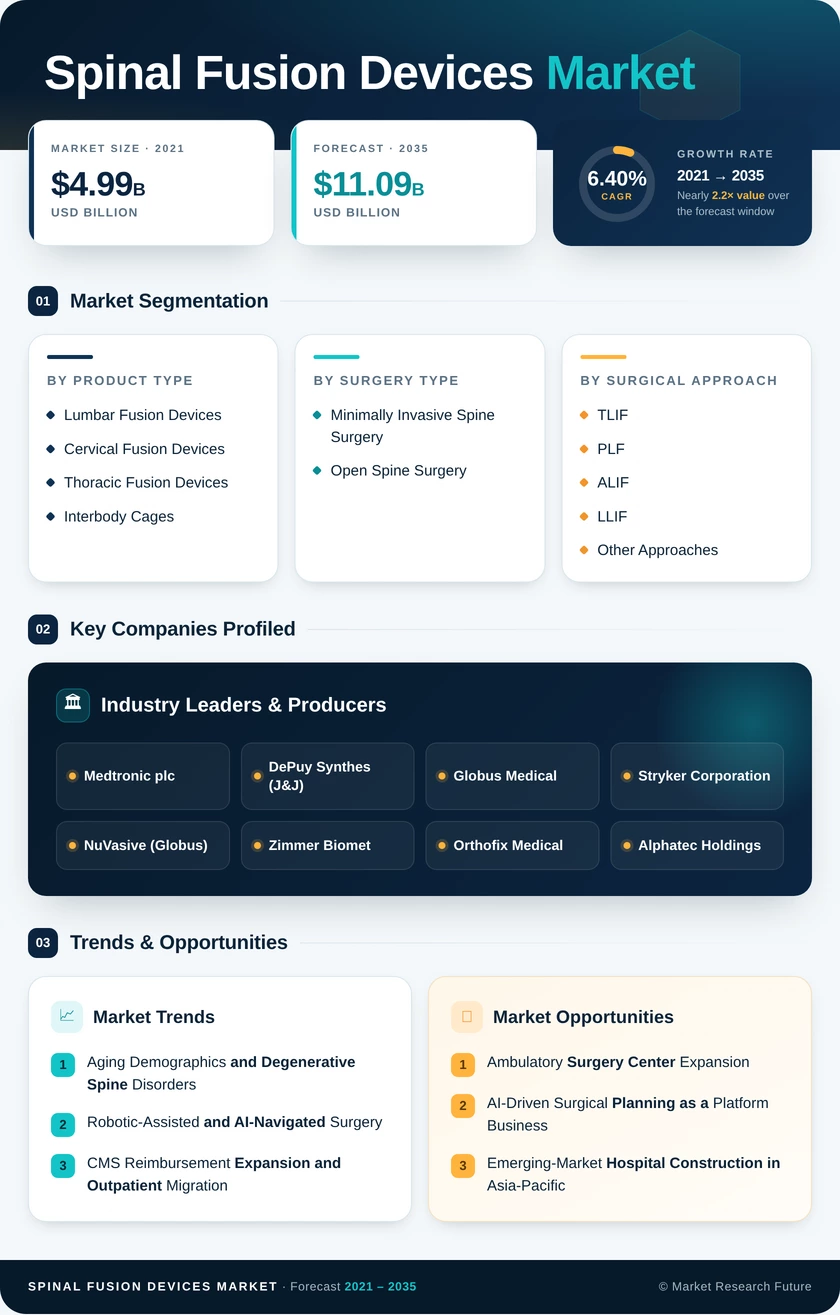
Segmentation Quick Reference
| Dimension | Sub-Segments | Dominant Segment | Fastest Growing Segment |
| Product Type | Lumbar Fusion Devices, Cervical Fusion Devices, Thoracic Fusion Devices, Interbody Cages | Lumbar Fusion Devices (46.0% share, 2025) | Interbody Cages (7.28% CAGR) |
| Surgery Type | Minimally Invasive Spine Surgery, Open Spine Surgery | Minimally Invasive Spine Surgery (66.4% share, 2025) | Minimally Invasive Spine Surgery |
| Surgical Approach | TLIF, PLF, ALIF, LLIF, Other Approaches | Posterolateral Fusion (36.2% share, 2025) | TLIF (6.88% CAGR) |
| End User | Hospitals, Ambulatory Surgery Centers, Specialty Spine Clinics | Hospitals (66.5% share, 2025) | Ambulatory Surgery Centers (7.03% CAGR) |
| Geography | North America, Europe, Asia-Pacific, South America, Middle East & Africa | North America (49.1% share, 2025) | Asia-Pacific (7.19% CAGR) |
Market Segmentation Overview
By Product Type
| Sub-Segment | Key Trend |
| Lumbar Fusion Devices | Dominant segment driven by high prevalence of lumbar degenerative conditions; increasing shift toward stand-alone interbody approaches |
| Cervical Fusion Devices | Growing ACDF procedure volumes; high ASC suitability, accelerating outpatient adoption |
| Thoracic Fusion Devices | Niche segment led by scoliosis correction and trauma stabilization applications |
| Interbody Cages | Fastest-growing product category; 3-D-printed porous titanium designs are gaining surgeon preference over traditional PEEK |
Lumbar fusion devices remain the cornerstone of this segmentation dimension, reflecting the disproportionate clinical burden of lower-back pathology among aging populations globally. Interbody cages are rapidly converging on lumbar devices in growth terms as stand-alone cage designs reduce the procedural complexity and cost of supplemental fixation.
By Surgery Type
| Sub-Segment | Key Trend |
| Minimally Invasive Spine Surgery | Robotic navigation platforms are expanding MIS applicability to complex multi-level cases. |
| Open Spine Surgery | Retains an essential role for severe deformity correction, tumor resection, and revision procedures |
Minimally invasive surgery has become the preferred technique for the majority of fusion procedures, driven by clinical evidence of faster recovery, lower infection rates, and shorter hospital stays. Open surgery continues to serve a clinically necessary but declining share of total procedure volume.
By Surgical Approach
| Sub-Segment | Key Trend |
| Transforaminal Lumbar Interbody Fusion (TLIF) | Fastest-growing approach; single-incision versatility compatible with robotic platforms |
| Posterolateral Fusion (PLF) | Largest share by established technique with decades of clinical outcome data |
| Anterior Lumbar Interbody Fusion (ALIF) | Preferred for disc-height restoration and sagittal balance optimization |
| Lateral Lumbar Interbody Fusion (LLIF) | Muscle-sparing access is gaining traction in ASC settings. |
| Other Approaches | Includes posterior cervical, combined approaches, and occipitocervical fusion |
TLIF and PLF together account for the majority of lumbar fusion procedures. TLIF's compatibility with MIS techniques and robotic guidance is driving its rapid adoption, while PLF remains the default for surgeons trained in traditional posterior approaches.
By End User
| Sub-Segment | Key Trend |
| Hospitals | Retain dominance for complex, multi-level, and high-acuity cases requiring ICU backup. |
| Ambulatory Surgery Centers | Fastest-growing channel driven by CMS outpatient expansion and cost-efficiency demands |
| Specialty Spine Clinics | Surgeon-owned facilities offering integrated care pathways and a premium patient experience |
Hospitals will continue to handle the most complex fusion procedures. However, ASCs are capturing an increasing share of single- and two-level cases as reimbursement pathways expand and patient preference shifts toward outpatient settings.
By Geography
| Sub-Segment | Key Trend |
| North America | Mature market led by US robotic surgery adoption and ASC migration |
| Europe | MDR compliance reshaping competitive dynamics; Germany and the UK leading volume |
| Asia-Pacific | Fastest-growing region fueled by China hospital construction and India insurance expansion |
| South America | Brazil-anchored growth; SUS public coverage expanding fusion access |
| Middle East & Africa | GCC medical tourism hubs are driving premium device demand |
North America and Europe collectively represent over 75% of global revenue, but Asia-Pacific's compounding growth rate positions it as the primary incremental revenue contributor over the 2026–2035 forecast window.