Steam Turbine Market (2026 - 2035)

Steam Turbine Market Research Report By Technology (Combined Cycle, Steam Cycle, Cogeneration / CHP), By Capacity (Up to 120 MW, 121–350 MW, 351–750 MW, Above 750 MW), By End User (Power & Utility, Industrial, Others (Marine, Nuclear Services)) and By Regional (North America, Europe, South America, Asia Pacific, Middle East and Africa) - Industry Forecast to 2035
ID: MRFR/EnP/3197-CR
135 Pages
Priya Nagrale
Last Updated: July 10, 2026
Steam Turbine Market
Market Size
Forecast Period2026-2035
CAGR (2026-2035)3.2%
2025 Market SizeUSD 17.5 Billion
Key Players
GE Vernova
Siemens Energy
Mitsubishi Power
Toshiba Energy Systems
Doosan Enerbility
Shanghai Electric
Opportunities
  • Ultra-Supercritical and Advanced USC Technology Adoption
  • Hydrogen and Ammonia Co-Firing Retrofits
  • Geothermal and Waste-to-Energy Expansion

Steam Turbine Market Summary

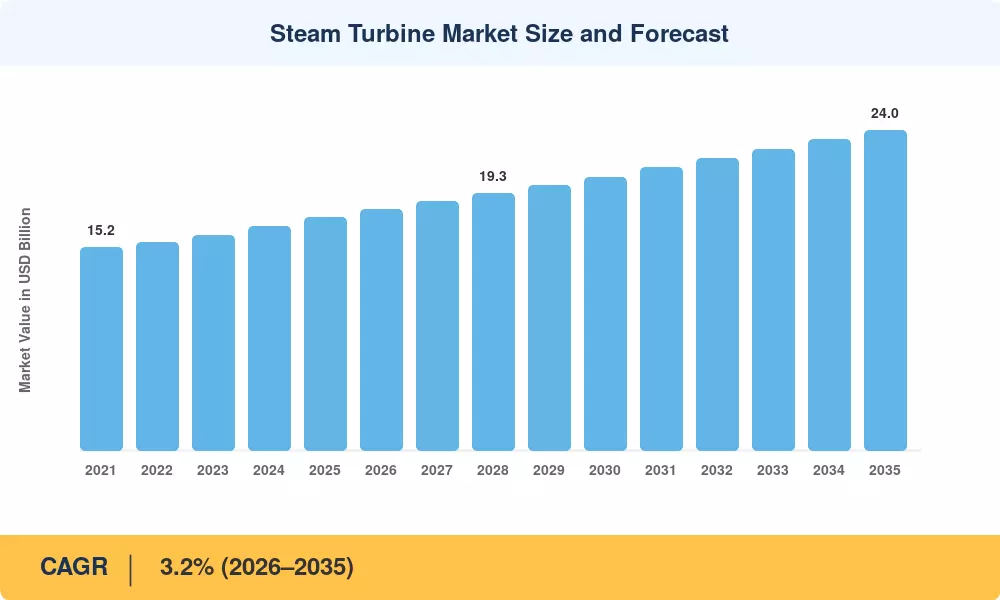
The global Steam Turbine Market reached an estimated USD 17.5 billion in 2025 and is projected to grow from USD 18.1 billion in 2026 to USD 24.0 billion by 2035, registering a CAGR of 3.2% during the forecast period (2026–2035). This growth trajectory reflects the dual pull of coal-to-gas fleet transitions in mature economies and accelerating thermal capacity additions across emerging Asia. The IEA's World Energy Outlook 2024 flagged over 680 GW of planned coal retirements by 2040, each requiring replacement dispatchable capacity — a pipeline that feeds directly into steam turbine demand [1].

Technologically, the Steam Turbine Market is transitioning through a generational shift. The backbone of 20th-century power generation – subcritical units – is being replaced by ultra-supercritical and advanced ultra-supercritical designs, running at steam temperatures >600°C and boosting net plant efficiency above 47%. GE Vernova and Siemens Energy have committed more than USD 2.8 billion for enhanced steam-path R&D until 2030 [2]. Close to 60% of all new orders for gas-fired capacity globally are now for combined-cycle gas turbine (CCGT) plants, which use the exhaust heat to drive a steam turbine [3].

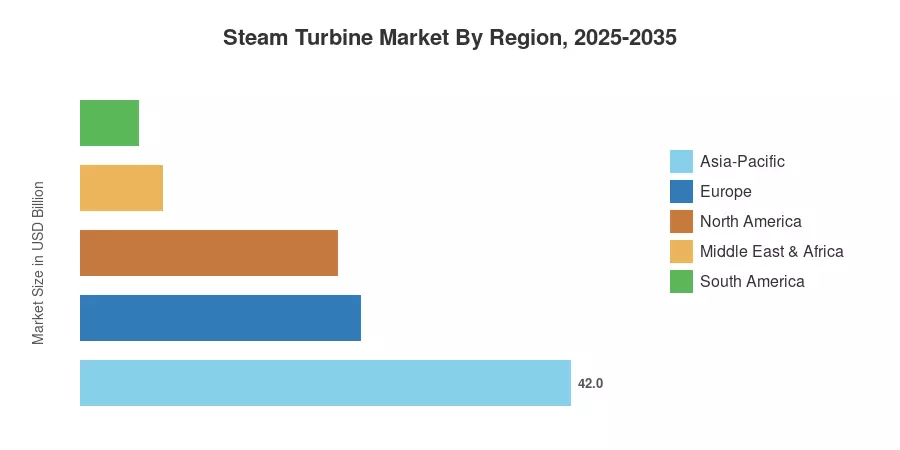
Asia-Pacific accounts for around 42% of the Steam Turbine Market, led by coal fleet upgrades in China and India, and LNG-based expansions in SE Asia. The region is also anticipated to witness the highest CAGR of 4.1% through 2035. Europe is estimated to have a 24% share backed by fleet life-extension programs and cogeneration obligations under the EU Energy Efficiency Directive. North America is at about 22% share and benefits from the clean-energy tax incentives from the Inflation Reduction Act that stimulate CCGT conversions

.


Key Report Takeaways

• By Technology

  • Combined-cycle configurations represent the largest revenue segment of the Steam Turbine Market, capturing roughly 48% share in 2025, as utilities pair gas turbines with heat-recovery steam generators.
  • Cogeneration/CHP installations are the fastest-growing technology segment, expanding at an estimated CAGR of 4.5% through 2035.
  • Conventional steam-cycle units contribute an estimated USD 6.3 billion in 2025 revenue, supported by coal-fired fleet maintenance in Asia.

• By End User

  • The power-and-utility sector dominates the Steam Turbine Market with approximately 68% share, reflecting base-load and peaking plant demand.
  • Industrial end users — petrochemical, pulp-and-paper, steel — are growing at roughly 3.8% CAGR, driven by on-site power and process-heat requirements.

• By Geography

  • Asia-Pacific leads all regions with an estimated USD 7.35 billion in 2025 revenue.
  • North America's Steam Turbine Market is projected to grow at 2.8% CAGR as CCGT conversions accelerate under federal incentives.
  • Fleet refurbishment programs and district-heating expansion sustain Europe's share of approximately 24%.


Steam Turbine Market Size and Forecast (2021–2035)

Market sizing relies on a bottom-up methodology integrating OEM shipment data, utility CAPEX filings, customs trade databases, and validated third-party estimates from EPRI and IEA. Historical figures (2021–2024) draw on reported revenues; the base year (2025) reflects preliminary shipment trackers; and the forecast period (2026–2035) applies segment-level growth modelling tied to capacity addition pipelines and fleet retirement schedules.
Steam Turbine Market Size and Forecast
Our Impact
Enabled $4.3B Revenue Impact for Fortune 500 and Leading Multinationals
Partnering with 2000+ Global Organizations Each Year
30K+ Citations by Top-Tier Firms in the Industry

Driver Impact Analysis

Driver ~% Impact on CAGR Geographic Relevance Impact Timeline
Coal-to-gas fleet transition +0.7% Global Medium-term (2–4 yr)
CCGT capacity expansion +0.6% North America, APAC Short-term (≤2 yr)
Industrial CHP mandates +0.4% Europe, Japan Medium-term (2–4 yr)
Grid reliability and dispatchable demand +0.3% North America, India Long-term (≥4 yr)
Nuclear steam turbine replacements +0.3% Europe, China Long-term (≥4 yr)
Geothermal and waste-to-energy growth +0.2% APAC, Africa Long-term (≥4 yr)
Aftermarket MRO spending acceleration +0.2% Global Short-term (≤2 yr)


Coal-to-Gas Fleet Transition

Global energy strategies prioritize decarbonizing power sectors by shifting from unabated coal to gas-fired generation. According to the International Energy Agency (IEA), natural gas output is set to expand through 2030, supported by the ongoing transition from coal-based power, particularly in emerging markets. Every new Combined Cycle Gas Turbine (CCGT) unit requires dedicated steam turbines, directly linking the growth of gas capacity to steam turbine demand.


Industrial Cogeneration Mandates

Regulatory frameworks are increasingly emphasizing energy efficiency in industrial sectors to reduce emissions. The IEA’s energy efficiency policy toolkits encourage governments to implement mandatory cogeneration assessments for large thermal installations. By incentivizing the integration of Combined Heat and Power (CHP) systems in sectors like steel and chemicals, these policies drive the adoption of advanced backpressure and extraction steam turbines designed for high-efficiency, on-site energy recovery.


Grid Reliability and Dispatchable Capacity Demand

As renewable energy sources like solar and wind reach significant penetration levels, grid operators are increasingly requiring dispatchable thermal capacity to maintain system stability. The IEA emphasizes that modernized power systems necessitate greater flexibility to counter weather-dependent supply fluctuations. Consequently, there is a sustained demand for steam turbine designs capable of rapid load-following and frequency response to balance the electricity grid’s operational variability effectively.


Aftermarket MRO Spending

The vast global installed base of power generation equipment necessitates consistent investment in Maintenance, Repair, and Overhaul (MRO) services. As aging infrastructure reaches critical service milestones, operators are prioritizing life-extension projects and system upgrades to improve reliability. According to IEA reports, the rising complexity of modern grid requirements further compels operators to invest in control-system retrofits and mechanical maintenance to ensure long-term operational efficiency and asset safety.


Restraints Impact Analysis

Restraint ~% Impact on CAGR Geographic Relevance Impact Timeline
Renewable energy substitution −0.5% Europe, North America Medium-term (2–4 yr)
Carbon pricing and emissions regulation −0.3% Europe, China Short-term (≤2 yr)
Long lead times and supply-chain bottlenecks −0.2% Global Short-term (≤2 yr)
An aging workforce and skilled-labor shortages −0.2% North America, Europe Long-term (≥4 yr)
Capital cost escalation for advanced materials −0.1% Global Medium-term (2–4 yr)


Renewable Energy Substitution

The cost competitiveness of renewables continues to accelerate, with the International Renewable Energy Agency (IRENA) reporting that over 90% of new utility-scale renewable capacity added globally in 2025 produced electricity more cheaply than fossil fuel alternatives. With global weighted-average solar photovoltaic costs reaching $44 per megawatt-hour, new coal-fired steam turbine projects face significant financial headwinds, favoring renewable-led power expansion and grid-integrated storage systems instead.


Carbon Pricing Mechanisms

Carbon pricing is increasingly integral to global regulatory frameworks, creating direct economic pressure on thermal plant operations. In the European Union, the transition to stricter emissions management is reflected in the Carbon Border Adjustment Mechanism (CBAM) certificate price, which was set at €75.28 per tonne of CO₂ for the second quarter of 2026, aligning with evolving auction clearing prices under the EU Emissions Trading System.


Supply-Chain and Lead-Time Constraints

Specialized manufacturing for high-performance equipment remains vulnerable to supply chain concentration. According to the International Energy Agency’s Energy Technology Perspectives 2026, many critical industrial supply chains contain single-point dependencies where less than 25% of demand could be met if the largest supplier were disrupted. These structural constraints in the procurement of high-alloy steels and castings continue to drive extended lead times for large-scale energy infrastructure projects.


Steam Turbine Market Opportunities

Ultra-Supercritical and Advanced USC Technology Adoption

Ultra-supercritical (USC) steam turbines achieve superior thermal efficiencies, often exceeding 45% compared to subcritical units. As energy security drives global investment, advanced technology is becoming the standard for new capacity; reports indicate that 90% of new coal-fired power capacity expected online in 2026 utilizes supercritical or ultra-supercritical technology. This shift significantly reduces fuel consumption and carbon intensity per megawatt-hour produced.


Hydrogen and Ammonia Co-Firing Retrofits

Global interest in decarbonizing thermal assets is driving innovation in hydrogen and ammonia co-firing. International initiatives are funding demonstration projects to adapt existing steam turbine components for cleaner fuel blends. These retrofits enable operators to utilize current infrastructure while lowering emissions. Ongoing research and pilot programs, as noted in recent IEA energy technology reviews, are critical for establishing long-term commercial feasibility.


Geothermal and Waste-to-Energy Expansion

Geothermal energy is expanding rapidly as next-generation drilling and closed-loop technologies unlock vast new reservoirs. With the IEA estimating that total global investment in geothermal could reach $1 trillion by 2035, demand for specialized steam turbines designed for corrosive geothermal fluids is rising. Simultaneously, waste-to-energy facilities are increasingly deploying small-to-medium steam turbines to convert municipal waste into reliable, dispatchable baseload power.


Digital Twins and Predictive-Maintenance Platforms

Digital twin technology is transforming power plant operations by replacing reactive maintenance with predictive, AI-driven strategies. Industry-wide implementations have demonstrated that these virtual models reduce unplanned downtime by 20–50% and decrease total maintenance costs by 15–25%. By optimizing performance and extending equipment life, these platforms allow operators to achieve higher capacity factors while maximizing the operational efficiency of complex steam cycle assets.


Emerging-Market Capacity Build-Out

Sub-Saharan Africa accounts for 86% of the global electricity access deficit, with approximately 563 million people lacking power as of 2024. Initiatives like the African Development Bank’s "Desert to Power" aim to harness 10 GW of solar capacity, while broader programs like "Mission 300" target connecting 300 million people by 2030. Concurrently, Southeast Asian nations are aggressively expanding both thermal and renewable infrastructure to support rapid industrialization.


Steam Turbine Market Future Outlook

Decarbonization Through Efficiency Gains

The next decade focuses on balancing emissions mandates with the essential requirement for dispatchable thermal power. Adopting advanced ultra-supercritical (USC) technology significantly enhances plant efficiency, reducing CO₂ intensity per megawatt-hour. According to the International Energy Agency (IEA), high-efficiency thermal generation remains critical for grid stability, with projections indicating it will continue to provide a substantial share of the global electricity supply through 2035.


Hydrogen-Ready Fleet Transformation

The industry is actively pivoting toward fuel flexibility to support decarbonization goals. By 2030, a significant portion of new and existing Combined Cycle Gas Turbine (CCGT) capacity is expected to incorporate hydrogen-blending capabilities. Major demonstration projects worldwide are currently testing 100% ammonia and high-volume hydrogen combustion, transitioning steam turbines from legacy assets into vital enablers for a lower-carbon, flexible energy future.


Digital Operations and Autonomous Plant Management

AI-driven control systems and digital twin technologies are fundamentally reshaping plant management. By integrating real-time sensor data with physics-based simulations, operators can enhance heat-rate performance by up to 2% and significantly reduce unplanned downtime. These advancements shift the competitive focus in the steam turbine market from traditional hardware specifications toward high-value, integrated software-driven lifecycles that optimize long-term operational and economic performance.


ESG Reporting and Sustainable Finance Requirements

New global regulatory frameworks, including the EU’s Corporate Sustainability Reporting Directive, mandate rigorous emissions transparency. High-efficiency steam turbines provide a verifiable pathway to reducing Scope 1 and 2 emissions, making them strategically vital for utilities. As sustainable finance mechanisms increasingly prioritize such upgrades, the market is capturing significant capital flows from green bonds and ESG-linked loans designed to accelerate industrial fleet decarbonization.


Steam Turbine Market Segmentation

By Technology

Segment Key Metric Primary Demand Driver
Combined Cycle 48% share (2025) CCGT plant orders for gas-fired generation
Steam Cycle USD 6.3B (2025) Coal and biomass base-load plants
Cogeneration / CHP CAGR 4.5% Industrial process heat and district heating


Combined-cycle configurations dominate the Steam Turbine Market because they pair a gas turbine with a heat-recovery steam generator, achieving plant efficiencies above 62%. This segment benefits from every new CCGT installation worldwide — a pipeline that is estimated at 250+ GW through 2035 [3]. OEMs compete aggressively on steam-path efficiency, with GE Vernova's advanced reheat designs and Siemens Energy's SST-5000 series targeting the 700–900 MW combined-cycle class.

The cogeneration segment, while smaller in absolute terms, is expanding faster than any other technology category in the Steam Turbine Market. European district-heating mandates and Japanese industrial-efficiency regulations are the primary demand drivers. Extraction and backpressure turbine configurations allow operators to simultaneously generate electricity and process steam, delivering total system efficiencies above 80%.

By Capacity

Segment Key Metric Primary Demand Driver
Up to 120 MW CAGR 3.8% Industrial CHP, waste-to-energy, geothermal
121–350 MW 32% share (2025) Mid-range CCGT and coal retrofit
351–750 MW USD 5.1B (2025) Utility-scale CCGT and USC coal
Above 750 MW CAGR 2.6% Large nuclear and supercritical coal


The 351–750 MW capacity bracket represents the core of utility-scale procurement in the Steam Turbine Market, driven by the global push toward larger, more efficient CCGT plants. Siemens Energy and GE Vernova dominate this segment with turbine-generator packages optimized for F- and H-class gas turbine bottoming cycles. The sub-120 MW segment, by contrast, is the fastest-growing on a percentage basis, fueled by distributed-generation projects, geothermal installations, and waste-to-energy plants that require compact, modular steam turbine designs.

By End User

Segment Key Metric Primary Demand Driver
Power & Utility 68% share (2025) Base-load, peaking, and balancing generation
Industrial CAGR 3.8% Petrochemical, steel, pulp-and-paper CHP
Others (Marine, Nuclear Services) USD 0.9B (2025) Naval propulsion and nuclear-island components


Power-and-utility buyers account for the largest share of the Steam Turbine Market, placing orders for units ranging from 100 MW cogeneration turbines to 1,000+ MW nuclear-island machines. Procurement cycles in this segment are long — typically 24–36 months from RFP to commercial operation — and favor OEMs with proven reference fleets. Industrial end users, particularly in refining and chemicals, prioritize reliability and steam-extraction flexibility, creating demand for specialized back-pressure and extraction-condensing turbine configurations.


Regional Market Share Analysis

Region Key Metric Primary Investment Themes
Asia-Pacific 42% share (2025) Coal fleet modernization, LNG expansion, USC adoption
Europe 24% share (2025) Cogeneration mandates, fleet life extension, nuclear refurbishment
North America 22% share (2025) CCGT conversions, IRA incentives, grid reliability
Middle East & Africa 7% share (2025) Gas monetization, desalination, cogeneration
South America 5% share (2025) Sugarcane biomass CHP, small-scale geothermal
Total 100%

The Steam Turbine Market exhibits a clear Asia-Pacific concentration, though investment themes vary sharply by region. The following analysis breaks down each region's positioning and country-level dynamics.


Asia-Pacific

Country Key Metric Key Driver
China USD 3.8B (2025) 14th Five-Year Plan coal and gas capacity additions
India CAGR 4.8% Supercritical national fleet program
Japan USD 0.9B (2025) Nuclear restart and hydrogen co-firing pilots
Southeast Asia CAGR 4.3% LNG-to-power projects in Vietnam and the Philippines


China alone accounts for over half of the Asia-Pacific's Steam Turbine Market revenue, driven by ongoing USC plant construction and a 100+ GW pipeline of CCGT projects approved under the dual-carbon strategy. India's National Electricity Plan 2023 mandates that all new coal units meet supercritical efficiency standards, pushing average turbine order values upward by 20–25% [10]. Japan's nuclear restart program — 12 reactors back online by mid-2025 — sustains domestic steam turbine demand for replacement components and life-extension outages.

Europe

Country Key Metric Key Driver
Germany 28% of the European share Coal exit and CHP district-heating expansion
United Kingdom CAGR 2.5% Offshore wind backup and Hinkley Point C
France USD 0.6B (2025) Nuclear fleet Grand Carénage refurbishment
Rest of Europe 34% of the European share Nordic biomass CHP and Eastern European gas


Two forces shape the European Steam Turbine Market: decarbonization mandates that constrain new coal builds, and energy-security imperatives that sustain gas and nuclear investments. Germany's Kohleausstieg (coal exit) law drives replacement CCGT demand, while the EU Cogeneration Directive promotes district-heating steam turbines across Scandinavia and the Baltics [8]. France's Grand Carénage program — a EUR 50 billion nuclear fleet refurbishment initiative — generates substantial steam turbine component orders through 2035.

North America

Country Key Metric Key Driver
United States 85% of regional share IRA tax credits, CCGT fleet expansion
Canada CAGR 2.4% LNG export terminal cogeneration
Mexico USD 0.3B (2025) CFE gas-fired capacity additions


The U.S. dominates the North American Steam Turbine Market, with the Inflation Reduction Act's Section 45Y clean-electricity production tax credit incentivizing high-efficiency CCGT plants. FERC data shows over 38 GW of proposed gas-fired capacity in interconnection queues as of Q4 2024, each requiring a heat-recovery steam turbine [6]. Canada's Pacific NorthWest LNG and LNG Canada projects include cogeneration steam turbines for plant self-supply, while Mexico's CFE continues to procure mid-range combined-cycle units.

Middle East & Africa

Country Key Metric Key Driver
Saudi Arabia 35% of MEA share NEOM and Vision 2030 gas-fired generation
UAE CAGR 3.6% Barakah nuclear and desalination cogeneration
Sub-Saharan Africa CAGR 4.0% Gas monetization in Nigeria, Mozambique


Saudi Arabia's Vision 2030 economic diversification agenda includes over 20 GW of new gas-fired capacity, all specified with combined-cycle configurations that require steam turbines [22]. The UAE's Barakah nuclear plant — four APR-1400 reactors — has created a maintenance and component-supply market for nuclear-grade steam turbines. Across Sub-Saharan Africa, the Steam Turbine Market benefits from gas-to-power initiatives, particularly in Mozambique's Rovuma Basin and Nigeria's Decade of Gas program.

South America

Country Key Metric Key Driver
Brazil 72% of regional share Sugarcane bagasse CHP and gas pre-salt
Argentina CAGR 3.1% Vaca Muerta gas development
Rest of South America USD 0.1B (2025) Small-scale geothermal in Chile and Colombia


Brazil anchors the South American Steam Turbine Market through its sugarcane ethanol industry, where over 350 mills operate bagasse-fired cogeneration plants with steam turbines ranging from 15 to 80 MW. The country's pre-salt offshore gas production is also spurring onshore CCGT construction. Argentina's Vaca Muerta shale gas play, with estimated reserves of 308 trillion cubic feet, underpins a 5 GW gas-fired capacity pipeline that will sustain regional demand through 2035 [23].


Steam Turbine Market By Region, 2025-2035

Competitive Benchmarking

The Steam Turbine Market is moderately concentrated, with the top five players holding an estimated 55–60% combined revenue share. The Herfindahl-Hirschman Index (HHI) sits in the 1,200–1,500 range, indicating moderate concentration with meaningful competition from regional and specialty manufacturers. Barriers to entry remain high due to metallurgical expertise, reference-fleet requirements, and long qualification cycles with utility buyers.

Company Est. Revenue Share Range Key Offerings for the Steam Turbine Market Strategic Positioning
GE Vernova ~14–17% D-series, STF-D100, advanced reheat designs Broadest installed base; digital Predix platform
Siemens Energy ~13–16% SST-5000, SST-6000, industrial SST series Integrated CCGT packages; hydrogen-ready roadmap
Mitsubishi Power ~10–13% HART series, USC and A-USC turbines Technology leader in USC; ammonia co-firing pioneer
Toshiba Energy Systems ~6–8% Geothermal and nuclear steam turbines Dominant in geothermal; strong Japan/SE Asia presence
Doosan Enerbility ~5–7% USC and supercritical coal turbines Cost-competitive Korean manufacturing base
Shanghai Electric ~5–7% Subcritical and supercritical steam turbines China's domestic market leader, Belt and Road exports
BHEL ~4–6% Supercritical and subcritical turbines India's national champion; vertically integrated
Harbin Electric ~3–5% Large coal-fired and nuclear steam turbines Chinese state-backed nuclear-island specialization
Ansaldo Energia ~2–4% Combined-cycle and industrial steam turbines European niche; cogeneration expertise
MAN Energy Solutions ~2–3% Industrial and marine steam turbines Specialty marine and process-industry focus


Recent News & Developments

  • Siemens Energy–(January 2026):Siemens Energy secured a contract to supply steam turbine generator sets for Babcock & Wilcox’s one-gigawatt power project supporting AI data center infrastructure.
  • Mitsubishi Power–(January 2026): Mitsubishi Power completed a major gas-to-combined-cycle (GTCC) reliability upgrade at VPI’s Damhead Creek Power Station, enhancing operational efficiency and long-term asset availability.


GE Vernova–(March 2026):GE Vernova signed a Memorandum of Understanding with Vietnam Electricity (EVN) to explore High Voltage Direct Current (HVDC) technology, aiming to strengthen grid reliability.


Steam Turbine Market Report Scope

Parameter Details
Market Scope Global Steam Turbine Market covering OEM equipment, aftermarket MRO, and digital services
Study Period 2021–2035
CAGR 3.2% (2026–2035)
Market Size Checkpoints USD 17.5B (2025), USD 18.1B (2026), USD 24.0B (2035)
Fastest Growing Segments Cogeneration/CHP (by technology); Asia-Pacific (by region)
Companies Profiled 10 (GE Vernova, Siemens Energy, Mitsubishi Power, Toshiba Energy Systems, Doosan Enerbility, Shanghai Electric, BHEL, Harbin Electric, Ansaldo Energia, MAN Energy Solutions)
Valuation Currency USD (constant 2025 dollars)


FAQs

How do procurement lead times for large steam turbines affect project financing?
Typical lead times of 18–30 months require developers to secure turbine orders before financial close, often necessitating bridge financing or supplier-backed credit facilities [18]. This front-loaded capital commitment increases project IRR sensitivity to interest-rate movements.
What distinguishes extraction-condensing turbines from backpressure turbines in industrial applications?
Extraction-condensing turbines allow flexible steam extraction at intermediate pressures while exhausting remaining steam to a condenser, maximizing electrical output. Backpressure turbines exhaust all steam at process pressure, prioritizing thermal delivery over power generation [15].
How does blade-path fouling affect steam turbine efficiency over time?
Deposit buildup on turbine blades can reduce stage efficiency by 2–5% within 18 months of operation, increasing heat rate and fuel costs [20]. Scheduled water-wash and chemical-cleaning protocols typically restore 80–90% of lost performance.
What role do long-term service agreements play in OEM competitive strategy?
LTSAs lock in aftermarket revenue for 10–20 years, covering scheduled inspections, spare parts, and performance guarantees [15]. They account for 30–40% of OEM lifetime revenue per unit and create high switching costs for plant operators.
How do carbon capture retrofit requirements change steam turbine design specifications?
Post-combustion carbon capture systems extract 15–25% of a plant's gross steam output for solvent regeneration, reducing net electrical output [17]. Turbines in CCS-equipped plants must be designed with higher extraction capacity and modified LP sections.
What technical barriers limit steam turbine application in small-scale geothermal plants below 10 MW?
Sub-10 MW geothermal sites face low steam quality and high mineral content that accelerates erosion, raising maintenance costs disproportionately [12]. Organic Rankine Cycle systems often prove more economic at this scale.
How are digital twin platforms changing the competitive dynamics among steam turbine OEMs?
Digital twins shift differentiation from hardware pricing to lifecycle value, rewarding OEMs with larger sensor-equipped installed bases [24]. Smaller OEMs without data-platform capabilities face margin compression as customers demand predictive-maintenance services.    
Author
Author
Author Profile
Priya Nagrale LinkedIn
Senior Research Analyst
With an experience of over five years in market research industry (Chemicals & Materials domain), I gather and analyze market data from diverse sources to produce results, which are then presented back to a client. Also, provide recommendations based on the findings. As a Senior Research Analyst, I perform quality checks (QC) for market estimations, QC for reports, and handle queries and work extensively on client customizations. Also, handle the responsibilities of client proposals, report planning, report finalization, and execution

Research Approach


Secondary Research

The secondary research process involved comprehensive analysis of energy regulatory databases, power generation publications, technical engineering journals, and authoritative energy organizations. Key sources included the International Energy Agency (IEA), U.S. Energy Information Administration (EIA), International Atomic Energy Agency (IAEA), International Renewable Energy Agency (IRENA), World Energy Council, Electric Power Research Institute (EPRI), International Electrotechnical Commission (IEC), American Society of Mechanical Engineers (ASME), International Association for Energy Economics (IAEE), Power Engineering Magazine, Gas Turbine World, Nuclear Energy Institute (NEI), International District Energy Association (IDEA), U.S. Department of Energy (DOE), EU Eurostat Energy Database, China Electricity Council (CEC), India Central Electricity Authority (CEA), and national power ministry reports from key markets. These sources were used to collect installed capacity statistics, generation mix data, regulatory policy frameworks, plant efficiency studies, and thermal power infrastructure development trends for condensing and non-condensing turbine technologies, coal-fired generation, nuclear steam supply systems, and industrial combined heat and power (CHP) applications.


Primary Research

Qualitative and quantitative insights were obtained by interviewing supply-side and demand-side stakeholders during the primary research process. Steam turbine OEMs and component manufacturers included Chief Technology Officers, VPs of Engineering, product line directors, and business development leaders as supply-side sources. Demand-side sources included energy consultants from thermal power generation companies, petrochemical complexes, sugar refineries, and district heating operators, as well as power utility procurement directors, EPC (Engineering, Procurement, Construction) contractors, industrial plant facility managers, and nuclear power plant operators. Market segmentation was validated across rated capacity categories, upgrade and modernization project timelines were confirmed, and insights on plant efficiency standards, carbon capture retrofits, operational and maintenance (O&M) service contracts, and competitive bidding dynamics were gathered through primary research.

Primary Respondent Breakdown:

By Designation: C-level Primaries (32%), Director Level (33%), Others (35%)

By Region: North America (32%), Europe (30%), Asia-Pacific (28%), Rest of World (10%)


Market Size Estimation

Global market valuation was derived through revenue mapping and installed capacity analysis. The methodology included:

Identification of 40+ key turbine manufacturers and service providers across North America, Europe, Asia-Pacific, Middle East & Africa, and South America

Product mapping across condensing and non-condensing technologies, capacity ranges (up to 150 MW, 151-300 MW, Above 300 MW), and heat source applications (coal, nuclear, biomass)

Analysis of reported and modeled annual revenues specific to steam turbine equipment, spare parts, and long-term service agreements (LTSA)

Coverage of manufacturers representing 75-80% of global market share in 2024

Extrapolation using bottom-up (installed capacity × unit pricing by region and technology type) and top-down (manufacturer revenue validation and EPC contract value analysis) approaches to derive segment-specific valuations for utility-scale power generation and industrial CHP applications

Download Free Sample

Kindly complete the form below to receive a free sample of this Report

Download PDF ×

We do not share your information with anyone. However, we may send you emails based on your report interest from time to time. You may contact us at any time to opt-out.
















