Submarine Market (2026 - 2035)

Submarine Market Size, Share, Industry Trend & Analysis Research Report Information By Propulsion Type (Diesel-Electric Submarines, Nuclear-Powered Submarines), By Combat Role (Attack Submarines, Ballistic-Missile Submarines, Other), By Displacement Class (Less Than 2,000 Tons, 2,000 to 4,000 Tons, More Than 4,000 Tons), By Component (Hull and Structural Modules, Propulsion Systems, Combat and Electronic Systems, Other Components), By Geography (North America, Europe, Asia-Pacific, South America, Middle East & Africa) โ€“ Forecast Till 2035
ID: MRFR/AD/3152-CR
140 Pages
Shubham Munde, Sejal Akre
Last Updated: July 03, 2026
Submarine Market
Market Size
Forecast Period2026-2035
CAGR (2026-2035)11.10%
2025 Market SizeUSD 22.46 Billion
2035 Market SizeUSD 38.99 Billion
Key Players
General Dynamics
Huntington Ingalls Industries
BAE Systems
Naval Group
ThyssenKrupp Marine Systems
Hanwha Ocean
Opportunities
  • Unmanned Underwater Vehicle Integration
  • Midlife Upgrade and Refit Programs
  • Submarine Export Markets in Southeast Asia and the Middle East

Submarine Market Summary

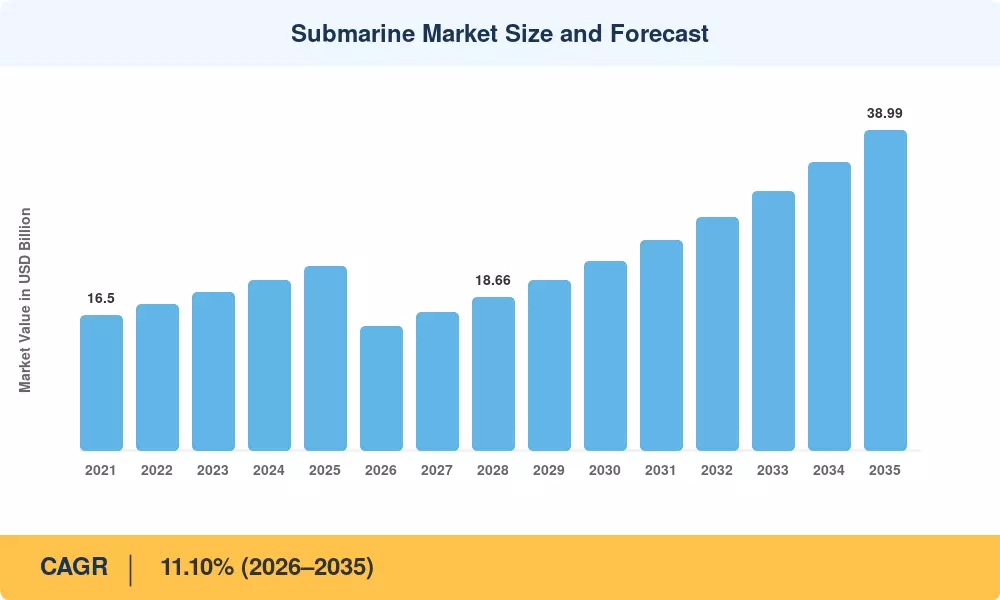
The global Submarine Market reached USD 22.46 billion in 2025, a figure inflated by several concentrated multi-hull contract awards across NATO and Indo-Pacific navies. As procurement cycles recalibrate in 2026, the market resets to an estimated USD 15.12 billion before climbing to USD 38.99 billion by 2035 at a compound annual growth rate of 11.10%. Two structural forces anchor this trajectory: parallel deterrence-renewal programs โ€” Columbia-class in the United States, Barracuda-class in France, Type 212CD across Northern Europe โ€” and a broadening policy consensus that subsea cable protection is critical infrastructure, not optional capability [1].

The technology space is changing in a big way. Short endurance traditional diesel-electric platforms are being replaced with air-independent propulsion versions and lithium-ion battery setups that double the duration of submerged patrols. Nuclear programs, by contrast, are seeing record investment with the U.S. Department of Defense requesting over USD 27.8 billion for submarine combatants within its FY2026 purchase budget alone [1]. France and the United Kingdom are running parallel nuclear-powered boat initiatives that will carry their construction pipelines into the 2030s.

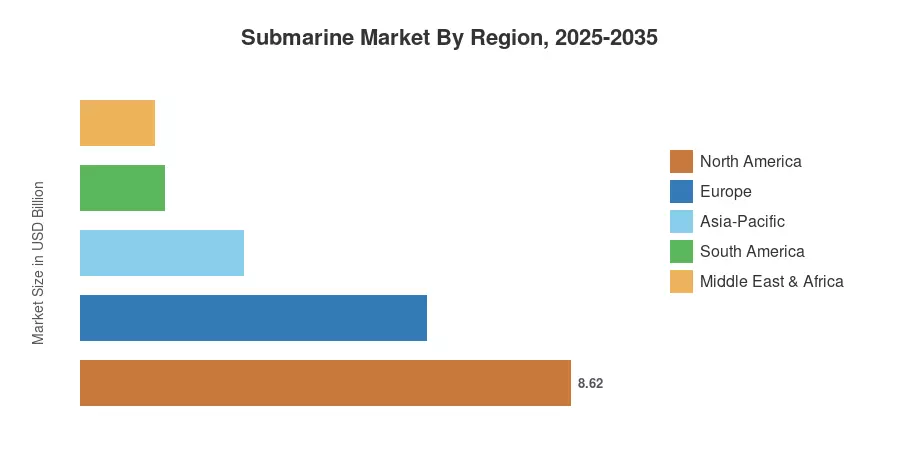
Columbia- and Virginia-class building helps North America to capture around 38.4% of the Submarine Market share by revenue. The Asia-Pacific is the quickest expanding region, with a predicted CAGR of 12.80%, on account of fleet augmentation in India, South Korea and Australia via the AUKUS trilateral pact. Europe has a share of about 27.1%, anchored by Franco-German and Scandinavian naval modernization. The pace at which these overlapping build cycles will translate budget commitments into produced hulls will shape the next decade.

ย 

ย 

Key Report Takeaways

โ€ข By Propulsion Type

  • Diesel-electric platforms accounted for 51.2% of the Submarine Market in 2025, reflecting broad conventional fleet demand across mid-tier navies.
  • Nuclear-powered submarines are projected to grow at a 13.10% CAGR through 2035, underpinned by U.S., UK, French, and Australian programs.

โ€ข By Combat Role

  • Attack submarines represented 52.5% of the Submarine Market in 2025, driven by anti-submarine warfare and sea-denial mission requirements.
  • Ballistic-missile submarines are forecast to expand at a 12.10% CAGR as nuclear triad renewal programs accelerate.

โ€ข By Displacement Class

  • The 2,000-to-4,000-ton class captured 42.3% of the Submarine Market in 2025, the preferred displacement band for littoral and regional patrol missions.

โ€ข By Component

  • Hull and structural modules led with 34.8% revenue share in 2025, while combat and electronic systems represent the fastest-growing component segment.

โ€ข By Region

  • North America dominated the Submarine Market with 38.4% share in 2025.
  • Asia-Pacific is projected as the fastest-growing region at a 12.80% CAGR through 2035.

ย 

Submarine Market Size and Forecast (2021โ€“2035)

Market Research Future's estimates draw on verified defense procurement databases, government budget submissions, shipyard order-book disclosures, and triangulated industry interviews. Historical values (2021โ€“2024) reflect actual contract commitments adjusted for delivery timing; forecast values (2026โ€“2035) apply the calibrated CAGR from the reset 2026 base.
Submarine Market Size and Forecast
Our Impact
Enabled $4.3B Revenue Impact for Fortune 500 and Leading Multinationals
Partnering with 2000+ Global Organizations Each Year
30K+ Citations by Top-Tier Firms in the Industry

Driver Impact Analysis

Driver ~% Impact on CAGR Geographic Relevance Impact Timeline
Nuclear triad renewal programs ~22% North America, Europe Long-term (โ‰ฅ4 yr)
Indo-Pacific conventional fleet expansion ~20% Asia-Pacific Medium-term (2โ€“4 yr)
AUKUS trilateral framework ~15% Asia-Pacific, North America Long-term (โ‰ฅ4 yr)
Subsea cable and infrastructure protection ~13% Europe, Asia-Pacific Medium-term (2โ€“4 yr)
Air-independent propulsion adoption ~12% Europe, Asia-Pacific Short-term (โ‰ค2 yr)
Lithium-ion battery integration ~10% Asia-Pacific, Europe Short-term (โ‰ค2 yr)
Export market growth (South Korea, France) ~8% Global Medium-term (2โ€“4 yr)

ย 

Nuclear Triad Renewal Programs

Global powers are aggressively modernizing their sea-based nuclear deterrents. The U.S. Navyโ€™s Columbia-class program, a top shipbuilding priority, recently reached a major production milestone with a $15.38 billion contract. With total procurement costs projected to exceed $130 billion, this program, alongside Franceโ€™s Invincible-class and the UKโ€™s Dreadnought-class, ensures sustained demand for high-end submarine industrial capacity.

ย 

Indo-Pacific Conventional Fleet Expansion

The Indo-Pacific is the primary driver for conventional submarine growth. Indiaโ€™s Project 75I is nearing final approval, with an estimated โ‚ฌ8 billion deal to build six advanced, AIP-equipped submarines. Concurrently, South Koreaโ€™s KSS-III program is producing high-performance boats, while Japan continues its steady Taigei-class build rate to address regional security requirements and underwater operational needs.

ย 

AUKUS Trilateral Framework

The AUKUS agreement represents a landmark shift in regional military capability. Australia has committed to acquiring nuclear-powered Virginia-class submarines starting in the early 2030s, followed by the joint development of SSN-AUKUS hulls. Trilateral investments, including initial outlays of AUD 3.9 billion for new construction infrastructure, are creating a sovereign industrial base capable of sustaining long-term operations.

ย 

Subsea Infrastructure Protection

The vulnerability of global data traffic has elevated undersea infrastructure protection to a top-tier defense mandate. Following dozens of cable-damage incidents in the Baltic and Red Seas between 2024 and 2025, NATO members are reorienting naval patrols. This shift mandates that both new and existing submarine fleets prioritize seabed monitoring to ensure long-term communication and economic security

ย 

Restraints Impact Analysis

Restraint ~% Drag on CAGR Geographic Relevance Impact Timeline
Industrial base capacity constraints ~โ€“18% North America, Europe Long-term (โ‰ฅ4 yr)
Cost escalation and schedule overruns ~โ€“16% Global Medium-term (2โ€“4 yr)
Skilled workforce shortages ~โ€“14% North America, Australia Long-term (โ‰ฅ4 yr)
Nuclear regulatory and proliferation barriers ~โ€“10% Asia-Pacific, Middle East Long-term (โ‰ฅ4 yr)
Geopolitical export restrictions ~โ€“8% Global Short-term (โ‰ค2 yr)

ย 

Industrial Base Capacity Constraints

The U.S. shipbuilding industrial base is struggling to meet concurrent production demands for Virginia-class and Columbia-class programs. With production rates for the Virginia-class currently limited to approximately 1.1 to 1.2 boats per year, the U.S. Navy faces a significant delivery backlog, with capacity to reach the target of two per year not expected until 2032.

ย 

Cost Escalation and Schedule Overruns

Defense programs are increasingly challenged by severe budget volatility and schedule delays. Historically, major programs like the UKโ€™s Astute-class experienced cost increases exceeding 50% from original forecasts, forcing extended service lives for older vessels. These financial constraints compress naval procurement budgets, often leading to reduced hull counts and complicating long-term strategic planning for global navies.

ย 

Skilled Workforce Shortages

Building a sovereign nuclear-powered submarine capability presents an acute human capital challenge. Australia, for instance, must cultivate a highly specialized workforce from the ground up, requiring thousands of trained personnel by the 2030s. Currently, over 220 Australian industry personnel are training at U.S. shipyards to build the necessary technical expertise for long-term fleet sustainment.

ย 

Submarine Market Opportunities

Unmanned Underwater Vehicle Integration

The deployment of extra-large unmanned underwater vehicles (XLUUVs) is becoming a core naval priority. The U.S. Navyโ€™s Orca XLUUV program, with a planned fleet investment of $1.13 billion through 2031, is designed to provide mass and sensor reach at lower costs. These autonomous systems now demand specialized integration kits, launch-and-recovery infrastructure, and sophisticated command-and-control software.

ย 

Midlife Upgrade and Refit Programs

With the global naval maintenance, repair, and overhaul market expected to reach $1.6 billion by 2035, refit demand is surging. Navies are increasingly prioritizing combat-system upgrades, sonar-suite refreshes, and lithium-ion battery conversions to extend the operational life of existing hulls. This creates a sustained, high-value services market as fleets strive to maintain readiness without immediate replacement.

ย 

Submarine Export Markets in Southeast Asia and the Middle East

Emerging economies, including Indonesia and the Philippines, are actively modernizing their naval fleets to address regional security concerns. Indonesia has initiated domestic submarine construction programs under the Scorpรจne Evolved project, aiming to foster national technology mastery. These greenfield markets offer significant volume potential for established defense providers willing to support local industrial partnerships and technology transfers.

ย 

Data-Driven Predictive Maintenance Platforms

Predictive maintenance is transforming naval logistics. The market for defense-specific predictive maintenance solutions is projected to reach $3.84 billion by 2034, growing at an 8.1% CAGR. By leveraging digital twin models and onboard sensor networks, operators can reduce unplanned maintenance events, effectively lowering lifecycle costs while ensuring that submarines remain combat-ready during extended, long-term deployment cycles.

ย 

Next-Generation Energy Storage and Propulsion

Solid-state batteries and hydrogen fuel-cell propulsion promise to close the endurance gap between conventional and nuclear submarines without the proliferation risks associated with naval reactors. Several European defense agencies have funded demonstrator programs targeting operational readiness by the early 2030s, potentially expanding the addressable Submarine Market for nations excluded from nuclear propulsion[21].

ย 

Submarine Market Future Outlook

Autonomous and AI-Enabled Undersea Operations

Artificial intelligence is transforming undersea warfare by enhancing data processing and autonomous decision-making. Defense budgets are prioritizing these technologies, with the global market for unmanned military systems projected to reach $85 billion by 2035. These AI-driven assets, capable of collaborative operations with manned platforms, will drastically increase fleet efficiency and reduce operational risk for personnel.

ย 

Digital Shipyard and Platform-Economics Transformation

Shipbuilders are undergoing a digital revolution to optimize production timelines. General Dynamics Electric Boatโ€™s major facility expansions represent the industryโ€™s commitment to robotic welding and modular construction. By adopting platform economics, manufacturers are shifting toward recurring revenue models through software-as-a-service and lifecycle maintenance, ensuring sustained performance for critical assets like the Columbia-class submarine fleet.

Energy Storage Disruption

Energy density advancements are revolutionizing conventional submarine capabilities. Japanโ€™s Taigei-class already utilizes lithium-ion batteries to boost submerged endurance compared to lead-acid systems significantly. With global research accelerating into next-generation power solutions, conventional submarines are narrowing the performance gap with nuclear-powered counterparts, providing nations with high-end patrol capabilities without the complexities of managing reactor-based infrastructure

ย 

ESG, Sustainability, and Nuclear Governance

Defense procurement is increasingly sensitive to Environmental, Social, and Governance (ESG) frameworks. European and international policies now weigh the long-term impact of defense activities, including reactor safety and proliferation risks. Consequently, navies are carefully balancing operational requirements with ethical investment mandates, often favoring advanced conventional propulsion as a lower-risk alternative to nuclear-powered vessels.

ย 

Submarine Market Segmentation

By Propulsion Type

Segment Key Metric Primary Demand Driver
Diesel-Electric Submarines 51.2% share (2025) Broad conventional fleet demand across Indo-Pacific and European navies
Nuclear-Powered Submarines 13.10% CAGR (2026โ€“2035) U.S. Columbia, UK Dreadnought, French SNLE 3G, AUKUS programs

ย 

Diesel-electric platforms remain the workhorse of the global Submarine Market, fielded by more than 30 navies worldwide. Their lower acquisition cost โ€” typically USD 500โ€“800 Million per hull versus USD 2โ€“4 Billion for nuclear boats โ€” makes them the default choice for nations without nuclear propulsion infrastructure. The integration of air-independent propulsion and lithium-ion battery systems is extending their tactical relevance.

Nuclear-powered submarines command the highest per-unit value and are growing faster because deterrence-renewal programs in the United States, United Kingdom, and France concentrate spending on high-value platforms. Australia's entry into the nuclear submarine club under AUKUS adds an entirely new demand stream that did not exist before 2021 [4][10].

By Combat Role

Segment Key Metric Primary Demand Driver
Attack Submarines 52.5% share (2025) Anti-submarine warfare, sea denial and ISR missions
Ballistic-Missile Submarines 12.10% CAGR (2026โ€“2035) Strategic nuclear deterrence renewal
Other (Guided-Missile, Special Operations) USD 2.87 Billion (2025) Land-attack cruise missile and SOF insertion roles

ย 

Attack submarines account for the largest share of the Submarine Market because every submarine-operating navy requires them. In contrast, ballistic-missile boats are limited to the six recognized nuclear-weapon states plus India. The Virginia-class, Astute-class, and Suffren-class programs are all attack-submarine production lines running simultaneously.

Ballistic-missile submarines, while fewer in number, carry disproportionate per-unit value โ€” a single Columbia-class hull costs approximately USD 15 billion. Their faster CAGR reflects the timing of concurrent replacement cycles across the U.S., UK, and French fleets during the forecast window [1][11].

By Displacement Class

Segment Key Metric Primary Demand Driver
Less Than 2,000 Tons USD 2.15 Billion (2025) Coastal defense, special operations and emerging navies
2,000 to 4,000 Tons 42.3% share (2025) Patrol and regional sea-denial in European and Pacific waters
More Than 4,000 Tons 11.90% CAGR (2026โ€“2035) Nuclear submarines and large conventional SSKs

ย 

The 2,000-to-4,000-ton class dominates the Submarine Market because it represents the sweet spot for modern conventional submarines โ€” large enough for extended patrol endurance and weapons payload, compact enough for littoral operations. Programs such as KSS-III, Taigei, and Type 212CD all fall within this range.

Boats exceeding 4,000 tons grow fastest because nuclear submarines โ€” which start at roughly 5,000 tons for SSNs and exceed 16,000 tons for SSBNs โ€” sit in this class. The Columbia-class, at over 20,000 tons submerged displacement, exemplifies the scale and cost concentration at the top end of the Submarine Market [1][7].

By Component

Segment Key Metric Primary Demand Driver
Hull and Structural Modules 34.8% share (2025) HY-80/100 steel and composite pressure hull fabrication
Propulsion Systems USD 4.24 Billion (2025) Reactor plants, AIP modules, battery integration
Combat and Electronic Systems 12.50% CAGR (2026โ€“2035) Integrated sonar, electronic warfare, C4ISR suites
Other Components 11.6% share (2025) Weapons handling, life support, auxiliary systems

ย 

Hull and structural modules lead the Submarine Market by share because pressure-hull fabrication absorbs the largest single portion of build cost โ€” specialized steel, precision welding, and hydrostatic testing are both material- and labor-intensive. Combat and electronic systems are the fastest-growing component category as navies invest in next-generation integrated combat management systems, towed-array sonars, and electronic countermeasure suites [12][20].

ย 

Regional Market Share Analysis

Region Key Metric Primary Investment Themes
North America 38.4% share (2025) Columbia-class, Virginia-class, AUKUS industrial base
Europe 27.1% share (2025) Type 212CD, Barracuda, Dreadnought, Baltic patrol
Asia-Pacific 12.80% CAGR (2026โ€“2035) KSS-III, Taigei, P-75I, AUKUS SSN build
South America USD 1.48 Billion (2025) Brazilian Riachuelo-class, Scorpรจne technology transfer
Middle East & Africa 5.8% share (2025) Emerging acquisition programs, UAE and Egypt
Total USD 22.46 Billion (2025) โ€”

The global Submarine Market concentrates heavily in regions with active naval shipbuilding industries and strategic undersea requirements. North America and Europe together account for nearly two-thirds of the market value, while Asia-Pacific is narrowing the gap through aggressive fleet expansion.

ย 

North America

Country Key Metric Key Driver
United States 88.2% of regional share Columbia-class and Virginia-class dual production
Canada USD 0.72 Billion (2025) Victoria-class sustainment and future replacement study
Mexico 2.1% of regional share Naval patrol modernization programs

ย 

The United States dominates the North American Submarine Market and the global market alike. Annual submarine procurement spending exceeded USD 27 billion in the FY2026 budget request, covering simultaneous Columbia-class SSBN and Virginia-class SSN production at a combined rate of approximately 2.5 hulls per year [1][7]. Canada's aging Victoria-class fleet โ€” four ex-British Upholder boats โ€” is reaching the end of life, and Ottawa is expected to launch a replacement program in the late 2020s with an estimated value above CAD 60 billion.

Europe

Country Key Metric Key Driver
Germany 22.5% of regional share Type 212CD with Norway; ThyssenKrupp export orders
United Kingdom USD 1.92 Billion (2025) Dreadnought SSBN and Astute SSN programs
France 20.8% of regional share Barracuda/Suffren-class SSN; SNLE 3G SSBN design
Italy 6.4% of regional share U-212NFS with Fincantieri
Spain USD 0.38 Billion (2025) S-80 Isaac Peral class completion
Nordic Countries 8.7% of regional share Swedish A26 program, Norwegian Type 212CD
Russia 14.2% of regional share Borei-A SSBN and Yasen-M SSGN production
Rest of Europe 4.6% of regional share Netherlands, Greece and Poland submarine plans

ย 

Europe runs more concurrent submarine programs than any other region. The Franco-British industrial axis produces both nuclear attack and ballistic-missile submarines, while the German-Norwegian Type 212CD partnership represents the most advanced conventional program in NATO [8][11]. Spain's long-delayed S-80 class reached operational milestone deliveries in 2024, and Sweden's Saab Kockums has secured the A26 Blekinge-class contract with export potential for the Netherlands and Poland.

Asia-Pacific

Country Key Metric Key Driver
China 31.4% of regional share Type 095 SSN and Type 096 SSBN expansion
India 12.10% CAGR (2026โ€“2035) P-75I conventional and Arihant-class SSBN programs
Japan USD 1.04 Billion (2025) Taigei-class with lithium-ion batteries
South Korea 24.6% of regional share KSS-III Batch III and export campaigns
ASEAN 7.30% CAGR (2026โ€“2035) Indonesian and Philippine acquisition plans
Rest of Asia-Pacific 5.1% of regional share Taiwanese and other fleet sustainment

ย 

Asia-Pacific represents the fastest-growing segment of the Submarine Market. China's People's Liberation Army Navy is expanding its submarine fleet with an estimated six Type 095 nuclear attack boats and at least four Type 096 ballistic-missile submarines in various stages of construction [6]. South Korea has emerged as a major exporter โ€” Hanwha Ocean's KSS-III design competes for contracts in Southeast Asia and the Middle East. At the same time, India's P-75I selection is expected to be one of the largest conventional submarine contracts awarded this decade [9][14].

South America

Country Key Metric Key Driver
Brazil 78.3% of regional share Riachuelo-class Scorpรจne and SN-BR nuclear program
Argentina USD 0.18 Billion (2025) TR-1700 sustainment and modernization
Rest of South America 6.8% of regional share Minimal submarine activity

ย 

Brazil anchors the South American Submarine Market through its partnership with Naval Group on the Riachuelo-class conventional submarines and the ambitious SN-BR nuclear-powered submarine, which, if completed, would make Brazil only the seventh nation to operate a nuclear submarine. The conventional program has delivered three of four planned hulls, while the nuclear boat remains in design and long-lead-item procurement [22].

Middle East & Africa

Country Key Metric Key Driver
Saudi Arabia 28.4% of regional share Nascent submarine capability interest
UAE USD 0.31 Billion (2025) Midget submarine and UUV procurement
South Africa 22.1% of regional share Type 209 sustainment
Egypt 25.8% of regional share Type 209/1400 fleet from ThyssenKrupp
Rest of MEA 5.2% of regional share Limited submarine operations

ย 

Egypt operates the most active submarine fleet in the region, having received four Type 209/1400 boats from ThyssenKrupp Marine Systems between 2017 and 2021 [19]. The UAE has expressed interest in acquiring midget submarines and XLUUVs for coastal defense and critical infrastructure protection in the Persian Gulf. Saudi Arabia's long-discussed submarine program has yet to advance beyond feasibility studies, though regional security dynamics could accelerate timelines during the forecast period.

ย 

Submarine Market By Region, 2025-2035

Competitive Benchmarking

The global Submarine Market exhibits medium concentration: the top five players โ€” General Dynamics, Huntington Ingalls, BAE Systems, Naval Group, and ThyssenKrupp Marine Systems โ€” collectively hold an estimated 55โ€“65% revenue share. The remaining market is distributed among a handful of state-linked builders and emerging Asian exporters. The estimated Herfindahl-Hirschman Index sits in the 1,200โ€“1,600 range, consistent with a moderately concentrated defense-industrial market where sovereign procurement preferences limit pure competition.

Company Est. Revenue Share Range Key Offerings for the Submarine Market Strategic Positioning
General Dynamics (Electric Boat) ~15โ€“19% Columbia-class SSBN, Virginia-class SSN U.S. lead nuclear submarine designer and builder
Huntington Ingalls Industries ~12โ€“16% Virginia-class SSN construction Co-builder of U.S. nuclear submarines, workforce expansion
BAE Systems ~8โ€“12% Astute-class SSN, Dreadnought-class SSBN UK sole nuclear submarine prime contractor
Naval Group ~7โ€“11% Suffren-class SSN, SNLE 3G, Scorpรจne export French champion, major conventional export franchise
ThyssenKrupp Marine Systems ~6โ€“9% Type 212CD, Type 214, HDW class German conventional market leader, global export
Hanwha Ocean ~5โ€“8% KSS-III, Type 214 license-built South Korean builder with growing export ambitions
Saab (Kockums) ~3โ€“5% A26 Blekinge-class, Gotland-class Scandinavian AIP pioneer, Netherlands export target
Mitsubishi Heavy Industries ~3โ€“5% Taigei-class, Soryu-class Japanese domestic builder, lithium-ion battery leader
Fincantieri ~2โ€“4% U-212NFS (with ThyssenKrupp), Todaro-class Italian naval prime, European partnership model
Navantia ~2โ€“4% S-80 Isaac Peral-class Spanish builder, AIP integration, export potential

ย 

ย 

Recent News & Developments

  • Saab(June, 2026): Saab signed a SEK 47 billion contract with Poland to deliver three A26-type submarines, including weapons, training, and maintenance support packages.
  • Microsoft and Lightstorm(July 2026): The companies formed a strategic partnership to develop a new subsea fiber-optic network connecting India and Singapore to support AI infrastructure.
  • Japan Ministry of Defense(July, 2026): Japan initiated a research project to develop vertical launch systems for diesel-electric submarines capable of firing hypersonic and cruise missiles.

ย 

ย 

ย 

ย 

ย 

ย 

ย 

Submarine Market Report Scope

Parameter Detail
Market Scope Global Submarine Market covering design, construction, integration, and delivery of manned military submarines
Study Period 2021โ€“2035
CAGR 11.10% (2026โ€“2035)
Market Size โ€” 2025 USD 22.46 Billion
Market Size โ€” 2035 USD 38.99 Billion
Fastest Growing Segment Nuclear-Powered Submarines (Propulsion); Combat & Electronic Systems (Component); Asia-Pacific (Region)
Companies Profiled 10 (General Dynamics, Huntington Ingalls, BAE Systems, Naval Group, ThyssenKrupp Marine Systems, Hanwha Ocean, Saab Kockums, Mitsubishi Heavy Industries, Fincantieri, Navantia)
Valuation Currency USD Billion

ย 

ย 

FAQs

What qualification standards apply to submarine-grade steel procurement?
Submarine pressure hulls require HY-80 or HY-100 steel certified to MIL-S-16216 standards, with yield strengths of 80,000โ€“100,000 psi. Only a handful of global mills hold active naval certification [17].
How do submarine acquisition lead times compare between nuclear and conventional programs?
Nuclear submarines typically require 8โ€“12 years from contract to delivery, while modern conventional boats average 5โ€“7 years. Dual-production schedules can extend nuclear timelines further [7].
What role do offset agreements play in submarine export contracts?
Major export deals routinely include 30โ€“60% offset obligations covering technology transfer, local construction, and supply-chain localization. These offsets significantly influence buyer selection decisions [19].
How does submarine crew training capacity affect fleet expansion timelines?
Training a qualified submarine crew takes 18โ€“36 months per cycle, and most navies operate dedicated shore-based trainers. Crew pipeline constraints often delay operational deployment more than shipyard delivery [17].
What insurance and classification considerations apply to submarine components?
Military submarines are exempt from commercial classification societies but follow naval technical authority standards. Component suppliers must maintain AQAP-2110 or equivalent defense quality certifications [16].
How are submarine decommissioning costs factored into lifecycle budgets?
Nuclear submarine disposal costs range from USD 25โ€“50 million per hull, covering reactor defueling, hazardous material removal, and hull recycling. These costs are increasingly budgeted upfront [18].
What cybersecurity standards govern modern submarine combat systems?
Submarine combat networks must comply with frameworks such as NIST SP 800-171 and NATO STANAG 4774 for classified system protection. Cyber hardening adds 5โ€“8% to combat-system integration costs [12]. ย  ย 
Author
Author
Author Profile
Shubham Munde LinkedIn
Team Lead - Research
Shubham brings over 7 years of expertise in Market Intelligence and Strategic Consulting, with a strong focus on the Automotive, Aerospace, and Defense sectors. Backed by a solid foundation in semiconductors, electronics, and software, he has successfully delivered high-impact syndicated and custom research on a global scale. His core strengths include market sizing, forecasting, competitive intelligence, consumer insights, and supply chain mapping. Widely recognized for developing scalable growth strategies, Shubham empowers clients to navigate complex markets and achieve a lasting competitive edge. Trusted by start-ups and Fortune 500 companies alike, he consistently converts challenges into strategic opportunities that drive sustainable growth.
Co-Author
Co-Author Profile
Sejal Akre LinkedIn
Senior Research Analyst
She has over 5 years of rich experience, in market research and consulting providing valuable market insights to client. Hands on expertise in management consulting, and extensive knowledge in domain including ICT, Automotive & Transportation and Aerospace & Defense. She is skilled in Go-to market strategy, industry analysis, market sizing, in depth company profiling, competitive intelligence & benchmarking and value chain amongst others.

Research Approach

Submarine Market

This research is conducted with an in-depth understanding of the global Submarine Market with the primary aim of exploring the various factors influencing the overall growth of the market, and the key strategies employed by the manufacturers, vendors, and service providers to gain a competitive edge. The methodology includes the use of both primary and secondary research data combined with market analysis and trend assessment. This section further entails information procurement and its validation processes through secondary research, primary research, and approaches such as bottom-up approach, top-down approach, factor analysis, time-series analysis, and demand side and supply side data triangulation.

Information Procurement Process

The initial phase for the preparation of this study involves the procurement of data from both primary and secondary sources. The primary sources include industry experts, opinion leaders, investor interviews, and other stakeholders while the secondary sources include published books and journals, Annual and Financial Reports, Newspapers, Trade Journals, White Papers, Government and Trade Websites, Press Releases, and other published materials related to Submarine Market and its related industry.

Primary Research

The primary sources include the industry key players, vendors, and industry professionals who participated in the primary research activities by filling out the questionnaire and contributing their valuable experience and knowledge which helped in the validation of the secondary research data. The questionnaire was prepared with the intention of collecting information related to the Submarine Market which included the opinion of the industry leaders, especially the major market players operating in the market, about the projected growth of the global Submarine Market.

Secondary Research

The secondary research included online and offline sources such as market research reports, news articles, financial reports, interviews with industry players, and other published materials and data related to the Submarine Market which helped to provide an analytical and empirical review of the global Submarine Market.

Data Triangulation

Data triangulation was employed throughout the research process to further validate the collected data and to facilitate the discussion related to the market analysis. This process also helped in a significant manner to eliminate any inconsistencies in the obtained data. The collected data was further stratified and analyzed based on different segments such as market players, regions, types, and applications to understand the detailed trends and market structure.

Bottom-Up Approach

The bottom-up approach was utilized during the research process wherein the market size of each segment and sub-segment was established using the CAGR of the previous five years. The market size of each of the segments and sub-segments was then used to arrive at the overall market size from the bottom-up approach.

Top Down Approach

The Top-down Approach was used to verify the bottom-up or detailed market size which included the measurement of the value of the total market by breaking it down into sub-segments and estimating the growth of the market for those sub-segments by using the current values of the historic data.

Factor Analysis

Factor Analysis was performed to identify the factors influencing the growth of the market and to determine which factors had the most influence on the overall growth of the Submarine Market. The factor analysis used examines the historical data and related current trends to warn stakeholders about market shifts and to plan future strategies appropriately.

Time-Series Analysis

Time-series analysis was used to evaluate the key factors related to the past, present, and future changes in the Submarine Market. The analysis also helped to evaluate the expected market growth by using the combined data of the past and present markets over a given period. The time-series analysis further helped to identify the scope for the upcoming marketing strategies of the market players by assessing the changes in the market structure and its potential growth in the near future.

Finally, the collected data was further evaluated and segregated to get qualitative and quantitative insights regarding the global Submarine Market which helped in the assessment of the future growth of the market for the forecast period 2023 to 2030. The market forecasts were validated using different approaches to identify and eliminate any possibility of a forecasting error. The report also includes a detailed Porterโ€™s Five Forces Analysis of the global Submarine Market coupled with the value chain analysis.

Download Free Sample

Kindly complete the form below to receive a free sample of this Report

Download PDF ×

We do not share your information with anyone. However, we may send you emails based on your report interest from time to time. You may contact us at any time to opt-out.