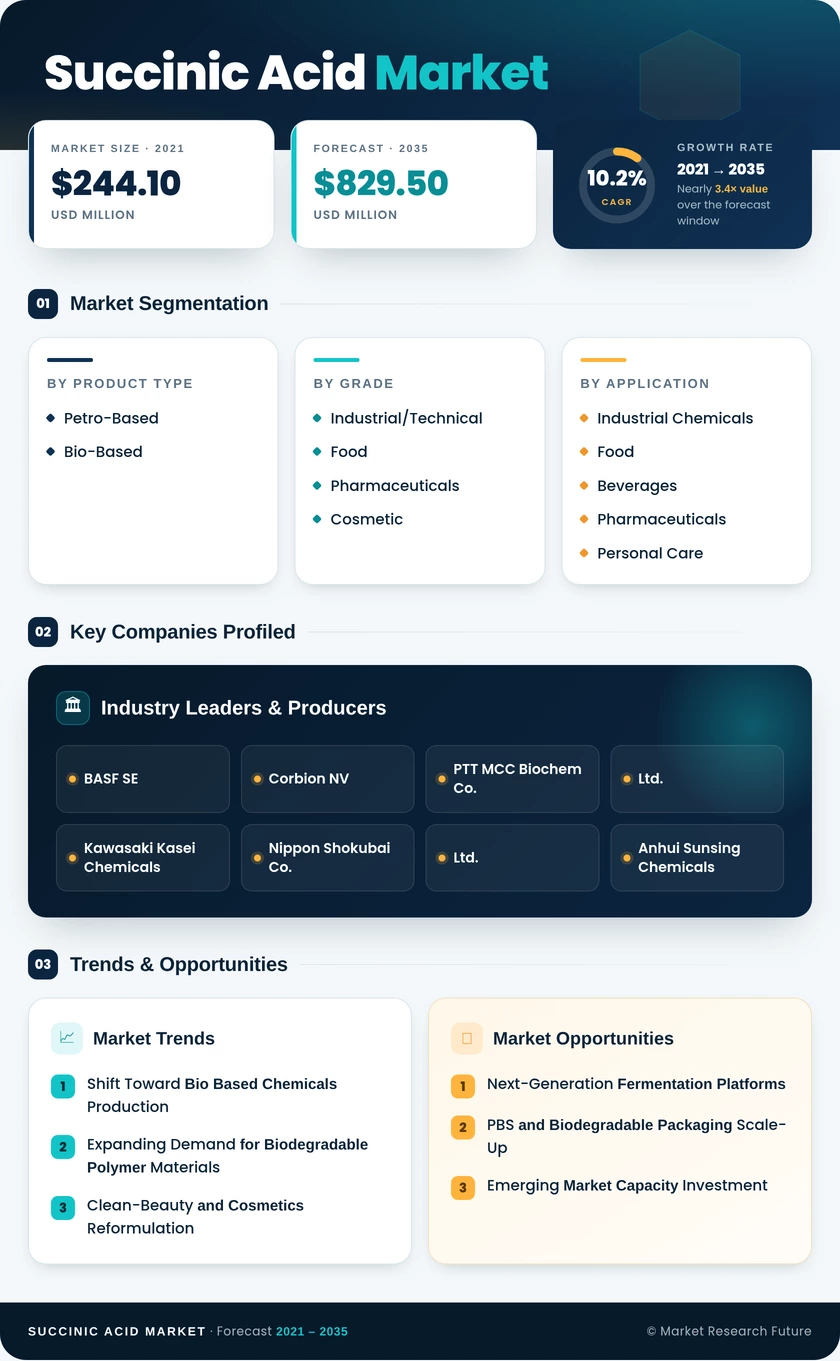
Succinic Acid Market

ID: MRFR/CnM/1382-HCR
111 Pages
Chitranshi Jaiswal
Last Updated: June 22, 2026
Succinic Acid Market Size, Share & Industry Analysis Research Report By Application (Chemical Synthesis, Food and Beverage, Pharmaceuticals, Cosmetics, Biodegradable Plastics), By End Use (Industrial, Personal Care, Food Industry, Automotive, Medicine), By Production Process (Fermentation, Chemical Synthesis, Catalytic Conversion, Biorefinery) and By Regional (North America, Europe, South America, Asia Pacific, Middle East and Africa) - Forecast to 2035.
Download PDF ×

We do not share your information with anyone. However, we may send you emails based on your report interest from time to time. You may contact us at any time to opt-out.

  1. 1 Market Overview |
    1. 1.1 Study Assumptions & Market Definition |
    2. 1.2 Scope of the Study |
    3. 1.3 Research Methodology
  2. 2 Market Summary & Key Takeaways
  3. 3 Market Dynamics |
    1. 3.1 Market Drivers Analysis | |
      1. 3.1.1 Shift Toward Bio-Based Chemicals Production | |
      2. 3.1.2 Expanding Demand for Biodegradable Polymer Materials | |
      3. 3.1.3 Clean-Beauty and Cosmetics Reformulation | |
      4. 3.1.4 Government Procurement and Green Chemistry Mandates |
    2. 3.2 Market Restraints Analysis | |
      1. 3.2.1 Feedstock Price Volatility | |
      2. 3.2.2 Capacity Bottleneck in Bio-Based Production | |
      3. 3.2.3 Petro-Based Cost Advantage in Emerging Economies |
    3. 3.3 Market Opportunity Analysis | |
      1. 3.3.1 Next-Generation Fermentation Platforms | |
      2. 3.3.2 PBS and Biodegradable Packaging Scale-Up | |
      3. 3.3.3 Emerging Market Capacity Investment | |
      4. 3.3.4 Data-Driven Fermentation Optimization | |
      5. 3.3.5 Pharmaceutical and Nutraceutical Expansion |
    4. 3.4 Industry Value Chain Analysis |
    5. 3.5 Porter's Five Forces Analysis
  4. 4 Global Succinic Acid Market Size & Forecast (2021โ€“2035) |
    1. 4.1 Historical Market Size (2021โ€“2025) |
    2. 4.2 Current & Forecast Market Size (2026โ€“2035) |
    3. 4.3 Market Size by Revenue (USD Million) |
    4. 4.4 Year-over-Year Growth Analysis
  5. 5 Segmentation Analysis |
    1. 5.1 By Product Type | |
      1. 5.1.1 Petro-Based | |
      2. 5.1.2 Bio-Based |
    2. 5.2 By Grade | |
      1. 5.2.1 Industrial/Technical | |
      2. 5.2.2 Food | |
      3. 5.2.3 Pharmaceuticals | |
      4. 5.2.4 Cosmetic |
    3. 5.3 By Application | |
      1. 5.3.1 Industrial Chemicals | |
      2. 5.3.2 Food and Beverages | |
      3. 5.3.3 Pharmaceuticals | |
      4. 5.3.4 Personal Care and Cosmetics | |
      5. 5.3.5 Others
  6. 6 Regional Analysis |
    1. 6.1 North America | |
      1. 6.1.1 United States | |
      2. 6.1.2 Canada | |
      3. 6.1.3 Mexico |
    2. 6.2 Europe | |
      1. 6.2.1 Germany | |
      2. 6.2.2 United Kingdom | |
      3. 6.2.3 France | |
      4. 6.2.4 Italy | |
      5. 6.2.5 Spain | |
      6. 6.2.6 Nordic Countries | |
      7. 6.2.7 Russia | |
      8. 6.2.8 Rest of Europe |
    3. 6.3 Asia-Pacific | |
      1. 6.3.1 China | |
      2. 6.3.2 India | |
      3. 6.3.3 Japan | |
      4. 6.3.4 South Korea | |
      5. 6.3.5 ASEAN | |
      6. 6.3.6 Rest of Asia-Pacific |
    4. 6.4 South America | |
      1. 6.4.1 Brazil | |
      2. 6.4.2 Argentina | |
      3. 6.4.3 Rest of South America |
    5. 6.5 Middle East & Africa | |
      1. 6.5.1 Saudi Arabia | |
      2. 6.5.2 UAE | |
      3. 6.5.3 South Africa | |
      4. 6.5.4 Egypt | |
      5. 6.5.5 Rest of MEA
  7. 7 Competitive Landscape |
    1. 7.1 Market Share Analysis (2025) |
    2. 7.2 Competitive Benchmarking Matrix |
    3. 7.3 Company Profiles | |
      1. 7.3.1 BASF SE | |
      2. 7.3.2 Corbion NV | |
      3. 7.3.3 PTT MCC Biochem Co., Ltd. | |
      4. 7.3.4 Kawasaki Kasei Chemicals | |
      5. 7.3.5 Nippon Shokubai Co., Ltd. | |
      6. 7.3.6 Anhui Sunsing Chemicals | |
      7. 7.3.7 Gadiv Petrochemical Industries | |
      8. 7.3.8 Shandong Lanbao Chemical | |
      9. 7.3.9 Mitsubishi Chemical Group | |
      10. 7.3.10 Roquette Frรจres
  8. 8 Future Outlook & Strategic Recommendations (2026โ€“2035) |
    1. 8.1 AI-Enabled Bioprocess Optimization |
    2. 8.2 Circular Economy and Closed-Loop Material Systems |
    3. 8.3 Electrification of Chemical Manufacturing |
    4. 8.4 ESG Reporting and Supply Chain Transparency
  9. 9 Recent Developments & News
  10. 10 Frequently Asked Questions (FAQs)
  11. 11 Report Scope & Methodology |
    1. 11.1 Study Period & Base Year |
    2. 11.2 Data Sources & Citations |
    3. 11.3 Abbreviations
  12. 12 LIST OF TABLES |
  13. TABLE 1 Global Succinic Acid Market Size & Forecast, by Revenue (USD Million), 2021โ€“2035 |
  14. TABLE 2 Global Succinic Acid Market โ€” Year-over-Year Growth Analysis, 2021โ€“2035 |
  15. TABLE 3 Global Succinic Acid Market โ€” Driver Impact Analysis |
  16. TABLE 4 Global Succinic Acid Market โ€” Restraint Impact Analysis |
  17. TABLE 5 Global Succinic Acid Market Size, by Product Type, 2021โ€“2035 (USD Million) |
  18. TABLE 6 Global Succinic Acid Market Size, by Grade, 2021โ€“2035 (USD Million) |
  19. TABLE 7 Global Succinic Acid Market Size, by Application, 2021โ€“2035 (USD Million) |
  20. TABLE 8 Global Succinic Acid Market Size, by Region, 2021โ€“2035 (USD Million) |
  21. TABLE 9 North America Succinic Acid Market Size, by Country, 2021โ€“2035 (USD Million) |
  22. TABLE 10 Europe Succinic Acid Market Size, by Country, 2021โ€“2035 (USD Million) |
  23. TABLE 11 Asia-Pacific Succinic Acid Market Size, by Country, 2021โ€“2035 (USD Million) |
  24. TABLE 12 South America Succinic Acid Market Size, by Country, 2021โ€“2035 (USD Million) |
  25. TABLE 13 Middle East & Africa Succinic Acid Market Size, by Country, 2021โ€“2035 (USD Million) |
  26. TABLE 14 Competitive Benchmarking Matrix โ€” Global Succinic Acid Market, 2025 |
  27. TABLE 15 Company Profiles โ€” Key Players, Global Succinic Acid Market |
  28. TABLE 16 Recent Developments & Strategic Announcements, 2023โ€“2025 |
  29. TABLE 17 North America Succinic Acid Market Size, by Product Type, 2021โ€“2035 (USD Million) |
  30. TABLE 18 North America Succinic Acid Market Size, by Grade, 2021โ€“2035 (USD Million) |
  31. TABLE 19 North America Succinic Acid Market Size, by Application, 2021โ€“2035 (USD Million) |
  32. TABLE 20 Europe Succinic Acid Market Size, by Product Type, 2021โ€“2035 (USD Million) |
  33. TABLE 21 Europe Succinic Acid Market Size, by Grade, 2021โ€“2035 (USD Million) |
  34. TABLE 22 Europe Succinic Acid Market Size, by Application, 2021โ€“2035 (USD Million) |
  35. TABLE 23 Asia-Pacific Succinic Acid Market Size, by Product Type, 2021โ€“2035 (USD Million) |
  36. TABLE 24 Asia-Pacific Succinic Acid Market Size, by Grade, 2021โ€“2035 (USD Million) |
  37. TABLE 25 Asia-Pacific Succinic Acid Market Size, by Application, 2021โ€“2035 (USD Million) |
  38. TABLE 26 South America Succinic Acid Market Size, by Product Type, 2021โ€“2035 (USD Million) |
  39. TABLE 27 South America Succinic Acid Market Size, by Grade, 2021โ€“2035 (USD Million) |
  40. TABLE 28 South America Succinic Acid Market Size, by Application, 2021โ€“2035 (USD Million) |
  41. TABLE 29 Middle East & Africa Succinic Acid Market Size, by Product Type, 2021โ€“2035 (USD Million) |
  42. TABLE 30 Middle East & Africa Succinic Acid Market Size, by Grade, 2021โ€“2035 (USD Million) |
  43. TABLE 31 Middle East & Africa Succinic Acid Market Size, by Application, 2021โ€“2035 (USD Million) |
  44. TABLE 32 Report Scope & Methodology Summary
  45. 13 LIST OF FIGURES |
  46. FIGURE 1 Global Succinic Acid Market Dynamics โ€” Drivers, Restraints, and Opportunities |
  47. FIGURE 2 Industry Value Chain Analysis โ€” Succinic Acid Market |
  48. FIGURE 3 Porter's Five Forces Analysis โ€” Succinic Acid Market |
  49. FIGURE 4 Global Succinic Acid Market Size Trend (USD Million), 2021โ€“2035 |
  50. FIGURE 5 Global Succinic Acid Market Share, by Product Type, 2025 (%) |
  51. FIGURE 6 Global Succinic Acid Market Share, by Grade, 2025 (%) |
  52. FIGURE 7 Global Succinic Acid Market Share, by Application, 2025 (%) |
  53. FIGURE 8 Global Succinic Acid Market Share, by Region, 2025 (%) |
  54. FIGURE 9 North America Succinic Acid Market Size Trend (USD Million), 2021โ€“2035 |
  55. FIGURE 10 Europe Succinic Acid Market Size Trend (USD Million), 2021โ€“2035 |
  56. FIGURE 11 Asia-Pacific Succinic Acid Market Size Trend (USD Million), 2021โ€“2035 |
  57. FIGURE 12 South America Succinic Acid Market Size Trend (USD Million), 2021โ€“2035 |
  58. FIGURE 13 Middle East & Africa Succinic Acid Market Size Trend (USD Million), 2021โ€“2035 |
  59. FIGURE 14 Competitive Landscape โ€” Market Concentration and Key Player Positioning, 2025

Segmentation Quick Reference

DimensionSub-SegmentsDominant SegmentFastest Growing Segment
Product TypePetro-Based, Bio-BasedPetro-Based (~54% share, 2025)Bio-Based (11.8% CAGR)
GradeIndustrial/Technical, Food, Pharmaceuticals, CosmeticIndustrial/Technical (~33% share, 2025)Cosmetic (11.3% CAGR)
ApplicationIndustrial Chemicals, Food and Beverages, Pharmaceuticals, Personal Care and Cosmetics, OthersIndustrial Chemicals (~27.5% share, 2025)Personal Care and Cosmetics (10.9% CAGR)
GeographyNorth America, Europe, Asia-Pacific, South America, Middle East & AfricaEurope (~29.2% share, 2025)Asia-Pacific (11.1% CAGR)

ย 

ย 

Market Segmentation Overview

By Product Type

Sub-SegmentKey Trend
Petro-BasedMature segment facing regulatory pressure; cost advantage eroding in carbon-priced regions.
Bio-BasedRapid capacity expansion driven by next-generation fermentation platforms and sustainability mandates

ย 

The product type dimension captures the fundamental production pathway split, shaping the Succinic Acid Market. Petro-based production retains volume leadership through established infrastructure, while bio-based production is gaining share at nearly double the market-average CAGR as fermentation economics improve and regulatory incentives favor renewable sourcing.

By Grade

Sub-SegmentKey Trend
Industrial/TechnicalHigh-volume demand from BDO, THF, and plasticizer manufacturing
FoodGrowing clean-label movement driving adoption as E363 acidulant.
PharmaceuticalsExpanding use as an API intermediate and excipient in controlled-release formulations
CosmeticFastest-growing grade segment, fueled by clean-beauty reformulation trends

ย 

Grade segmentation reflects purity requirements and end-use regulatory standards. Industrial/technical grade commands the largest share due to bulk chemical applications, while cosmetic grade is the fastest-growing, driven by premiumization in the personal care sector.

By Application

Sub-SegmentKey Trend
Industrial ChemicalsFoundational demand as chemical synthesis intermediates for downstream derivatives.
Food and BeveragesRising preference for bio-derived acidulants and flavor enhancers
PharmaceuticalsGrowing pipeline of succinate-based drug intermediates
Personal Care and CosmeticsPremium positioning for bio-based ingredients in skincare formulations
OthersNiche applications in de-icing fluids, lubricants, and agricultural adjuvants

ย 

Application segmentation spans established industrial demand through emerging high-value specialty channels. The industrial chemicals segment anchors baseline demand, while personal care and cosmetics offer the strongest growth trajectory and margin premium for producers investing in high-purity bio-based capacity.

By Geography

Sub-SegmentKey Trend
North AmericaFederal green procurement mandates and PBS packaging demand
EuropeCircular economy regulation and leading fermentation R&D ecosystem
Asia-PacificRapid capacity buildout leveraging feedstock diversity and government incentives.
South AmericaSugarcane-based biorefinery infrastructure is creating cost-competitive production
Middle East & AfricaPetrochemical diversification strategies and early-stage bio-based pilots

ย 

Geographic segmentation captures the divergent regulatory, feedstock, and demand dynamics across regions. Europe leads on mature regulatory frameworks, while Asia-Pacific's combination of government incentives and low-cost feedstocks positions it as the fastest-growing region through 2035.