Sun Care Products Market Summary
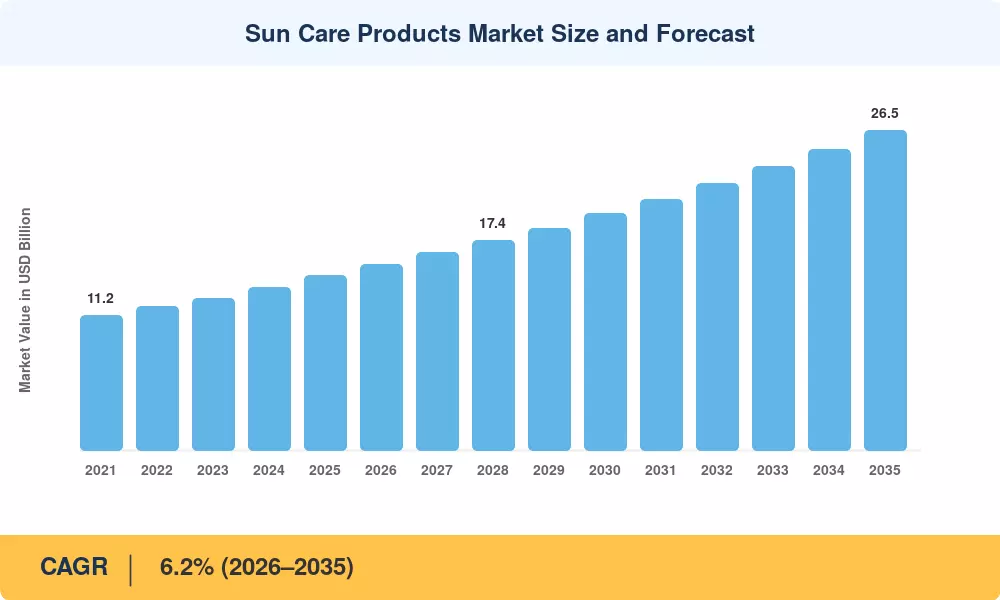
The global Sun Care Products Market reached an estimated USD 14.5 billion in 2025, with the forecast period beginning at USD 15.4 billion in 2026 and climbing to USD 26.5 billion by 2035 at a compound annual growth rate of 6.2%. Two forces are accelerating spending: rising melanoma incidence rates tracked by the WHO — which recorded a 50% increase in global skin cancer diagnoses between 2015 and 2024 [1] — and a wave of government-backed public health campaigns promoting daily photoprotection across school-age and working-age populations [2]. These macro-catalysts are converting sun care from a seasonal beach product into a daily personal care essential.
Within the Sun Care Products Market, a generational transition is being driven by formulation technology. Hybrid formulations that combine organic absorbers with inorganic particulates to enhance photostability are replacing legacy chemical-only filters. An industry-wide reformulation cycle valued at approximately USD 1.8 billion in collective R&D expenditure through 2026 was initiated by the European Commission's 2024 revision of Annex VI cosmetic UV filter regulations [3]. Brands that previously depended on oxybenzone-heavy mixtures are now rapidly adopting next-generation encapsulation and tinted base technologies.
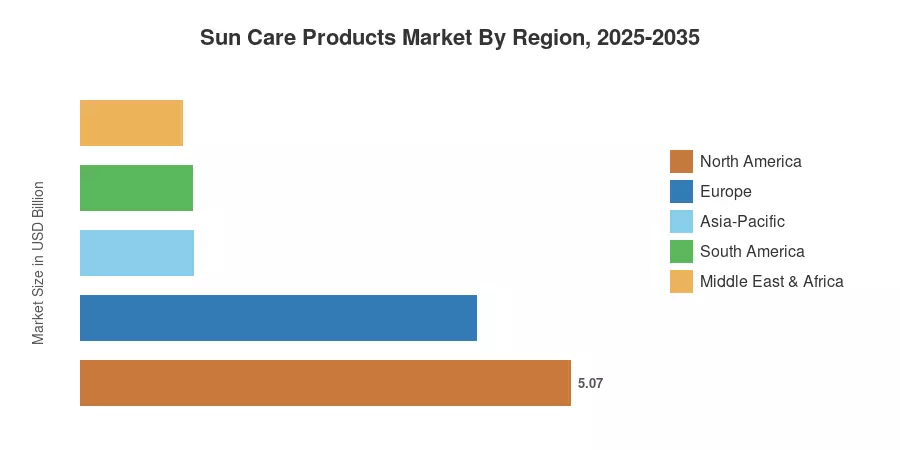
North America is responsible for approximately 35% of global revenue, which is supported by the United States' high per capita consumption and premium pricing. The Sun Care Products Market is rapidly expanding in the Asia-Pacific region, with a projected CAGR of 8.1%. This growth is being driven by the rapidly increasing middle-class demand in China, India, and Southeast Asia. The second-largest share, approximately 28%, is held by Europe, which is supported by robust consumer awareness and stringent EU cosmetic safety regulations. The pace at which emerging-market consumers adopt daily sun care routines beyond traditional resort and leisure occasions will determine the course of the next decade.
Key Report Takeaways — Sun Care Products Market
By Product Type
- Sun protection products (sunscreens, lotions, sprays) account for approximately 64% of the Sun Care Products Market, reflecting the dominance of preventive photoprotection over after-sun and self-tanning categories.
- Self-tanning products are projected to register the fastest segment CAGR at 7.8% through 2035, propelled by the "sunless glow" beauty trend in Western markets.
- After-sun care products represent an estimated USD 2.1 billion in annual revenue globally, buoyed by travel retail and resort-channel distribution.
By Distribution Channel
- Online retail is the fastest-growing channel for the Sun Care Products Market, with a projected CAGR of 9.4% as D2C brands and marketplace platforms expand reach.
- Supermarkets and hypermarkets maintain approximately 38% channel share, anchored by mass-market pricing and seasonal promotional displays.
By Region
- North America leads the Sun Care Products Market with roughly USD 5.1 billion in 2025 revenue, supported by dermatologist-driven consumer education and premium product penetration.
- Asia-Pacific is expected to add the largest absolute revenue increment during 2026–2035, driven by urbanization and skin-lightening-to-sun-protection category migration in East and South Asia.
- Europe contributes approximately 28% of global market share, reflecting strong regulatory standards and well-established brand loyalty.
Sun Care Products Market Size and Forecast (2021–2035)
Market sizing draws on a triangulation of manufacturer revenue disclosures, retail audit panels (including Nielsen and Euromonitor syndicated data), trade association import-export statistics, and proprietary primary interviews with formulators, distributors, and dermatology practitioners across 32 countries. All historical values (2021–2024) are based on confirmed actuals; the base year 2025 reflects preliminary full-year estimates. Forecast figures for the Sun Care Products Market apply a consistent 6.2% CAGR anchored to demand-side modeling and validated against supply-side capacity expansion plans.





















.webp?v=1784723644)
