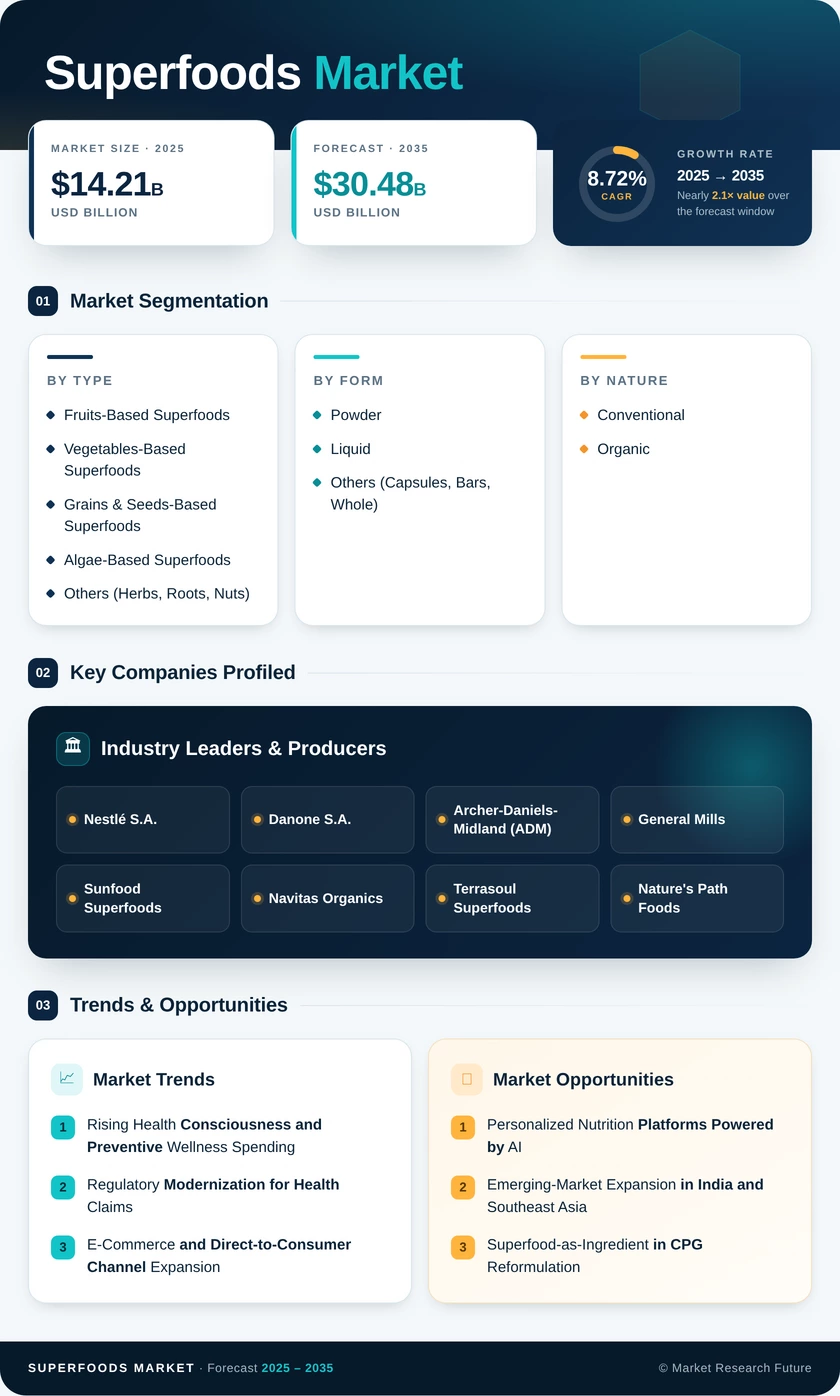
Superfoods Market

ID: MRFR/FnB/5091-HCR
100 Pages
Pradeep Nandi
Last Updated: June 05, 2026
Superfoods Market Size, Share, Industry Trend & Analysis Research Report: By Product Type (Fruits-Based, Vegetables-Based, Grains & Seeds-Based, Algae-Based, Others), By Form (Powder, Liquid, Others), By Nature (Conventional, Organic), By Distribution Channel (Supermarkets & Hypermarkets, Convenience Stores, Online Platforms, Specialty Stores, Others), By Region (North America, Europe, Asia-Pacific, South America, Middle East & Africa) - Forecast to 2035
Download PDF ×

We do not share your information with anyone. However, we may send you emails based on your report interest from time to time. You may contact us at any time to opt-out.

  1. 1 Market Overview |
    1. 1.1 Study Assumptions & Market Definition |
    2. 1.2 Scope of the Study |
    3. 1.3 Research Methodology
  2. 2 Market Summary & Key Takeaways
  3. 3 Market Dynamics |
    1. 3.1 Market Drivers Analysis | |
      1. 3.1.1 Rising Health Consciousness & Preventive Wellness Spending | |
      2. 3.1.2 FDA & EU Regulatory Modernization for Health Claims | |
      3. 3.1.3 E-Commerce & DTC Channel Expansion | |
      4. 3.1.4 Aging Population & Longevity-Focused Nutrition |
    2. 3.2 Market Restraints Analysis | |
      1. 3.2.1 Price Premiums Limiting Mass-Market Adoption | |
      2. 3.2.2 Supply Chain Fragility for Tropical Superfoods | |
      3. 3.2.3 Consumer Skepticism & Regulatory Ambiguity |
    3. 3.3 Market Opportunity Analysis | |
      1. 3.3.1 Personalized Nutrition Platforms Powered by AI | |
      2. 3.3.2 Emerging-Market Expansion in India and Southeast Asia | |
      3. 3.3.3 Superfood-as-Ingredient in CPG Reformulation | |
      4. 3.3.4 Subscription and Data Monetization Models | |
      5. 3.3.5 Algae and Adaptogen Commercialization |
    4. 3.4 Industry Value Chain Analysis |
    5. 3.5 Porter's Five Forces Analysis
  4. 4 Global Superfoods Market Size & Forecast (2021–2035) |
    1. 4.1 Historical Market Size (2021–2025) |
    2. 4.2 Current & Forecast Market Size (2026–2035) |
    3. 4.3 Market Size by Revenue (USD Billion) |
    4. 4.4 Year-over-Year Growth Analysis
  5. 5 Segmentation Analysis |
    1. 5.1 By Product Type | |
      1. 5.1.1 Fruits-Based Superfoods | |
      2. 5.1.2 Vegetables-Based Superfoods | |
      3. 5.1.3 Grains & Seeds-Based Superfoods | |
      4. 5.1.4 Algae-Based Superfoods | |
      5. 5.1.5 Others (Herbs, Roots, Nuts) |
    2. 5.2 By Form | |
      1. 5.2.1 Powder | |
      2. 5.2.2 Liquid | |
      3. 5.2.3 Others (Capsules, Bars, Whole) |
    3. 5.3 By Nature | |
      1. 5.3.1 Conventional | |
      2. 5.3.2 Organic |
    4. 5.4 By Distribution Channel | |
      1. 5.4.1 Supermarkets & Hypermarkets | |
      2. 5.4.2 Convenience Stores | |
      3. 5.4.3 Online Platforms | |
      4. 5.4.4 Specialty Stores | |
      5. 5.4.5 Others (Pharmacies, Foodservice)
  6. 6 Regional Analysis |
    1. 6.1 North America | |
      1. 6.1.1 United States | |
      2. 6.1.2 Canada | |
      3. 6.1.3 Mexico |
    2. 6.2 Europe | |
      1. 6.2.1 Germany | |
      2. 6.2.2 United Kingdom | |
      3. 6.2.3 France | |
      4. 6.2.4 Italy | |
      5. 6.2.5 Spain | |
      6. 6.2.6 Nordic Countries | |
      7. 6.2.7 Russia | |
      8. 6.2.8 Rest of Europe |
    3. 6.3 Asia-Pacific | |
      1. 6.3.1 China | |
      2. 6.3.2 India | |
      3. 6.3.3 Japan | |
      4. 6.3.4 South Korea | |
      5. 6.3.5 ASEAN | |
      6. 6.3.6 Rest of Asia-Pacific |
    4. 6.4 South America | |
      1. 6.4.1 Brazil | |
      2. 6.4.2 Argentina | |
      3. 6.4.3 Rest of South America |
    5. 6.5 Middle East & Africa | |
      1. 6.5.1 Saudi Arabia | |
      2. 6.5.2 UAE | |
      3. 6.5.3 South Africa | |
      4. 6.5.4 Egypt | |
      5. 6.5.5 Rest of MEA
  7. 7 Competitive Landscape |
    1. 7.1 Market Share Analysis (2025) |
    2. 7.2 Competitive Benchmarking Matrix |
    3. 7.3 Company Profiles | |
      1. 7.3.1 Nestlé S.A. | |
      2. 7.3.2 Danone S.A. | |
      3. 7.3.3 Archer-Daniels-Midland (ADM) | |
      4. 7.3.4 General Mills | |
      5. 7.3.5 Sunfood Superfoods | |
      6. 7.3.6 Navitas Organics | |
      7. 7.3.7 Terrasoul Superfoods | |
      8. 7.3.8 Nature's Path Foods | |
      9. 7.3.9 NOW Health Group | |
      10. 7.3.10 Naturya
  8. 8 Future Outlook & Strategic Recommendations (2026–2035) |
    1. 8.1 AI-Driven Personalized Nutrition (2026–2028) |
    2. 8.2 Supply Chain Digitization and Traceability (2028–2031) |
    3. 8.3 Clinical Integration and Medical Nutrition (2030–2033) |
    4. 8.4 Regenerative Agriculture and Carbon-Neutral Superfoods (2032–2035)
  9. 9 Recent Developments & News
  10. 10 Frequently Asked Questions (FAQs)
  11. 11 Report Scope & Methodology |
    1. 11.1 Study Period & Base Year |
    2. 11.2 Data Sources & Citations |
    3. 11.3 Abbreviations
  12. 12 LIST OF TABLES |
  13. TABLE 1 Global Superfoods Market Size & Forecast, by Revenue (USD Billion), 2021–2035 |
  14. TABLE 2 Global Superfoods Market – Year-over-Year Growth Analysis, 2021–2035 |
  15. TABLE 3 Global Superfoods Market – Driver Impact Analysis, 2026–2035 |
  16. TABLE 4 Global Superfoods Market – Restraint Impact Analysis, 2026–2035 |
  17. TABLE 5 Global Superfoods Market Size, by Product Type, 2021–2035 (USD Billion) |
  18. TABLE 6 Global Superfoods Market Size, by Form, 2021–2035 (USD Billion) |
  19. TABLE 7 Global Superfoods Market Size, by Nature, 2021–2035 (USD Billion) |
  20. TABLE 8 Global Superfoods Market Size, by Distribution Channel, 2021–2035 (USD Billion) |
  21. TABLE 9 Global Superfoods Market Size, by Region, 2021–2035 (USD Billion) |
  22. TABLE 10 North America Superfoods Market Size, by Country, 2021–2035 (USD Billion) |
  23. TABLE 11 Europe Superfoods Market Size, by Country, 2021–2035 (USD Billion) |
  24. TABLE 12 Asia-Pacific Superfoods Market Size, by Country, 2021–2035 (USD Billion) |
  25. TABLE 13 South America Superfoods Market Size, by Country, 2021–2035 (USD Billion) |
  26. TABLE 14 Middle East & Africa Superfoods Market Size, by Country, 2021–2035 (USD Billion) |
  27. TABLE 15 Competitive Benchmarking Matrix – Global Superfoods Market, 2025 |
  28. TABLE 16 Company Profiles – Key Players, Global Superfoods Market |
  29. TABLE 17 Recent Developments & Strategic Announcements, 2023–2025 |
  30. TABLE 18 Report Scope & Methodology Summary |
  31. TABLE 19 Detailed Sources and Citations
  32. 13 LIST OF FIGURES |
  33. FIGURE 1 Global Superfoods Market Dynamics (Drivers, Restraints, Opportunities) |
  34. FIGURE 2 Industry Value Chain Analysis – Superfoods Market |
  35. FIGURE 3 Porter's Five Forces Analysis – Superfoods Market |
  36. FIGURE 4 Global Superfoods Market Size Trend (USD Billion), 2021–2035 |
  37. FIGURE 5 Superfoods Market Share, by Product Type (%), 2025 |
  38. FIGURE 6 Superfoods Market Share, by Form (%), 2025 |
  39. FIGURE 7 Superfoods Market Share, by Nature (%), 2025 |
  40. FIGURE 8 Superfoods Market Share, by Distribution Channel (%), 2025 |
  41. FIGURE 9 Superfoods Market Share, by Region (%), 2025 |
  42. FIGURE 10 North America Superfoods Market Share, by Country (%), 2025 |
  43. FIGURE 11 Europe Superfoods Market Share, by Country (%), 2025 |
  44. FIGURE 12 Asia-Pacific Superfoods Market Share, by Country (%), 2025 |
  45. FIGURE 13 South America Superfoods Market Share, by Country (%), 2025 |
  46. FIGURE 14 Middle East & Africa Superfoods Market Share, by Country (%), 2025 |
  47. FIGURE 15 Competitive Landscape – Market Share Analysis, 2025

Segmentation Quick Reference

DimensionSub-SegmentsDominant SegmentFastest Growing Segment
Product TypeFruits-Based, Vegetables-Based, Grains & Seeds-Based, Algae-Based, OthersFruits-Based SuperfoodsAlgae-Based Superfoods
FormPowder, Liquid, OthersPowderLiquid
NatureConventional, OrganicConventionalOrganic
Distribution ChannelSupermarkets & Hypermarkets, Convenience Stores, Online Platforms, Specialty Stores, OthersSupermarkets & HypermarketsOnline Platforms
RegionNorth America, Europe, Asia-Pacific, South America, Middle East & AfricaNorth AmericaAsia-Pacific


Market Segmentation Overview

By Product Type

Sub-SegmentKey Trend
Fruits-Based SuperfoodsAcai, blueberry, and goji dominate retail; freeze-dried formats expand addressable channels
Vegetables-Based SuperfoodsKale, broccoli sprout, and beet powder mainstreaming in smoothie and supplement categories
Grains & Seeds-Based SuperfoodsChia, quinoa, and hemp gaining traction in functional snacking and plant-based protein
Algae-Based SuperfoodsSpirulina and chlorella scaling via photobioreactor technology; complete amino-acid profiles
Others (Herbs, Roots, Nuts)Adaptogenic mushrooms, ashwagandha, and maca bridging traditional medicine and modern wellness


Fruit-based superfoods maintain category leadership through consumer familiarity and decades of clinical evidence supporting polyphenol benefits. Algae-based products represent the disruptive growth vector as spirulina production costs decline and plant-protein demand accelerates globally.

By Form

Sub-SegmentKey Trend
PowderDominant format; microencapsulation preserving bioactive compounds; blending versatility
LiquidRTD smoothies and cold-pressed juices attracting convenience-focused consumers
Others (Capsules, Bars, Whole)On-the-go supplement formats; superfood-infused snack bars; whole-food meal kits


Powder formats lead because they integrate seamlessly into existing consumer habits—smoothies, baking, and daily supplement routines. Liquid formats are the fastest-growing as beverage innovation brings superfood functionality to grab-and-go retail.

By Nature

Sub-SegmentKey Trend
ConventionalThe majority share through price accessibility; private-label growth compressing margins
OrganicRapid expansion driven by USDA and EU certification growth; 25% organic farmland EU target by 2030


Organic superfoods are the clear growth story, with regulatory support and consumer clean-label preferences driving double-digit CAGR. Conventional products retain volume leadership but face margin pressure from private-label competition.

By Distribution Channel

Sub-SegmentKey Trend
Supermarkets & HypermarketsBroadest assortment; in-store sampling programs driving trial
Convenience StoresSingle-serve superfood bars and RTD beverages fueling impulse purchases
Online PlatformsDTC subscriptions, cross-border e-commerce, and algorithmic discovery driving the fastest growth
Specialty StoresCurated assortments with expert staff; premium positioning
Others (Pharmacies, Foodservice)Clinical nutrition integration; hotel and restaurant menu incorporation


Online platforms are reshaping distribution through subscription economics and algorithmic recommendation engines. Supermarkets retain dominance in volume but face share erosion as DTC brands capture high-value, repeat-purchase consumers.