Superfoods Market

Key Players: Nestlé S.A., Danone S.A., Archer-Daniels-Midland (ADM), General Mills, Sunfood Superfoods, Navitas Organics, Terrasoul Superfoods, Nature's Path Foods

Superfoods Market

Superfoods Market Size, Share, Industry Trend & Analysis Research Report: By Product Type (Fruits-Based, Vegetables-Based, Grains & Seeds-Based, Algae-Based, Others), By Form (Powder, Liquid, Others), By Nature (Conventional, Organic), By Distribution Channel (Supermarkets & Hypermarkets, Convenience Stores, Online Platforms, Specialty Stores, Others), By Region (North America, Europe, Asia-Pacific, South America, Middle East & Africa) - Forecast to 2035
ID: MRFR/FnB/5091-HCR
100 Pages
Pradeep Nandi
Last Updated: June 05, 2026
 

Superfoods Market Summary

The global Superfoods Market was valued at USD 14.21 billion in 2025 and is projected to reach USD 15.36 billion in 2026, climbing to USD 30.48 billion by 2035 at a CAGR of 8.72% during the forecast period (2026–2035). This expansion is anchored in a decisive shift toward preventive healthcare spending—global wellness expenditure surpassed USD 5.6 trillion in 2024—and updated regulatory frameworks such as the FDA's revised "healthy" nutrient content claim, which now permits nutrient-dense foods like avocados, nuts, and salmon to carry front-of-pack health labels [2]. The Superfoods Market benefits directly from these policy catalysts as consumers increasingly seek antioxidant-rich foods and functional food ingredients that align with clinical nutrition guidance.

Whole food nutrition items being delivered to consumers are changing. Legacy bulk-commodity supply networks are being replaced by digitally integrated, cold-chain-optimized distribution methods that preserve bioactive components in superfood powders and supplements. In 2024, private-label investment in nutrient-dense health foods around the globe surpassed USD 2.1 billion, with shops like Costco and Aldi expanding their product offerings for organic acai, spirulina, and moringa [3]. With this change in the infrastructure, smaller brands can compete on quality, not just shelf space.


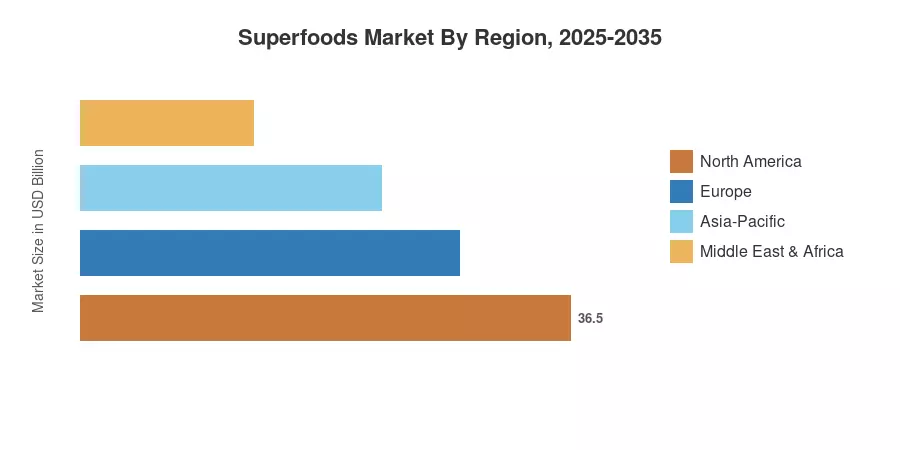
North America accounts for around 40.3% of the Superfoods Market, because to high retail penetration and clinical research funding Asia-Pacific is the fastest-growing market with a projected CAGR of 10.87% through 2035, due to rising disposable incomes in China and India, and emerging e-commerce channels for whole food nutrition products [4]. Europe retains the second greatest proportion of about 27.5%, with the Farm to Fork strategy of the EU strengthening the demand for organic and antioxidant foods [5]. “Over the next 10 years, personalized nutrition platforms and AI-powered formulation will increasingly define the Superfoods Market.


Key Report Takeaways

• By Product Type

  • Fruit-based superfoods led the Superfoods Market with a 36.1% revenue share in 2025, reflecting strong demand for acai, blueberry, and goji berry products across retail and foodservice channels
  • Algae-based superfoods are forecast to expand at an 11.08% CAGR through 2035, positioning spirulina and chlorella as high-growth functional food ingredients

• By Form

  • Powders captured approximately USD 6.32 billion in 2025 revenue, driven by convenience-oriented consumers blending superfood powders and supplements into daily routines
  • Liquid formats are the fastest-rising form at a 10.34% CAGR, propelled by ready-to-drink smoothie and cold-pressed juice innovation

• By Region

  • North America retained the dominant position in the Superfoods Market with 40.3% of 2025 global revenue
  • Asia-Pacific is on course for a 10.87% CAGR to 2035, with China and India as primary growth engines for nutrient-dense health foods

Market Size and Forecast (2021–2035)

MRFR's proprietary sizing framework triangulates top-down revenue estimates from trade databases, company filings, and customs data with bottom-up demand models validated through 120+ expert interviews conducted in Q4 2024 and Q1 2025.
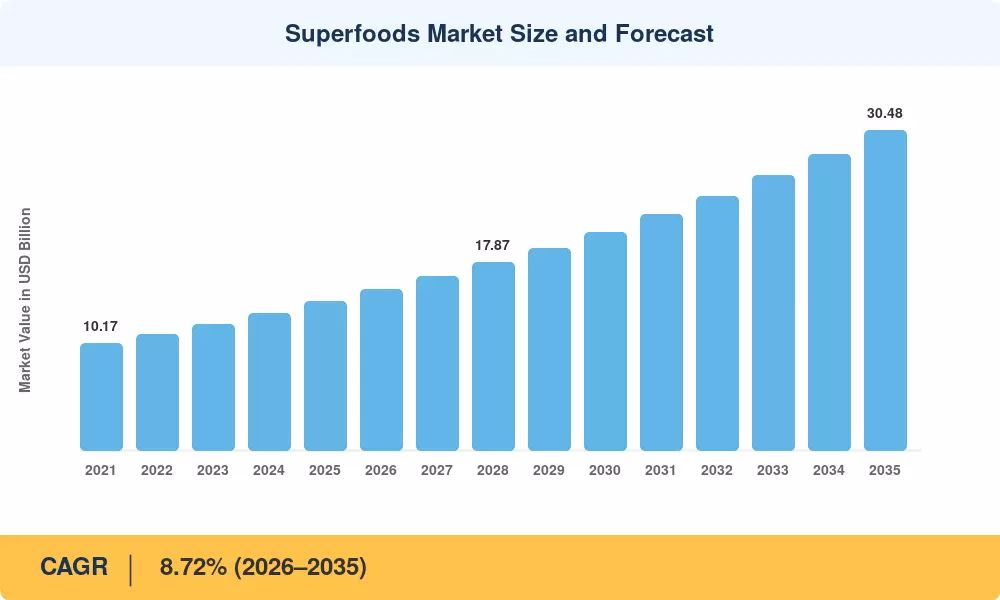
Superfoods Market Size and Forecast
Our Impact
Enabled $4.3B Revenue Impact for Fortune 500 and Leading Multinationals
Partnering with 2000+ Global Organizations Each Year
30K+ Citations by Top-Tier Firms in the Industry
 

Driver Impact Analysis

Driver ~% Impact on CAGR Geographic Relevance Impact Timeline
Rising health consciousness & preventive wellness spending ~22% Global Short-term (≤2 yr)
FDA & EU regulatory modernization for health claims ~18% North America, Europe Short-term (≤2 yr)
E-commerce & DTC channel expansion ~16% Asia-Pacific, North America Medium-term (2–4 yr)
Organic & clean-label consumer preferences ~14% Europe, North America Medium-term (2–4 yr)
Aging population & longevity-focused nutrition ~12% Japan, Europe, North America Long-term (≥4 yr)
Personalized nutrition & AI-driven formulation ~10% Global Long-term (≥4 yr)
Emerging-market middle-class expansion ~8% Asia-Pacific, South America Long-term (≥4 yr)


Rising Health Consciousness and Preventive Wellness Spending

Global out-of-pocket wellness spending reached USD 5.6 trillion in 2024, with dietary supplements and nutrient-dense health foods accounting for roughly 12% of that total. Consumers are migrating away from reactive healthcare models, choosing instead to invest in antioxidant-rich foods and whole food nutrition products as a daily health infrastructure. The U.S. alone saw a 14.3% year-over-year increase in superfood-branded product launches, signaling that the Superfoods Market is capturing a larger slice of preventive health budgets.

Regulatory Modernization for Health Claims

The FDA's September 2024 final rule redefining "healthy" nutrient content claims allows products rich in fruits, vegetables, and whole grains to qualify for front-of-pack labeling without meeting legacy fat-content thresholds [2]. In the EU, the Farm to Fork strategy targets 25% organic farmland by 2030, directly expanding the certified supply of functional food ingredients [5]. These regulatory shifts lower marketing barriers for superfood brands and build consumer trust in label accuracy.

E-Commerce and Direct-to-Consumer Channel Expansion

Online sales of superfood powders and supplements grew at 19.2% CAGR between 2021 and 2024, with platforms like Amazon and iHerb serving as primary discovery channels [4]. In the Superfoods Market, DTC brands such as Athletic Greens and Navitas Organics leverage subscription models that drive repeat purchase rates above 40%. Cross-border e-commerce is also unlocking Asia-Pacific demand for imported nutrient-dense health foods, particularly in China, where Tmall Global superfood imports doubled between 2022 and 2024 [3].

Aging Population and Longevity-Focused Nutrition

By 2030, one in six people in the world will be over 60 years old [14]. Japan, with 29% of its population over 65, has targeted functional food ingredients as pharmacological options for cardiovascular and cognitive health. The Superfoods Market uses as its foundation the fact that clinical research conducted at Tufts University has shown that frequent ingestion of blueberries and walnuts leads to demonstrable increases in memory recall in persons over 60 [10].


Restraints Impact Analysis

The restraint impact percentages below represent estimated drag on CAGR growth. These are directional, derived from MRFR's proprietary modeling, and are not directly subtractable from driver estimates.

Restraint ~% Drag on CAGR Geographic Relevance Impact Timeline
Price premiums limiting mass-market adoption ~−18% Global Short-term (≤2 yr)
Supply chain fragility for tropical superfoods ~−15% South America, Africa Medium-term (2–4 yr)
Inconsistent quality standards & adulteration risks ~−12% Asia-Pacific, MEA Medium-term (2–4 yr)
Consumer skepticism toward health claims ~−10% Europe, North America Short-term (≤2 yr)
Perishability and cold-chain infrastructure gaps ~−8% Emerging markets Long-term (≥4 yr)


Price Premiums Limiting Mass-Market Adoption

Organic superfood powders and supplements are generally priced 35–60% more than their conventional counterparts [6]. The gap limits the Superfoods Market to urban, upper-middle-income families in price-sensitive regions of Southeast Asia and Sub-Saharan Africa. Retailers like Walmart and Trader Joe’s are squeezing margins for branded whole food nutrition products with private-label competition, even in the U.S., creating a split market where the premium and value tiers are diverging ever farther.


Supply Chain Fragility for Tropical Superfoods

Acai berries, cacao, and maca root depend on geographically concentrated growing regions in Brazil, Peru, and West Africa. The 2024 El Niño cycle reduced Brazilian acai yields by an estimated 11%, triggering a 23% spot-price increase that rippled through the antioxidant-rich foods supply chain [15]. Climate volatility and deforestation pressures threaten long-term supply stability for functional food ingredients sourced from tropical ecosystems.

Consumer Skepticism and Regulatory Ambiguity

A 2024 Eurobarometer survey found that 38% of EU consumers distrust superfood health claims, viewing them as marketing rather than science [17]. This skepticism is compounded by inconsistent international labeling standards—what qualifies as a "superfood" in the U.S. carries no formal regulatory definition. For the Superfoods Market, building credible clinical evidence remains essential to sustaining premium positioning for nutrient-dense health foods.


Superfoods Market Opportunities

Personalized Nutrition Platforms Powered by AI

AI-driven nutrigenomics platforms such as Zoe and DayTwo are creating individualized dietary protocols that incorporate superfood powders and supplements based on microbiome analysis. The global personalized nutrition industry is expected to surpass USD 16 billion by 2030, offering the Superfoods Market a high-value channel where antioxidant-rich foods are prescribed rather than browsed

Emerging-Market Expansion in India and Southeast Asia

India's Ayush Ministry allocated INR 3,000 crore (≈USD 360 million) in the 2024–25 budget toward traditional medicine and functional food ingredients research [4]. Indonesia, Vietnam, and Thailand represent largely untapped markets where local superfoods—moringa, turmeric, and pandan—can be commercialized for domestic and export channels. The Superfoods Market stands to gain from these markets as cold-chain logistics and e-commerce infrastructure mature

Superfood-as-Ingredient in CPG Reformulation

Major CPG companies, including Nestlé, PepsiCo, and Danone, are reformulating snack and beverage lines to include nutrient-dense health foods such as chia, hemp, and spirulina. Nestlé's 2024 "Good for You" portfolio expansion embedded superfood ingredients into 47 SKUs across six countries [12]. This B2B ingredient opportunity extends the Superfoods Market beyond retail into foodservice, hospitality, and clinical nutrition

Subscription and Data Monetization Models

DTC superfood brands are monetizing purchase behavior and health-outcome data through subscription tiers that bundle whole food nutrition products with wellness tracking apps. Athletic Greens reportedly generates over 60% of revenue from subscribers, reducing customer acquisition costs by 30% compared to one-time purchasers [13]. Data-driven product development—using anonymized consumption patterns to guide new SKU launches—represents a significant margin opportunity for the Superfoods Market.

Algae and Adaptogen Commercialization

Production capacity of spirulina and chlorella increased 28% globally from 2022 to 2025 [12] while adaptogenic herbs such as ashwagandha and reishi experienced double-digit retail growth. Vertical farming and photobioreactor technology are making algae-based functional food ingredients cheaper to produce and providing scalable supplies to meet the increased demand for plant-based protein and antioxidant-rich diets


Superfoods Market Future Outlook

AI-Driven Personalized Nutrition (2026–2028)

Machine-learning platforms that match individual biomarkers to optimal superfood protocols will reshape how consumers interact with the Superfoods Market. Companies like Zoe and Viome are already integrating microbiome data with dietary recommendations that emphasize antioxidant-rich foods and functional food ingredients. By 2028, MRFR estimates that 15% of premium superfood purchases will originate from algorithm-driven recommendations.

Supply Chain Digitization and Traceability (2028–2031)

Blockchain-based traceability platforms are being adopted by superfood supply chains to verify origin, organic certification, and fair-trade compliance for whole food nutrition products. IBM Food Trust and SAP GreenToken deployments in the acai and cacao sectors aim to reduce adulteration risk and build consumer confidence in nutrient-dense health foods [16]. The Superfoods Market will increasingly reward brands that can prove provenance from farm to shelf.

Clinical Integration and Medical Nutrition (2030–2033)

The convergence of medical nutrition therapy and superfood science will open clinical channels for the Superfoods Market. Hospital systems in the U.S. and Japan are piloting whole food nutrition products in post-surgical recovery and oncology support protocols [10]. Regulatory pathways for medical food claims—distinct from dietary supplement labeling—will enable premium pricing for clinically validated superfood powders and supplements.

Regenerative Agriculture and Carbon-Neutral Superfoods (2032–2035)

ESG mandates and consumer demand for sustainability will push the Superfoods Market toward regenerative sourcing. Certified B Corp brands are already commanding 20–25% price premiums for carbon-neutral functional food ingredients [8]. By 2035, MRFR projects that over 30% of organic superfood acreage will operate under regenerative agriculture protocols that sequester carbon while producing antioxidant-rich foods.


Superfoods Market Segmentation

By Product Type

Segment Metric Primary Demand Driver
Fruits-Based Superfoods 36.1% share (2025) Acai, blueberry, and goji consumer familiarity
Vegetables-Based Superfoods USD 3.12 Billion (2025) Kale, broccoli sprout, and beet powder mainstreaming
Grains & Seeds-Based Superfoods 8.96% CAGR (2026–2035) Chia, quinoa, and hemp adoption in functional food ingredients
Algae-Based Superfoods 11.08% CAGR (2026–2035) Spirulina and chlorella as plant-protein alternatives
Others (Herbs, Roots, Nuts) USD 1.47 Billion (2025) Adaptogen and medicinal mushroom growth


Fruits-based superfoods anchor the Superfoods Market because consumers intuitively associate berries and tropical fruits with antioxidant-rich foods. Blueberries, acai, and goji berries benefit from decades of clinical research linking polyphenol intake to cardiovascular and cognitive health outcomes [10]. Retail innovation in freeze-dried formats and single-serve pouches has expanded the addressable market beyond smoothie enthusiasts to mainstream snack consumers seeking whole food nutrition products.

Algae-based superfoods represent the fastest-expanding product category, driven by spirulina's positioning as a complete protein source with all essential amino acids. Global spirulina production capacity grew 28% between 2022 and 2025 [12], with photobioreactor technology reducing costs by an estimated 15% per kilogram. The Superfoods Market recognizes algae as a cornerstone of future plant-based nutrient-dense health foods.

By Form

Segment Metric Primary Demand Driver
Powder 38.9% share (2025) Blending convenience, extended shelf life
Liquid 10.34% CAGR (2026–2035) RTD smoothies, cold-pressed juices
Others (Capsules, Bars, Whole) USD 3.18 Billion (2025) On-the-go formats, supplement crossover


Superfood powders and supplements dominate the form segmentation because powder formats offer unmatched versatility—consumers add them to smoothies, oatmeal, baked goods, and protein shakes. The Superfoods Market has seen powder-format innovation accelerate through microencapsulation technology that preserves bioactive compounds during processing [7]. Liquid formats are gaining ground as ready-to-drink functional beverages attract time-constrained consumers who prefer nutrient-dense health foods without preparation effort.

By Nature

Segment Metric Primary Demand Driver
Conventional 53.2% share (2025) Price accessibility, mass-market retail distribution
Organic 12.31% CAGR (2026–2035) Clean-label demand, EU and USDA organic certification growth


Conventional products retain the majority share in the Superfoods Market due to lower price points that enable mass-market accessibility. However, organic lines are outpacing conventional growth by a significant margin as consumers increasingly prioritize pesticide-free, non-GMO whole food nutrition products. The EU's target of 25% organic farmland by 2030 [5] and USDA's Organic Transition Initiative (USD 300 million allocated in 2024) [8] are expanding certified supply of antioxidant-rich foods.

By Distribution Channel

Segment Metric Primary Demand Driver
Supermarkets & Hypermarkets 44.4% share (2025) One-stop shopping, in-store sampling
Convenience Stores USD 1.21 Billion (2025) Impulse purchases, single-serve formats
Online Platforms 13.52% CAGR (2026–2035) DTC subscriptions, cross-border e-commerce
Specialty Stores 12.8% share (2025) Curated assortments, staff expertise
Others (Pharmacies, Foodservice) 7.14% CAGR (2026–2035) Clinical nutrition, hospitality integration


Supermarkets and hypermarkets remain the backbone of Superfoods Market distribution, offering the broadest assortment of functional food ingredients across price tiers. Online platforms represent the most disruptive channel, with Amazon, iHerb, and Tmall Global driving discovery and repeat purchase of superfood powders and supplements through algorithmic recommendation and subscription models [4].


Regional Market Share Analysis

Region Metric Primary Investment Themes
North America 40.3% of 2025 revenue Retail premiumization, clinical nutrition, DTC subscriptions
Europe USD 3.91 Billion (2025) Organic certification, Farm to Fork policy, clean-label demand
Asia-Pacific 10.87% CAGR (2026–2035) E-commerce expansion, Ayurvedic superfoods, middle-class growth
South America USD 0.98 Billion (2025) Acai & maca export growth, domestic superfood commercialization
Middle East & Africa 7.85% CAGR (2026–2035) Urban wellness trends, date & moringa value chains
Total USD 14.21 Billion (2025)

The Superfoods Market exhibits distinct regional dynamics. North America leads on per-capita consumption and retail infrastructure, while Asia-Pacific is accelerating through e-commerce adoption and indigenous superfood commercialization. Europe's regulatory rigor supports premium pricing for organic nutrient-dense health foods. South America and the Middle East & Africa represent nascent but high-potential regions where rising urbanization is expanding addressable demand for whole food nutrition products.


North America

Country Metric Key Driver
US 78.4% of regional revenue FDA healthy-label reform, DTC superfood powders and supplements
Canada 12.9% CAGR (2026–2035) Cannabis-adjacent wellness crossover, organic retail expansion
Mexico USD 0.41 Billion (2025) Growing middle-class demand for antioxidant-rich foods


The U.S. Superfoods Market benefits from the world's deepest retail infrastructure for nutrient-dense health foods, with Whole Foods, Sprouts, and Costco collectively stocking over 1,200 superfood SKUs. Canada's organic food sector grew 8.7% in 2024, with British Columbia and Ontario leading demand for functional food ingredients [3]. Mexico is an emerging consumer market where traditional ingredients like chia and cacao are being repackaged as premium whole food nutrition products for domestic and cross-border e-commerce.

Europe

Country Metric Key Driver
Germany 23.6% of regional share Organic retail leadership, clinical nutrition channels
UK USD 0.72 Billion (2025) Post-Brexit health-labeling reform, superfood powders and supplements demand
France 9.14% CAGR (2026–2035) Nutri-Score adoption, antioxidant-rich foods in gastronomy
Italy 11.2% of regional share Mediterranean diet synergy with nutrient-dense health foods
Spain USD 0.31 Billion (2025) Tourism-driven functional food ingredients demand
Nordic Countries 10.18% CAGR (2026–2035) High per-capita wellness spending, lingonberry and sea buckthorn
Russia 5.8% of regional share Import substitution, domestic berry superfood cultivation
Rest of Europe USD 0.49 Billion (2025) Eastern European organic farmland expansion


Germany anchors European demand with its established organic retail ecosystem—Bio-Siegel certified products accounted for 6.4% of total food sales in 2024 [8]. The UK Superfoods Market is pivoting toward evidence-based product positioning after the Advertising Standards Authority tightened health-claim enforcement in 2024 [17]. Nordic countries punch above their weight on a per-capita basis, with indigenous superfoods like lingonberry and cloudberry gaining international traction as antioxidant-rich foods.

Asia-Pacific

Country Metric Key Driver
China 34.7% of regional share Tmall Global imports, TCM-functional food ingredients convergence
India 12.64% CAGR (2026–2035) Ayush policy support, turmeric and moringa commercialization
Japan USD 0.52 Billion (2025) Aging population, matcha and fermented superfood powders and supplements
South Korea 10.91% CAGR (2026–2035) K-beauty wellness crossover, ginseng-based nutrient-dense health foods
ASEAN 11.53% CAGR (2026–2035) E-commerce infrastructure, tropical whole food nutrition products
Rest of Asia-Pacific USD 0.18 Billion (2025) Early-stage market development


China's Superfoods Market is expanding rapidly through cross-border e-commerce platforms, where imported acai, quinoa, and spirulina products attract urban millennials. India's government-backed promotion of traditional functional food ingredients through the Ayush Ministry creates a unique demand trajectory. Japan's mature consumer base prioritizes clinically validated antioxidant-rich foods, with matcha exports reaching a record USD 290 million in 2024 [4].

South America

Country Metric Key Driver
Brazil 62.4% of regional share Acai and guarana export leadership
Argentina 8.47% CAGR (2026–2035) Chia seed production, domestic wellness trends
Rest of South America USD 0.21 Billion (2025) Maca, quinoa, and camu camu sourcing for global superfood powders and supplements


Brazil dominates the South American Superfoods Market as the world's largest acai producer, with Pará state alone generating over 1.5 million tonnes annually [15]. The challenge for the region lies in converting raw material export strength into branded whole food nutrition products that capture higher margins. Argentina's Patagonian chia production is gaining organic certification, positioning the country as a credible supplier of nutrient-dense health foods to North American and European buyers.

Middle East & Africa

Country Metric Key Driver
Saudi Arabia 28.3% of regional share Vision 2030 wellness investment, date-based functional food ingredients
UAE 9.23% CAGR (2026–2035) Health tourism, premium retail for antioxidant-rich foods
South Africa USD 0.09 Billion (2025) Rooibos and baobab commercialization
Egypt 7.61% CAGR (2026–2035) Young demographics, moringa cultivation expansion
Rest of MEA 6.5% of regional share Early-stage whole food nutrition products demand


Saudi Arabia's Vision 2030 agenda includes a healthcare transformation pillar that is driving investment in preventive wellness, including functional food ingredients and superfood powders, and supplements. The UAE's positioning as a global health-tourism hub creates premium demand for nutrient-dense health foods in hospitality and retail channels. South Africa's rooibos and baobab industries are scaling for export, supported by USAID-funded smallholder programs in Limpopo province [4].


Superfoods Market By Region, 2025-2035
 

Competitive Benchmarking

The Superfoods Market is moderately concentrated, with the top five firms projected to together have an 18–24% share of revenue. The Herfindahl-Hirschman Index (HHI) is less than 500, indicating a highly fragmented competitive structure with hundreds of regional and specialized companies competing alongside international CPG giants. Differentiation focuses on sourcing transparency, organic certification, and clinical confirmation of nutrient-packed health foods.

.

Company Est. Revenue Share Range Key Offerings for Superfoods Market Strategic Positioning
Nestlé S.A. ~4–6% Garden of Life, Nuun; whole food nutrition products Diversified CPG with clinical nutrition arm
Danone S.A. ~3–5% Alpro, Silk; plant-based functional food ingredients Dairy-alternative superfood integration
Archer-Daniels-Midland (ADM) ~3–5% Bulk superfood ingredients, WILD Flavors B2B ingredient supply for superfood powders and supplements
General Mills ~2–4% Annie's, Cascadian Farm; organic antioxidant-rich foods Natural & organic portfolio strategy
Sunfood Superfoods ~2–3% Raw superfood powders, adaptogens DTC premium purity positioning
Navitas Organics ~2–3% Organic superfood powders, snacks USDA Organic, Fair Trade certified
Terrasoul Superfoods ~1–3% Bulk superfood powders, nuts, seeds Value-oriented e-commerce
Nature's Path Foods ~1–2% Organic cereals and granola with superfood ingredients Certified organic, non-GMO verified
NOW Health Group ~1–2% Spirulina, chlorella, superfood capsules Supplement-channel focus for nutrient-dense health foods
Naturya ~1–2% Superfood powders, seeds, and snack bars UK and European retail distribution


Recent News & Developments


  • Navitas Organics (November 2023): Secured B Corp recertification and expanded direct-trade sourcing of maca and cacao from Peruvian cooperatives [22].
  • EU Commission (June 2023): Published interim Farm to Fork Strategy targets confirming 25% organic farmland mandate by 2030, reinforcing demand for organic nutrient-dense health foods [5].


Superfoods Market Report Scope

Parameter Detail
Market Scope Global Superfoods Market across product type, form, nature, distribution channel, and region
Study Period 2021–2035
CAGR 8.72% (2026–2035)
Market Size (2025) USD 14.21 Billion
Market Size (2035) USD 30.48 Billion
Fastest Growing Segment Algae-Based Superfoods (by product type); Online Platforms (by distribution)
Companies Profiled 10 (Nestlé, Danone, ADM, General Mills, Sunfood, Navitas, Terrasoul, Nature's Path, NOW Health, Naturya)
Valuation Currency USD Billion


FAQs

How does bioavailability differ between whole superfoods and extracted superfood powders and supplements?

Whole superfoods retain their fiber matrix, which slows nutrient absorption and supports gut health. Extracted superfood powders and supplements concentrate specific compounds but may lose synergistic cofactors present in the original whole food nutrition products [10].

What certifications should procurement teams prioritize when sourcing antioxidant-rich foods?

USDA Organic, EU Organic, and Fair Trade certifications provide the strongest supply-chain assurance. Third-party testing through NSF International or ConsumerLab adds adulteration screening critical for functional food ingredients [16].

How is the Superfoods Market responding to greenwashing concerns?

Blockchain traceability and third-party lifecycle assessments are replacing self-declared sustainability claims. Brands investing in verified regenerative sourcing of nutrient-dense health foods are gaining measurable trust premiums at retail [24].

What role do adaptogens play in the Superfoods Market growth trajectory?

Ashwagandha, reishi, and lion's mane are bridging the gap between traditional herbal medicine and modern functional food ingredients. Clinical interest in stress-modulation and cognitive support is driving double-digit retail growth for adaptogen-based superfood powders and supplements [12].

How should investors evaluate margin structures across the Superfoods Market value chain?

Branded DTC companies typically achieve 55–65% gross margins versus 20–30% for bulk ingredient suppliers. Subscription models for whole food nutrition products compress customer acquisition costs and improve lifetime value [13].

What cold-chain challenges affect antioxidant-rich foods in emerging markets?

Tropical superfoods like acai degrade rapidly without −18°C storage, yet Sub-Saharan Africa and parts of Southeast Asia lack reliable cold-chain infrastructure. Freeze-drying and spray-drying technologies mitigate this by converting perishable, nutrient-dense health foods into shelf-stable formats [15].

How are clinical nutrition protocols integrating the Superfoods Market into patient care?

U.S. and Japanese hospital systems are piloting blueberry and spirulina-based functional food ingredients in post-surgical and oncology recovery diets. Reimbursement pathways for medical nutrition therapy remain the key regulatory bottleneck for broader adoption of superfood powders and supplements [10].


FAQs

What is the projected market valuation of The Global Superfoods by 2035?

The projected market valuation of The Global Superfoods by 2035 is 541.06 USD Billion.

What was the overall market valuation of The Global Superfoods in 2024?

The overall market valuation of The Global Superfoods in 2024 was 216.09 USD Billion.

What is the expected CAGR for The Global Superfoods during the forecast period 2025 - 2035?

The expected CAGR for The Global Superfoods during the forecast period 2025 - 2035 is 8.7%.

Which product type segment had the highest valuation in 2024?

In 2024, the product type segment with the highest valuation was Grains, valued at 40.0 USD Billion.

What are the projected valuations for the Whole form of superfoods by 2035?

The projected valuation for the Whole form of superfoods by 2035 is 150.0 USD Billion.

Which distribution channel is expected to dominate The Global Superfoods by 2035?

The Supermarkets distribution channel is expected to dominate The Global Superfoods by 2035, with a projected valuation of 215.0 USD Billion.

What was the valuation of the Dietary Supplements segment in 2024?

The valuation of the Dietary Supplements segment in 2024 was 40.0 USD Billion.

Which key player is recognized for its significant presence in The Global Superfoods?

Nestle is recognized for its significant presence in The Global Superfoods among key players.

What is the projected valuation for the Capsules form of superfoods by 2035?

The projected valuation for the Capsules form of superfoods by 2035 is 221.06 USD Billion.

How does the valuation of the Food and Beverages segment compare to other end-use segments in 2024?

In 2024, the Food and Beverages segment had a valuation of 150.0 USD Billion, making it the largest compared to other end-use segments.
Author
Author
Author Profile
Pradeep Nandi LinkedIn
Senior Research Analyst
I have a bachelor's degree in mechanical engineering and an MBA. I have more than two years of expertise in the retail, food, and beverage, chemical, and material industries, and hence have developed a sound cross-domain expertise. A firm believer in lifelong learning and sharing of knowledge. Having a proclivity for hatching ideas and trying to absorb as much information as possible in a short amount of time. Introducing corporates to the data and insight, which enables them to move from probability to possibility, has been my key areas of interest. 

Research Approach


Secondary Research

The secondary research process involved comprehensive analysis of regulatory databases, peer-reviewed nutritional journals, agricultural publications, and authoritative food & beverage organizations. Key sources included the US Food & Drug Administration (FDA), European Food Safety Authority (EFSA), US Department of Agriculture (USDA) Economic Research Service, Food and Agriculture Organization (FAO) of the United Nations, World Health Organization (WHO) Nutrition Database, National Institutes of Health (NIH) Office of Dietary Supplements, Centers for Disease Control and Prevention (CDC) National Health and Nutrition Examination Survey, European Commission Agriculture and Rural Development Database, Organic Trade Association (OTA), International Food Information Council (IFIC), National Agricultural Statistics Service (NASS), EU Eurostat Agriculture and Food Database, and national health ministry reports and agricultural department statistics from key markets. These sources were used to collect consumption statistics, regulatory approval data for novel superfood ingredients, clinical nutrition studies, dietary trend analysis, organic certification data, import/export trade flows, and market landscape analysis for fruit-based superfoods, ancient grains, chia and hemp seeds, spirulina and chlorella algae, and other functional ingredient categories.


Primary Research

Qualitative and quantitative insights were obtained by interviewing supply-side and demand-side stakeholders during the primary research process. CEOs, VPs of Product Development, R&D heads, agricultural procurement directors, and supply chain directors from superfood ingredient manufacturers, organic farming cooperatives, and functional food & beverage OEMs comprised supply-side sources. Demand-side sources included category managers from supermarket chains and health food retailers, registered dietitians, clinical nutritionists, procurement leads from dietary supplement manufacturers, product development scientists from functional beverage companies, and cosmetic formulators who incorporated superfood extracts. Primary research verified market segmentation for powder, liquid, whole, and capsule formulations, verified the timelines for new product pipelines, and collected information on consumer adoption patterns, clean-label pricing strategies, sustainable sourcing dynamics, and omnichannel distribution economics in online platforms, supermarkets, health food stores, and convenience channels.

Primary Respondent Breakdown:

• By Designation: C-level Primaries (28%), Director Level (42%), Others (30%)

• By Region: North America (32%), Europe (35%), Asia-Pacific (22%), Rest of World (11%)


Market Size Estimation

Global market valuation was derived through revenue mapping and consumption volume analysis. The methodology included:

• Identification of over 60 key manufacturers and ingredient suppliers in North America, Europe, Asia-Pacific, Latin America, and the Middle East and Africa

• Product mapping across fruits (berries, acai, goji), vegetables (kale, spinach), grains (quinoa, chia), seeds (hemp, flax), and algae (spirulina, chlorella) categories, segmented by powder, liquid, whole food, and capsule/tablet delivery forms

• Channel-specific analysis across online direct-to-consumer platforms, supermarket chains, specialty health food stores, and convenience retail networks

• End-use segmentation covering dietary supplements, functional food & beverage applications, and nutraceutical cosmetics

• Analysis of reported and modeled annual revenues specific to superfood ingredient portfolios and finished product lines

• Coverage of manufacturers and suppliers representing 75-80% of global market share in 2024

• Extrapolation using bottom-up (consumption volume × average selling price by country and distribution channel) and top-down (manufacturer revenue validation and trade import/export data triangulation) approaches to derive segment-specific valuations for each product type and regional market

Download Free Sample

Kindly complete the form below to receive a free sample of this Report

Download PDF ×

We do not share your information with anyone. However, we may send you emails based on your report interest from time to time. You may contact us at any time to opt-out.
















